Playing Guitar in a Band: What Changes When You Stop Playing Alone
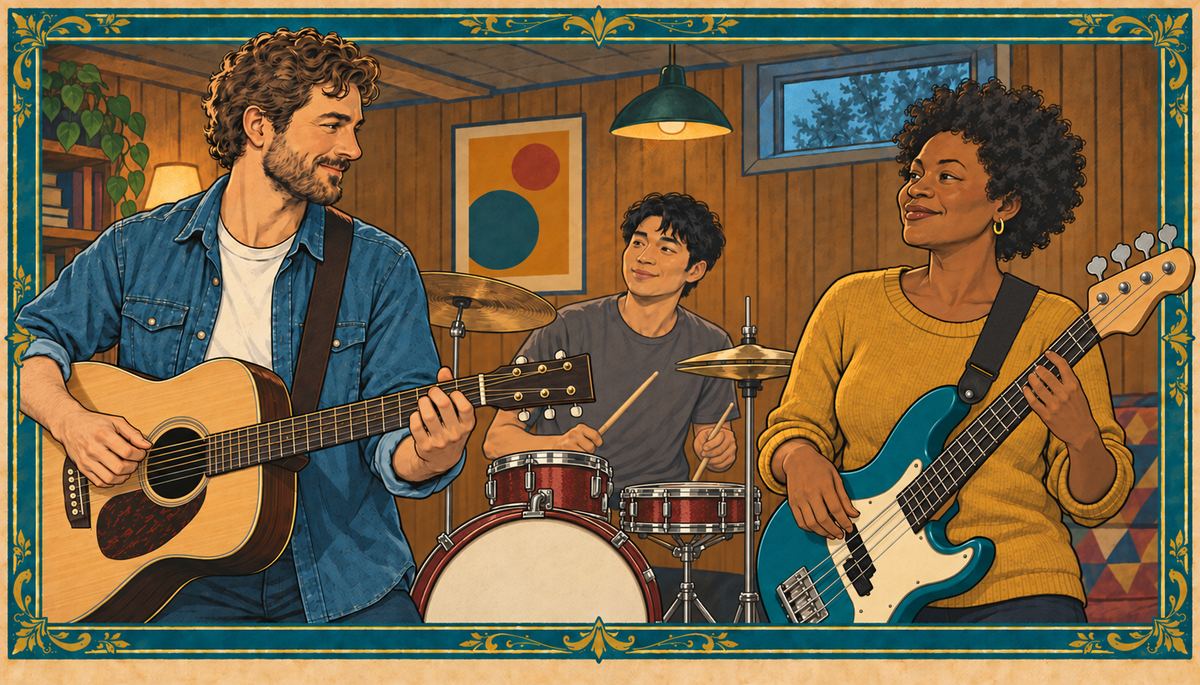
A guitarist who practices alone plays every part of the song at once. The open chords carry the bass notes, the strumming hand keeps time, and the fills between vocal lines stand in for the melody. In a band, other people own most of those jobs. The bass player has the low end, the drummer has the time, the singer has the melody, and the guitar part that sounded full in the bedroom now gets in everyone’s way.
So the first thing that changes is what the guitarist is listening to. The second is how much they play.
Pete L. teaches guitar at Tunelark. He is a Brooklyn session and touring guitarist who has played with John Cale, Durand Jones and the Indications and Aaron Frazer, and has appeared on NPR’s Tiny Desk Concerts and Jimmy Kimmel Live!. We asked him what changes for a guitarist who starts playing with other people, how a student learns to find a part that fits, and what a beginner needs before a first band or jam.
Listening is the skill a band teaches
For Pete, what changes starts with the ears, and listening is a skill he says can really only be learned by playing with other musicians. “In my experience, the most inspiring musicians I’ve played with are rarely the best technical players, and almost always the best listeners,” he says.
Listening in a band is specific. It means knowing which chord the bass player is on and whether they are playing the root or walking toward the next chord. It means hearing where the kick drum lands in the bar, so the guitar’s accents line up with it instead of falling just beside it. It means hearing where the singer breathes, because a fill that starts on top of a vocal line covers the words the audience came to hear.
A player who listens like this adjusts all the time, and most of the adjustments make the guitar part smaller. “People that can take in what everyone else is doing and respond in a sensitive and supportive way are so much more valuable to a band than the player who does a million things on their own musical island,” Pete says.
The player on the island is usually not a bad guitarist. They are often a good one who learned alone and is still playing the full version of every song, with the bass notes, the rhythm and the fills, while three other people play the same song around them.
What playing for the song means
Musicians say “play for the song” to mean choosing a part because it helps the whole arrangement rather than because it shows what the guitarist can do. Pete explains it with a line from baseball. “There’s a famous saying in baseball, “Hit ‘em where they ain’t.”” The hitter aims for the gaps between fielders. The guitarist aims for the gaps between the other instruments: the register nobody is using, the beats nobody is playing on, the space in the song that is still empty.
Finding them is mostly a matter of restraint. “Often this comes down to trusting in simplicity,” Pete says.
Simplicity takes trust because a simple part can feel like doing too little. A guitarist who plays one chord per bar with a short, clean strum, while the bass plays the roots and the drums play the groove, can feel as if they have stopped contributing. In the room the guitar is often easier to hear that way, because it is not competing with anything for the same space.
Pete points to the same advice from jazz. In 1960 the saxophonist Steve Lacy kept a notebook of things Thelonious Monk told his band, and one entry was a blunt instruction to stop playing the strange notes and play the melody (Premier Guitar reprints the list).
Rhythm, register and density
Pete gives students a quick way to hear what the rest of the band is doing. “Breaking the orchestration of song into broad strokes like rhythm, register, and density can be a great way to quickly analyze what your bandmates are doing,” he says.
Each of the three is a question a guitarist can answer by ear in the first run through a song. Our guide to learning songs by ear on guitar covers the same listening applied to working out chords.
- Rhythm is where the notes fall in time. Are the drums playing steady eighth notes, or leaving space? Is the bass playing long notes or a busy line?
- Register is how high or low the notes sit. A bass guitar lives below the guitar. A piano player’s left hand often sits in the same range as a guitar’s open chords, and a singer’s melody usually sits above them.
- Density is how many notes are happening at once and how often. A full open chord strummed sixteen times a bar is dense. A two-note shape played once on the downbeat is sparse.
The useful move is to choose the opposite of whatever is already crowded. Pete gives two examples. “If the keys player is playing something low with lots of heavy left hand, maybe try something up the neck of the instrument. If the drummer is playing a fast train beat, maybe big sustained chords are the best choice.”
The first example is about register. A keyboard player’s left hand and a guitar’s open chords sit in the same middle and lower range, so when both play there the sound turns muddy and neither part is clear. Moving the guitar up the neck, to small chord shapes on the top three or four strings, puts it in a range nobody else is using. The second example is about rhythm and density. A train beat is a fast, driving drum pattern with a constant run of snare notes, common in country and rockabilly. Strumming busily on top of it adds a second layer of fast notes that blurs the first. A chord struck once and allowed to ring for the bar fills the sound out without adding to the rhythm.
Here is the same idea on a simple song in G, with the chords G, C and D. Alone, a guitarist would probably play full open chords and strum straight eighth notes. With a bass player on the roots and a drummer on a busy beat, the same guitarist might play the same three chords as small three-string shapes higher on the neck, hit each one on beat two and beat four, and let the bass and drums carry everything below and between. Nothing about the chords changes. The part changes so it fits around the parts already there. Small chord shapes higher on the neck come from the same scale and chord knowledge covered in our guide to guitar scales and the fretboard, and they are a common next step after the barre chords most guitarists learn first.
Pete’s reason for working this way is about what the audience hears. “Remembering that you’re one part of a whole ecosystem that the audience hears as a whole, it’s not a competition for who can do the most,” he says.
Start playing with other people early
A common assumption among guitarists who have only played alone is that they need to get good first and join a band later. Pete thinks the order should run the other way. “I’m a strong believer that guitarists (and all musicians) should start playing with other people as soon as they possibly can,” he says.
His reasoning is that the skills described above cannot be practiced alone. “Whether it’s starting your own band, or showing up at local jams, there is so much to be learned from making music in real time with other human beings, especially if you have the opportunity to play with folks that have more experience than you do,” he says. A more experienced player in the room shows a newer one what leaving space sounds like, how to follow a song’s changes and how to recover from a mistake without stopping.
The people matter more than the player’s readiness, in Pete’s view. “I think it’s much more important to find a community that supports, encourages, and mentors you than it is to have some arbitrary checklist of skills that make you “ready” to play with others,” he says.
That community can be a few friends in a basement, an open jam at a local bar or music store, a community music school’s ensemble program, or a church band.
What to know before a first band or jam
Pete does not dismiss preparation entirely. “With that said, I do think it’s important to have some at least basic tools in the toolbox so that you don’t get side-eyed at the jam,” he says. His toolbox has a few specific items.
Basic chords and barre chords, or a capo. Open chords cover most songs in the keys guitarists play in most often. Barre chords let a guitarist play the same chord shape anywhere on the neck, so a song in B flat or F sharp is no longer a problem. Pete adds an alternative: “how to do quick capo translations.” A capo is a clamp that raises the pitch of every string. With a capo at the third fret, a G chord shape sounds as B flat, so a player who knows only open shapes can play in B flat by moving the capo and keeping the shapes. A capo translation is working out quickly which fret and which shapes give the key the band is in.
A small set of strumming patterns. Pete describes “having a vocabulary of basic strumming patterns so that you can find something that fits the song.” Three or four patterns, a straight eighth-note strum, a pattern with a skipped downbeat, a slow one-strum-per-beat ballad feel and a shuffle, cover most of what a first band plays. The choice between them is the rhythm and density decision from the section above. Our lesson on guitar strumming patterns counts the common ones out stroke by stroke, with where the accents go.
Song form. Pete also lists “having a working knowledge of common song structure (what’s a verse, what’s a chorus, what’s an instrumental break)” as something that “can get you a long way to start out with.” A guitarist who knows the song is going to the chorus can hear it coming and change with the band. One who is counting bars without knowing the form gets lost the first time the song does something unexpected.
A few songs ready to lead. Jams have a custom that catches many first-timers: as Pete says, “often they will call on participants to lead a song.” His advice is to keep “a small set of five or so tunes that you’re comfortable playing and/or singing that are in the genre of the jam (if you’re going to a bebop jam, Wonderwall probably isn’t the right fit).” A song that fits the jam’s style is one the other players can join on the first pass. For a first set built around chords most players already know, our list of easy guitar songs with two or three chords is a reasonable place to start choosing.
Here Pete plays “Bring It On Down To My House, Honey,” a western swing standard from 1936, the kind of tune a swing or country jam might call.
Performance · Bring It On Down To My House, Honey
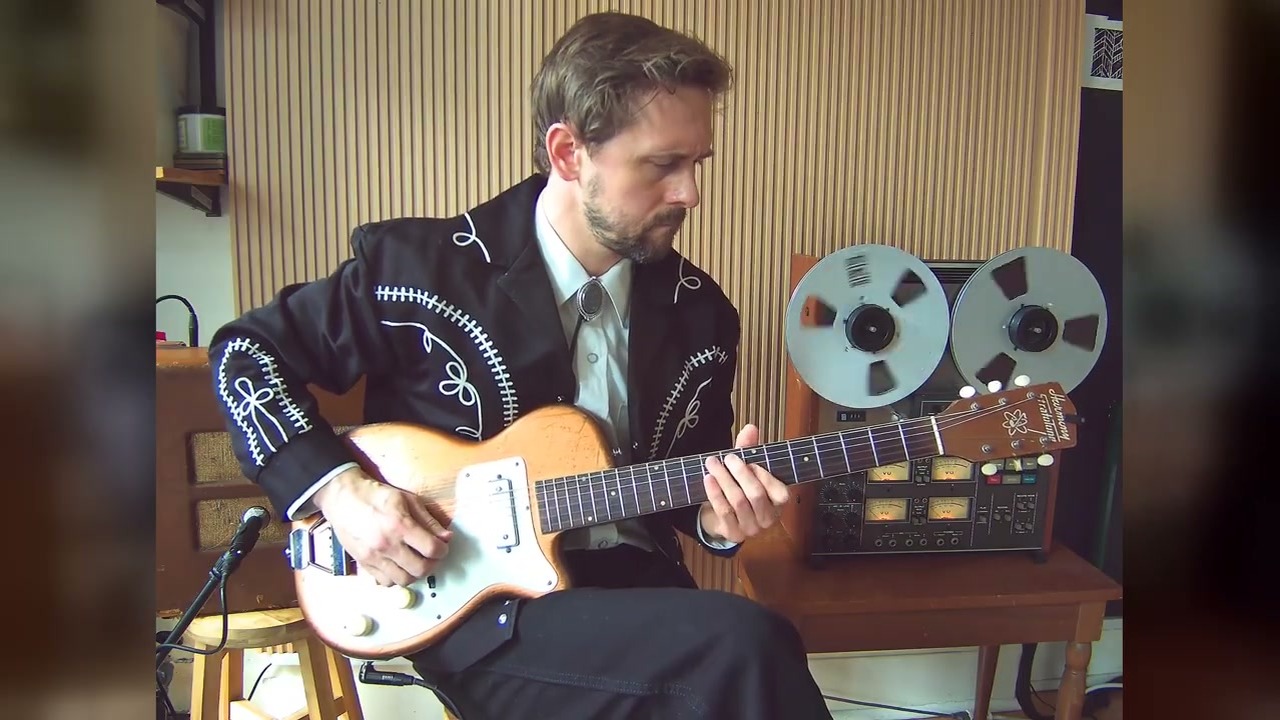
Pete teaches guitar on Tunelark. View Pete’s profile
Pentatonic scales, for improvising jams. Some jams expect every player to take a solo. Pete puts it this way: “if it’s a type of jam that relies heavily on improvisation and instrumental breaks (bluegrass, blues, jazz) then being able to get around your pentatonic scales and how to find the right one to improvise over the changes is invaluable.” The pentatonic is a five-note scale that fits over most chords in blues and rock, and “the changes” means the song’s chord progression. Our guide to starting to improvise on guitar works through the twelve-bar blues and a first solo, and a guitarist heading to a bebop jam will need the chord vocabulary covered in our guide to learning jazz guitar from rock or blues.
Everything outside that list comes later, from playing. “Everything else you can (and should!) learn from experience,” Pete says.
What lessons can and cannot do
Pete names the limits of teaching this over a screen. “While some of this doesn’t translate as well over virtual lessons, the underlying principles of listening, understanding, and connecting to the music rather than just “playing” are a huge part of my lessons with students,” he says.
The limit is real. A video call carries a short delay, so a teacher and a student cannot play in time together the way two people in a room can. What a lesson can do is everything around that: work through rhythm, register and density on recordings of the songs a student’s band is playing, build the chord shapes and strumming patterns that give a student choices, and talk through what happened at last week’s rehearsal or jam. The playing with other people happens outside the lesson, and the lesson prepares the student for it and helps them make sense of it afterward.
About Pete
Pete is a Brooklyn-based multi-instrumentalist, composer and producer with more than sixteen years of teaching experience. As a session and touring musician he has worked with John Cale, Durand Jones and the Indications, Aaron Frazer, Iris DeMent and Lady Lamb, among others, and he writes and produces for his Americana band the Stray Dogs, which has released three albums. In 2012 he co-founded Bantam Studios, a music school for adults in the New York area that has taught more than 8,000 students, and he has taught for the Brooklyn Conservatory of Music and the New York City Department of Education.
He started on violin at six, with lessons, youth orchestras and string quartets, and picked up the guitar at twelve. For about a decade he took no guitar lessons at all and learned from records and from playing with friends who were better than he was. At Tunelark he teaches guitar to students of every age, built around the music each student wants to play. Here he teaches the fingerpicking pattern Elizabeth Cotten built her playing on.
Skill video · Cotten Picking
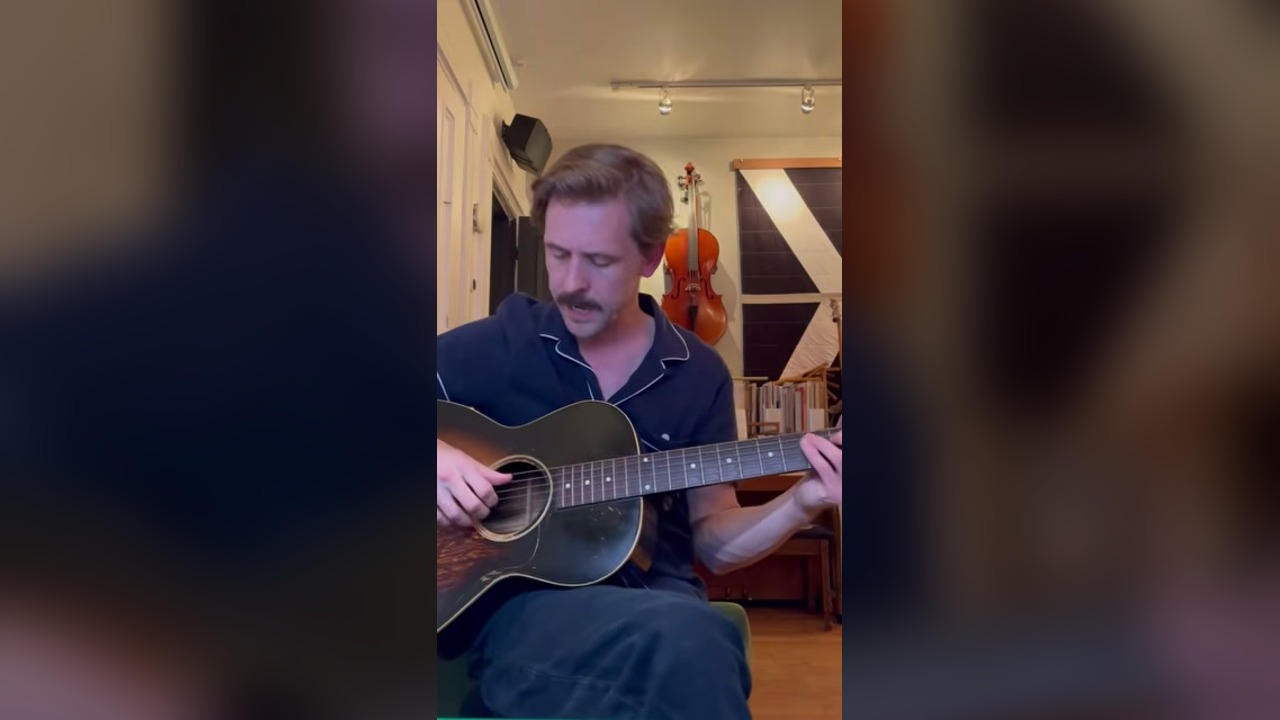
Pete teaches guitar on Tunelark. View Pete’s profile
Ready to play with other people?
Pete is accepting new guitar students at Tunelark, and a song your band or local jam plays is a good thing to bring to a first lesson, so you can work out a part that fits it. You can also find a teacher for another instrument across the rest of the roster.
Frequently Asked Questions
How good do I need to be to join a band?
Good enough to change between your basic chords in time and to follow a song’s form. Most guitarists who wait until they feel ready wait too long, because the skills a band needs, listening and fitting a part, are learned by playing in one.
What is a capo translation?
Working out which capo fret and which open chord shapes produce the key the band is playing in. A capo at the second fret turns a G shape into an A chord, for example, so a player who knows only open shapes can play in many more keys.
What should I bring to my first jam session?
Your guitar, a tuner, a capo, spare strings and a few songs you could lead if asked, chosen to fit the style of that jam. Bluegrass, blues and jazz jams also expect solos, so have the pentatonic scales ready.
Why does my guitar part sound muddy with the band?
Usually because it sits in the same range as another instrument, often the bass player or a keyboard player’s left hand. Moving to smaller chord shapes higher on the neck, or playing fewer notes, usually clears it up.
Can online guitar lessons prepare me for playing in a band?
They can build the chords, strumming patterns, song form and listening that a band needs, and help you work out parts for the songs your band plays. The playing in time with other people happens in rehearsals and jams.
Looking for an online guitar teacher? See our full Online Guitar and Bass Lessons page for everything you need to know about getting started.
Keep reading
About Jennifer Heath
I'm Jennifer Heath, VP of Operations at Tunelark and a lifelong singer. I joined the company in 2020 and oversee much of what makes Tunelark work for students and teachers: hiring, training and supporting our instructors, student support, marketing and day-to-day operations. I started voice lessons at 7 and sang with touring choirs through my teens. Music belongs in every life, for the self-expression, the discipline, the comfort and the simple joy of it.