How to Start Playing Metal Guitar: Technique First
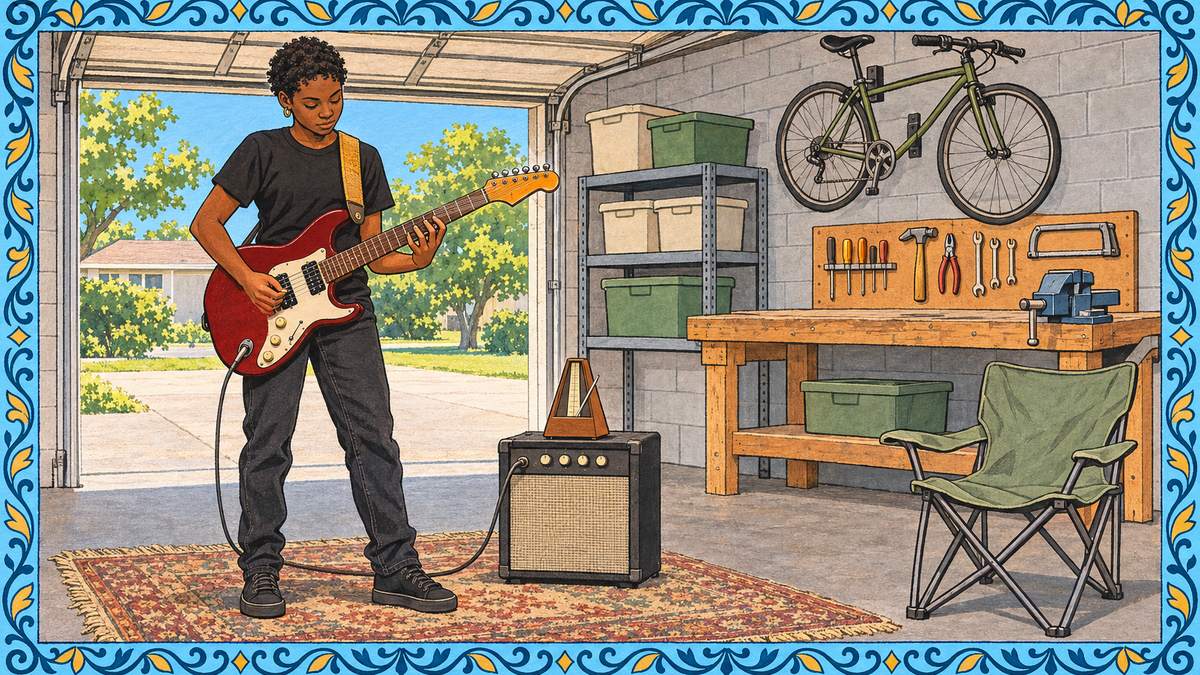
Metal guitar sounds like it is about volume and aggression, and a beginner who plays it that way gets a wall of noise with no riff inside it. What makes a part sound like metal is control: the right hand deciding exactly when a string sounds and when it stops, at speed, with a distorted amp that turns every mistake up. The techniques are palm muting first, then string dampening, then speed built slowly with a metronome and a light touch, and the gear can be almost anything made in the last decade.
Michael H. teaches guitar and bass at Tunelark, with rock and metal at the center of what he plays and teaches. He has taught for more than 15 years and performs Metallica and Soundgarden on his profile. We asked him which techniques make up the style and in what order he teaches them, how a student builds speed without building tension, and what gear matters at the start.
Palm muting comes first
Ask most beginners what metal technique they want and they say speed. Michael starts somewhere else. “The most important technique that I stress when it comes to metal guitar is palm-muting, which can be elusive for some players,” he says.
Palm muting is the heel of the picking hand resting on the strings right where they leave the bridge, so that a picked note sounds as a short, percussive thump instead of ringing. The chug that opens almost every metal riff is a palm-muted low string. The technique is elusive for the reason Michael names: it is a matter of a few millimeters and a few grams. Too far toward the neck and the note dies to a click with no pitch in it. Too far back on the bridge and nothing is muted at all. Too much pressure and the string goes sharp and choked. The hand has to find the spot where the note keeps its pitch but loses its ring, and then has to stay there while the pick moves.
The way to find it is one note on a loop. Pick the low E string with the hand resting at the bridge, listen, move the hand a few millimeters toward the neck, listen again, and keep going until the pitch starts to disappear. Then come back a little. That spot is the home position for every riff that follows, and the hand should return to it without looking. Once it is there, the second skill is lifting the palm off for a note that should ring and dropping it back for the next one that should not. Most metal rhythm playing is that alternation, muted and open, in time.
Silence is part of the riff
Michael’s second technique follows from the first. “Similar to what I was just talking about with bass, when playing metal a guitarist needs to be more careful about the silent moments that are present in many riffs,” he says. “Using a high gain distortion requires playing with a greater level of control and authority, and so after palm-muting has been discussion I like to also talk about string dampening.”
The reason silence is harder in metal than in any other style is the amp. Distortion compresses the signal: quiet things get louder and loud things get squashed toward the same level. On a clean amp, a string you brushed by accident is a faint sound under the note you meant to play. On a high-gain amp it is as loud as the note, and the five strings you are not playing are all available to make that sound. A riff with rests in it, which is most of them, has to have every string silent in those rests, and a beginner playing with gain for the first time is usually startled to hear how much noise their hands make.
String dampening is the fix, and it is the job of both hands. The picking hand’s palm covers the strings below the one being played, which the palm-mute position already does. The fretting hand lays its unused fingers lightly across the strings above, touching without pressing, so a stray pick stroke produces nothing. Releasing a fretted note means relaxing the finger, not lifting it clear of the string, because a lifted finger lets the open string ring and a relaxed one stops it. Our guide to the fretting hand covers that release in detail for any style.
A useful test is to play a riff with rests at a slow tempo and listen only to the rests. If anything is sounding, find which string and which hand let it through. Players who do this for a week stop producing the hiss and rumble that make a beginner’s metal recording unlistenable, and the riff starts to sound tight, which is the word metal players use for exactly this control.
Building speed without building tension
Metal asks for speed and precision together, and the usual way beginners try to get there, by playing a riff as fast as they can and hoping it cleans up, builds the opposite. “This all comes down to perfecting your playing mechanics at slower, more manageable tempos,” Michael says. “From there you gradually increase your practice tempo in small BPM increments using a metronome.”
Mechanics first means that at the slow tempo everything is already right: the palm in its spot, the pick moving the smallest distance that still catches the string, the fretting fingers close to the frets and close to the strings, and the shoulders down. Speed is those same movements repeated faster, not new movements. A riff learned sloppy at speed has to be unlearned before it can be learned clean, which is slower than doing it in order.
The increments are small on purpose. Two to four beats per minute at a time, and the tempo moves up only when the riff is clean at the current one, every note muted or ringing as intended, for several repetitions in a row. A riff that is clean at 80 and falls apart at 100 has a tempo somewhere between them where it starts to go, and the metronome finds it. Going back to that tempo and sitting there is the practice. Our guide to what ten minutes of guitar practice buys you covers how to fit that kind of focused repetition into a short daily session, and when progress stalls, our article on why playing stops improving covers what usually needs to change.
Michael names the misconception that undoes most of this. “With metal I think there’s a misconception that one needs to play the guitar aggressively,” he says. In his words, “in order to play with the speed and precision that’s needed within this genre one needs to play lightly and move with efficiency. This can really only be achieved through the development of muscle memory through repetition and the use of a metronome.”
Lightly is the opposite of what the music sounds like, and it is the thing to trust. A pick that digs deep into the string has to travel further to get out and back, and a hand that grips it hard cannot move quickly. The players who sound heaviest are usually moving the least: a small pick stroke from the wrist, a relaxed grip, and the force coming from the muting and the timing rather than from hitting the string. Tension shows up as a forearm that aches after a minute, a shoulder that creeps up, or a picking hand that locks when the tempo rises. Any of those is a sign to drop the tempo back and find the lighter version of the same movement.
Here is the end of one of Michael’s lessons, where he recaps what was covered and sets the week’s practice plan.
Inside a lesson · Inside an Online Guitar Lesson

Michael teaches guitar and bass on Tunelark. View Michael’s profile
What to practice, in what order
For a student starting from a few open chords, the order Michael describes turns into a plan that looks like this.
Weeks one to four: palm muting on one string. Find the mute position, then play eighth notes on the low E string at a slow tempo, all muted, with the pick moving as little as possible. Add the muted-and-open alternation: four muted, one open, back to muted. Then move the same pattern to the A string and learn to cross between them without the palm leaving its spot.
Weeks four to eight: power chords and dampening. A power chord is the root and fifth on two adjacent low strings, and almost every metal riff is built from them. Play them palm muted, then open, then in a riff with rests, and use the rests to check that nothing else is sounding. The fretting hand’s unused fingers learn to lie across the higher strings here.
Months two to four: speed on a real riff. Pick a riff from a song you want to play, learn it clean at a tempo well below the record, and bring it up a few beats per minute at a time. Downpicking, every stroke in the same direction, is the traditional metal rhythm sound and tires the hand quickly, which is itself a lesson in playing lightly. Alternate picking comes in for faster passages.
After that: the rest of the style. Drop tunings, tremolo picking, galloping rhythms and lead playing all sit on top of the three techniques above. A student who can palm mute cleanly, keep the rests silent and build tempo without tension can add any of them. Soloing draws on the same fretboard knowledge as any style, and our guides to guitar scales and the fretboard and starting to improvise on guitar cover that ground.
Gear and tone: what matters at the start
The gear conversation is shorter than beginners expect. “We’re very fortunate these days when it comes to gear,” Michael says. “Low cost guitar pedals, amps, and modeling processors are all mostly capable of good guitar tones, especially when it comes to metal.”
A practice amp with a gain channel, a cheap distortion pedal into a clean amp, or a modeling unit into headphones will all produce a usable metal sound, and the differences between them matter far less at the start than what the hands are doing. The guitar needs humbucking pickups for the classic sound, which most electric guitars sold for rock already have, and it needs to stay in tune. Everything else can wait.
What Michael tells students about tone is about delivery rather than equipment. “In general I try to remind students that a lot of what we perceive to be ‘heavy’ is related to the delivery of the guitar parts,” he says. He has found, in his words, that “using a little less distortion and incorporating aggressive palm-muting techniques is the best way to achieve the percussive guitar sound that we all associate with metal.”
The mechanism is the compression described earlier. Turning the gain all the way up squashes the attack of each note, so a palm-muted chug and an open note end up at nearly the same level and the riff loses its shape. Backing the gain off lets the attack through, so the muted notes hit and the open notes ring and the difference between them, which is the riff, is audible again. The heaviest rhythm sounds on record are usually less distorted than they seem, played by a right hand doing most of the work. A beginner who starts with the gain at about two-thirds and the palm doing the rest will sound tighter than one with the gain maxed, and will hear their own mistakes clearly enough to fix them.
About Michael
Michael came to the electric guitar through 1980s radio, where Eruption and Surfing with the Alien were the tracks that caught him as a child. His father and stepfather both played, so there was gear in the house to explore when he started at 12. For four years he taught himself, by ear and then from tab in magazines, and at 16 he began lessons with Andy Martin, who later wrote a reference book on the seven-string guitar.
He wanted to teach in his early twenties and did not have the confidence or the connections yet. Working as an assistant manager at a music store changed both, and a coworker’s referral to an agency that offered in-home lessons started a teaching career that has run for more than 15 years. He studied composition at the University of Maine, arranged for jazz and rock ensembles, and now teaches online from his studio.
His own teachers shared a pattern he still uses: they built up his confidence while asking him to work harder than felt comfortable at the time, and they taught by example. The speed section above is that pairing in practice, a light touch and a slow tempo held until the riff is right.
Here he plays the guitar solo from Metallica’s The Unforgiven.
Performance · The Unforgiven Guitar Solo

Michael teaches guitar and bass on Tunelark. View Michael’s profile
Ready to play your first riff?
Michael is accepting new guitar and bass students at Tunelark, and the riff you most want to play is the best thing to bring to a first lesson, whatever tempo you can manage it at today. If you play an instrument he does not teach, you can find a teacher for it across the rest of the roster.
Frequently Asked Questions
What is the first technique to learn for metal guitar?
Palm muting: the heel of the picking hand resting on the strings at the bridge so a picked note sounds short and percussive. Almost every metal riff is built on the alternation between muted and open notes.
How do I play metal guitar faster without tension?
Get the movements right at a slow tempo, then raise the metronome two to four beats per minute at a time, moving up only when the riff is clean. A light pick stroke and a relaxed grip move faster than a hard one.
How much distortion should a beginner use for metal?
Less than feels natural. Too much gain squashes the attack of each note and hides the difference between muted and open notes. Backing it off and muting harder sounds heavier and lets you hear your own mistakes.
Do I need expensive gear to play metal guitar?
No. An inexpensive amp with a gain channel, a basic distortion pedal, or a modeling unit all produce a usable metal sound. A guitar with humbucking pickups that stays in tune is the only real requirement.
Why does my metal playing sound messy with distortion on?
Strings you are not playing are ringing. Distortion makes stray noise as loud as the notes, so the picking-hand palm and the fretting hand’s spare fingers have to keep every unused string silent.
Looking for an online guitar teacher? See our full Online Guitar and Bass Lessons page for everything you need to know about getting started.
Keep reading
About Jennifer Heath
I'm Jennifer Heath, VP of Operations at Tunelark and a lifelong singer. I joined the company in 2020 and oversee much of what makes Tunelark work for students and teachers: hiring, training and supporting our instructors, student support, marketing and day-to-day operations. I started voice lessons at 7 and sang with touring choirs through my teens. Music belongs in every life, for the self-expression, the discipline, the comfort and the simple joy of it.