What Beginning Music Lessons Are Really Like for Adults
The Embarrassment Problem
Teachers hear the same reason constantly from adults who took years to work up to a first lesson: they’re embarrassed. Embarrassed about being a beginner. Embarrassed about being bad at first. Embarrassed about being seen and heard making the awkward early sounds that every musician makes. It is one of the most common reasons adults never start.
Here is what adult beginner lessons are actually like, and why the embarrassment is almost always smaller in practice than in anticipation.
What You’re Actually Imagining vs. What Actually Happens
The mental image most adults have of starting music lessons goes something like this: you walk into a room, sit down, play badly in front of a serious-faced teacher, and feel exposed and stupid.
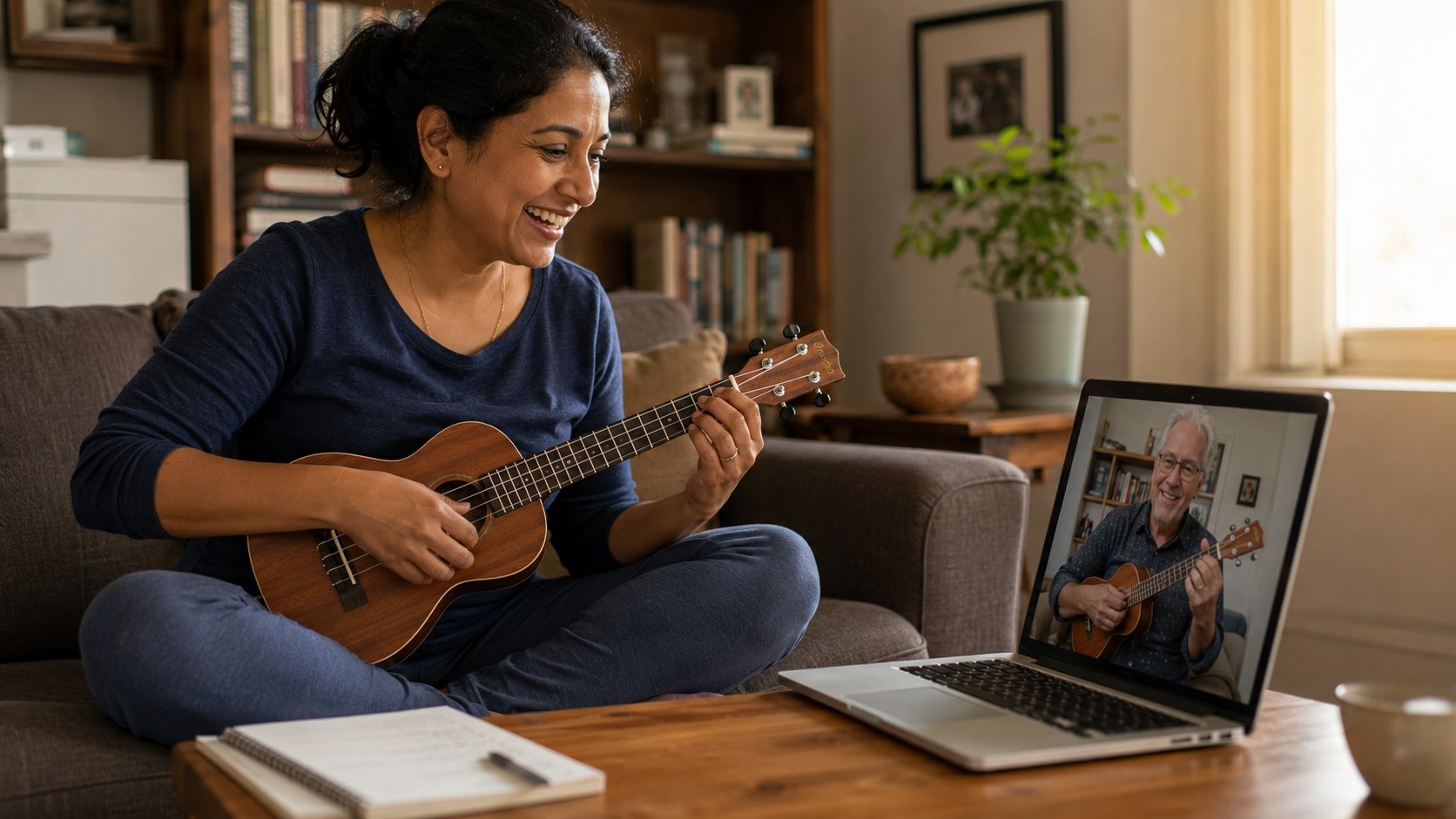
What actually happens: you log into a video call, the teacher introduces themselves, you talk about why you’re here and what you want to learn, you try a few things, the teacher gives gentle, specific feedback, and the lesson ends with you both having a sense of next steps. It’s far more conversational and less performative than the imagined version.
The first lesson is mostly diagnostic and getting-to-know-you. There’s almost no pressure to play well: the teacher wants to understand where you are, what you want, and how you learn.
Dr. Gino P., who teaches voice on Tunelark, runs his first lessons this way. There is a little singing so he can hear the instrument, and a lot of conversation, because knowing the person and their goals is what lets him make the lessons personal.
What Teachers Actually Think About Adult Beginners
A few honest truths from the teacher’s perspective:
They want adult beginners. Teaching adults is a different kind of work than teaching children: more conversational, more goal-led, and built around a student who can say what they are after and why. Most teachers who advertise lessons online actively want adult students.
They’ve seen every level. Whatever you’re worried about (being too bad, being too old, having no rhythm, having a bad voice) they’ve worked with students at exactly your level dozens of times. You are not the worst they’ve heard. You’re not even close.
They’re not judging you the way you fear. Teachers see beginner work as the raw material they get to shape. Your awkward early playing is interesting to them, not embarrassing. They’re looking at how to help, not whether you’re worthy.
They would rather you play out, even badly. A student who plays tiny and hidden is harder to teach. Teachers actively want you to take risks in the lesson. That’s where the learning happens.
Michael H., who teaches guitar on Tunelark, has a student who took up the instrument as an adult during the pandemic.
“Attempting to learn a new instrument as an adult has been a humbling experience to say the least. Mike is patient and explains things very well.”
The same student says Michael meets them where they are and helps them improve without judgment.
The Specific Embarrassments and Why They Pass
Several common worries that are real but smaller than they feel:
“I’ll sing badly and feel humiliated.” Voice teachers spend their careers working with beginners who think they can’t sing. Your sound in the first lesson is not what they’re judging. They’re looking for what your voice can do, not how good it currently sounds.
Kathryn Z., who teaches voice on Tunelark, has a student who started from that fear.
“I started as a person who loved singing but was too embarrassed to sing even around my own husband, but now I sing openly in front of friends and family.”
“I’ll struggle with simple things and feel stupid.” This is universal among adult beginners. The teacher expects it. Within a few weeks most of them get noticeably easier, and the things that felt impossible in the first lesson stop being the hard part of the piece.
“My fingers won’t do what I tell them.” Normal for the first months on any instrument. It’s a motor learning issue, not a personal failing, and it keeps improving for as long as you practice.
“I’ll cry in front of my teacher.” Some adults do, occasionally. Voice teachers in particular see emotional moments because the voice is so connected to identity. A good teacher handles this professionally and kindly. Many of these moments end up being the most meaningful parts of the learning.
Why Online Lessons Are Easier for the Anxious
Online lessons specifically reduce the embarrassment factor for several reasons:
- You’re in your own space. Your home, your instrument, your environment. You’re not on someone else’s turf.
- The physical distance lowers the stakes. Being on a screen feels slightly less exposing than being in the same room.
- With your teacher’s permission, you can record the lesson and review it privately later. Many breakthroughs happen on second listen, when the in-the-moment embarrassment is gone.
- It’s easier to switch teachers if the fit isn’t right. No awkward in-person dynamic if you decide to try someone else.
- Nobody overhears you. There’s no waiting room and no student in the next studio.
What Helps the Embarrassment Pass Faster
A few specific approaches:
Acknowledge it openly with your teacher. “I’m nervous about doing this as an adult” is something teachers hear constantly. Saying it lowers the pressure and gets the elephant out of the room.
Lower the stakes of practice. Practice doesn’t have to sound good. It just has to happen. The work is in the practicing, not the results.
Find another adult beginner to compare notes with. Just knowing other adults are going through similar struggles helps enormously. Some online communities and message boards exist for this.
Remind yourself that “good” is not the goal of early practice. The goal is better than yesterday by tiny increments. That’s all anyone is ever doing.
What the Six-Month Mark Feels Like
Teachers we work with say the acute embarrassment usually fades within the first month or two, and that by around six months in it has mostly gone. By then, you’ve:
- Gotten comfortable with your teacher and the lesson format.
- Made enough progress to feel like you can do this.
- Built a sense of musical identity, even as a beginner.
- Realized that the things that felt impossible at the start have become possible.
Teachers hear the same thing from students who push through the initial embarrassment: they wish they had started years earlier. The adults who let embarrassment keep them from starting tend to carry the wish to play around for years, and it does not go away on its own.
How to Find an Adult-Friendly Teacher on Tunelark
Many Tunelark teachers work with adult beginners and say so in their bios, so filter for those. Every Tunelark teacher is vetted by working musicians and educators for teaching quality before they can list, and the bios tell you who specializes in adults. To find a teacher whose approach feels safe and welcoming:
1. Open the teacher list and filter by your instrument.
2. Read bios. Look for warm tone, explicit mention of adult students, and language that doesn’t feel intimidating.
3. Book a trial lesson with one whose profile resonates. It is $25 off that teacher’s 30-minute rate.
4. After the trial, ask yourself: did the teacher feel safe to be a beginner with?
The embarrassment is real, and it’s also temporary. The students who acknowledge it, start anyway, and find a teacher who creates a safe space often describe music lessons as some of the most rewarding work they’ve done in adult life.
Frequently Asked Questions
Will I be the worst student my teacher has ever had?
No. Teachers have seen every level of beginner, including students far less confident or capable than you fear you are. What they are listening for in a first lesson is different from what you imagine: whether you can hear the difference when they correct something, and whether you can reproduce it once you have heard it. Neither depends on how you sound on the day.
What if I cry in front of my teacher?
Some adults do, especially in voice lessons, usually because a song or an exercise touches something they were not expecting. A good teacher pauses, gives you a moment, and picks the lesson up where it stopped. If you would rather not be watched through it, say so at the start of lessons and ask for a short break instead, and nothing about it changes how the teacher works with you afterward.
Should I tell my teacher I’m nervous?
Yes. It lowers the pressure for both of you and lets them tailor their approach. Teachers appreciate honesty about emotional state. It makes them better at their job.
How long until I stop feeling embarrassed?
Performance nerves are a separate thing and can last a good deal longer. The day-to-day nervousness of being a beginner in a lesson goes much faster: teachers describe the turn arriving in the first month or two, and by the six-month mark most students have stopped thinking about it at all.
Are online lessons less embarrassing than in-person?
Generally yes. The physical distance, your own home environment, and the slightly more transactional feeling of a video call all lower the social pressure. Teachers who teach both ways say many anxious adults find online the easier place to start.
Keep reading
About Jennifer Heath
I'm Jennifer Heath, VP of Operations at Tunelark and a lifelong singer. I joined the company in 2020 and oversee much of what makes Tunelark work for students and teachers: hiring, training and supporting our instructors, student support, marketing and day-to-day operations. I started voice lessons at 7 and sang with touring choirs through my teens. Music belongs in every life, for the self-expression, the discipline, the comfort and the simple joy of it.