How to Find a Good Music Teacher: A Step-by-Step Checklist
Finding a good music teacher is half the battle of learning music. The right teacher accelerates progress, sustains motivation, and makes the work feel rewarding rather than grinding. The wrong teacher slows everything down and often ends with a student concluding that they aren’t musical, when really, the fit was just bad.
Here’s a step-by-step checklist for finding the right teacher, whether for yourself, your child, or a relative. It works for any instrument, online or in-person.
Step 1: Get Specific About What You Actually Want
Before you start looking, spend ten minutes answering:
- What instrument? Obvious, but be honest. If a parent wants their child to play piano but the child wants drums, the search starts with the wrong instrument and rarely ends well.
- What style? Classical, jazz, rock, pop, folk, sacred music? Many teachers specialize. Asking for “guitar lessons” without specifying style is like asking for “food” at a restaurant.
- Who’s learning? Adult beginner, returning adult, child, teen, advanced student. The right teacher for a six-year-old is rarely the right teacher for a forty-year-old.
- What’s the goal? Casual enjoyment, lessons for fun, audition prep, performance, eventually teaching. The realistic goal shapes which teacher fits.
Write your answers down. They become the filter for everything that follows.
Step 2: Decide On Online vs. In-Person
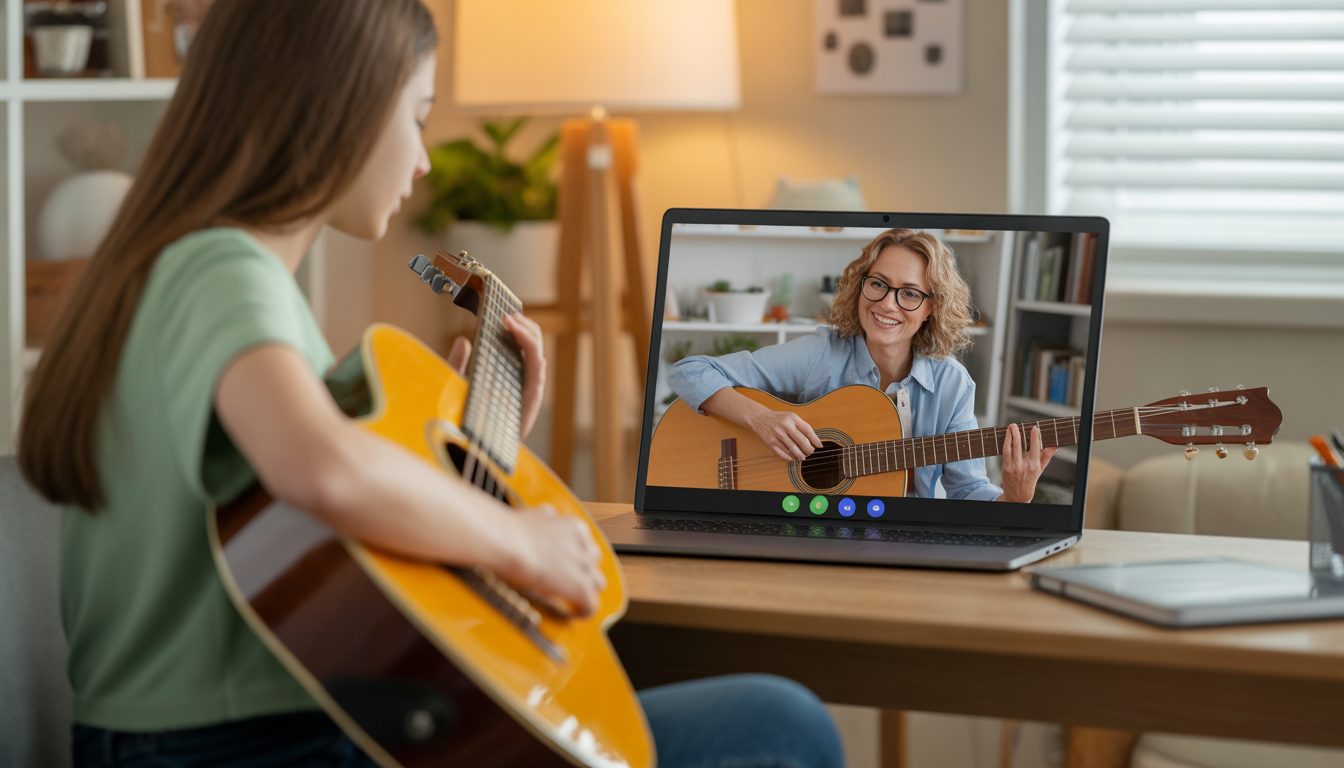
Online lessons are now a common choice for adults and many young learners, for good reason. They expand the pool of potential teachers from “who is within driving distance” to “any teacher anywhere in the world who teaches your instrument and style.” That’s an enormous difference for niche instruments or specific stylistic needs.
In-person makes more sense if:
- The student is very young and has a hard time staying focused on a screen. Children vary here: a child who can stay with one activity for about 15 to 20 minutes is usually ready for online lessons. A 30-minute lesson is not 30 minutes of one activity, because teachers of young children move between playing, listening and short games, and a trial lesson will tell you inside the first ten minutes whether the format holds your child.
- You need hands-on adjustments for fine motor work (some piano and string teachers prefer in-person for the first few months).
- You’re studying an instrument that requires shared physical space, sometimes drums, sometimes brass for specific technique work.
For most everyone else, online works as well as in-person and often better: adults, teens, older children, singers, wind players, and most keyboard and string players. If none of the three cases above describes your situation, the online pool is the one to search, and it is a much larger pool.
Step 3: Look in the Right Places
Don’t rely on a single source:
- Dedicated online lesson platforms. Every Tunelark teacher is vetted by working musicians and educators for teaching quality before they can list. That bar is meaningfully higher than general tutoring marketplaces, where anyone can post a listing.
- Local music schools and conservatories. Many of their faculty also teach privately, online or in-person.
- Professional teacher organizations. Music Teachers National Association, National Association of Teachers of Singing, etc. They have directories.
- Asking other students. Word of mouth in your community or online is often the highest-signal source.
For a comparison of platform options, see our guide to where to find online music teachers now that the big general marketplace has closed.
Step 4: Read Bios Carefully (Look for Specifics)
Strong teacher bios share certain qualities:
Specific teaching experience. “Twelve years teaching adult beginners” is far more useful than “experienced teacher.”
Stated teaching philosophy. “I focus on building technique before repertoire” or “I prioritize student curiosity and let them choose music they love” tells you something. Vague language like “I love teaching” tells you nothing.
Clear specializations. “Specializing in classical and jazz piano, with experience preparing students for graded exams” is concrete. “I teach all styles for all levels” tells you little about who the teacher works best with.
Education and performance background. Relevant but not decisive. Conservatory training matters less than teaching skill. A great teacher with a community-college degree can be far better than a mediocre teacher from Juilliard.
Student outcome examples. Mentioning specific outcomes (“students have gone on to top music programs,” “many adult students have learned their first piece from scratch within six months”) shows the teacher tracks results.
Save the three to five bios that resonate most. For music production the bio also needs to name the software you own, and our guide to music production lessons for beginners explains why.
Step 5: Book Trial Lessons
Most platforms and many independent teachers offer discounted trial lessons. Take them. A trial lesson is by far the best signal of fit, and worth the time.
In the trial, pay attention to:
- How they start. Do they spend time learning about you, or jump straight into a generic lesson? Diagnosis is a key quality.
- How they correct. Do their corrections feel like teaching (“try this: notice how it feels different”) or like criticism (“no, that’s wrong”)?
- How they end. Do you leave with a clear, specific homework assignment for the week? Or vague instructions?
- How you feel. Did you leave more curious about the instrument and your own playing, or self-conscious and discouraged? This is the most important signal.
That last one sounds soft next to the others, and teachers do not treat it that way. Jay H., who teaches voice and guitar on Tunelark, was asked what he actually spends a first lesson doing.
“I also want us both to feel comfortable. We all play, sing, learn, and teach better when we’re relaxed and trust each other.”
He is describing it as a condition for the work rather than a pleasant extra, and from his side of the lesson it cuts both ways. If a trial leaves you braced, that is information about the pairing, not about you.
If possible, try two or three teachers before committing. The cost is minimal; the difference in fit can be enormous.
Step 6: Trust Your Gut, Then Verify Over Time
After the trial, your instinct will probably tell you something. Trust it. If you walked out of the trial feeling lit up, that is a good sign, one the first month should confirm. If you walked out feeling vaguely deflated or eager to be done, that’s a sign to keep looking, regardless of how impressive the resume.
After committing to a teacher, give them about a month, roughly four lessons, before you judge the fit. At one month the question is narrow: are you leaving each lesson with something specific to work on, and are you practicing it in between? If both are yes, the relationship is working and the rest is time. Reassess properly at the two to three month mark, when you should be able to point to:
- Tangible progress on at least one specific skill.
- A clear sense of what you’re working on and why.
- A practice habit forming around the lessons.
- Genuine enthusiasm before lessons (not dread).
If most of those are still missing at the two to three month mark, the fit isn’t right. Switch. The cost of switching once is much smaller than the cost of staying with a poor fit for a year.
Step 7: Maintain the Relationship Over Time
When you find a good teacher, treat the relationship as a real one:
- Show up on time, prepared, every lesson.
- Practice the assigned work. Your teacher is investing in you weekly, and they can tell.
- Communicate early when life is hard or motivation is flagging. Good teachers adjust.
- Express appreciation for specific things they’ve helped you with. They remember.
The student-teacher relationship is one of the most consequential of your music education. Treat it well and it pays back for years.
How to Find a Good Music Teacher on Tunelark
Every Tunelark teacher is vetted by working musicians and educators for teaching quality before they can list. Teachers set their own rates, and you choose the one who fits. To get started:
1. Open the teacher list and filter by your instrument.
2. Read bios closely with the checklist above in mind.
3. Book a trial lesson with one whose profile resonates. Trial lessons are discounted by design: your first lesson with a new teacher is $25 off their 30-minute rate.
4. Notice how you feel after. That’s the most reliable signal you’ll get.
A great music teacher is one of life’s most underrated gifts. The search is worth doing carefully. The right teacher is out there for you.
Frequently Asked Questions
Where should I look for a music teacher?
For online lessons, start with a dedicated music-lesson platform such as Tunelark, where every teacher is vetted for teaching quality before they can list. For in-person, ask local music schools, music stores, or check community board listings. Word of mouth is highly reliable.
How many trial lessons should I take before committing?
Two or three is typical. Each trial gives you a sense of teaching style and rapport. By the third trial, you’ll have clear preferences.
What signs indicate a great teacher in a trial lesson?
Clear explanations, patience with mistakes, specific feedback (not vague praise), curiosity about your goals, and a roadmap of what to work on. You should leave wanting to practice.
What signs suggest you should keep looking?
Defensiveness when questioned, disorganized lessons, no clear plan for your development, dismissiveness about your interests, or feeling discouraged afterward. Trust your instinct on this.
How much does a great teacher actually cost?
Teachers set their own rates, so it depends on the teacher and the lesson length. On Tunelark, 30-minute lessons run $39 to $65, with $44 the typical price (roster checked September 2026). Rates across the wider online market vary widely by teacher and by region. The listed rates we checked on the other music lesson marketplaces in September 2026 run roughly $40 to $90 for 30 minutes, with most of them between $40 and $60. Teachers at the top of the range usually have specific credentials or specialties, and most students find an excellent fit in the middle.
Keep reading
About Jennifer Heath
I'm Jennifer Heath, VP of Operations at Tunelark and a lifelong singer. I joined the company in 2020 and oversee much of what makes Tunelark work for students and teachers: hiring, training and supporting our instructors, student support, marketing and day-to-day operations. I started voice lessons at 7 and sang with touring choirs through my teens. Music belongs in every life, for the self-expression, the discipline, the comfort and the simple joy of it.