Free Music Learning Games for the Classroom: Tunelark for Schools
School music programs run on stretched budgets and borrowed time. Fine arts funding covers instruments that need repairs and sheet music that needs replacing, and the software line item, if it exists at all, rarely stretches to the kind of adaptive learning tools that math and reading classrooms take for granted. Music teachers are expected to build sight readers and trained ears with a whiteboard and whatever they can photocopy.
That gap is the reason Tunelark’s music learning games are free for verified classroom teachers. All of them. More than 150 adaptive, level-based games covering note reading in treble, bass, and alto clef, music theory, and ear training, with a full set of classroom management tools attached, at no cost to you or your school. No subscription, no trial period that expires in thirty days, no premium tier hiding the good games. The giveaway has a story behind it, and your classroom gets the whole product.
Why our flagship product is free
Tunelark started in 2017 as an education software company. The games were the flagship product, built to teach music theory and instrument fundamentals to students in schools, and we sold them to school programs. The problem we kept running into was the one every music teacher already knows: the schools that most needed high-end music learning software were precisely the schools that could not afford it. Selling to fine arts budgets meant the tool reached the programs with money and skipped the ones without.
In 2020, the company pivoted to online private music lessons, which is what Tunelark is best known for today. That change freed the games from having to pay the bills, and we made the decision we had wanted to make all along: give the flagship away. Any verified classroom teacher can sign up and give their entire class access to the full game library. The private lesson marketplace funds the mission, and the mission includes music education in schools.
Since then, more than 2,500 classroom teachers have claimed free accounts, nearly 75,000 students have played through their classrooms, and students have logged close to five million game sessions answering over 45 million questions. We are pleased to report the games have been thoroughly play-tested.
What the games teach
The library climbs from absolute fundamentals to genuinely advanced skills, so it serves a sixth-grade general music class and an honors choir equally well. The core strands:
- Note reading in treble, bass, and alto clef, from “name the white notes” to reading the full staff fluently.
- Music theory fundamentals: major scales, the circle of fifths, key signatures, building intervals and triads, and how chords and melody fit together.
- Interval ear training, from distinguishing two intervals to identifying any interval within the octave by ear.
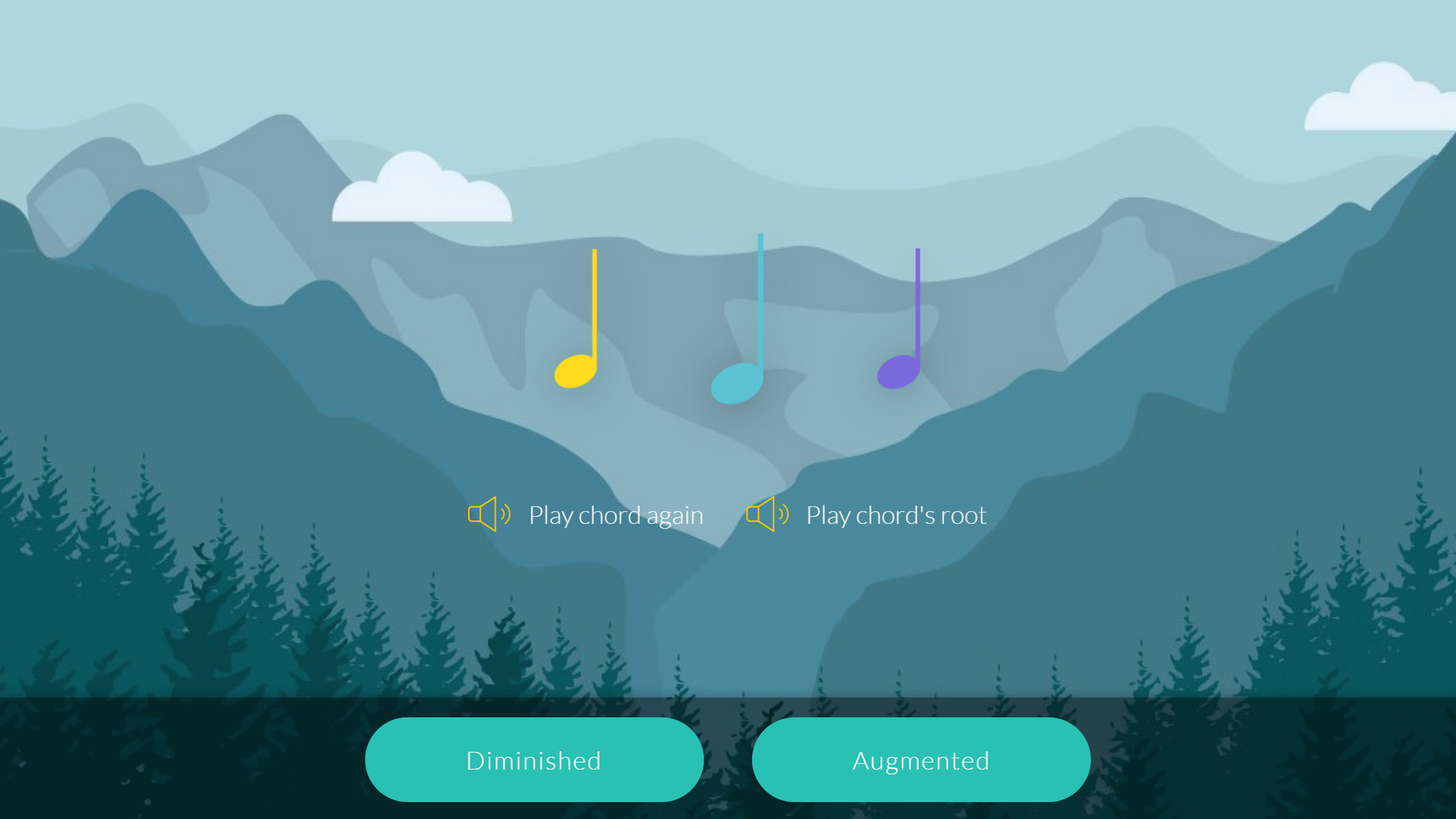
- Chord ear training, from basic major and minor triads through seventh chords and advanced qualities like diminished and augmented.
Every game is level based and adaptive. Students start where they are, advance by demonstrating mastery, and get instant feedback on every answer. They can answer on an on-screen keyboard, a MIDI keyboard, or by playing their acoustic instrument into the microphone, and everything runs in a browser on the laptops, tablets, and phones your students already have.
The adaptive part is what teachers tell us matters most in a room of thirty students at thirty levels. One classroom teacher put it this way: “It was thrilling to be able to move around the classroom knowing that each of the 30 students was engaged in learning at their own pace.” Differentiated instruction is the whole design, not a feature.
Claim Your Free Classroom Account
Built for how classrooms actually work
A free game library is only useful if you can manage it, so the classroom tools are included. Create a classroom, add your students, and you can shape and monitor everything from one dashboard:
- Curriculum control. Toggle missions or individual skills on and off per classroom, so your beginning band sees note reading while your AP theory students drill seventh chords.
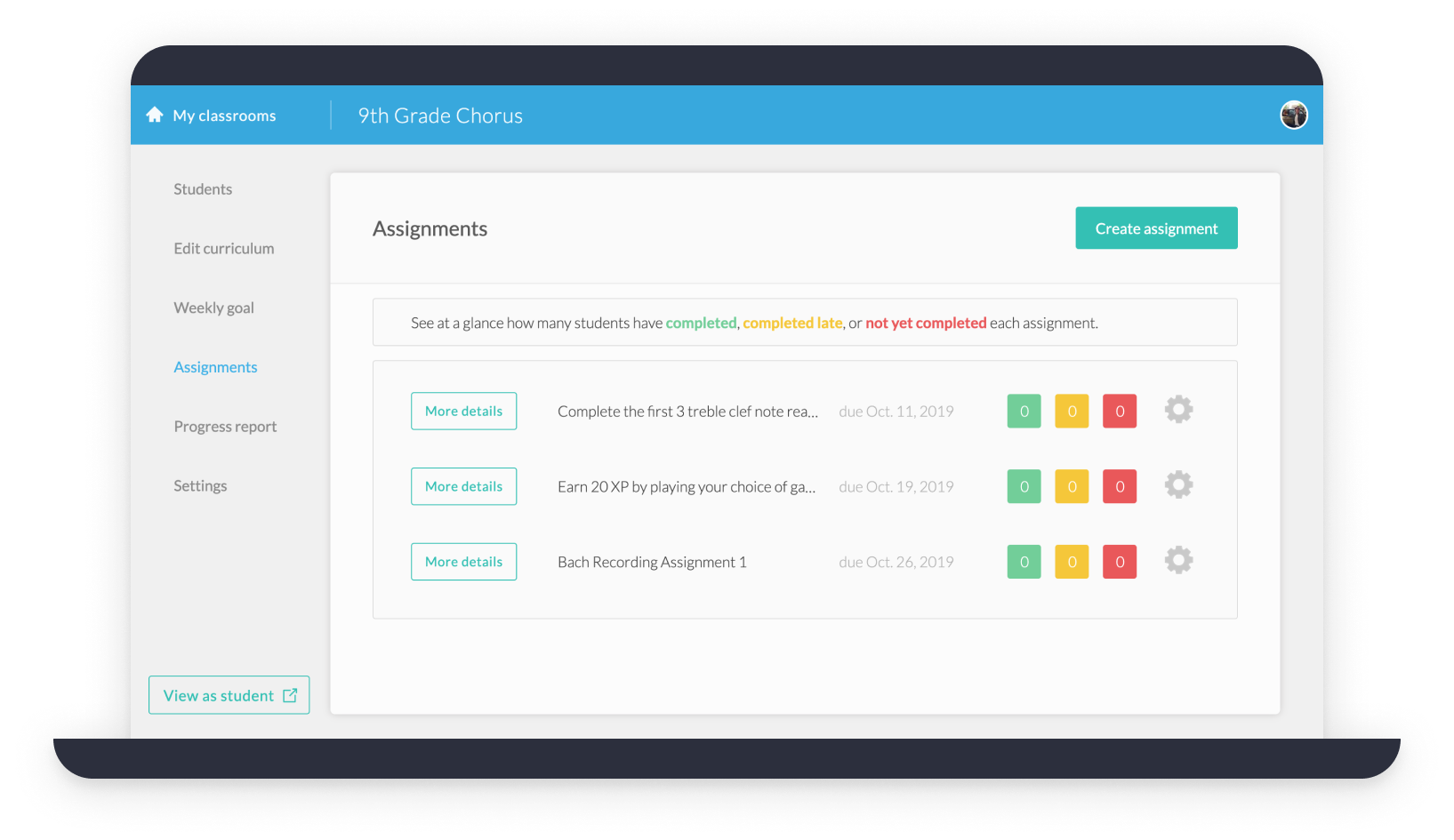
- Assignments with due dates. Assign specific games and levels, or set experience-point goals that let students choose their own games. A dashboard shows who completed each assignment, who finished late, and who has not started.
- Progress reports. Per-student reports show game sessions, skills mastered, and levels completed for every skill, which turns “did you practice?” into information you already have.
- Weekly goals. Set a target and let the streak do the nudging.
The games earn their keep as warm-ups, as station work, as substitute-day plans that students genuinely do, and as differentiated homework that grades itself. Teachers of younger students tend to lean on the hearts and medals; directors of advanced ensembles use the ear training strands to build section leaders.
Does game-based learning actually work?
The research says yes, with honest caveats, and we wrote up the full evidence on music learning games separately. The short version: meta-analyses of game-based learning find real gains in learning outcomes, and the mechanisms are the sturdiest findings in learning science: retrieval practice, spaced repetition, and immediate feedback. Reviews of music education research add one condition that classroom teachers will find unsurprising: the personal and social benefits of music engagement arrive when the experience is enjoyable. Games do not replace your teaching. They make the drilling part of your teaching self-running and pleasant, which hands the podium minutes back to actual music making.
How to claim your free classroom account
The signup takes minutes, and verification keeps the free tier for the classrooms it is meant for:
1. Go to tunelark.com/schools and claim your free account.
2. We verify that you are a classroom teacher. That is the only gate.
3. Create your classroom, add students, and toggle on the missions that fit your curriculum.
4. Try the teacher demo first if you want to explore the dashboard before signing up.
If you also teach private students outside of school, your verified account works for them too: create a separate classroom for your studio and assign away.
Frequently Asked Questions
Are Tunelark’s classroom music games really free?
Yes, fully. Verified classroom teachers get the entire game library and all classroom management tools at no cost, with no trial period, no student caps designed to force an upgrade, and no premium tier. Tunelark’s online private lesson marketplace funds the platform, so the school product does not have to.
What is the catch?
Verification. We confirm that you are a classroom teacher before activating the free account, because the free tier exists specifically to support music education in schools. Beyond that, there is no catch to find.
What grade levels do the games fit?
The games are adaptive and level based, starting from naming the white notes and climbing through advanced ear training, so they fit elementary general music through high school ensembles and theory classes. Each classroom’s curriculum is yours to shape, so different classes can see entirely different material.
What technology do my students need?
A web browser. The games run on laptops, Chromebooks, tablets, and phones with nothing to install. Students answer on an on-screen keyboard by default, and MIDI keyboards and microphone input for real instruments and voice are supported where you have them.
Can I track individual student progress?
Yes. Every student has a progress report showing sessions played, skills mastered, and levels completed per skill, and every assignment shows completion status across the class. Skill gaps surface on their own, before the playing test does it for you.
Keep reading
About Jennifer Heath
I'm Jennifer Heath, VP at Tunelark and a lifelong singer. I joined the company in 2020 and oversee much of what makes Tunelark work for our students and our teachers. That includes hiring, training, and supporting our instructors, customer and student support, marketing, and the day-to-day operations of the business.
I started voice lessons at age 7, sang with professional choirs that toured internationally through my teens, and performed solo at competitions and community events across Texas before stepping away in my twenties to study other interests, including business management. I haven't performed professionally in years, but I'll happily take the microphone at a karaoke night. Music has been in me every day of my life. Being able to spend the last six years working inside an online music education company, while traveling the world full-time, has been a perfect fit.
I believe deeply that music belongs in every life. For the self-expression, the discipline, the comfort, and the simple joy of it.
The Tunelark blog is where we share what we've learned about online music lessons: how to choose an instrument and a teacher, what to expect from your first lesson, how the major platforms compare, and how to keep music going through the busier seasons of life. Practical, honest writing you can act on.
Who we are
Tunelark provides virtual 1-on-1 music lessons to learners
of all ages.
We remove the barrier of geography and connect learners and teachers — wherever they are. Our growing community of vetted, experienced music educators have expertise in a wide variety of instruments, genres, and skill levels. We are passionate about connecting each student with the perfect instructor.