Posture for Singing: What the Alexander Technique Teaches

“Stand up straight” is the posture instruction singers hear most, and it is the one most likely to go wrong. Told to stand up straight, plenty of people lift the chest, pull the shoulders back, lock the knees and arch the lower back. They look tall, and they have stiffened the ribs, belly and back that breathing depends on.
Good alignment for singing is a balance the body keeps finding while it moves, not a shape to hold. That is the idea at the center of the Alexander Technique, a method for noticing and dropping the habits that make ordinary movement harder than it needs to be. It began as a solution to a voice problem, which is why it keeps turning up in voice studios.
Isabel S. teaches voice at Tunelark and brings principles of the Alexander Technique and mindfulness into her lessons. She is a classically trained soprano with a master of music in voice from the Mannes School of Music, and she has more than eleven years of teaching behind her. We asked her what the technique is, what good alignment actually feels like, and how a singer changes a habit they cannot see.
A technique that started with a lost voice
Frederick Matthias Alexander was born in Tasmania in 1869 and became a reciter and teacher of elocution, performing dramatic readings across Australia and New Zealand. As the engagements multiplied, his voice began to give out in the middle of performances. According to his biography at Mouritz, a specialist publisher on the Alexander Technique, the technique he went on to teach was developed to solve that loss of voice, and he moved to London in 1904 to teach it.
His method was to watch himself in mirrors while he spoke. A history of the technique from an Alexander teaching school in Ireland records three habits he found: he pulled his head back, he depressed his larynx, and he sucked in air through his mouth. When he stopped pulling his head back, the hoarseness decreased.
Isabel finds that origin the most interesting thing about it. “Alexander developed this technique to overcome voice hoarseness and chronic vocal fatigue,” she says. “So while it is a full mind-body technique, its origins are most directly linked to finding vocal ease.”
Alexander’s second discovery shaped the method more than the first. When he tried to correct himself by putting his head forward, the mirrors showed him still pulling it down onto his spine. He was doing the opposite of what he felt he was doing. His sense of his own position was wrong, and he later concluded that this was true of nearly everyone. The technique grew from there into a way of working that does not trust the feeling of “correct” until it has been checked.
What the Alexander Technique is, for a singer
Isabel describes it in two parts. The first is how the body is used. “Overall, the technique is a guide to the most efficient “use” or dynamic balance/posture for all activities in life,” she says. “This goes for everything from tongue position for most easeful and deep breathing, to how to get in and out of a chair.”
“Use” is Alexander’s own word for the way a person organizes their body while doing something. “Dynamic” is doing real work in her description. A singer’s balance shifts with every breath, every phrase and every step across a stage, so good use is a way of moving and staying free rather than a position to find and freeze.
The second part is how habits change. “Another key component is a method for increasing awareness and letting go of habits that are not serving you,” Isabel says. “These skills are essential in singing.”
For a singer the habits are specific: a chin that lifts toward a high note, a jaw that clamps on a closed vowel, shoulders that rise on the inhale, a head that pulls back at the start of every phrase, the same pull Alexander saw in his mirrors. None of these is a posture problem in the usual sense. Each is a movement the body makes on its way to singing, repeated so often that it feels like part of the sound.
Isabel remembers a fellow singer in her own training describing what happened when those habits started to go. “On one of my first days of AT training, a fellow classmate and singer told me, “Once I started AT, my singing technique completely fell into place.”” That is one singer’s experience, and it fits how the technique is meant to work: a skill that has been taught correctly can stay out of reach while an old habit keeps interfering with it.
Why “stand up straight” backfires
Isabel starts from the premise that the body is the instrument. “The way we use our bodies while singing is very important, since our whole body is our instrument,” she says. A pianist can sit badly and the piano still sounds the same. A singer’s posture changes the instrument itself.
That is why she avoids the most familiar instruction. “I tend to be wary of over-generalized instructions which can feel confusing or can easily be mis-interpreted, like “stand up straight,” since some people might overdo this and arch their back,” she says.
The trouble with a general instruction is that each person carries it out through their own habits. One singer hears “stand up straight” and lifts the chest. Another pulls the shoulder blades together. A third locks the knees and tips the pelvis forward, and the lower back arches to keep them upright. All three have obeyed. Each has added tension somewhere the breath needs to move: the ribs, the belly wall, the lower back. Our guide to breath support for singers explains how much of breathing for singing happens in those places.
“Relax your shoulders” fails in a similar way. Told to relax, many people push the shoulders down, which is another held position, or collapse through the chest. Relaxation that is ordered tends to arrive as a different kind of effort.
What good alignment actually feels like
Isabel starts somewhere a singer can feel. “There are many details to get into, but overall, feeling grounded and present is a great place to start,” she says. “Feeling your feet in the ground, the ground supporting you, and a soft bend in your knees.”
Each of those cues works against one of the “stand up straight” habits. Feeling the ground take your weight gives the legs and back less to do. A soft bend in the knees keeps them from locking, and locked knees leave the legs rigid and push the adjustment up into the hips and lower back. None of the cues asks the singer to hold anything.
For the head and neck she uses an image about where the eyes go. “A nice way to find head/neck alignment is to use a soft focus: ensuring you are not only looking in front of you, but also taking in your full peripheries as if looking at a horizon line of the sky meeting the sea.”
The eyes and the head move together. A hard stare at one point, a music stand or a note on a page, tends to draw the head forward and down, and a singer reaching for a high note tends to lift the chin toward it. A soft, wide gaze at the level of a horizon leaves the head balanced on the top of the spine instead of being pushed or pulled into place. The larynx sits in the front of the neck and hangs from the hyoid bone at the root of the tongue, so the angle of the head and neck changes the space it works in. That is the relationship Alexander found in his mirrors.
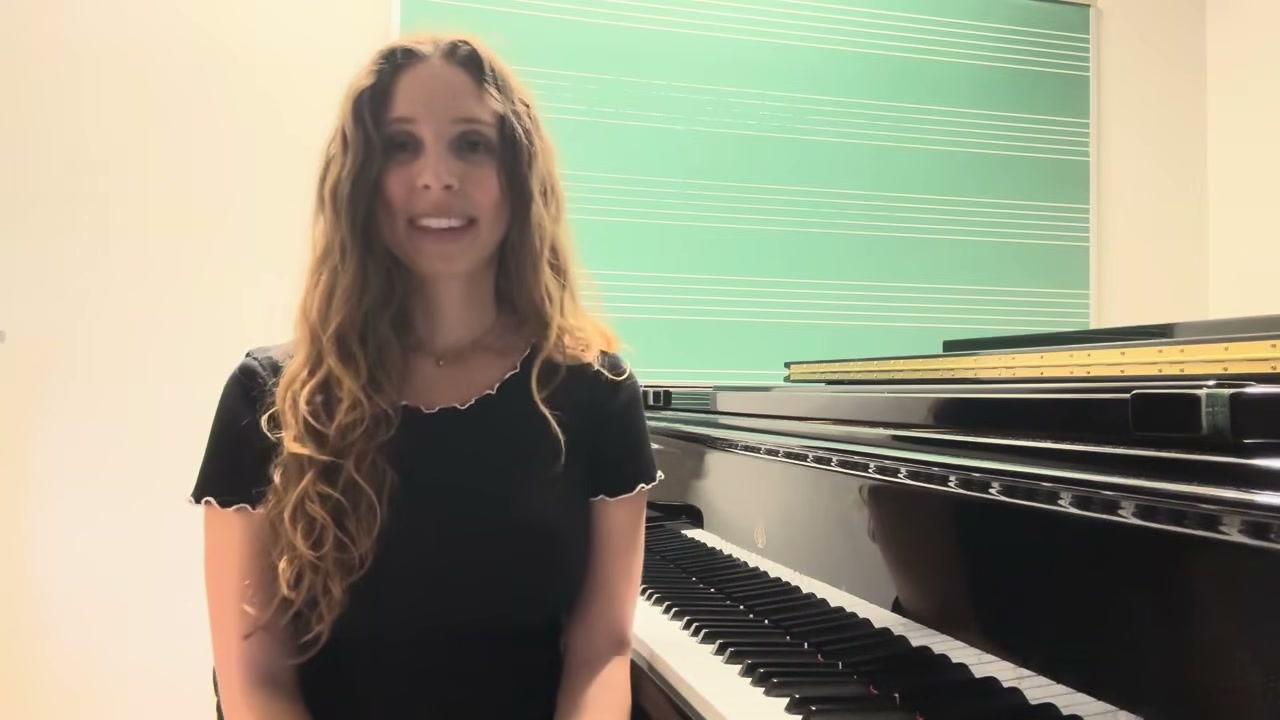
Breathing is where these cues show up first. A singer who is grounded, with free knees and a balanced head, has ribs that can widen on the inhale without being hauled open. Isabel demonstrates where the breath actually goes, and how to stop tightening around it, in the lesson below.
Skill video · Rib Breathing
Isabel teaches voice on Tunelark. View Isabel’s profile
Noticing comes before changing
Isabel brings mindfulness into her lessons for a practical reason. “Paying attention to your body while working on singing is how we make changes to our instrument and technique,” she says. “Noticing is the first step to building new habits.”
Her example is small and specific. “Often, I will assign a student the task of simply noticing where their tongue tends to rest in their mouth. Once that awareness has been built, it is much easier to generate the ideal position for the sound they wish to achieve.”
The tongue is a good place to start because it is hard to see and easy to hold. Its root attaches to the same hyoid bone the larynx hangs from, so a tongue that pulls back or presses down tends to pull the larynx with it, and the sound thickens or tightens. Most singers have no idea where their tongue sits, because the habit is invisible from the inside. Correcting it straight away usually means one held position replacing another. A week of observing it, while speaking, while resting, and during different vowels, gives the singer a baseline to change from.
The same order works for any habit: the chin, the jaw, the shoulders on the inhale. First the singer learns when it happens. Then the change has something to attach to. Our guide to vocal warm-up exercises covers the exercises that release the jaw and tongue once the habit has been found.
An alignment check you can run before singing
Put together, Isabel’s cues make a short check a singer can run at the start of a practice session. This sequence is ours, built from what she described.
1. Stand and feel your feet. Let the floor take your weight through both feet. Do not straighten anything yet.
2. Unlock your knees. A small bend, enough that you could bounce gently. If your lower back relaxes as you do it, your knees were locked.
3. Widen your gaze. Look toward a point at eye level across the room and let your vision take in the edges of the room as well, as if you were looking at a horizon.
4. Observe your tongue. Say a short sentence and pay attention to where your tongue settles afterward. Do not move it. Just find out.
5. Breathe in and let the ribs widen. Keep the shoulders out of it. If they rise, go back to step 1.
6. Sing one phrase you know well, then check again. Did the chin lift? Did the knees lock? Did the gaze harden onto one point? Whatever changed is the habit to watch this week.
The check takes about two minutes. It also sits well before a warm-up, since the warm-up then trains a freer body rather than a braced one, and it fits into the daily care our guide to vocal health for singers describes.
Why this works better with a teacher
Alexander needed mirrors because his own sense of his posture was unreliable, and so is everyone’s. A singer who feels straight may be arching. A singer who feels relaxed may have moved the tension somewhere new. Isabel ends her description of alignment on exactly this point. “This is why having a teacher help with your individualized needs and understanding is so important,” she says.
A teacher sees the habit a singer cannot feel, and connects it to the sound the singer can hear. In an online lesson that works best with the camera set far enough back to show the whole body, or at least the head, shoulders and torso, and occasionally turned side-on, since the arch of the back and the jut of the chin are easiest to see in profile. Between lessons, a phone propped at the side of the room does the same job. Our guide to recording your singing practice covers how to set that up and what to listen for.
Changes of this kind are gradual. An old habit returns under pressure, on a high note or in front of an audience, long after it has gone from the practice room. Our honest timeline of vocal technique describes how long each kind of progress usually takes.
About Isabel
Isabel is an American-German soprano and voice educator. She holds a master of music in voice from the Mannes School of Music and a bachelor of music in voice from the University of Michigan, and she has performed in standard and world-premiere operas, recitals, musicals and choral projects across the United States, Europe and the Middle East, including a featured soloist engagement at Carnegie Hall.
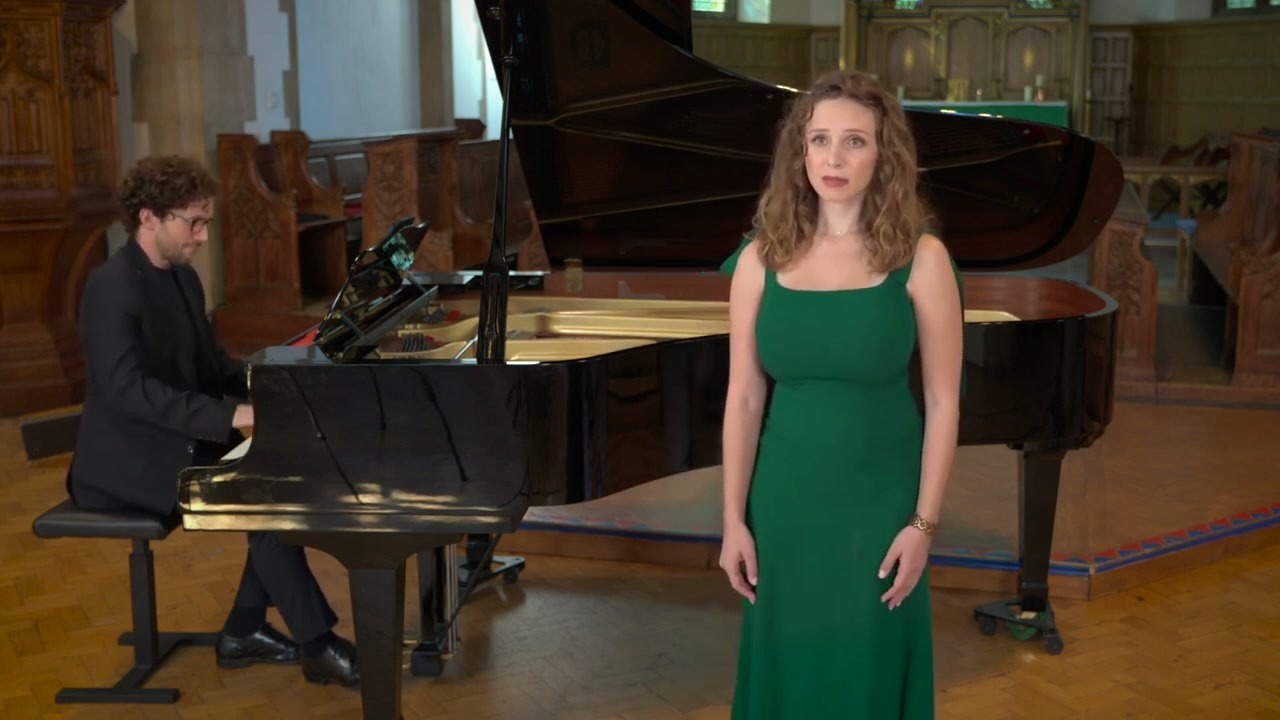
She came to singing by way of the body. She started piano at six and trained in dance through high school, competing and taking classes many hours a week, and dance gave her the rhythm and body awareness that she now counts among the reasons opera fit her so well. At Tunelark she teaches singers from age five up across classical, musical theater and contemporary styles, with lessons built around breath, alignment and storytelling, and she still takes voice lessons herself. Here she is in performance, singing “Zeffiretti lusinghieri,” an aria from Mozart’s Idomeneo. She was also interviewed for our guide to singing in a foreign language.
Performance · Zeffiretti lusinghieri
Isabel teaches voice on Tunelark. View Isabel’s profile
Ready to work on how you stand when you sing?
Isabel is accepting new voice students at Tunelark, and a song you already sing often is a good thing to bring to a first lesson, because the habits in your posture show up most readily in music you know well. You can also find a teacher for another instrument across the rest of the roster.
Frequently Asked Questions
What is the best posture for singing?
A balanced, grounded stance rather than a held one: weight through both feet, knees unlocked, head balanced on top of the spine with a level gaze. The exact adjustments differ from singer to singer, which is why a general rule such as standing up straight often adds tension instead.
What is the Alexander Technique?
A method developed by F. M. Alexander, a reciter who kept losing his voice in the 1890s, for noticing and letting go of habitual tension in everyday movement. It is taught to singers, actors and instrumentalists because the habits it targets often interfere with breathing and sound.
Do I need Alexander Technique lessons to sing well?
No. Many voice teachers bring its principles into ordinary voice lessons, working on alignment and habits inside the singing itself. Some singers also take separate lessons with an Alexander teacher.
Should I sit or stand to practice singing?
Standing makes it easiest to feel the whole body working, and it is how most singers perform. Sitting is fine when you stay balanced on your sit bones with your feet on the floor, rather than slumping back or perching forward.
Why does my chin go up on high notes?
Reaching up with the head is a common habit when a note feels high, and it tightens the neck around the larynx at the moment the voice needs the most freedom. Watching for it on video, and keeping a level gaze through the phrase, are the usual ways to start changing it.
Looking for an online voice teacher? See our full Online Voice Lessons page for everything you need to know about getting started.
Keep reading
About Jennifer Heath
I'm Jennifer Heath, VP of Operations at Tunelark and a lifelong singer. I joined the company in 2020 and oversee much of what makes Tunelark work for students and teachers: hiring, training and supporting our instructors, student support, marketing and day-to-day operations. I started voice lessons at 7 and sang with touring choirs through my teens. Music belongs in every life, for the self-expression, the discipline, the comfort and the simple joy of it.