How Long Does It Take to Learn Trumpet? A Realistic Timeline

Most trumpet beginners buzz a note on the mouthpiece in their first lesson and play simple tunes on a handful of notes within the first few weeks. Range and endurance take years: one published school band curriculum expects two playing years before a student holds about an octave and a half consistently, from the G below the staff to the D on its fourth line, about five before the G above the staff is reliable, and six or seven before the full practical range up to high C. The fingering is not what takes the time, because the trumpet’s three valves give only seven fingerings. The time goes into the lip muscles that pick each note and hold it.
The timeline below follows that curriculum, the band curriculum of Arlington Public Schools in Virginia, concert by concert. We found no research-based month-by-month sequence for brass, and a school band’s levels are the most detailed yardstick available. Read it as one district’s plan for a class on a school calendar, not as a measurement of what any one student will reach.
Two Clocks: What You Know and What Your Lips Can Do
Learning trumpet runs on two clocks. Reading, rhythm and fingering move at the speed of understanding. The seven fingerings, laid out in our guide to whether trumpet is hard to learn, can be learned in a sitting, and a student who already reads music from piano or choir carries that reading straight over.
Range and endurance move at the speed of muscle. Range is the span from your lowest to your highest note with a usable sound. Endurance is how long you can keep playing before the tone thins and the pitch sags. Both depend on the embouchure, the way the lips and the muscles around them hold against the mouthpiece. Every higher note on the same fingering needs the lips to vibrate faster, and Brian Weidner’s open textbook Brass Techniques and Pedagogy notes that brass range develops slowly compared with woodwinds and strings, with beginning trumpet players often limited to about an octave (Weidner, The Trumpet).
The two clocks explain a common stall in a first trumpet year: a student who understands a piece completely and still cannot play it, because one note sits above where their lips reliably reach.
The First Weeks: A Buzz, a Note, Then Five
The first lesson usually starts on the mouthpiece alone, buzzing the lips into it, and a first note on the trumpet itself comes in the first lesson or two. The lips and the muscles around them are often sore for the first couple of weeks, and that passes as the embouchure becomes efficient. A rest day while they are sore is part of the plan.
Weidner’s rule for a beginner is as much time off the face as on it. His opening mouthpiece exercise is four counts of buzzing, then four counts of rest, repeated, and every long tone, one note held steadily for several beats, is followed by a rest just as long (Weidner, mouthpiece fundamentals). Fifteen to twenty minutes a day, five or six days a week, is the usual beginner load.
In Arlington’s first semester, the goal by the winter concert is five notes, written C, D, E, F and G, with whole, half and quarter notes, rests and ties, played in tunes such as Hot Cross Buns, Go Tell Aunt Rhody and Jingle Bells. Band music calls those same five notes concert B-flat, C, D, E-flat and F, because a B-flat trumpet’s written notes sound a whole step lower than printed, the distance from C down to B-flat, so the band director and the trumpet part name the same sound differently.
The First Two Band Years, Concert by Concert
Arlington’s beginning level spans the first two playing years, grades 4 and 5 there, and the curriculum sets out what each concert should show.
| By this concert | Notes and scales introduced | Rhythm and reading |
|---|---|---|
| Year 1, winter | Written C, D, E, F, G | Whole, half and quarter notes and rests, ties |
| Year 1, spring | Written A in two octaves, B, and a first scale | Eighth notes, 2/4 and 4/4 time, loud and soft |
| Year 2, winter | New notes and two more scales | 3/4 time, repeats and endings, pick-up notes that start a tune before the first full bar, short, smooth and accented notes |
| Year 2, spring | Four scales, a chromatic scale, new notes for range | A solo with piano, duets and trios, a first try at improvising |
A chromatic scale climbs by half steps, the smallest step in Western music. Arlington’s beginning-level outcome for trumpet, reached by the end of year two, is to play written G below the staff to fourth-line D consistently. At the same level a student should buzz sirens, smooth glides up and down in pitch, or simple songs on the mouthpiece with a full, clear, sustained tone, start notes with the tongue on the syllable doh or toh, oil the valves and grease the slides, and play four consecutive notes on one breath. Our guide to private lessons alongside school band covers when a band student also needs a private teacher.
Years Three to Seven: The Top Note Climbs Slowly
Arlington’s intermediate level covers playing years 3 to 5, middle school there. By its end a trumpet player should play consistently from F-sharp below the staff to G above it, reach the C above the staff some of the time, use the third-valve slide to tune, and show the start of double tonguing, a faster articulation that alternates the front and back of the tongue. Weidner explains the slide: the low D and C-sharp that use valves one and three, or all three, are extremely sharp unless the slide is pushed out, and many beginners leave them out of tune. The phrase target rises to four bars of 4/4 time on one breath.
Scale tempos rise in step. In year 3 the curriculum asks for seven major scales at 72 beats a minute, in year 4 nine at 92 plus a two-octave chromatic scale, and in year 5 two octaves where the scale allows, at 100.
The advanced level, playing years 6 and 7, is where the full practical range becomes consistent: F-sharp below the staff to C above it. A basic vibrato becomes a trumpet goal, and the phrase target becomes six bars on one breath by the end of grade 9 and eight bars by the end of grade 10.
From the end of the beginning level to the end of the advanced level, the top of the reliable range climbs from fourth-line D to G above the staff, then to C, while the bottom moves down a single half step to F-sharp, the trumpet’s lowest standard note. That is roughly five years for the top of the range to gain six letter names. Weidner’s levels for printed music agree: intermediate literature runs from F-sharp below the staff to G above it, and advanced literature to the D above high C, higher for jazz and some solos.
Sandra plays trumpet in a five-piece brass ensemble on an arrangement of Amazing Grace, recorded in a music shop. A slow hymn leaves every long note and every breath exposed, which is the stamina the later levels measure in bars per breath.
Performance · Amazing Grace
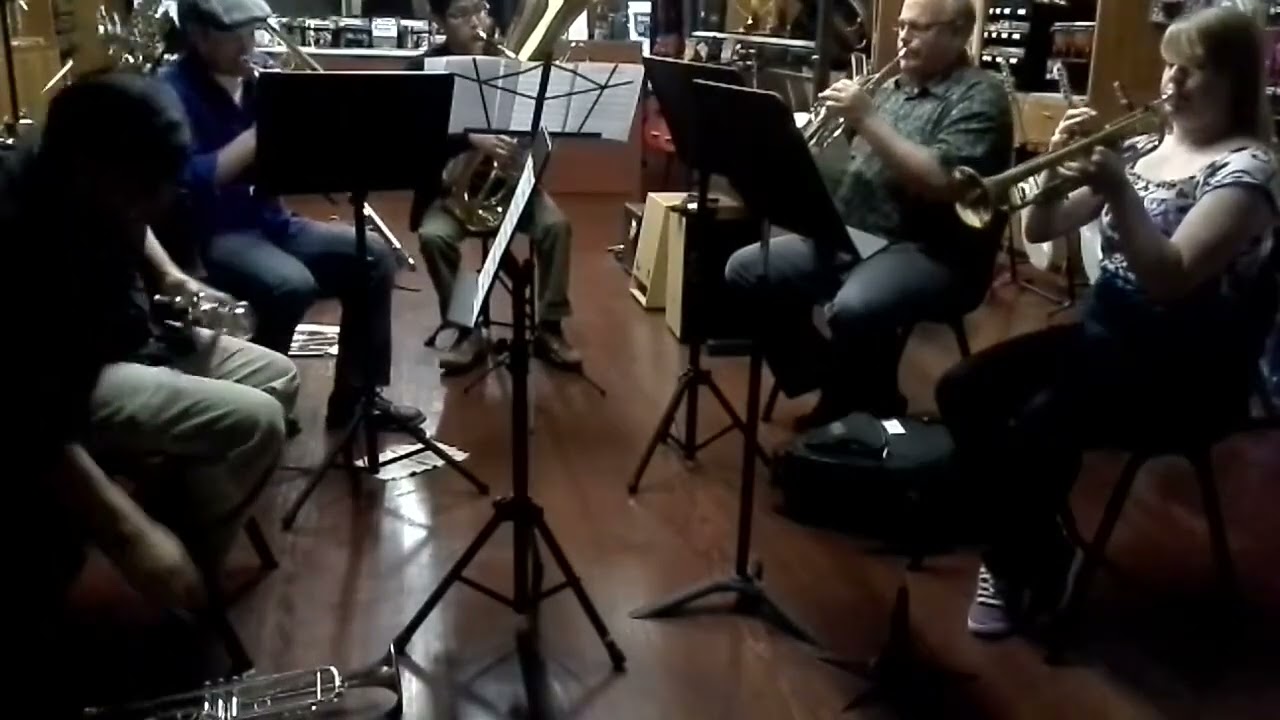
Sandra on trumpet with a brass ensemble, from the Tunelark channel.
Tracking Endurance at Home
In the first months, tired lips end a practice session sooner than a hard note does. The embouchure muscles tire quickly while they are new to the work, which is why short, frequent sessions with rests suit trumpet better than one long one.
Endurance is the easiest thing to track weekly at home. A long tone, adapted from Weidner’s mouthpiece routine, makes a simple measure:
1. Play a comfortable note, written G on the second line, softly, and count steady beats until the tone wavers.
2. Take the mouthpiece off your lips for the same number of beats.
3. Repeat until a round ends sooner than the first one did, and note how many rounds you managed.
4. Write both numbers down once a week, at the same point in the session.
Both numbers can creep up in weeks when the top note does not move, which is endurance growing before range shows it. If a higher note only comes out when the mouthpiece is pressed harder into the lips, that note is borrowing from endurance and is not yet in range.
Record a piece you know every four to six weeks, the same way each time. Listen for the highest note that speaks cleanly and whether a whole tune now fits before the tone thins. For a parent who cannot read the music, our guide to telling whether a child is making progress uses the same two-recording comparison, and our guide to practicing music at home covers building short sessions that actually happen.
Adults Build the Same Range on Their Own Calendar
A school band moves at the pace of the class and the concert calendar. An adult in weekly private lessons does not have to: reading, rhythm and new fingerings can move as fast as they are understood, and an adult who already reads music may cover the reading half of year one in weeks. Our guide to starting music as an adult covers what else changes for a later beginner.
Range and endurance are another matter. None of the curricula and pedagogy texts we checked publishes a separate adult sequence, and nothing we found says adult lips build range faster or slower than a child’s. Read the school levels as playing years for range, not for everything else.
Sophie P., who teaches trumpet, trombone and euphonium on Tunelark, teaches adults as well as children, and one student’s review on her profile says she helped them learn trumpet at 50.
How to Find a Trumpet Teacher on Tunelark
Every Tunelark teacher is vetted by working musicians and educators for teaching quality before they can list. Each teacher sets their own rate and shows it on their profile, and Tunelark handles scheduling, billing and support.
- Open the teacher list at tunelark.com/find-a-teacher and filter by instrument.
- Choose a lesson length of 30, 45 or 60 minutes.
- Book a trial lesson. The first lesson with a new teacher is that teacher’s rate minus $25, for whatever length you choose, so trials start at $14.
- Bring a recording from a month or more ago, and play the highest note you can hold cleanly, so the teacher can place you on the timeline.
Frequently Asked Questions
Why does my trumpet part name different notes from the piano?
Most trumpets are in B-flat. To play along with a piano or a recording, read the piano part a whole step higher, or ask your teacher for a part already written for trumpet.
How long does high C take on trumpet?
Arlington expects the C above the staff consistently by the end of year 7. Its artist level, the last two years of high school there, asks for the full extended range above high C, so those notes are a senior-year goal in that program, and the top trumpet parts in jazz bands go higher still.
Will practicing longer each day shorten the timeline?
Only up to the point where the tone thins, because minutes past that build fatigue rather than range. Past the first year the usual recommendation rises to 30 to 45 minutes a day, five or six days a week, and on trumpet the extra time goes into a second short sitting later in the day rather than a longer first one.
I played trumpet in school years ago. How long until I get it back?
The reading and the fingerings usually come back quickly. Range and endurance depend on the condition of the lip muscles, so expect short sessions and a lower top note for the first weeks, and rebuild with long tones and rests rather than by forcing the old high notes.
Is trumpet slower to learn than trombone?
They run on the same school calendar and both build range slowly. Trombone adds a gate of its own: the outer slide positions stay unreliable long after the inner ones are solid. Arlington’s two-year target for trombone is F below the bass staff up to middle C.
Keep reading
About Jennifer Heath
I'm Jennifer Heath, VP of Operations at Tunelark and a lifelong singer. I joined the company in 2020 and oversee much of what makes Tunelark work for students and teachers: hiring, training and supporting our instructors, student support, marketing and day-to-day operations. I started voice lessons at 7 and sang with touring choirs through my teens. Music belongs in every life, for the self-expression, the discipline, the comfort and the simple joy of it.