Does My Child Need Private Lessons Alongside School Band?
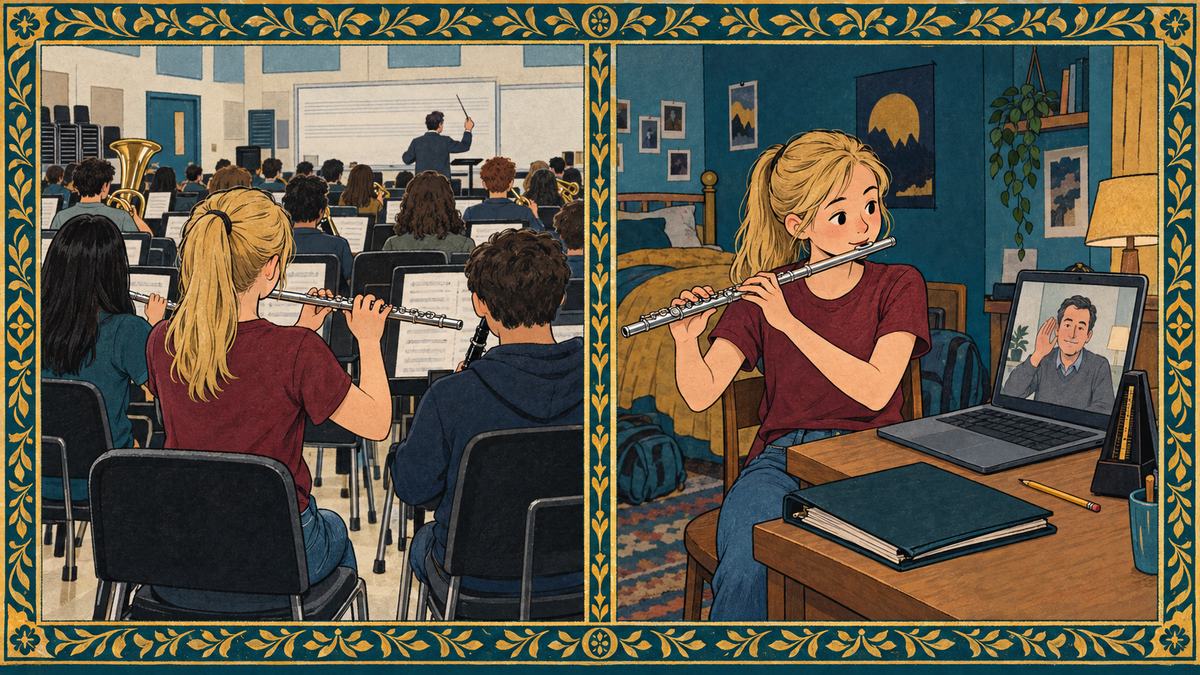
Most band and orchestra students do not need private lessons to enjoy the class, keep up and stay in it through graduation. A smaller group gains a great deal from them. One is the child who has fallen behind their section, the other players on the same instrument. Another is the child chasing a top chair, one of the ranked seats a director assigns after a short playing test, or an honor band, a select ensemble students audition into at the district, region or state level. The third is the child who is bored because the class stopped stretching them. Which child you have decides the answer. On trombone that gap is usually the outer slide positions, and our guide to whether trombone is hard to learn shows how far out they really are. For a trumpet player that chair is mostly about endurance, and our guide to whether trumpet is hard to learn covers how it is built.
What the Band Room Teaches Well
A school ensemble teaches things a private lesson cannot: reading music at speed, counting through 40 bars of rest, tuning to a note given from across the room, blending inside a section, and delivering a part by the concert date whether or not the week went well. A private teacher has no equivalent to a December concert, or to 50 other children as a reason to show up.
The limits are structural, not a reflection on the director. One adult often stands in front of 40 or more students for a class period of 45 to 50 minutes, and after warm-up, tuning and the rehearsal itself each child gets seconds of individual attention. Embouchure, the way the lips, jaw and facial muscles form around a mouthpiece or reed, is checked closely in the first months of beginning band and then rarely, because the director is listening to the trumpet section as a whole and does not see twelve sets of lips. Hand position on a violin or clarinet gets the same treatment, and a sixth-grade habit can ride unchallenged into high school, where it caps range and tone.
The McNeil High School band in Round Rock, Texas, tells parents on its private lesson FAQ that lessons are strongly encouraged for all band students because they provide consistent one-to-one instruction, and lists what students use them for: region and all-state auditions, solo and ensemble contest, a judged solo or small-group performance that earns a rating, and chair tests. The Argyle High School band’s lessons page says the one-to-one attention matters most in its larger classes and calls private lessons the biggest predictor of a student’s musical success. That is a director’s view from a state-level program, not a study.
What a Private Teacher Adds
A private teacher watches one child for 30 minutes and hears all of it: tone, tuning, breath, hand shape, and the fingering the child has been faking since October. The teacher usually plays the child’s instrument, which a director often does not. A trombonist directing band teaches flute from a method book; a flutist hears in one note that the air is aimed too low. Which instrument that is gets decided before any of this, and our guide to choosing a band instrument covers the fitting itself.
The private teacher also picks material for one child: an exercise for the passage the child cannot play, a solo piece a level above the band’s parts. A director with 50 students cannot rehearse each of them for a chair test or a region audition one at a time. A private teacher can, and mock auditions are a normal part of the lesson in the months before one.
When School Alone Is Enough
A child who is keeping up, plays in tune, enjoys rehearsal and practices a little at home is getting what band is for, and adding a weekly lesson can turn a thing they like into a second homework subject.
There are reasonable times to wait. The first year of beginning band is one, because the director checks fundamentals more often in those months than later and the child is still deciding whether they like the instrument. A week that is already full is another, and so is a program with instrument-specific sectional coaches, who cover some of what a private teacher would.
Revisit the question at natural checkpoints: the end of the first year, the first chair test the child cares about, the first time they say they are bored, and the first time they say they want to quit. A child who wants to quit band is often saying something else, and our guide to what a child means when they want to quit music separates the practice complaint from the real thing.
A Decision Table for the Common Situations
| What is going on | What school covers | What private lessons add | Reasonable call |
|---|---|---|---|
| Keeping up and happy | Reading, counting, blending, a concert deadline each semester | Polish the child is not asking for | Wait. Revisit at year end or when they ask |
| Behind the section | Rehearsal at the section’s pace | A diagnosis, usually one fundamental, and a fix within weeks | Start now, 30 minutes a week, and tell the director |
| Wants first chair or honor band | The audition excerpts and the deadline | Excerpt coaching, tone and range work, mock auditions | Start two to three months before the audition |
| Bored | Parts written for the whole section’s level | Solo repertoire above the band’s level | Start. Boredom in a large class rarely fixes itself |
| About to quit | Nothing new until the child says why | Help when the cause is falling behind, not when it is the instrument or the schedule | Ask the director and the child why first |
| Instrument switch mid-year | A new method book and a section already months past the basics | The beginning fundamentals the class covered in the fall | Start for the first three months of the switch, then reassess |
| Band has no teacher for that instrument | A director teaching oboe, bassoon or horn from a method book | Instrument-specific instruction the class cannot give | Start. Online lessons open up teachers of rare instruments |
The last row is more common than it sounds: many middle school directors have not played oboe or horn, and a child on one of those is often the only one in the room.
How the Two Teachers Work Together
Band music comes first. The private teacher builds the lesson around what the child already carries in the folder: concert parts, region audition etudes, the set study pieces for that audition, and the chair test excerpt. Technique and solo repertoire sit on top of that, not instead of it, and a practice week runs in the same order: whatever has the nearest deadline, then the private teacher’s technique work, then the piece the child chose for fun.
Ask the director what to work on. One email: if you had ten minutes alone with my child, what would you fix? Most directors answer that gladly and specifically, and the answer is the first lesson’s agenda.
The two adults should not contradict each other on fundamentals. A child told two ways to hold the bow or place the tongue ends up doing neither well. On anything graded in class, such as breathing marks, articulation, meaning how notes are tongued and separated, or which of two fingerings the school method uses, the private teacher should teach the school’s version and explain the alternative. When a difference limits the child’s playing, a specialist on the instrument is usually right, and the honest move is to raise it with the director directly rather than through the child.
Practice stays one session, not two. A child of 11 or older is working toward 25 to 45 minutes a day, five or six days a week, with the band folder and the lesson assignments inside the same session. Our guide to helping a child practice at home covers the routine that makes that hold.
The Questions to Ask Both Teachers
For the director: Is my child keeping up with their section? What would you fix first? Do you keep a list of private teachers, and can any of them teach during the school day? When is the next audition or chair test, and what is on it? Would you like to see the lesson notes?
For the private teacher: Have you taught students in a school program, and do you work from their band music? What do you do when your advice differs from the director’s? How do you prepare a student for a chair test or a region audition? What will I hear from you after each lesson? Our checklist of what to look for in a children’s music teacher covers the signals to watch at the trial lesson.
School and district lesson programs screen their teachers: Northwest ISD in Texas requires its lesson teachers to be fingerprinted and background checked every year, and every McNeil lesson teacher holds an undergraduate degree in music education or performance. Every Tunelark teacher is vetted by working musicians and educators for teaching quality before they can list, and the vetting includes a music degree, at least two years of teaching experience and a background check run by Tunelark.
Timing, Cost and What a Week Looks Like
The best starting points are the first weeks of the school year and two to three months before an audition the child cares about. A mid-year start is fine when the trigger is falling behind. Give a new teacher about a month, roughly four lessons, before judging the fit, and give a child three months unless they dread the lessons or the teacher cannot explain a stall.
Argyle and Northwest ISD charge $25 to $27 for a 25 to 30 minute lesson as of 2026, often during the band period itself. Online, a 30-minute lesson on Tunelark runs $39 to $65 with a typical price of $44, and a 45-minute lesson runs $54 to $93. At the typical rate, a weekly 30-minute lesson across a 36-week school year comes to about $1,600. Middle schoolers usually start at 30 minutes. High schoolers preparing region material usually need 45, which is also what the McNeil FAQ recommends.
A band student who already practices most days adds little load by taking lessons. A band student who practices only in class is being asked to build a habit and a skill at once, and the first month will feel like a lot. A wind player’s first weeks are also the hardest on the face, and our guide to the first saxophone, flute or clarinet lesson explains what that fatigue means. Our parent’s guide to online music lessons for kids covers the home setup.
How to Find a Music Teacher on Tunelark
Tunelark connects you with deeply vetted music teachers who teach online. Vetting is run by working musicians and music teachers, not a general recruiter, and every teacher sets their own rate and shows it on their profile. Scheduling, billing and support are handled for you.
- Browse teachers at tunelark.com/find-a-teacher, filter for your child’s instrument, and watch their videos.
- Read bios for teachers who mention school band or region auditions.
- Book a trial lesson at $25 off the teacher’s 30-minute rate.
- Send the teacher the band folder and the director’s answer before the first lesson.
Frequently Asked Questions
Do band directors mind when a student takes private lessons?
Most directors welcome it. What they dislike is hearing about it only when a lesson fingering contradicts theirs, so name the teacher to the director early and ask the two of them to compare notes by email once a semester.
How do I find a teacher for a rare band instrument like oboe, bassoon or horn?
Start with the director, who may know a regional player who teaches. For oboe and bassoon, ask any teacher you consider whether they adjust or supply reeds by mail. Both instruments play on a double reed, two blades of cane bound together, and much of a beginner’s tone comes from that reed. A teacher who has not seen it is guessing.
Should the private teacher play the same instrument as my child?
Yes. A specialist hears problems in embouchure, air and hand position that a generalist teaches around. The exception is percussion, where a band percussionist rotates among snare, mallets and timpani and needs a teacher who covers all three.
Can my child take private lessons during the school day?
In many districts, yes: the lesson happens in a practice room during the band period, usually for half the class. Online lessons take place after school or on weekends, around the ensemble schedule instead of inside it.
My child takes lessons and still did not move up in chair. Is it working?
A chair test measures one excerpt on one day, and nerves decide more of it than parents expect. Ask the teacher to run timed mock tests and judge progress on recordings across three months rather than one seating. A seat can stay put while tone and range have clearly improved.
Keep reading
About Jennifer Heath
I'm Jennifer Heath, VP of Operations at Tunelark and a lifelong singer. I joined the company in 2020 and oversee much of what makes Tunelark work for students and teachers: hiring, training and supporting our instructors, student support, marketing and day-to-day operations. I started voice lessons at 7 and sang with touring choirs through my teens. Music belongs in every life, for the self-expression, the discipline, the comfort and the simple joy of it.