AI Music Apps and Kids: What to Ask Before You Hand One Over
Start with the part nobody selling you one of these will mention.
In February 2026, four researchers published a systematic review in Frontiers in Psychology examining how AI tools affect music learners’ beliefs about themselves and their sense of agency. They searched four databases, screened the literature systematically, and included 21 empirical studies. In describing the limits of what they found, they noted that the research is concentrated in higher education, heavily concentrated in China, and that early childhood settings were absent.
Not thin. Absent.
So if you are the parent of a five-year-old and you are wondering whether a music app is good for them, the honest answer is that nobody has properly studied children that age. There is a little evidence about primary-age children, which we come to below, and beyond that anyone answering you confidently is extrapolating from university students. It is fair to ask them to say so.
That does not mean the answer is no. It means the answer is be the one paying attention, because the research is not going to do it for you.
What the research does say about younger learners
There is one finding in that review that speaks directly to children, and it is the most useful sentence in this entire article. It also rests on a single primary-school study among the twenty-one, and the review’s authors say that stage-related claims like this one should be treated as provisional, because age and setting are tangled together in the studies they had to work with. Read it as the best signal currently available rather than a settled developmental fact.
The researchers observed a developmental split in how learners related to these tools. Primary-age children tended to experience AI as a restrictive scoring referee, something sitting in judgment over them. University students tended to treat it as an assistant they directed, deploying it strategically for their own purposes.
The same technology. Two completely different relationships.
An adult using a practice app has an established sense of who they are, why they are playing, and what they think of their own work. The app is an instrument they pick up. A child does not have that yet. They are still assembling their sense of whether they are any good at this, and a machine that grades them daily is participating in that construction whether anyone intended it to or not.
This is why “it’s just a practice tool” is a weaker claim for a nine-year-old than for a thirty-nine-year-old. For the adult it probably is just a tool. For the child it may be an authority.
The developmental case for using them well
None of this means keep technology away from children learning music, and there is a good argument in the other direction.
A chapter in The Oxford Handbook of Artificial Intelligence in Music Education, published in August 2026 and written by Sangmi Kang and Hyesoo Yoo, looks at general music education through developmental psychology and social constructivism. Their argument is that AI can be meaningfully integrated into music education for young learners when it is matched to how children actually learn at each stage, moving through enactive learning where children learn by doing, iconic learning through images and representations, and symbolic learning through notation and abstraction, aligned with the developmental stage the child is actually at.
They also frame children’s roles as evolving: learners move from observers, to participants, to agents. That progression is the goal, and it gives you a genuinely useful test for any tool. Does this move my child toward being an agent, someone making decisions about their own music? Or does it park them permanently as a participant, doing what the screen says?
A 2025 article in Arts Education Policy Review by Lee Cheng, looking at generative AI in school music education, reaches compatible conclusions and adds that concerns about cultural bias, originality and equity require careful regulation rather than being left to individual judgment. That is a policy point, but it lands at home too: somebody has to be setting the rules, and if it is not the school, it is you.
The questions actually worth asking
Here is what to ask before handing a music app to a child, in rough order of how much it matters.
What is it measuring, and what is it therefore ignoring?
Every automated system judges some things and not others. Pitch, rhythm, timing and note accuracy are measured reliably for a single line. Chords and two hands on a piano are much harder for any pitch tracker, so expect more missed and phantom notes there, which matters because piano is the instrument most children start on. Tone, phrasing, expression and musical intent are not measured well at all. This is not a small distinction for a child, because whatever gets measured is what they will learn to care about. A child who practices for two years inside a system that only checks accuracy learns, correctly, that music is about accuracy.
Does it grade, and how loudly?
There is a real difference between a tool that says “that note was flat” and one that awards a score out of a hundred with a streak counter attached. The first is information. The second is a verdict, and children take verdicts to heart in a way adults have mostly learned not to. If the scoring can be turned down or off, consider turning it down.
What happens to the recordings?
Music apps involve microphones, sometimes cameras, and recordings of a child’s voice or playing. Bauer’s chapter on the ethical landscape of AI in music education, in the same Oxford handbook, names nine areas of concern, among them data privacy and security, bias and fairness, transparency and explainability, academic integrity, intellectual property, dependency and skill development, the evolving role of the educator, accessibility, and student voice and agency.
Privacy is on that list, and it deserves an actual answer rather than an assumption. Where do the recordings go, how long are they kept, are they used to train anything, and can you delete them. If you cannot find that out in five minutes, that is itself an answer.
Can they still hear themselves?
This is the one that matters most in the long run and the one nobody asks. Ask your child whether the piece sounded good. Not whether they got a good score, whether it sounded good. If they can only answer with the score, something has gone wrong that is worth correcting now rather than in five years.
The ear that answers that question can be trained away from the app too. Russell K., who teaches piano on Tunelark, turns ear training into a game a student can play on their own between lessons.
Skill video · Ear Training Game
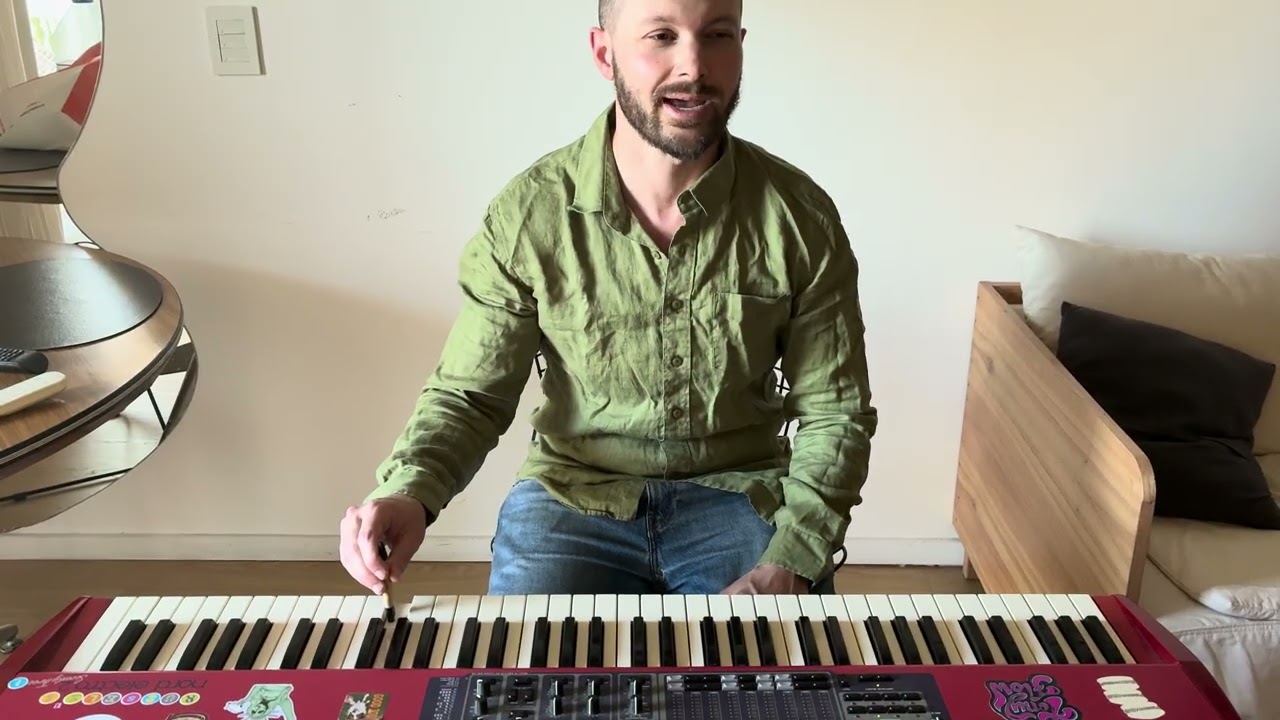
Russell teaches piano lessons online with Tunelark. View Russell’s profile
Does the reliance go down over time?
Scaffolding is meant to come down. A tool that is still holding a child up after three years has quietly stopped being support. The 2026 review found learners felt more confident using the tool but no more in control of their own playing, so that confidence may not outlast it. It found that in a body of studies dominated by university students. Whether it works the same way in a child is untested, which is a reason to watch for it rather than a reason to assume it.
Is it replacing something better?
Twenty minutes with an app is better than twenty minutes of nothing. Nobody has run the study that would rank it against twenty minutes with a person, so take what follows as our judgment rather than a finding: it is not a substitute for the person, and it should not crowd out the unstructured messing about on an instrument that is how a lot of musicians got started.
What technology genuinely helps with
Having been appropriately cautious, it is worth being fair about the upside, because there is one.
A 2026 review in Discover Education focused on instrumental music education identifies practice efficiency, personalized instruction and consistent assessment as real benefits, while listing constraints in expressive feedback, dataset bias and limited cultural sensitivity as the open problems, and concluding that hybrid human and machine models are the defensible ones.
For a child specifically, the honest benefits are these. Something is checking the mechanical layer on the days when nobody else is. Practice becomes a defined activity with a beginning and an end rather than a vague instruction to go and practice, which is often the actual reason children resist practicing. Progress becomes visible, and visible progress is motivating for a child who cannot yet hear their own improvement. And a well-designed music game can make the boring necessary parts, note reading and rhythm, considerably less boring.
Those are real. They are also all in the same category: the mechanical layer. None of them touch the part where a child decides that music is theirs.
Where a teacher fits
The thing a teacher does for a child that no system currently does is pay attention to them.
A teacher sees that they are bored with this piece and need a different one. That they are frustrated in a way that is about to become quitting. That the technically wrong thing they just did was actually more musical than the right version. That they have started playing to satisfy the metric, and gently redirects them. That they love this, and that nobody has told them so.
Tony G., who teaches guitar on Tunelark, describes a teenage student who arrived at a lesson needing help with a song he was about to play with a band. The scales Tony had planned could wait, and the lesson went to the song. Students who stay with him long enough nearly always return to whatever was set aside, he says, and return more motivated for having used their skills on something real.
For an adult, a practice app fills a gap between lessons. For a child, the human relationship is doing more of the work, because a large part of what determines whether a child keeps going is whether somebody they respect thinks they are worth the attention.
That is also why the age question and the when to start lessons question are connected. What a young child needs most is not better feedback. It is a person who is glad to see them each week.
A reasonable position for a parent
Putting all of it together, here is a defensible default.
Use technology for the mechanical layer, deliberately and with the scoring turned down where possible. Keep a person in the loop, weekly if you can. Check what happens to the recordings. Treat the questions above as a routine rather than a one-off audit, and ask them again as your child grows, because the answer that fits a six-year-old is not the answer that fits a twelve-year-old.
If you want the broader research picture, we covered whether AI can replace a music teacher and what happens in the days between lessons in their own articles.
Where we sit
Tunelark uses AI across our own daily operations and we are building it into what we make. Our practice games are technology rather than AI, using structured progression and mastery checks so a student has something concrete to do between lessons, and AI features may join them in time.
For children in particular, the reason a live teacher stays at the center of every lesson is not a philosophical position. It is that research on early childhood is absent and research on primary-age children is thin, so nobody can yet tell you what a machine that grades a young child every day does to how that child comes to see their own ability. Until somebody has actually studied it, a person who knows your child is the responsible default.
The bottom line
Nobody has researched what AI practice tools do to children in early childhood, and the evidence on primary-age children is thin. That is not a reason to keep every tool with a microphone in it away from your child. It is a reason to stay the person who decides what the tool is for, and to keep checking that the answer still fits the child in front of you rather than the one who started lessons two years ago.
Use them for the mechanical work. Keep the scoring quiet. Keep a person in the loop. And keep asking your child the question the app cannot ask them: did that sound good to you?
How to Find a Music Teacher on Tunelark
Tunelark connects you with deeply vetted music teachers who teach online across piano, guitar, voice, violin, drums and more. Vetting is run by working musicians and music teachers, not a general recruiter, and background checks are part of the process because many of our students are minors. Every teacher sets their own rate and shows it on their profile, and scheduling, billing and support are handled for you.
- Browse teachers for your child’s instrument at tunelark.com/find-a-teacher.
- Read their bios and watch their videos to see how they teach.
- Book a trial lesson with the one who seems right for your child. It is $25 off that teacher’s 30-minute rate.
- How your child is afterward is the thing no system can measure for you.
Frequently Asked Questions
Are AI music apps safe for children?
Nobody has studied young children properly. A 2026 systematic review of 21 studies reported that early childhood settings were absent from the research entirely, and the evidence on primary-age children is thin. On privacy specifically, these tools involve microphones and sometimes cameras and recordings of a child, so it is worth finding out where those recordings go, how long they are kept, and whether you can delete them.
At what age can a child use a music practice app?
There is no research-backed age threshold, which is itself the answer. One primary-school study in the 2026 review found children treating these tools as a scoring referee while older students directed them. Its authors call stage claims provisional, so it is a signal, not a settled fact.
Will a practice app replace my child’s music teacher?
No, and for children the case is stronger than for adults. Much of what keeps a child playing is a relationship with a person who notices them, which is not something these tools do. The reviews we cite favor hybrid models where technology handles the mechanical layer and a teacher does the rest.
My child only cares about their score. Is that a problem?
It is worth correcting, yes. A 2026 review identified goals bending toward whatever the system measures and learners reshaping their work to fit what the system rewards. The practical fix is to ask your child whether the piece sounded good before you ask about the score, consistently, until they answer the first question first.
Should I turn off the scoring features?
Turning them down is often worth trying, especially for younger children. There is a real difference between a tool that tells a child a note was flat and one that grades them out of a hundred, and children take grades more personally than adults do.
What should I watch for?
Three things, on different timescales. In any given week, playing that has turned correct and lifeless. Over a few months, a child whose sense of how it went comes from the screen rather than from their own ears. And over a year, whether they need the tool less than they did, because support that never reduces has stopped being support.
Keep reading
About Jennifer Heath
I'm Jennifer Heath, VP of Operations at Tunelark and a lifelong singer. I joined the company in 2020 and oversee much of what makes Tunelark work for students and teachers: hiring, training and supporting our instructors, student support, marketing and day-to-day operations. I started voice lessons at 7 and sang with touring choirs through my teens. Music belongs in every life, for the self-expression, the discipline, the comfort and the simple joy of it.