What Age Should My Child Start Music Lessons? An Honest Guide
What Age Should My Child Start Music Lessons? An Honest Guide
There’s no universal right age for a child to start music lessons. There’s a range (a wide one) and within it, the right starting age depends on the instrument, the individual child, and the kind of teacher you have access to. This guide walks through what’s actually realistic at each age and how to tell whether your specific child is ready.
The Honest Answer
The most common starting age for private music lessons is between six and eight. This isn’t because younger children can’t make music (many can) but because age six to eight is when most children develop the attention span, frustration tolerance, and motor control needed for traditional weekly lessons.
That said, starting earlier or later is fine. It just changes what kind of music education makes sense.
By Instrument
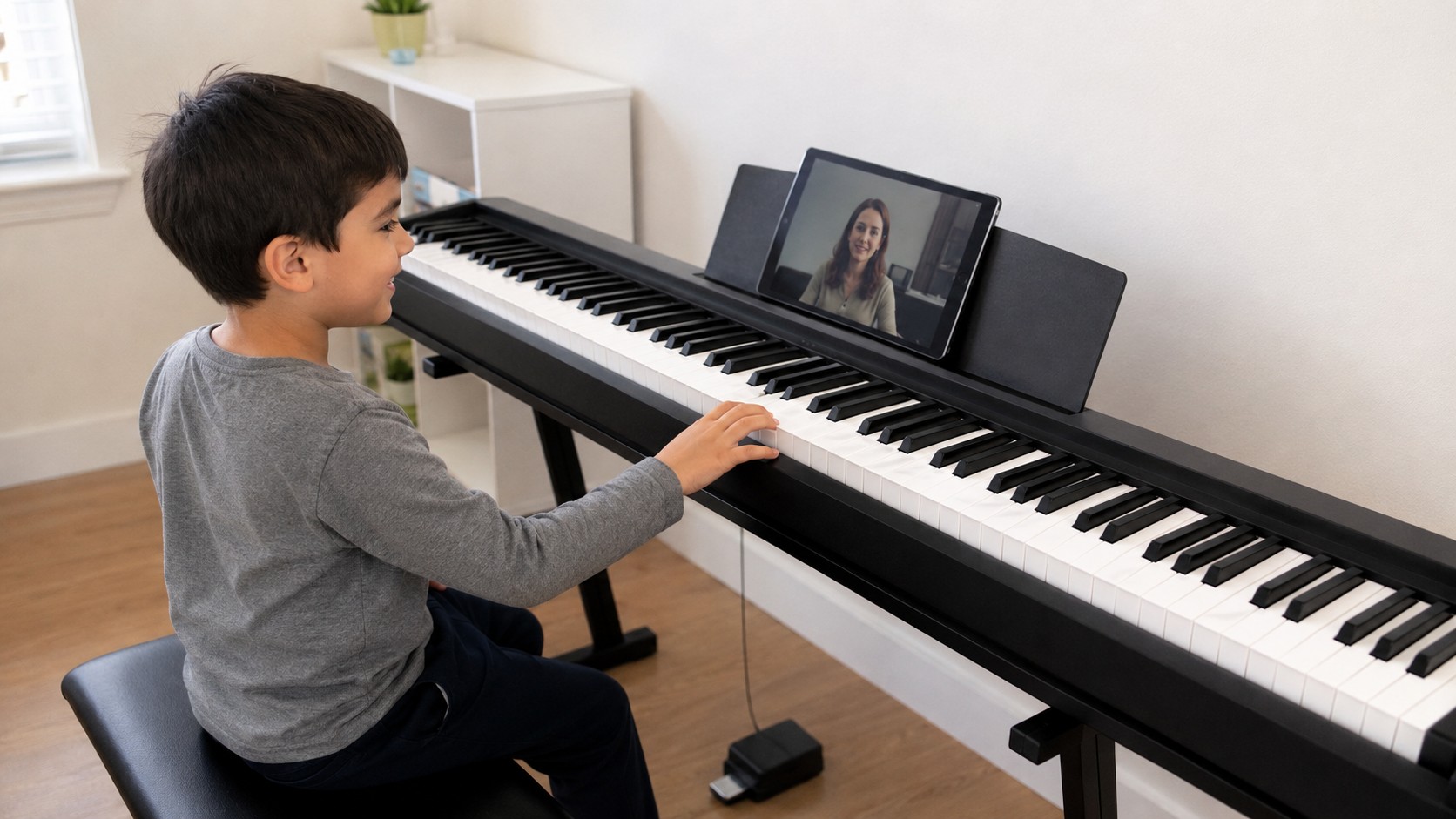
Piano: ages 5 to 7 is the most common start. Some particularly focused children can start at 4 with the right teacher. The piano is well-suited to early starts because the notes are pre-tuned (you just press a key, the right pitch comes out), and the layout is visually clear.
Violin: ages 4 to 6 with Suzuki method, ages 6 to 8 with traditional method. Violin is one of the few instruments where starting young is genuinely advantageous, because the physical adjustment to the instrument is easier when children are still highly malleable.
Guitar: ages 7 to 9 is most common. Younger children can start with smaller-bodied guitars, but the hand strength and finger reach needed for basic chords usually emerges around 7 or 8.
Voice: age 8 to 10 for most children, though informal singing instruction can start much earlier. Formal voice training usually waits until the voice has matured slightly past the early-childhood register.
Drums: ages 6 to 8 for most children. Drum kits scaled for kids are available, and the gross motor coordination that drumming requires often emerges in this age range.
Wind instruments (flute, clarinet, saxophone, trumpet): ages 8 to 10 for most students. These instruments require breath control, lung capacity, and adult-sized dental development that don’t fully come together until elementary school’s later years.
What Younger Than 5 Looks Like
For children younger than five, the right approach usually isn’t private lessons but music exposure. Group programs like Music Together, casual exploration on a household keyboard, singing together as a family, and listening to a wide variety of music. These build the foundation that makes later private lessons more successful.
A few exceptions: some prodigies do well on piano or violin starting at 3 or 4 with the right teacher. Suzuki violin specifically was designed to start very young. But these are not the norm and shouldn’t be the expectation for most families.
What Older Than 12 Looks Like
It’s never too late to start. Adolescents and adults who start music lessons later can make rapid progress, often faster than younger children, because they bring better attention spans, more developed motor skills, and (often) stronger personal motivation.
The trade-off is that older starters sometimes feel self-conscious about being beginners. A patient, experienced teacher who’s worked with older starters can dissolve that quickly.
For more on starting music as an adult, see our Online Guitar Lessons for Adults guide.
How to Tell If Your Specific Child Is Ready
Age is a rough guideline. Readiness is the real question. Look for:
- Sustained attention for 15 to 20 minutes on a focused task
- Independent interest in music (not just reflected interest from the family)
- Ability to follow multi-step instructions
- Tolerance for frustration when something doesn’t work
- A specific instrument they’re drawn to
For a deeper look at these signs, see our guide on whether your child is ready for music lessons.
What About Starting “Just to See”?
A common parent question: should we start lessons as a test, and stop if it doesn’t work?
Our honest take: yes, but commit to at least three months. Music lessons in the first month often feel slow. Kids are building habits, getting used to the teacher, and grappling with the fact that progress requires daily practice. Quitting after a month often means quitting before the first real wins.
Three months is a fair test window. If your child still isn’t engaged after three months of consistent practice and lessons, the teacher might be the wrong fit, the instrument might be wrong, or the timing might be off. Any of those can be adjusted.
How to Find a Teacher When You’re Ready
Every teacher on Tunelark is hand-vetted for credentials, teaching experience, and effectiveness with online lessons. Many specifically work with beginners and young children. To get started:
2. Filter for your child’s age range and instrument.
3. Book a discounted trial lesson with one whose profile resonates.
4. Pay attention to whether your child leaves the lesson smiling.
The trial lesson tells you more than any article can. Start there.
How to Find a Good Music Teacher on Tunelark
When it comes to finding the right teacher for your child, fit matters more than credentials. Many Tunelark teachers specialize in working with kids and know how to make lessons engaging without losing structure.
1. Browse our teachers and filter by your chosen instrument.
2. Read bios. Look for teachers who explicitly mention working with children in your child’s age range. Teaching a seven-year-old is a different skill from teaching a teenager.
3. Book a trial lesson with one whose profile resonates.
After the trial, ask yourself: did your child seem engaged and curious, or just polite? That’s the signal that matters most.
The right teacher does more than teach the instrument. They build the relationship that makes a child want to keep showing up.
Frequently Asked Questions
What’s the youngest age a child can start music lessons?
Children as young as 3-4 can begin with the right teacher and method (Suzuki, Kindermusik). These are very different from traditional lessons, playful, short, parent-involved. Traditional structured lessons usually wait until 5-6.
How do I know if my child is ready for music lessons?
Look for sustained attention on a task for 20+ minutes, interest in music or movement, and ability to follow simple multi-step instructions. These developmental readiness signs matter more than chronological age.
What if my child seems young for their age?
Trust the development, not the calendar. A 5-year-old who can’t sit still for 20 minutes isn’t ready. A 4-year-old who can is. Most teachers will assess readiness during a trial lesson.
Will starting music lessons too early cause my child to quit?
Yes, sometimes. Starting before a child is developmentally ready often creates frustration that taints music for years. Waiting 6-12 months is far better than pushing a struggling 4-year-old.
What instrument is easiest for a young child to start with?
Piano, ukulele, and singing are popular first instruments. Piano is visual, ukulele is physically manageable, and voice requires no purchase. The best ‘easy’ instrument is the one your child seems drawn to.
Keep reading
About Jennifer Heath
I'm Jennifer Heath, VP at Tunelark and a lifelong singer. I joined the company in 2020 and oversee much of what makes Tunelark work for our students and our teachers. That includes hiring, training, and supporting our instructors, customer and student support, marketing, and the day-to-day operations of the business.
I started voice lessons at age 7, sang with professional choirs that toured internationally through my teens, and performed solo at competitions and community events across Texas before stepping away in my twenties to study other interests, including business management. I haven't performed professionally in years, but I'll happily take the microphone at a karaoke night. Music has been in me every day of my life. Being able to spend the last six years working inside an online music education company, while traveling the world full-time, has been a perfect fit.
I believe deeply that music belongs in every life. For the self-expression, the discipline, the comfort, and the simple joy of it.
The Tunelark blog is where we share what we've learned about online music lessons: how to choose an instrument and a teacher, what to expect from your first lesson, how the major platforms compare, and how to keep music going through the busier seasons of life. Practical, honest writing you can act on.
Who we are
Tunelark provides virtual 1-on-1 music lessons to learners
of all ages.
We remove the barrier of geography and connect learners and teachers — wherever they are. Our growing community of vetted, experienced music educators have expertise in a wide variety of instruments, genres, and skill levels. We are passionate about connecting each student with the perfect instructor.