Your First Song on Piano: A 30-Day Path for Adult Beginners
If you’ve just put a piano or keyboard in your home and you want to play a real song within a month, you can. Not a virtuoso piece, not a complicated arrangement, but a real, recognizable song that sounds like music. The 30-day timeline is honest if you put in 15 to 20 minutes most days and follow a sensible plan. Here’s that plan.
This isn’t a magic shortcut. It’s the same path a good piano teacher would walk you down, written out so you can see the whole arc at once. Playing your first piano song 30 days from now becomes much more believable when you can see exactly what each week looks like. When you are ready for the second song, our easy piano songs for adults, sorted by skill picks the next one.
Why 30 Days Is a Realistic Target
Thirty days of consistent practice, which at 15 to 20 minutes most days comes to roughly six to ten hours of total time at the instrument, is enough to learn one specific piece at a basic level. That is what our piano teachers see, again and again, with adult beginners who follow a plan like this one. The catch is the word “specific.” You’re not learning to play piano in 30 days. You’re learning to play one song.
Adult beginners get frustrated when they expect generalized fluency from a small amount of practice. But targeted, focused work on a single goal (one song, learned slowly and deliberately) produces real results in real time. Spaced practice is one of the best-supported findings in learning research, and our piece on the science behind short daily practice walks through it: brief, frequent sessions build skill more efficiently than longer, less frequent ones.
For a realistic target song, pick something with a slow tempo, a clear melody, and a simple left-hand accompaniment. “Ode to Joy,” “Amazing Grace,” “Let It Be,” “Imagine,” or a basic arrangement of a hymn or pop ballad all work well. Avoid anything with fast passages, large jumps, or complex rhythms for this first attempt. Played in the key of C, the left hand for most of these is one of the six beginner piano chords. The opening of “Für Elise” is the one adult beginners ask about most, and it sits a tier above the rest of that list rather than on it. Its famous right-hand figure is a fast alternation between two notes and the hands trade the line back and forth, which is exactly the kind of writing to leave alone on a first song. The left hand alternates A minor with an E major chord, so there is a black key, G sharp, to find as well. Take it on as the stretch option if you have played a keyboard before. If this is your first month at an instrument, learn one of the others and come back to it in month two.
Week 1: The Foundation
The first week is about your hands, the keyboard, and the basic vocabulary. No actual song work yet. The temptation is to skip straight to the song, but the first week is what makes weeks two through four possible.
Daily targets for week one:
- Learn the layout of the keyboard. Find every C. Find every black-key pair. This takes about 20 minutes total over the week.
- Learn finger numbering. Thumb is 1, pinky is 5, in both hands. Practice playing the first five notes, C-D-E-F-G, slowly. The right hand climbs with fingers 1-2-3-4-5, thumb on middle C. The left hand plays the same five letter names one octave lower, with 5-4-3-2-1, pinky on the C below middle C and thumb on the G below middle C. The hands are not mirrored: the right thumb sits on C, the left thumb on G. The notes themselves move in parallel an octave apart, which is why the hands never land on the same keys. Do not read this as the mirror exercise where the left hand descends while the right hand climbs, which is a different pattern for a later month.
- Learn to read the names of notes on the treble staff at least up to G above middle C, and on the bass staff down to the C an octave below middle C, which is where your left hand is sitting this week.
- Practice the C major five-finger pattern, C-D-E-F-G, hands separately, slowly, with even pressure on each note. Five notes under five fingers is a pattern rather than a scale. A full scale needs the thumb to cross under, and that comes later.
By the end of week one, your hands have a basic shape and you can find your way around the middle of the keyboard. You haven’t played your song yet. That’s correct.
If week one is the part that sounds least like music, it is also the part that is quickest to learn from watching someone do it. Travis, who teaches piano on Tunelark, shows how to find any note on the keyboard by reading the pattern of black keys rather than counting up from C. Ten minutes with this is most of the first target on the list above.
Skill video · Finding Any Note on the Keyboard
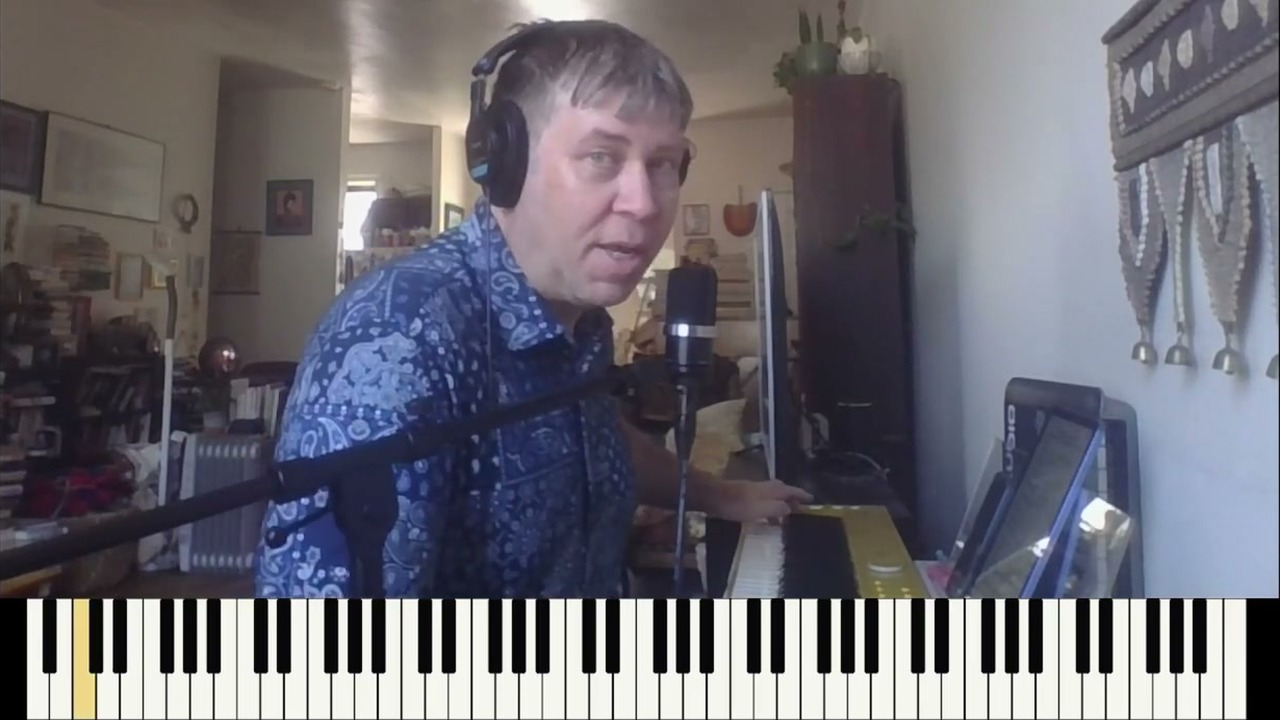
Travis teaches piano lessons online with Tunelark. View Travis’s profile
Week 2: Real Notes, Real Rhythms
Week two is when you start learning the actual notes of your chosen song, but only the right hand (melody). Don’t try to add the left hand yet. That’s a week three problem.
Find an easy piano arrangement of your chosen song in C, with a single-line melody and a simple left hand, or take the version in a beginner method book. Mark in finger numbers above the notes. This is normal for beginners and almost every method book does it. Identify the easiest first four-bar phrase. Practice it slowly, finger by finger, until you can play it without looking at your hand.
Then move on to the next phrase. Then the next. By the end of week two, you should be able to play the entire melody of your chosen song with your right hand, slowly, hands-separately. It may sound thin without accompaniment, but the melody is yours.
Tempo this week: half-speed or slower. Speed comes later. Accuracy now.
A common week-two mistake is rushing the melody to “make it sound like the song.” Resist that urge. The version of the song you play at the end of week four will sound like the song. The version you play this week is supposed to sound like practice.
Week 3: Putting Hands Together
Week three is where it gets interesting. You add the left hand, usually as a simple chord accompaniment or a slow bass line under the melody.
For most beginner arrangements, the left hand plays one chord per measure, or one note per beat. Take it slowly. Practice the left hand alone first, getting comfortable with its pattern. Then put the hands together at quarter speed, one measure at a time.
This is the week where it stops feeling like one hand and starts feeling like coordinated music. It also tends to be the week where adult beginners feel like their brain might short-circuit. That feeling is normal. You are asking two hands to do different jobs at the same time for the first time, and our piano teachers see it settle within a few days for most adult beginners.
The pattern that helps most: play the first measure hands together at quarter speed five times correctly. Then move to the second measure. Then play measures one and two together. Build the song in small chunks rather than trying to play it all at once. Our guide on practicing music at home has more detail on slow, chunked practice.
By the end of week three, you should be able to play the full song hands together at slow tempo, with stops and restarts allowed. The shape of the song is there.
Week 4: Polish and Play
Week four is about smoothing things out and gradually raising the tempo. The notes are learned. Now you work on flow.
Start each practice session by playing the song hands together at the same slow tempo you’ve been using. Then push the tempo up by a small amount (maybe a metronome click or two) and play through again. Then back to slow. Then push a little faster. Bit by bit, the song moves up to a tempo that sounds like music rather than like an exercise.
Pay attention to dynamics this week. Where does the song get a little louder? Where does it ease back? Adding even minimal expression transforms a beginner performance.
By the end of week four, you should be able to play the song from beginning to end at a steady tempo you can hold without stopping, with reasonable accuracy and some musical shape. That tempo may well be slower than the recording, and at this stage it should be. Not perfect. Just real.
Then play it for someone. The act of performing (even for one person, even in your kitchen) locks in what you’ve learned and gives you a marker to come back to.
How to Find a Piano Teacher on Tunelark
A teacher is what turns a 30-day project into a year-long path. Once you’ve played your first song, the next questions get harder, and a teacher makes those questions answerable.
1. Open the teacher list and filter by piano.
2. Read bios. Look for teachers who mention working with adult beginners or teaching by song-based methods if that resonates with you.
3. Book a trial lesson with one whose profile resonates. Your first lesson with a new teacher is $25 off their 30-minute rate.
4. After the trial, ask: did this teacher meet me where I am, or did they have a fixed curriculum they wanted to push?
Thirty days is a real start, not a finish line. The students who get the most out of piano are the ones who treat the first song as proof of concept and keep going. If you’re curious about the longer arc, our article on how long it takes to learn piano lays out the realistic timeline.
Frequently Asked Questions
Do I need a real piano, or will a keyboard work?
Any keyboard with at least 61 full-size keys works for this plan, weighted or not. You will want 88 weighted keys eventually, but not for your first song.
What if I miss a few days?
Don’t panic. Missing two or three days in a 30-day window is normal life. Just resume where you left off. Don’t try to “catch up” by doing double practice. Consistency, not intensity, builds the skill.
Should I learn to read music or just memorize the song?
Both. Use the sheet music while you learn so your reading skill develops alongside the song. Most beginners end up partly memorizing as they go, and that’s fine, but don’t skip the reading entirely.
What song do you recommend for absolute beginners?
“Ode to Joy” and “Amazing Grace” are the most reliable choices because both have simple melodies and forgiving rhythms. “Let It Be” works well if you want something more contemporary. Pick whichever you actually like: motivation matters.
Will I really be able to play a song after 30 days?
Yes, at a beginner level, if you practice 15-20 minutes most days and stick to the plan. You won’t play it like a concert pianist. You will play it like someone who’s learning piano and just achieved a real milestone, which is exactly what’s happening.
Looking for an online piano teacher? See our full Online Piano Lessons page for everything you need to know about getting started.
Keep reading
About Jennifer Heath
I'm Jennifer Heath, VP of Operations at Tunelark and a lifelong singer. I joined the company in 2020 and oversee much of what makes Tunelark work for students and teachers: hiring, training and supporting our instructors, student support, marketing and day-to-day operations. I started voice lessons at 7 and sang with touring choirs through my teens. Music belongs in every life, for the self-expression, the discipline, the comfort and the simple joy of it.