How to Overcome Stage Fright: Tips for Young Performers

Your heart is pounding, your hands are cold, and a song you have sung a hundred times has gone somewhere you cannot reach. That is stage fright, and almost every performer knows it, including the professionals. For a young performer it can feel like proof that they are not cut out for the stage. It is nothing of the kind, and a teacher can prepare them for it the same way a teacher prepares the notes.
Elspeth C. teaches voice, piano and drums at Tunelark and has spent years getting young singers ready to perform. She has run school choirs, taught after school in a district where the arts classes had been cut, and coached students who have gone on to sing at Radio City Music Hall, Hersheypark and Universal Studios and to land lead roles in their school musicals. We asked her how she prepares a young performer for the nerves as well as the notes, what she says about the feeling itself, and how she talks to a student once the performance is over.
Why the fear is usually bigger than the mistake
Stage fright is the body’s stress response switched on by a situation it reads as high stakes. Adrenaline rises, the heart speeds up, muscles tighten and attention narrows. The response is built to help, and for a musician it arrives as exactly the wrong kind of help, because singing and playing both need loose muscles and a clear head. Our article on what performance anxiety does to the nervous system goes through the physiology in more depth.
What Elspeth adds is where the fear usually points. It is rarely at the performance itself. “I also think a lot of nerves can come from the idea of something going wrong,” she says, “which can be so much worse than the reality of it.”
That changes what preparation is for. A young performer who has only ever run the song cleanly has no idea what a mistake on stage would feel like, so the imagined version fills the gap, and the imagined version is usually worse. The work in the weeks before a concert is partly the notes and partly shrinking that imagined disaster down to its real size.
Prepare so that a mistake stays small
The first half of that is practice, and Elspeth is specific about what the practice is meant to achieve. It is not perfection.
“A big part of preparation for these big performances is doing enough practice that, even if things get shaky onstage, my students are still able to recover enough to do a great job overall,” she says.
She tells her students that directly, and she tells them the other half too. Part of her process, she says, is “normalising that mistakes will happen no matter what, but the more prepared they are, the smaller and easier to recover from the mistakes will be!”
Those two ideas work together. A student who expects a flawless performance treats the first wobble as a catastrophe. A student who expects a wobble or two, and knows they have practiced enough to get through it, treats the same wobble as ordinary. The mistake is the same size in both cases. The reaction to it is not.
Preparing to recover looks a little different from preparing to be perfect. Run the song from start to finish without stopping to fix anything, because stopping is the one thing a performer cannot do on stage. Pick a few places in the piece to restart from, so that losing your place has a plan attached to it. And sing it for someone, even one person at home, before the day. Our guide to practicing music at home covers how to structure those run-throughs, and the recital preparation guide covers the final week.
Rehearse the thing going wrong
The second half is the part young performers rarely get: practicing the disaster on purpose.
Elspeth does this with a game. In her choir classes it was a favorite in the run-up to a concert, and she calls it “The Distraction Game”. The rules are simple: “half the class had to try to sing their repertoire as normal, and the other half could do anything they wanted (with safety limitations and personal boundaries set in place) to try to make them laugh or otherwise distract them from singing.”
It turns the worst case into a joke everyone is in on, and it has a teaching payoff too. As a bonus, she says, “this could also be used to see how well students know their harmonies without certain people from their part to sing along with!”
The game does not need a choir. “There are versions of this game that work great with individual students as well,” she says, “where you can manipulate various obstacles to help them find a way to recover (turn down the backing track, turn off their keyboard/turn the volume down, make crying baby sounds, etc etc).”
Every item on that list really does happen at school concerts and talent shows. Backing tracks cut out. Keyboards get switched off by accident. Somebody’s baby cries in the third row. A student who has already had each of those happen in a lesson, and has already found a way to keep going, walks on with one less thing to fear. The same idea works at home: during the last few run-throughs, a parent can turn the track down halfway through a verse and see what happens. The same skill carries all the way into professional work, as our guide to becoming a cruise ship singer explains.
The humor matters because of where it leaves the student’s attention. Handled this way, Elspeth says, rehearsing the obstacles helps “shift the students’ focus to doing their best with everything that is in their control.”
Say out loud that it is scary
Most of us were given one piece of advice about stage fright as children, and Elspeth was too. She remembers it as something along the lines of “don’t be scared, just relax and have fun!”, which, she says, “while true, is not particularly helpful advice when the fear becomes insurmountable!”
She takes the opposite approach, because she believes “facing these fears head-on is so much more effective than trying to brush them off”. In the lessons before a big performance, she and her students talk about stage fright directly, as a subject in its own right.
“In my experience, it’s so much better to acknowledge that, yes, performing can be scary!” she says. “Singing in front of a big crowd of people is a big deal, and it’s natural to be nervous, especially when you haven’t done something on that scale before!”
Being told not to be scared asks a child to switch off a feeling they cannot switch off, and then leaves them feeling they have failed at that as well. Being told the fear is reasonable does something different. In Elspeth’s experience, validating the feeling helps students understand “that nerves are a natural part of performing, but also that they are in control and they are being brave by doing something scary like this.”
A nervous child who walks on anyway has not failed to be calm. They have done the harder thing.
Box breathing for the last few minutes
Talking about the fear is work for the weeks before. For the last few minutes before walking on, Elspeth gives her students something to do with their bodies.
“I’ve said elsewhere that breathing is the foundation of good singing, but I also find that it’s really helpful for calming nerves before a performance,” she says. In the lead-up to a performance she teaches a few techniques that slow the breath, and her favorite is box breathing: “breathe in for four counts, hold for four counts, breathe out for four counts, hold for four counts, and repeat.”
“This is something students can then use in the minutes before going onstage to help them get control of their breath,” she says.
Box breathing suits a young performer for practical reasons. It is easy to remember, it can be done silently in the wings or in a line of choir members without anyone noticing, and counting to four gives an anxious mind a small, definite job at the moment it most wants to race. Anxious breathing tends to be quick and high in the chest, and a slow, even count pulls it back down. Practice it in lessons well before the day, so that in the wings it is a familiar routine rather than a new instruction. Singers who already work on breath support tend to find it comes naturally, since slow, low breathing is already part of their technique.
The more you perform, the easier it gets
The last thing Elspeth tells her students about stage fright is the one she says to performers of every age: “the more you perform, the easier it gets and the less nervous you’ll end up feeling each time.”
She does not pretend there is a shortcut. There is no cure for stage fright or performance anxiety, in her view, “besides doing it so much that it becomes second-nature, and the love of the music becomes so much stronger than the nerves.”
That means the first performance is usually the hardest one a young performer will give. Each one after that has a little less novelty in it. Small, low-stakes chances to perform all count toward the total: singing for family, a class sharing day, a recorded run-through sent to a grandparent. Our guide to recording your singing practice is a gentle way to start, because a phone on a stand is a small audience that never frowns.
After the performance: praise first
How a performance ends matters as much as how it begins, because it decides whether a young performer wants to do it again. Elspeth has what she calls a “secret rule” for this. It is that “while I hold my students to a very high standard in the lead-up to a performance, once they step off that stage, I will only tell them how great they did and how proud they should feel of themselves.”
The reasoning is practical. Her students, she says, “will already be fully aware of anything that went wrong, and I don’t believe it’s helpful to tell them off for making a mistake.” Pointing out a slip they already know about only teaches them that stepping off the stage is where the trouble starts.
It is also a matter of fairness. “It would also be hypocritical of me to do this, because as a musician, I have made mistakes onstage many times, and so has every professional musician working today,” she says, and that is often what she tells a student who is being too hard on themselves.
For parents, the rule translates directly. The car ride home is not the place for the note that went wrong.
Three things, three things and three things
Praise first does not mean the performance goes unexamined. It means the examining belongs to the student, and it happens later, in its own conversation. Elspeth likes to talk a performance through with her students in a way that has them judge it for themselves, and she gives them a structure for it: “asking them to find three things they did really well, three things they want to do differently next time, and three things that are fun about performing in general.”
Only one of the three questions is about what to change, and the last one is not about the performance at all. It is about why performing is worth doing.
When the performance was a group one, she adds another question. “I also encourage them to pick someone else who they thought did a really good job, as I believe community-building and lifting other people up is essential in any musical community,” she says. It also teaches, because “there’s a lot that students can learn from seeing someone else give a great performance.”
The aim of all of it is that her students come away feeling performing is more fun than it is scary, and that even when it did not go the way they wanted, “they always have a chance to get even better the more they do it!”
About Elspeth
Elspeth is a British-born singer, multi-instrumentalist and composer who specializes in musical theater. She holds a BA in music from the University of Cambridge and an MFA in musical theater writing from NYU Tisch, and her work as a performer and composer has been featured at 54 Below, The Green Room 42, SoHo Playhouse and the Edinburgh Fringe Festival. She has worked on every side of a show: onstage, backstage, in the pit as a drummer, and as the composer and orchestrator. She was also interviewed for our guide to how to sing musical theater.
Her teaching began in an after-school program in a public school district where the arts classes had been cut, and has since taken her from a boarding school in the mountains near Lake Tahoe to schools in Brooklyn. At Tunelark she teaches voice, piano and drums to beginners through advanced students, from preschool to adult, with an approach built on empathy, curiosity and the belief that high expectations and fun belong together. Here she is in performance, on drums.
Performance · Come Together
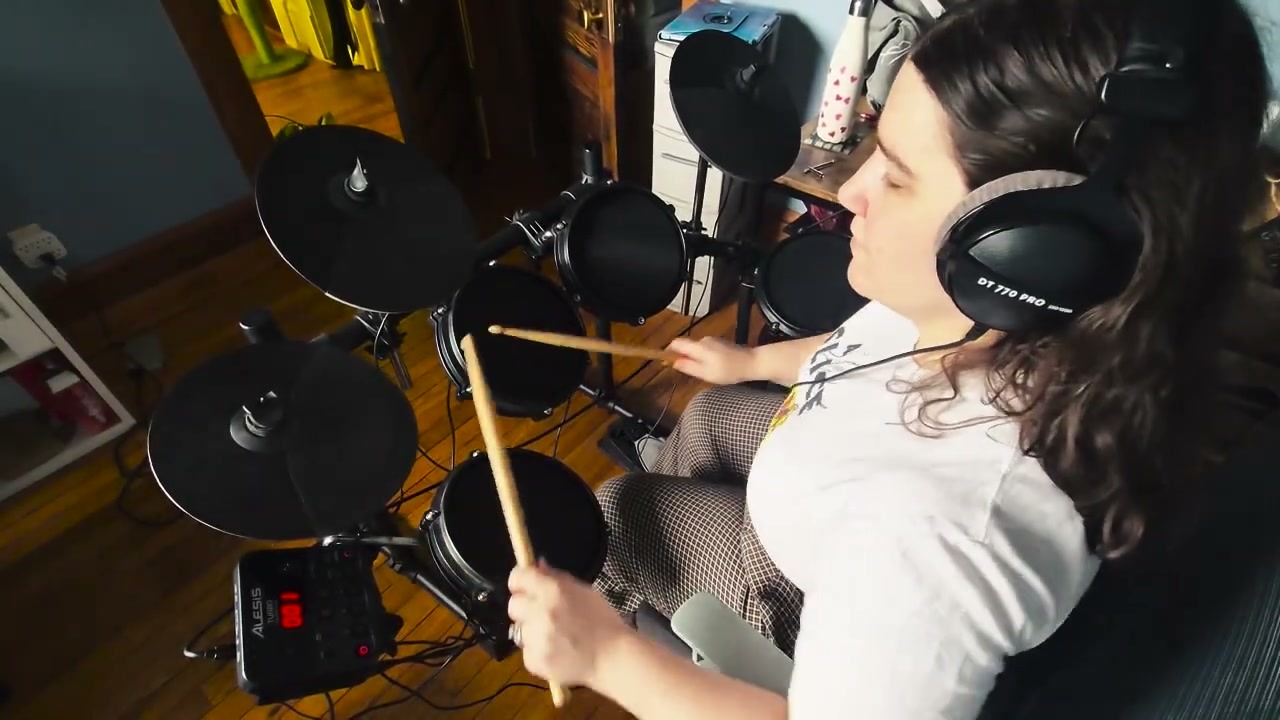
Elspeth teaches voice, piano and drums on Tunelark. View Elspeth’s profile
Ready to get your young performer on stage?
Stage fright does not go away because someone says it should. It gets smaller with preparation, honest talk about the feeling, a breathing routine practiced before the day, and a run of performances that each end well. A teacher who has walked young singers through all of that can build it into lessons from the start.
Elspeth is accepting new voice, piano and drum students at Tunelark, and a song your child is preparing for a school concert, musical or recital is a good thing to bring to a first lesson. You can also find a teacher for any instrument across the rest of the roster.
Frequently Asked Questions
Is stage fright normal for kids?
Very. Nerves before a performance are common at every age and usually ease with experience. A child who is nervous before a concert is showing that the concert matters to them, which is not a problem to be fixed.
Should my child push through stage fright or skip the performance?
For ordinary nerves, go ahead and lower the stakes rather than the commitment: a shorter piece, a song they already know well, a smaller room if there is a choice. Panic symptoms, weeks of dread or distress that does not ease are different, and are worth raising with their teacher and, if it persists, a doctor or counselor.
What if my child freezes on stage?
Most audiences at school and studio performances are on the performer’s side. It helps to agree on a plan in advance: restart from a rehearsed point in the song, keep going with the accompaniment, or take a breath and begin the line again. A plan practiced at home is much easier to reach for under pressure.
How long before a performance should we start preparing for nerves?
A few weeks is enough for most school performances. That leaves time to run the piece start to finish several times, practice recovering from interruptions, and make a breathing routine familiar, so that nothing on the day is being tried for the first time.
Does stage fright get better with experience?
For most young performers, yes. The first few performances are usually the hardest, and each one after that is a little more familiar. A single rough performance is not a measure of anything; what changes a child’s relationship with the stage is a run of performances that each end with them feeling proud.
Keep reading
About Jennifer Heath
I'm Jennifer Heath, VP of Operations at Tunelark and a lifelong singer. I joined the company in 2020 and oversee much of what makes Tunelark work for students and teachers: hiring, training and supporting our instructors, student support, marketing and day-to-day operations. I started voice lessons at 7 and sang with touring choirs through my teens. Music belongs in every life, for the self-expression, the discipline, the comfort and the simple joy of it.