How to Sing Musical Theater: Telling the Story in the Song

A musical theater song asks a singer to do two jobs at once. The notes have to be right, and the song has to tell a story, sung by a particular character at a particular moment in their life. A singer can manage the first job perfectly and still leave an audience cold, because in this genre the voice is also how the character acts.
Elspeth C. teaches voice at Tunelark and knows the genre from every side. She holds an MFA in musical theater writing from NYU Tisch, writes musicals as a composer and lyricist, and has sung onstage, played drums in the pit and orchestrated shows. Her students range from beginners to young performers who have landed lead roles in their school musicals. We asked her how she teaches a student to tell the story of a song, and how she helps a singer find their way around a genre whose scores run from classical to pop and rock.
Her starting point is one sentence, and everything else in this article follows from it: “the musical choices and the storytelling should always be one and the same.”
Start with what the song is about
Before any technique, Elspeth asks a question most singers skip. With a student who is new to the genre, a good starting point, she says, is “to ask them to tell me in their own words what they think the song is about, and what’s happening in the song.”
It sounds almost too simple, but it changes how a song is practiced. A singer who has only learned the melody treats every phrase as the same kind of task: hit the note, hold the note, move on. A singer who can say what is happening in the song, that the character is working up the nerve to say something or realizing they have been wrong, has a reason for every phrase to sound different from the one before.
Elspeth also finds these conversations run both ways, because “a lot of the time, a student will have a slightly different interpretation than I’ve always had, or a new insight or way of phrasing their opinion, so it can be a chance for me to learn a whole new take on a familiar song.” A student’s reading of a song is not a test with one right answer. It is the beginning of their version of it.
The same approach works outside the genre. She uses it with a pop song too when the student has a theater interest, because the question of what the song is about applies to any song that tells a story. If you are learning a new piece, our guide to learning a song as a singer covers the practical steps, and this is the question to add at the start.
Who is singing, and what the music says about them
The next question is about the character. “Alongside what’s happening during the song itself, an important element is who is singing the song, and what the music tells us about the character,” Elspeth says.
This is where vocal technique turns into acting. The same line can be sung many ways, and each way says something different about who is singing it. One of Elspeth’s favorite moments in a lesson is when a student finds “a really good take on how their vocal choices shape the character, for example what impact it has to approach a section in a lighter, mixer sound vs a full belt.”
Those two sounds are worth defining, because they are the main colors in a musical theater singer’s palette. Mix, or mixed voice, is a coordination that blends the qualities of chest voice and head voice across the break between them, keeping some of chest’s firmness while the sound stays lighter and easier. Belting carries the power of chest voice higher into the range by mixing, and it is the big, bright sound people often picture when they think of a Broadway number. Our guides to how the registers work and to what belting actually is cover both in detail. Neither sound is more correct. A lighter mix can make a character sound tentative, tender or private. A full belt can make the same character sound certain, defiant or overwhelmed. The singer’s job is to choose the one that fits the moment.
Change something every time the chorus comes back
Musical theater songs repeat themselves, and that is where many singers go flat, dramatically if not in pitch. The second chorus is sung exactly like the first, and the song stops moving.
“It’s also important to think about what to do with repetitions, and how changing the musical choices on each repetition can help show the character’s journey through the song,” Elspeth says. Using the mix and belt example, she describes one way it could go: “perhaps in the first chorus, the highest notes could be softer and closer to head voice, then in the second chorus onwards they could be more belted to show growing confidence.”
The words on the page may be identical from one chorus to the next. The character singing them is not, because something has happened in between. Showing that change is what turns a repeated section from filler into the point where the audience feels the character grow. A practical way to work on it is to mark each repetition in your score with a word for where the character is emotionally at that point, and let that word decide the vocal choice.
Technique that serves the drama
None of this means technique matters less in musical theater. Elspeth holds both sides at once: “while it’s wonderful to have great technique and be able to do absolutely anything musically, it’s only a meaningful performance if that technique is used to underpin the dramatic purpose of the song.”
Technique is what gives a singer the options. A singer who can only belt has one color for every moment. A singer who can move between a soft head voice, a light mix and a full belt can make a real choice, and making choices is what acting through song is.
It is also what hands the song to the student, because “if they can understand the story and the character behind the song, they can be empowered to make their own decisions about their musical choices, and really create a version of the song that’s entirely their own.” That, for her, is the best part of teaching this way.
Build a voice that can go anywhere
Musical theater covers an unusual amount of vocal ground. Older shows are often written for a legit sound, the classically rooted, head-voice-led singing of traditional musical theater. Contemporary scores draw on pop, rock and belt. Some shows ask for both in a single role. Our guide to how to sing different styles covers moving between them.
“The key here is creating a strong technical foundation with a lot of versatility,” Elspeth says.
That foundation starts in the warm-up, which is why the warm-up can take up a good part of her lessons. “I’ll always start with something breath-focused and some diaphragm exercises, because this is something we need to connect with for any musical style, and from there, I’ll try to keep a nice balance between different parts of the voice, different timbres, and different skillsets,” she says. Breath is the one thing every style shares, so it comes first, and the exercises after it cover the whole voice rather than only the part a student’s favorite songs use. Our guide to breath support for singers explains what that breathing work is doing physically.
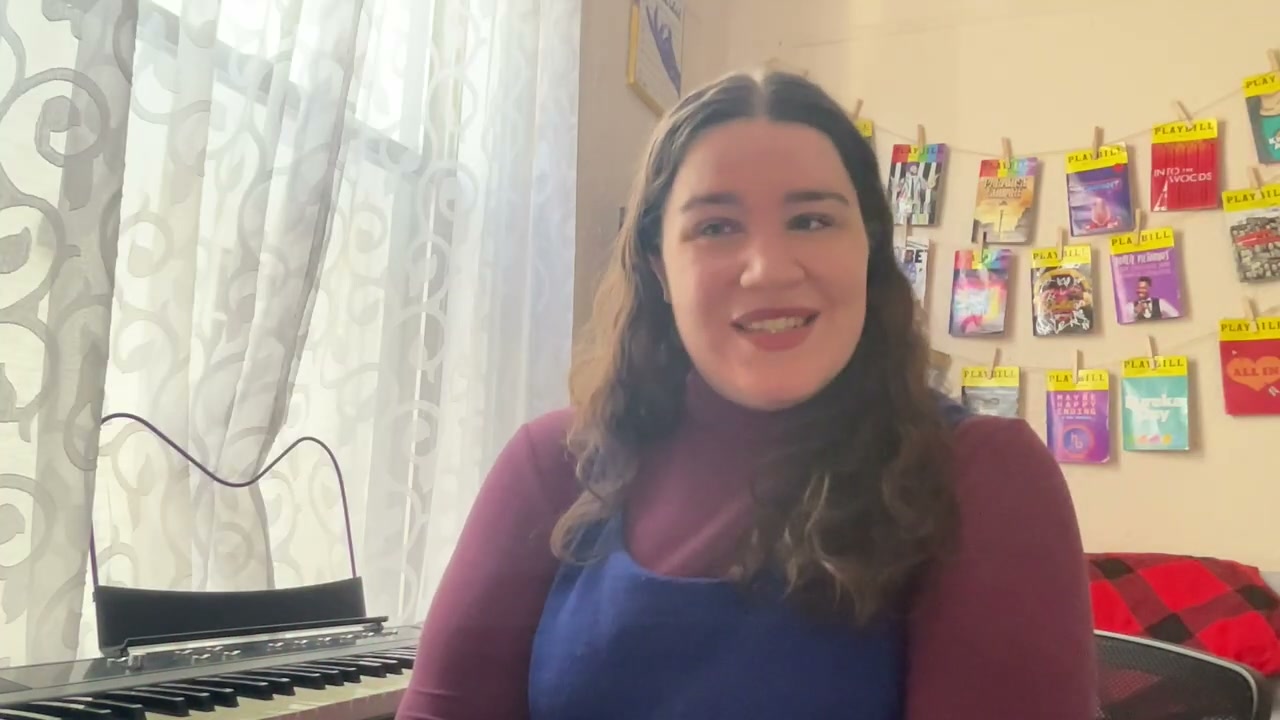
For a beginner this is also the answer to where to start. Not with the hardest song in the show, and not with one style, but with breath, a balanced warm-up, and a clear sense of your own range. Elspeth demonstrates how to find yours below, and knowing where your voice sits makes choosing repertoire much easier.
Skill video · Find Your Vocal Range
Elspeth teaches voice, piano and drums on Tunelark. View Elspeth’s profile
Why head voice matters even if you only want to belt
The part of the foundation singers most often want to skip is head voice, especially singers drawn to belting. Elspeth encourages her students to keep an open mind here, because “things that might not seem directly relevant to the type of music they’re interested in singing might still end up being helpful.”
“The clearest example of this is the importance of building a strong head voice, whether or not a student is interested in singing in a more legit style,” she says, and the reason is structural: “you can’t develop a strong mix without a strong head voice, and a strong mix is great to have in conjunction with and as an alternative to your belt.”
A belter who neglects head voice ends up with a mix that has nothing light to blend with, and a belt with no alternative beside it. There is also a longer-term reason. “Plus, it means that if you later change your mind and want to try a song that requires some head voice work, you’ve already done a lot of the work for that process!” If you want to go deeper into what a classical foundation gives singers in other genres, our article on the benefits of classical vocal training covers it.
Feel it, then name it
The other half of versatility is awareness. Elspeth spends a lot of time “teaching students to self-analyze, connect the physical feeling to the sound they are creating, and be able to produce different sound qualities by making small adjustments.”
Early on, that looks like questions. She gives three examples of what she asks: “where did you feel that sound coming out?”, “When you hit that last note and it was so much stronger, could you feel what you changed to make that happen?” and “What happens if you try to make that same note with a different mouth shape?”
The questions do something a demonstration cannot. A singer who only copies their teacher’s sound can reproduce it in the lesson and lose it by the next day. A singer who has noticed what it feels like when the sound works can find it again alone, which is what practice between lessons depends on.
The Nyeh: carrying an exercise back into the song
Elspeth also connects each warm-up exercise to specific parts of a student’s songs, so that the exercise does not stay in the warm-up. Her example is one of her favorite exercises for belting, the Nyeh sound, which “helps you create a really strong resonant placement that’s locked directly into the mask.” The mask is the front of the face, around the nose and cheekbones, where a well-placed sound tends to buzz. She learned the exercise from her own singing teacher more than ten years ago and still uses it on her own voice.
The step that makes it useful comes after the warm-up. When a student is struggling to keep a passage in their belt, she has them sing the notes on a Nyeh “to build that resonance, and then to try to keep that placement when putting the words back in.” The exercise supplies the feeling, and the words go back on top of it.
Repeated enough, it becomes the student’s own tool: “after enough times applying this exercise, my hope is always that students will remember it whenever it’s applicable in the future.” Belting builds best on a voice that is already warmed up and coordinated, so if you want to try it, our guide to essential vocal warm-up exercises is the place to begin.
Listen to three singers, then find your own
The last habit Elspeth gives her musical theater students is about listening. “Something I always tell my students when they begin work on a new musical theatre song is to find three versions of it by three different singers, and see what each singer does to make the song their own,” she says.
A student who learns a song from one recording tends to learn that singer’s performance along with the melody. Elspeth’s exercise “encourages a student not to get too attached to one version of a song and end up doing an impression of that singer.” Hearing three singers make three different sets of choices shows that the choices are choices, and that the song leaves room for more than one reading.
Students can borrow, too. The exercise lets them “pull ideas from multiple versions (they might choose to copy a riff or an opt-up that they think works particularly well) and feel empowered to find their own ideas.” A riff is a short run of quick notes decorating a melody, and an opt-up is an optional higher note a singer takes in place of the written one, usually near the end of a song. Taking one from a recording you love is part of how singers learn. Taking everything from one recording is how they end up with an impression instead of a performance.
About Elspeth
Elspeth grew up in a musical family in Britain; her parents met doing musicals together. She took piano from the age of five and added flute, drums and voice, and it was writing her own songs as a teenager that settled music as her life. Musical theater brought everything together for her. She holds a BA in music from the University of Cambridge and an MFA in musical theater writing from NYU Tisch, and she has played the pit for musicals and cabarets in Cambridge, Edinburgh and New York, including the original Edinburgh Fringe run of Six. She music-directed and played for her own Off-Broadway musical, Collisions, and her work as a performer and composer has been featured at 54 Below and The Green Room 42.
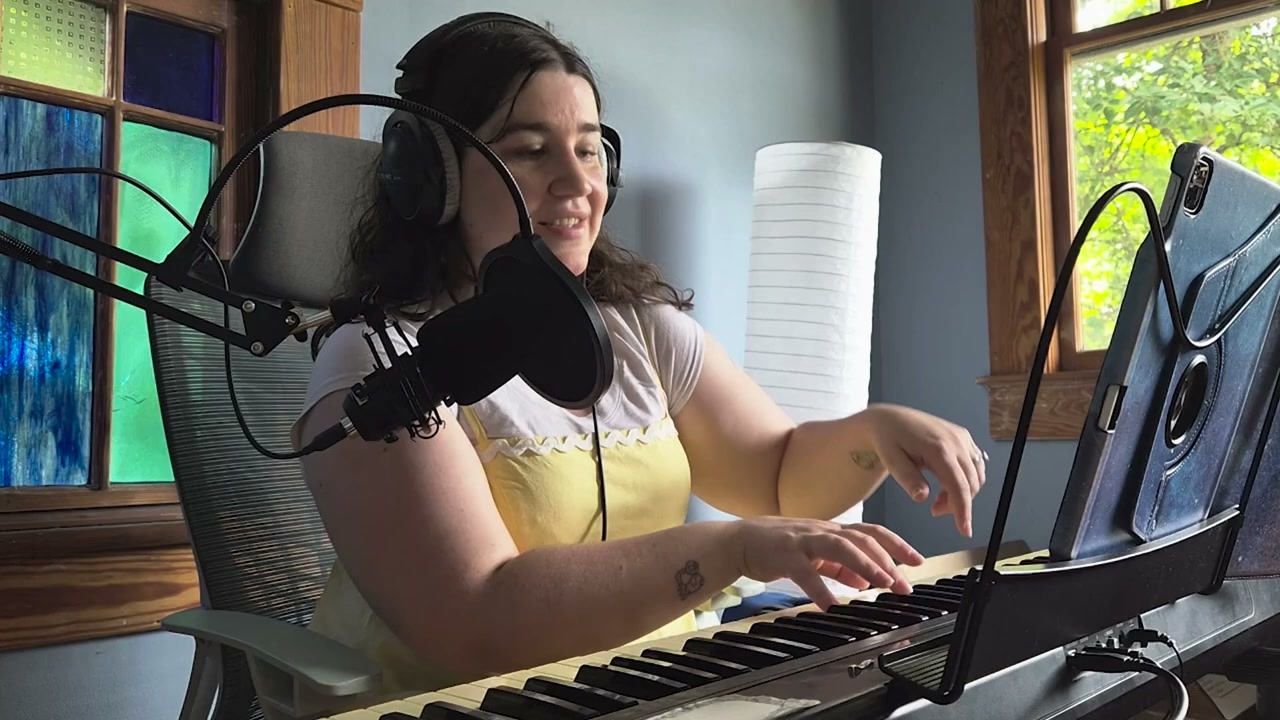
At Tunelark she teaches voice, as well as piano and drums, to beginners through advanced students of every age. In a first lesson she likes to hear a student sing something they already know and love, and when they go on to regular lessons that song often becomes the first piece they work on together. Here she is in performance, singing “Vienna” at the keyboard.
Performance · Vienna
Elspeth teaches voice, piano and drums on Tunelark. View Elspeth’s profile
Ready to start singing musical theater?
Singing musical theater well is not a matter of a bigger voice. It is knowing what the song is about, choosing sounds that tell that story, and having the technique to make those choices on purpose. All of that can be learned, and a teacher who writes musicals as well as sings them hears a song the way it was built to be heard.
Elspeth is accepting new voice students at Tunelark, and a song from a musical you love is a good thing to bring to a first lesson, even if you have only ever sung it along with the cast recording. You can also find a teacher for any instrument across the rest of the roster.
Frequently Asked Questions
Do I need a big voice to sing musical theater?
No. Musical theater uses many kinds of voices, from light and lyrical to powerful and brassy, and a role is often cast for the character as much as for the size of the sound. What every style asks for is control, clear words and a sense of the story.
What is the difference between legit and belt in musical theater?
Legit is the classically rooted sound of traditional musical theater, led by head voice with a round, open tone. Belt carries chest-voice power higher into the range through mixing. Many modern shows ask for both, which is why a versatile foundation matters.
Can an adult beginner learn to sing musical theater?
Yes. Adults start with the same foundation as anyone else: breath, a balanced warm-up, a clear sense of their range and a first song they genuinely love. Adults often bring a head start on the acting side, because they have lived through more of what the songs are about.
How do I choose a first musical theater song?
Pick a song that sits comfortably in your current range, that you understand and care about, and whose character you could describe in a sentence. A song that is emotionally clear but vocally modest teaches more than a showstopper you can barely reach.
Is belting bad for your voice?
Belting done with good coordination is not harmful. Pushing sound out with neck and throat tension is what causes trouble, which is why belting is built gradually on breath support, head voice and mix rather than attempted first.
Looking for an online voice teacher? See our full Online Voice Lessons page for everything you need to know about getting started.
Keep reading
About Jennifer Heath
I'm Jennifer Heath, VP of Operations at Tunelark and a lifelong singer. I joined the company in 2020 and oversee much of what makes Tunelark work for students and teachers: hiring, training and supporting our instructors, student support, marketing and day-to-day operations. I started voice lessons at 7 and sang with touring choirs through my teens. Music belongs in every life, for the self-expression, the discipline, the comfort and the simple joy of it.