How Adults Use Music Lessons to Decompress and De-Stress
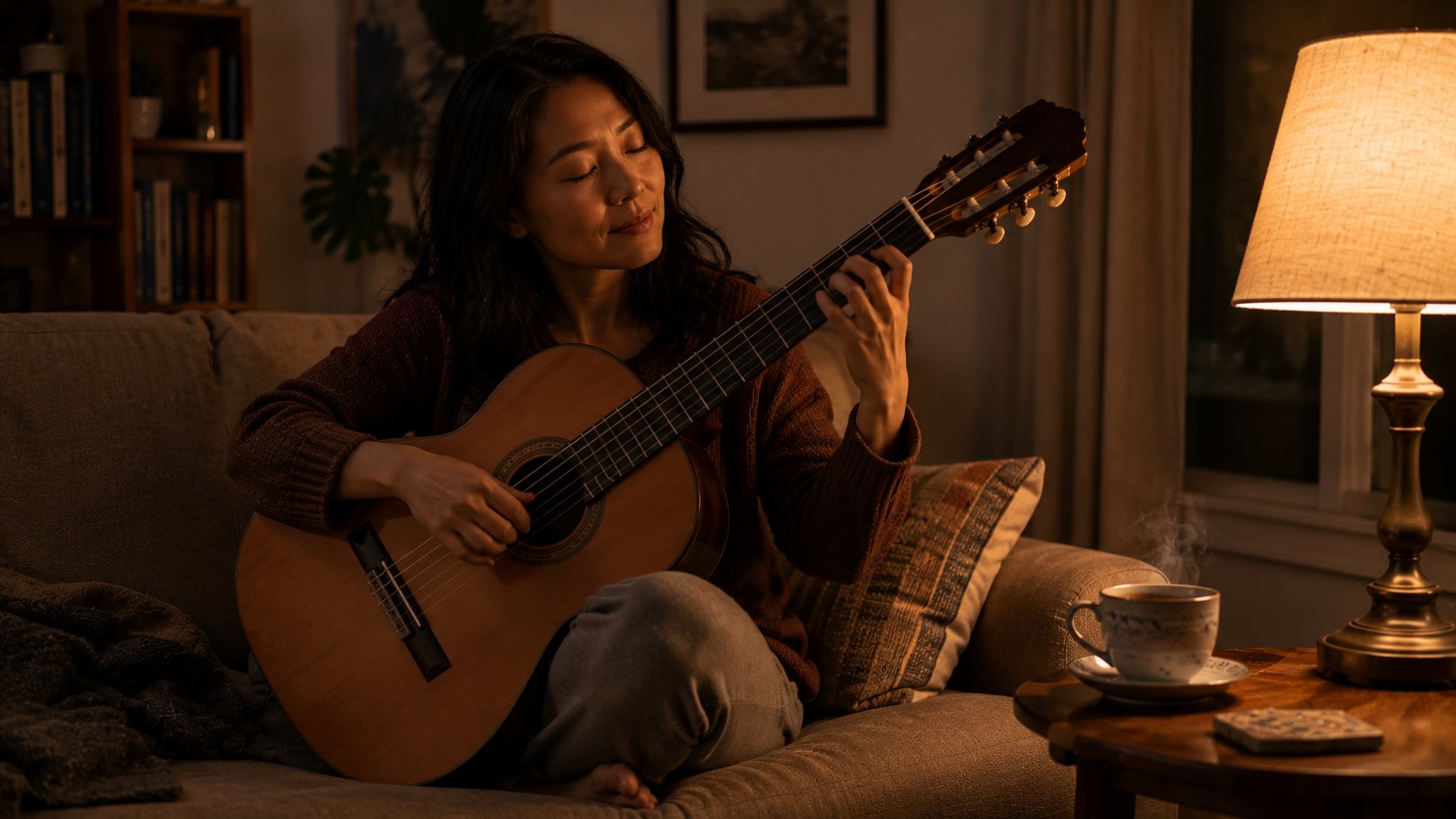
Many adults pick up an instrument hoping it’ll help them manage stress. Some succeed dramatically and describe their daily practice as the most reliably calming part of their lives. Others give up after a few months because practice felt like one more obligation, not a release. The difference is mostly structure, not personality.
Here’s what the research says about music and stress relief, and how to actually set up music lessons to function as decompression rather than as another item on your to-do list.
The Science of Music and Stress
A few findings worth knowing, with what each one actually rests on:
Music-making has produced measurable cortisol reductions. Cortisol is the body’s primary stress hormone, and the clearest evidence comes from group drumming and from choir singing, which are the easiest settings to run a controlled study in. It is tempting to rank playing above listening, and the research does not support that ranking: the one experiment that compared them found its cortisol drop in the listening condition rather than in the singing one. Guitar has barely been studied on its own, and the sessions that produced measurable drops mostly ran thirty to sixty minutes, so a shorter practice is a reasonable bet rather than a measured result.
It may engage the parasympathetic nervous system. Music practice involves rhythmic breathing, fine motor focus and sustained attention, and slow breathing on its own shifts the body out of fight-or-flight and into rest-and-digest mode. The parasympathetic step is a proposed mechanism here rather than something the music studies measured.
It produces flow states. Music practice has the features flow research associates with total absorption in a task, a clear goal, immediate feedback and a challenge matched to skill, which is why it comes up so often in that literature. Flow is associated with lower reported anxiety and better mood, and most of that research measures the experience while it is happening rather than tracking how long the lift lasts once you put the instrument down.
It builds a sense of agency. Visible progress in something you are working on runs counter to the feeling of having no control over what is happening to you. That link comes from the wider literature on stress and control rather than from anything the music studies measured.
The combined effect: across a 2020 review of 104 randomized trials, music interventions produced small to medium reductions in physiological stress markers and a somewhat larger drop in how stressed people said they felt. That review did not compare music with meditation or exercise, so the honest claim is that music works, not that it works better than the alternatives.
Why It Doesn’t Always Work
Despite this evidence, many adults who pick up an instrument for stress relief find it stressful. The common causes:
Treating practice like a job. If you’re tracking minutes, hitting metrics, comparing yourself to others, practice becomes another performance arena. The stress-relief benefit evaporates.
Choosing the wrong piece to learn. A piece that’s too hard creates frustration. A piece you don’t love creates boredom. Neither produces flow.
Practicing at high-stress times. Squeezing in 20 minutes between a hard meeting and dinner prep, while your nervous system is already activated, doesn’t work the way evening practice in a quiet room does.
Comparing yourself to professionals. YouTube is full of brilliant players. If you’re measuring yourself against them, the gap is the stressor.
Picking the wrong teacher. A teacher who creates pressure and judgment in lessons turns music into another source of anxiety, not relief.
Each of these is fixable. The structural setup of your practice and lessons determines whether music actually delivers stress relief or just adds another stressor.
How to Set Up Music for Decompression
A few specific structural choices:
Choose an instrument that lets you sit and breathe. Piano, guitar, and voice work well for this. Drums work surprisingly well. Physical release is also stress release. Some brass and woodwind instruments ask for so much physical management early on that practice can feel like effort rather than rest.
Find a teacher who lowers the temperature, not raises it. Ask in your trial lesson: how do you work with adult students who want music as a relaxation practice, not a performance discipline? Their answer tells you everything.
Set goals that match your stress-relief intent. “Play through this beautiful piece reasonably well” is a stress-relief goal. “Pass my Grade 8 exam by December” is a performance goal. Be honest about which one you want.
Pick music you actually love. Adult students who learn pieces they love practice voluntarily. Adult students who learn pieces they’re “supposed to” learn often don’t. Love matters more than appropriateness.
Practice when you can actually decompress. For most adults, this is evening, after kids are settled, after work email is done. Defending one specific evening window is worth the effort.
Keep practice short and gentle, especially when stressed. A 15-minute session of a piece you love is easier to keep up than a 45-minute drill session of hard new material, and for most adults it rarely feels like work. That is a teaching observation rather than a measured comparison.
The Specific Practices That Work as Stress Relief
A few concrete practice approaches that adults report as genuinely calming:
Slow piece work. Take a piece you know reasonably well and play it slowly, focusing entirely on tone, dynamics, and expression. Forget about getting somewhere and just inhabit the music. Many adults find twenty minutes of this the calmest part of their day.
Improvisation in a simple framework. A single scale, a simple chord progression, a familiar harmonic structure: improvising within constraints lets you create without the pressure of being right.
Sight-reading at low pressure. Slowly reading through new music, accepting that you’ll make mistakes, just experiencing the discovery. This is more relaxing than people expect.
Returning to childhood pieces. If you played as a kid, revisiting pieces from that era often produces a particular kind of soothing nostalgia. Many returning adult players describe this as deeply restful.
Singing in your easy range. For voice students, time spent humming or singing softly in your comfortable range without any technical demand is often the most calming part of any practice session.
A Note on When Music Won’t Help
Music is powerful but not magical. A few situations where music practice probably won’t be enough:
- Active depression or anxiety disorders. These often respond to professional treatment in ways music alone can’t substitute for.
- Chronic over-scheduling. If your stress is structural (too many demands, too little time) adding music can compound rather than relieve.
- Grief, trauma, or major life upheaval. Music can be supportive, but isn’t a substitute for processing big experiences.
For ordinary daily stress, many adults find music genuinely steadying. For deeper challenges, music can play a role alongside other interventions.
What Adults Actually Report
The research above measures physiology. What our teachers hear from adult students is about something else, and it arrives unprompted.
Tony G. has taught guitar full time for over a decade, and the thing he says still surprises him is how much more people turn out to have in them than they expected.
Adults describe the lesson as the hour when nothing else is asking for them, and the surprise of being better at something than they expected. Neither is a cortisol reading. Both are the reason people keep booking.
How to Find a Music Teacher on Tunelark
If music as stress relief is what you want, finding the right teacher matters enormously:
1. Open the teacher list and filter by your instrument.
2. Read bios. Look for teachers who write warmly about adult students and the joy of music, not just technical accomplishment.
3. Book a trial lesson with one whose tone feels relaxed.
4. After the trial, ask yourself: did this lesson feel like rest or like more work? You’re optimizing for the first answer.
For adults who set it up right, music lessons become a dependable part of the day. The evidence supports a real if modest effect on stress, and the rest of what you get is not in the trials at all: a repertoire you can play, an ear that keeps sharpening, and an hour in the week that belongs to you.
Frequently Asked Questions
Will music lessons actually reduce my stress?
For most adults it helps with reported stress, when it is set up properly. Group music-making has produced measured cortisol drops in sessions of thirty to sixty minutes, and whether your own practice does the same has not been measured. The structural choices around your practice determine whether you experience these benefits.
What if practice feels stressful?
That’s a signal that the structure isn’t working. Common causes: too-hard repertoire, pressure-focused teacher, practicing during high-stress windows, or unrealistic goals. Each is fixable.
Which instruments are most calming?
Piano, guitar, voice, and (surprisingly) drums all work well. The right instrument is the one that feels good in your body. Try a few before committing.
How long does the stress-relief effect last?
Most trials measure a single session, and longer programs have been studied less, so how long the lift lasts is not well established. Treat any compounding claim as a hypothesis. What is durable is the habit itself, and a practice you keep up gives you the calmer hour more often.
Should I tell my teacher I want music as stress relief, not performance?
Yes. The right teacher will design lessons differently for this goal. The wrong teacher will keep pushing you toward performance milestones you don’t want.
Keep reading
About Jennifer Heath
I'm Jennifer Heath, VP of Operations at Tunelark and a lifelong singer. I joined the company in 2020 and oversee much of what makes Tunelark work for students and teachers: hiring, training and supporting our instructors, student support, marketing and day-to-day operations. I started voice lessons at 7 and sang with touring choirs through my teens. Music belongs in every life, for the self-expression, the discipline, the comfort and the simple joy of it.