Music Lessons for Toddlers: What Actually Works at Ages 2-4
Most parents who want to start their toddler in music are surprised by what’s actually appropriate at this age. Formal one-on-one music lessons are usually not right for kids ages 2-4, but that doesn’t mean nothing works. The right early music exposure builds foundations that pay back enormously when formal lessons begin later.
Here’s what actually helps musical development in toddlers, and what to skip.
Why Formal Lessons Usually Don’t Fit at This Age
Three reasons most music teachers start private students at 5 to 7 rather than earlier:
Attention span. A 30-minute focused lesson is beyond most toddlers. Even 15 minutes of structured one-on-one work is a stretch.
Physical coordination. Most instruments require finger independence and sequencing that are still developing. Most 2- and 3-year-olds are not ready for instrument-specific instruction. The exceptions are Suzuki violin on a tiny fractional instrument and piano from about age 3-4, and both depend on a parent who practices alongside the child every day.
Reading and instruction following. Toddlers learn primarily through play, repetition, and imitation. They struggle with sequenced verbal instruction, which is how most formal lessons work. Notation asks for more again. Decoding symbols left to right, holding them in order, and turning each one into a movement is a literacy skill most children do not have at 2 to 4, which is why the early-childhood methods teach entirely by ear and leave reading for years.
This isn’t a developmental shortcoming. It’s just what’s normal for the age. The right approach meets toddlers where they are.
What Actually Works at Ages 2-4
The single best approach for this age range is group early-childhood music programs. Several well-developed methods exist:
Music Together. Active family music-making for ages 0-5. Parents participate fully. Songs, instruments, movement, free play. Available widely in person and through online formats.
Kindermusik. Structured early-childhood music curriculum, age-graded from babies through age 7. More structured than Music Together with a stronger developmental framework.
Suzuki “Early Childhood Education” classes. Pre-instrumental Suzuki classes that build listening, rhythm, and ensemble skills before formal lessons begin.
Local children’s choirs and music programs. Many communities have informal singing programs for very young children through community centers, religious organizations, or libraries.
These programs build the foundation that makes later instrumental lessons dramatically more effective.
At-Home Practices That Build Musical Foundation
You don’t need formal programs to develop your toddler’s musical foundation. Several daily habits matter:
Sing every day, multiple times. Sing in the car, at bedtime, during cleanup, while cooking. Don’t worry about how you sound. Toddlers don’t judge. They internalize the patterns.
Listen to varied music actively. Classical, jazz, folk, world music, age-appropriate kids’ music. Don’t just have music on as background, sometimes sit and listen together, pointing out instruments, rhythms, dynamics.
Move to music. Dance together. Clap rhythms. Use your bodies as the first musical instrument. Movement-music connection is foundational.
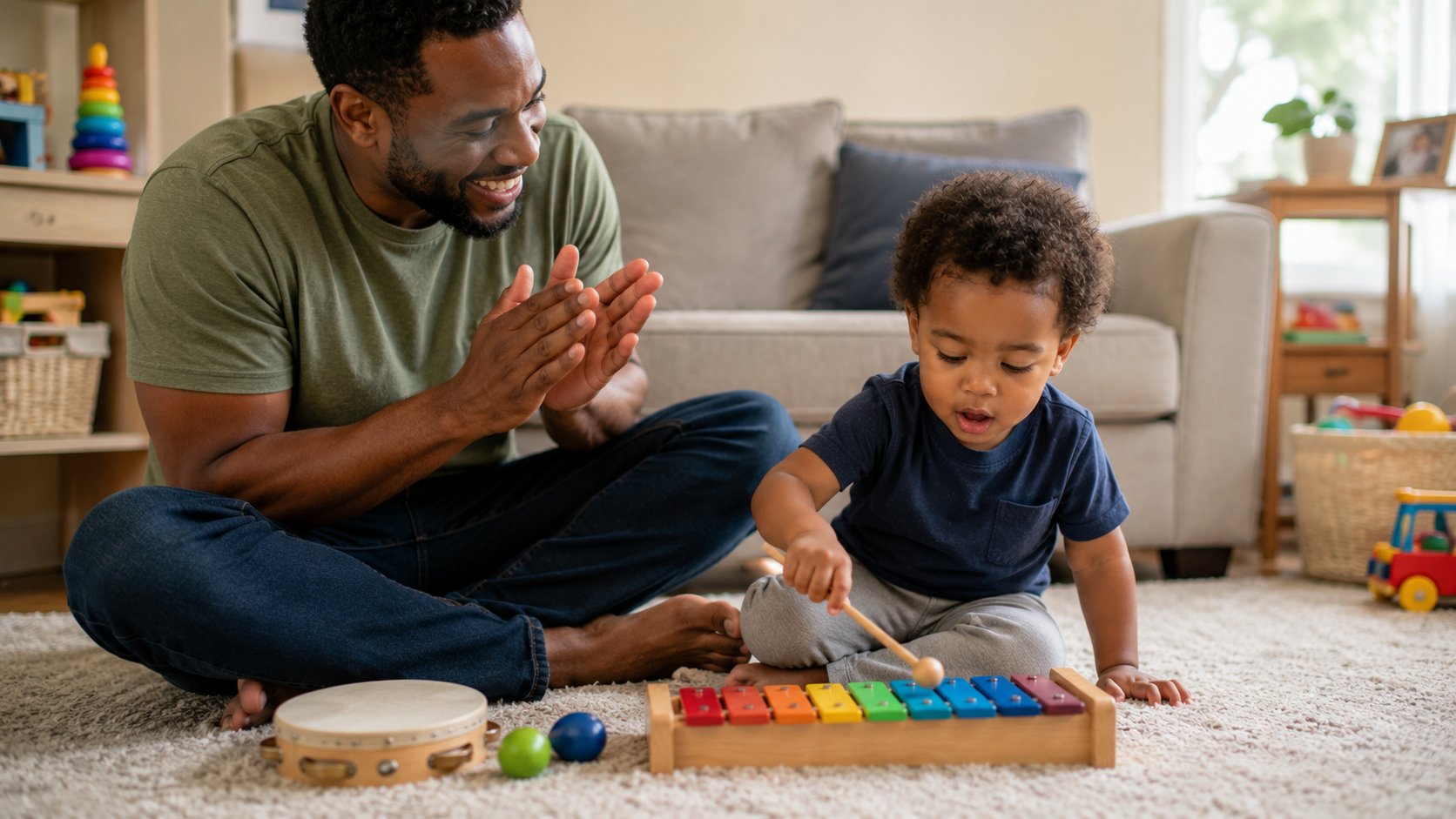
Provide simple instruments to explore. A wooden xylophone, hand drums, shaker eggs, a small ukulele. Let your child mess around with no instruction. Exploration matters more than technique at this age.
Read books about music. Picture books featuring instruments, characters who play music, or simple musical concepts plant seeds. The library has hundreds.
What to Avoid
A few common parent attempts that backfire:
- Forcing toddlers to “practice” anything. Practice is for older children. Toddlers play with music, they don’t practice it.
- Buying toy electronic keyboards with songs and lights. A real, simple instrument invites more exploration than a toy that plays songs at the push of a button.
- Pushing formal lessons before the child is developmentally ready. A bad early experience can sour your child on music for years. Wait until 5 to 7 unless you are using a true early-childhood method like Suzuki, with a parent in the lesson and practicing alongside the child every day.
- Worrying about “missing the window.” Nothing closes at age 4. A rich informal foundation followed by lessons at 5 to 7 is how most musicians start. The evidence for a hard early window is weak and contested, the differences researchers have measured are small, and none of them decide whether a child becomes a good musician. Children who come to formal lessons at 6 or 7 with a rich early-childhood music foundation do beautifully.
A Note on “Prodigy” Tracks
Some parents see videos of three-year-olds playing concertos and worry they’re behind by not starting their toddler in formal lessons. A few perspective points:
- Those videos represent a tiny number of children, usually with intensive Suzuki-style parental commitment.
- Most of the professional musicians we know started in early elementary school, not as toddlers.
- Rushing into formal lessons before developmental readiness produces frustrated quitters, not prodigies.
- The “wasted years” before formal lessons aren’t wasted. They’re the foundation years.
Waiting until the child is ready costs them nothing that matters, and it spares them the bad first experience that ends many musical lives before they begin.
When to Transition to Formal Lessons
The signs that your child is ready for one-on-one instrumental lessons:
- They can focus on a single activity for 15-20 minutes.
- They can follow a sequence of instructions reliably.
- They have hand and arm proportions suitable for an appropriately sized instrument.
- They show genuine interest in playing a specific instrument (not just “trying music”).
- They can communicate clearly about what they understand and don’t understand.
These typically come together around age 5 to 7 for most instruments, though they arrive at different times in different children. A trial lesson is the fastest way to find out where your child actually is.
What This Looks Like With a Real Teacher
Formal lessons rarely fit at two to four, and the reason is attention rather than ability. A child of that age can stay with one activity for about fifteen to twenty minutes.
Some of our teachers do take very young students. Zach S. takes piano students from age 3. Largely self-taught by ear, he teaches theory through ear training rather than from a book, which suits a child who cannot read yet.
That is what to look for if you want to start early: a bio that names this age, teaching by ear rather than from the page, and room for a parent in every lesson.
How to Find Family-Friendly Music Resources
If you’re not sure where to start in your community:
- Local libraries often run free early-childhood music programs.
- Music Together and Kindermusik have searchable directories on their websites.
- Religious communities frequently have children’s music programs.
- Online classes (live or recorded) can supplement when in-person options are limited.
For Tunelark specifically, our private lesson teachers typically start with students ages 5-7+. We don’t currently offer early-childhood group programs, but those are exactly the right preparation for the lessons we do offer once your child is ready.
How to Find a Children’s Music Teacher on Tunelark
When your child is ready for formal lessons (typically ages 5-7+):
1. Open the teacher list and filter by your child’s instrument.
2. Read bios. Look for teachers who specifically mention working with young beginners.
3. Book a trial lesson with one whose approach feels right.
4. After the trial, ask your child how they felt. Enjoyment is the best predictor of progress.
The toddler years are foundation years. The richer your child’s musical environment now (singing, listening, dancing, exploring) the more rewarding their formal lessons will be when the time comes.
Frequently Asked Questions
Will my toddler fall behind if we don’t start formal lessons now?
No. What a child brings to a first lesson at 6 or 7 is mostly what the toddler years put there: a store of songs they can already sing in tune, a steady beat in the body, and the habit of listening closely to music rather than through it. Teachers say those are what make the first year go quickly, and none of them need a lesson to build.
Are there any formal lessons appropriate for ages 2-4?
Specialized Suzuki Early Childhood classes are designed for this age range. Beyond those, Suzuki violin on a tiny fractional instrument and piano can both work from about 3 to 4, on one condition: a parent attends every lesson and leads a short practice at home each day. Without that participation, both are too early. Most other formal lessons should wait until 5 to 7.
What instruments can toddlers play?
Toddlers can explore simple percussion (drums, shakers, xylophones), make sound on ukuleles and small keyboards, and most importantly, sing. Formal technique isn’t the goal. Playful exploration is.
How much music exposure is good for toddlers?
Daily singing, regular active listening, and weekly group music classes (if available) is a strong foundation. More isn’t better. Pressure-free engagement matters more than quantity.
When should we consider one-on-one music lessons?
Most children are ready between ages 5 and 7, depending on the instrument and the child. Most voice teachers start formal technique around age 7 or 8, and younger children do best in playful, singing-based lessons. Watch for the readiness signs above.
Keep reading
About Jennifer Heath
I'm Jennifer Heath, VP of Operations at Tunelark and a lifelong singer. I joined the company in 2020 and oversee much of what makes Tunelark work for students and teachers: hiring, training and supporting our instructors, student support, marketing and day-to-day operations. I started voice lessons at 7 and sang with touring choirs through my teens. Music belongs in every life, for the self-expression, the discipline, the comfort and the simple joy of it.