Online Ukulele Lessons for Beginners: How to Actually Get Started
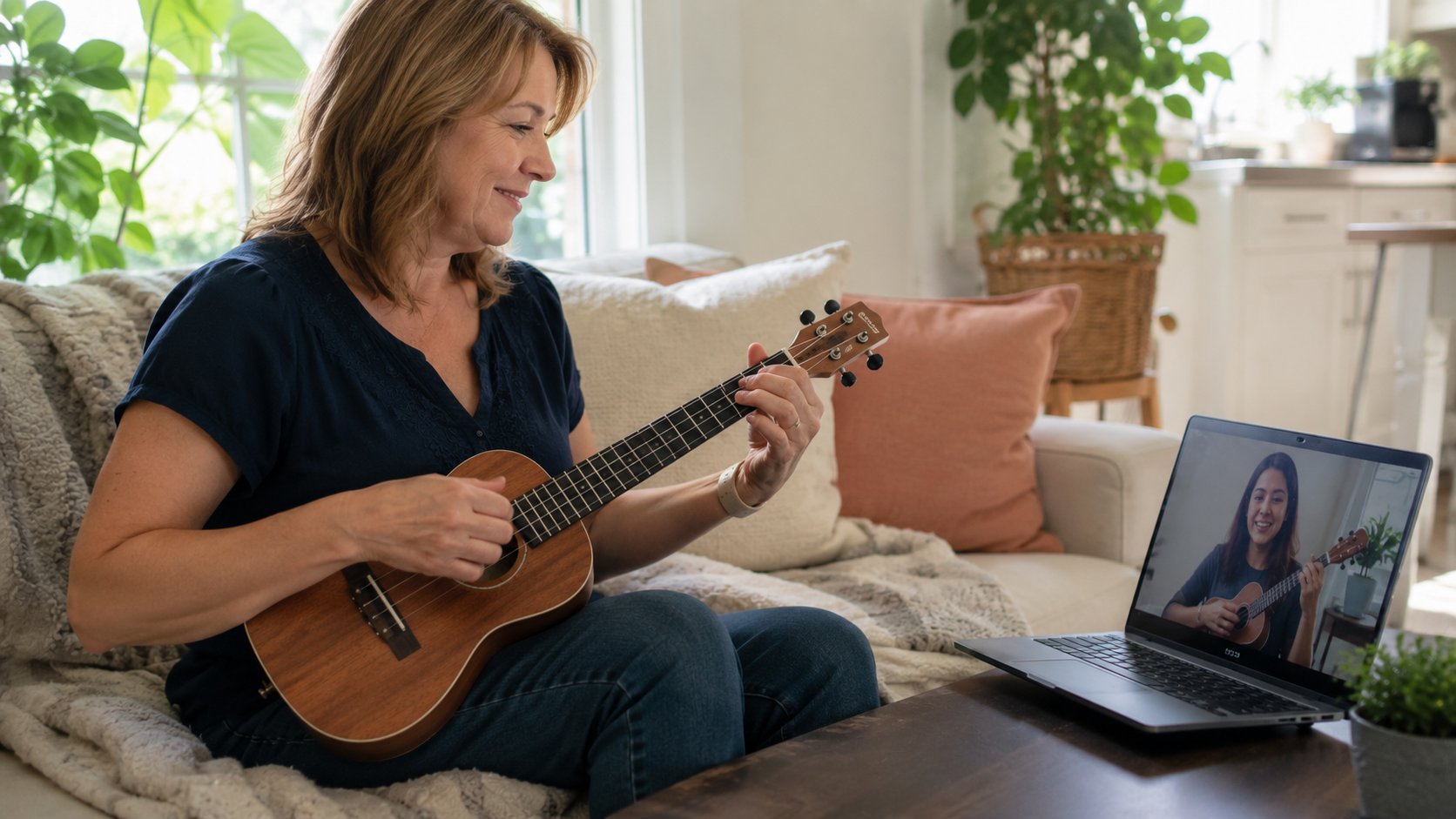
The ukulele has quietly become one of the best instruments for adult beginners. It’s cheap to start, the strings don’t hurt your fingers the way steel guitar strings do, you can play recognizable songs within the first month, and it’s portable enough that practicing is genuinely convenient. Online lessons add to all of this. You can learn from anywhere, on your own schedule, with a teacher whose style fits you.
Here’s how to get started without making the common beginner mistakes.
Why Ukulele Is Underrated for Adult Beginners
Three reasons.
The learning curve is friendly. A standard soprano or concert ukulele has four nylon strings, a short neck, and a small body. C and Am take one finger, F takes two, and G (or G7) takes three, and those first few chords are why beginners play a song so quickly. You can play a first song within a week or two. Ukulele chords need less finger strength and stretch than guitar chords, so the first clean chord comes sooner. One thing that trips beginners up is the ukulele’s reentrant tuning, which our guide to tuning a guitar or ukulele explains.
It sounds pleasant immediately. Even a beginner’s strumming on a uke sounds musical. There’s no screech period, and nylon strings are far gentler than steel, so any fingertip soreness is mild and fades within a few weeks. Teachers will tell you that an instrument that sounds bad in the first month loses more beginners than one that sounds good from the start.
It’s social. Ukulele groups, jams, and casual playing situations are everywhere. You can take a uke to a beach, a backyard, a friend’s house, and someone will start singing along. That kind of low-pressure social use is exactly what keeps adult beginners practicing.
What to Buy
A starter soprano or concert ukulele costs roughly $50 to $100 as of 2026. Don’t go cheaper: the $20 to $30 ukuleles sold in toy aisles often won’t stay in tune, which teaches your ear the wrong pitches.
Three main sizes for beginners:
- Soprano. Smallest and most traditional. Bright, classic uke sound. Good for smaller hands, and usually the least expensive size.
- Concert. Slightly larger and easier to play for adults. Most popular adult choice. Fuller tone.
- Tenor. Larger still, with a fuller sound closer to guitar. Best for players with bigger hands or those wanting more volume.
Brands to look for: Kala, Ohana, Lanikai, Donner. Avoid no-name brands from anonymous online sellers.
Beyond the instrument, you need: a clip-on tuner ($10-$20), a soft case ($15-$30), and ideally a webcam and a quiet spot for your lessons.
How Online Ukulele Lessons Work
A typical 30- or 45-minute online ukulele lesson covers:
- A short warm-up: chord shapes, transitions, finger picking patterns.
- Review of last week’s homework (a song or technique).
- New material: a chord shape, a strumming pattern, or a piece you’re working on.
- Q&A and homework for the week.
Your teacher sees your hands and the fretboard clearly through your webcam. They hear your playing through your laptop’s microphone. They can demonstrate chords, fingerpicking patterns, and strumming techniques in real time, and you go back and forth until things click. The change itself is where most beginners stall, and our guide to keeping the strum going through a chord change explains why the hand stops and how to stop it stopping.
The technology rarely gets in the way, but it does need one setting changed. A ukulele is a quiet instrument, and the default speech processing in a video call treats quiet strumming as background noise, gating the attack and thinning the tone. Turn on original sound before your first lesson: Zoom calls it Original Sound, and FaceTime has Wide Spectrum under Mic Mode. With that on, a laptop microphone carries your strumming and your chord changes clearly enough for a teacher to work from.
What to Expect in the First Three Months
Month 1. The basics: tuning, holding the uke, your first three or four chords (typically C, F, G, Am), basic strumming. By the end of month one, you should be able to play several simple songs from start to finish. Our guide to easy ukulele songs sorted by chords and strumming skill names which songs those should be, by chord count and change speed.
Month 2. More chord shapes (D, Em, G7, A7), faster transitions between chords, basic fingerpicking patterns, more song repertoire. You start to feel like a player rather than a learner.
Month 3. Reading basic chord charts and tabs, playing along with recordings, beginning to sing while you play. By the end of three months, most students have a small repertoire of songs they can perform comfortably.
Common Beginner Mistakes
A few things teachers see students do that slow progress:
- Not tuning before every practice session. A clip-on tuner takes 30 seconds and makes everything sound better.
- Pressing too hard on the strings. Light pressure is enough; pressing hard fatigues your hand and slows chord changes.
- Strumming with the wrist locked. The strum should come from a loose wrist, not the whole arm.
- Skipping the slow practice phase for chord transitions. Going slowly to get clean changes builds speed faster than starting fast.
A good teacher catches all of these in the first few lessons.
How to Find a Ukulele Teacher on Tunelark
Every Tunelark teacher is vetted by working musicians and educators for teaching quality before they can list, and each teacher sets their own rate and shows it on their profile. To get started:
1. Open the teacher list and filter by ukulele.
2. Read bios. Look for teachers who describe their approach to adult or beginner students.
3. Book a trial lesson with one whose style resonates. It is $25 off that teacher’s 30-minute rate.
4. After the trial, notice: did the lesson feel relaxed and fun? Ukulele teaching that feels heavy is teaching that doesn’t fit the instrument.
The ukulele is a forgiving, joyful instrument to start with. With a good teacher and 15-20 minutes of practice most days, you’ll be playing real songs sooner than you expect.
Frequently Asked Questions
Is ukulele actually easier to learn than guitar?
Yes, especially in the first few months. The nylon strings don’t hurt your fingers, the chord shapes are simpler, and many songs only need three or four chords. Long-term, both instruments take serious time to master.
What’s the difference between ukulele sizes?
Soprano, concert and tenor are compared above. Baritone is the fourth size: largest, tuned D G B E like a guitar’s four highest-pitched strings, and closer to a guitar in sound.
Can I learn ukulele as a complete musical beginner?
Yes. Ukulele is one of the most beginner-friendly instruments. Most adults can play simple songs within a few weeks of starting, even with no prior musical experience.
Do I need to read music to learn ukulele?
No. Most ukulele instruction uses chord charts and tabs, not standard notation. You can play hundreds of songs without ever reading music, though it’s a useful skill to add eventually.
How much practice do I need each day?
15-20 minutes a day, five or six days a week, will produce steady progress. More is fine but rarely necessary in the beginning. Consistency matters more than duration.
Keep reading
About Jennifer Heath
I'm Jennifer Heath, VP of Operations at Tunelark and a lifelong singer. I joined the company in 2020 and oversee much of what makes Tunelark work for students and teachers: hiring, training and supporting our instructors, student support, marketing and day-to-day operations. I started voice lessons at 7 and sang with touring choirs through my teens. Music belongs in every life, for the self-expression, the discipline, the comfort and the simple joy of it.