Online Violin Lessons for Adults: It’s Genuinely Not Too Late

Adults asking about violin almost always start with the same disclaimer. “I know it’s probably too late, but…” Then they describe what they actually want, to play a piece they’ve loved for years, to learn the instrument their grandmother played, to take on something difficult that they’ve quietly thought about for decades.
Violin is harder than most instruments in the first year. But “too late” is wrong. Adults learn violin every day and reach satisfying levels, and online lessons work well once you find the right teacher.
Why Violin Is Special for Adults
There’s a reason adults keep coming to the violin despite its difficulty. The sound itself is part of it: the violin produces tone in a way that feels intimate and human, closer to the singing voice than almost any other instrument. The repertoire is part of it: the violin has one of the deepest catalogs of beautiful music in the Western tradition, from folk fiddle through Bach to film scores.
The emotional pull is part of it too. Adults who come to violin often have a specific connection: a relative who played, a piece they loved as a child, a wish to play a melody by ear. In our teachers’ experience, adults who start with a connection like that tend to keep going, and those without one tend to drift.
The cognitive and wellbeing benefits reported for adult music learning apply to violin as much as to any instrument. Our piece on the benefits of learning music as an adult covers the research: studies of adult music learners, most of them small, suggest benefits for memory, mood and cognitive health.
What’s Genuinely Hard
Four things make violin harder than piano or guitar early on.
No frets. Fretted and keyed instruments give you visible markers for where the notes are. Violin gives you none. You’re learning to place your fingers in exactly the right spot by feel and ear, simultaneously, from day one. This takes time and produces a lot of out-of-tune sound in the first few months.
The bow. A clean, sustained tone is a skill separate from the left hand. Bow weight, speed, angle, contact point: all of these affect tone. Most adults can play recognizable melodies on piano in their first lesson. On violin, the first lesson is usually just about how to hold the instrument and the bow without injuring yourself.
Bow direction is where that separate skill starts. Brian S., who teaches violin on Tunelark, works through up bow and down bow and why the direction shapes the sound as much as the notes do.
Skill video · Up and Down Bow
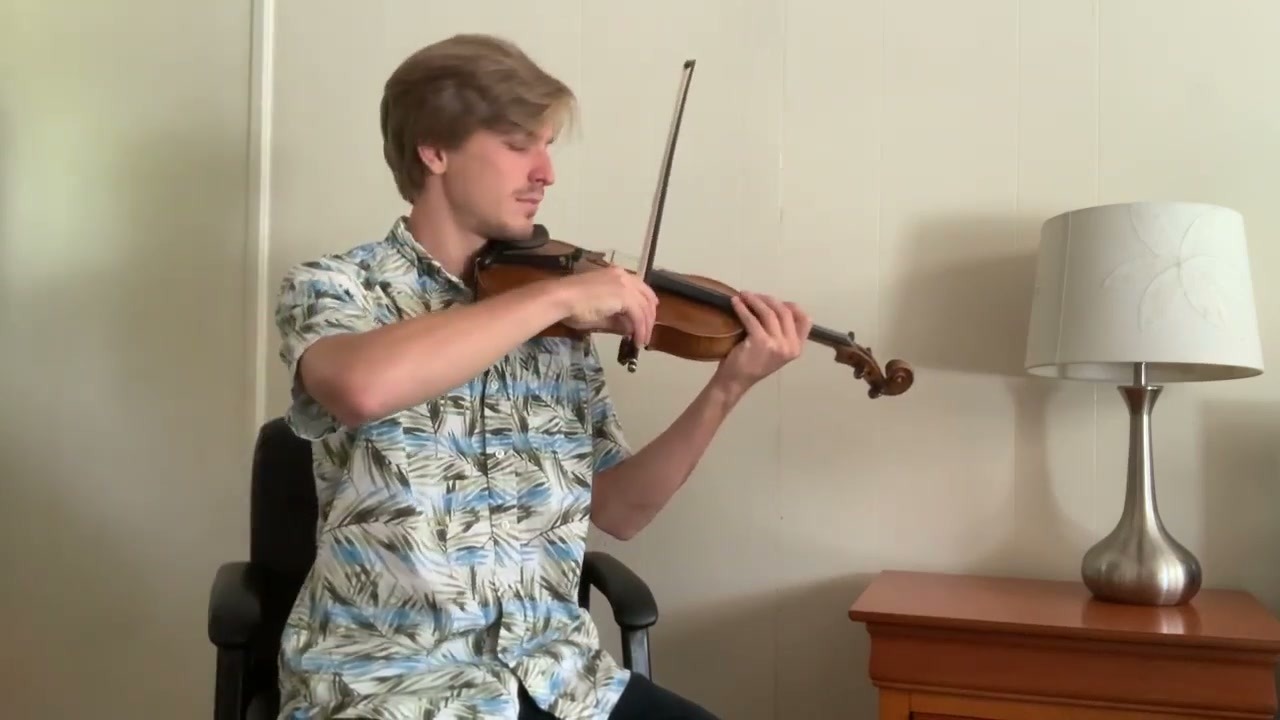
Brian teaches violin lessons online with Tunelark. View Brian’s profile
Listening tolerance. Beginner violin sounds scratchy, for everyone. You have to tolerate that for a few months while bow control improves, which is hard for adults with a lifetime of musical taste.
Physical demands. The violin asks you to hold an awkward posture, support an instrument under your chin with your left side, and use the right side asymmetrically. Most adults need some focused work on body position and tension to play comfortably. Unlike piano, you can’t just sit down and play.
Our beginner violin tips cover the early stage in more depth.
What’s Easier Than People Think
Some things are easier for adults than for children.
Adults can follow instructions. A teacher can say “place your second finger slightly higher than where you have it” and an adult understands and adjusts. Young children generally need shorter sessions built on more repetition and less explanation.
Adults can self-direct practice. A young child usually needs structured assignments from the teacher. An adult can take a general instruction, “work on the third position transitions this week”, and figure out how to use their practice time.
Adults can hear pitch problems and correct them. The musical ear adults bring to the instrument is usually more developed than they realize, even without formal training. You can hear when a note is off. That’s half the battle on a fretless instrument.
Adults have musical taste. You know what you want to play. You know what kind of tone you want to produce. That gives you specific goals.
Adults can manage frustration. A young child is more likely to walk away from something hard before it gets easier. In teachers’ experience, an adult more often recognizes the frustration and keeps going.
Online lessons suit these traits, because the format relies on the student bringing focus and self-direction.
What You Need to Start
Starting violin doesn’t require a big investment.
An instrument. A playable student outfit runs roughly $200 to $500 as of 2026, and is more than enough for the first year or two. Rental from about $20 a month is also widely available and often a smart starting move. Our guide to renting or buying a first violin compares how rental credit works at three string shops.
A bow, case, rosin and shoulder rest. The first three come with most student outfits. A shoulder rest usually does not, so add one to the order (roughly $15 to $30 as of 2026). It helps posture and comfort, and a teacher in your first lesson can help you adjust it.
A tuner. A clip-on tuner on the scroll removes a frustrating variable in the first months. A typical first month of practice is 15 to 20 minutes a day: tune, check posture and bow hold in a mirror, bow the open strings slowly, then work on the first finger patterns your teacher sets.
A space. Violin is louder than most beginners expect. A room where you won’t worry about neighbors, with enough space to fully extend the bow, is ideal.
A teacher. On violin, habits formed in the first few months are hard to undo, so start with a teacher rather than adding one later. Our guide to the best online violin lessons for beginners goes deeper on what to look for.
How to Find the Right Adult-Friendly Teacher
Not all violin teachers are equally good with adults. Look for four things.
A teacher who has taught adults and says so on their profile. Many violin teachers built their practice around children.
A teacher who’s willing to start with adult-relevant repertoire. If the first six months are folk songs, simple pieces from films, or melodies the student actually wanted to learn, motivation stays high. If it’s children’s method-book pieces with no musical interest, adult students drop out fast.
A teacher who takes the time to address physical comfort and tension. Adults bring more pre-existing posture habits and body tension than kids do. A good adult-violin teacher works on this from the start.
A teacher who’s patient with the early scratchy phase and doesn’t make the student feel bad about it. The right teacher for an adult is the one who finds it interesting, not annoying.
Older students may also find useful framing in our piece on music lessons for seniors, which is blunter about violin’s early difficulty for older beginners.
The first year is the steepest part. After that, the curve flattens, the tone improves, and the music starts to sound like music. In our teachers’ experience, people who get through the first year usually stay with it. The question is whether you’re willing to spend a year on the steep part to earn the decades of playing that come after.
How to Find a Violin Teacher on Tunelark
Tunelark has violin teachers who specifically work with adult beginners and adult returners. Here’s how to find the right one.
1. Open the teacher list and filter by violin.
2. Read bios. Look for teachers who mention working with adults and who describe their approach to beginners.
3. Book a first lesson with one whose profile resonates. It is $25 off that teacher’s rate for the length you choose.
4. In the trial, watch for whether the teacher addresses your posture and bow hold patiently, and whether the energy in the lesson feels respectful of you as an adult learner.
It’s not too late. Online lessons produce real adult players. The hardest year of your violin life is the first one, and the right teacher makes even that one a lot more enjoyable than you’d expect.
Frequently Asked Questions
Am I too old to start violin?
No. People begin in their fifties, sixties and seventies and play for years afterward. The first year is harder than on most instruments.
How long until I can play a real piece?
For most adult violin beginners, simple recognizable melodies are within reach in two to three months. A piece you would happily play for a sympathetic listener usually arrives around the end of the first year. A piece you would perform for a stranger, with clean tone, reliable intonation and real phrasing, is usually a second-year milestone.
Will online violin lessons work as well as in-person?
For most adult students, yes. With the camera to the side at instrument height, the teacher can see your bow hold, posture and left hand. The main limitations are very advanced bowing nuances and ensemble work, neither of which matters much in the first few years.
Do I need a high-quality violin to start?
No. A playable student outfit at roughly $200 to $500, as of 2026, covers the first year or two, and rental from about $20 a month is widely available. Upgrade when you know what you want.
Will my hands hurt at first?
Some mild fingertip soreness is normal in the first two to four weeks while the calluses form, and it fades as they toughen. If you take a long break later, the calluses soften and you get a short repeat of that first tender stretch. Significant or persistent pain is not normal and usually points to posture or tension, so tell your teacher early.
Looking for an online violin teacher? See our full Online Violin Lessons page for everything you need to know about getting started.
Keep reading
About Jennifer Heath
I'm Jennifer Heath, VP of Operations at Tunelark and a lifelong singer. I joined the company in 2020 and oversee much of what makes Tunelark work for students and teachers: hiring, training and supporting our instructors, student support, marketing and day-to-day operations. I started voice lessons at 7 and sang with touring choirs through my teens. Music belongs in every life, for the self-expression, the discipline, the comfort and the simple joy of it.