What Ten Minutes of Guitar Practice Actually Buys You
Most people who pick up a guitar do so in a season of life that already feels full. There’s a job, or school, or kids, or all three. The dream is to play the instrument they’ve always wanted to play, and the friction is the same friction every adult learner runs into: the calendar. The advice they encounter when they search the internet for help isn’t always reassuring. Practice an hour a day. Practice every day. If you don’t have the time, you’re not serious.
That framing leaves a lot of would-be guitarists in an uncomfortable place. They can give the instrument ten or fifteen real minutes a day, sometimes, and they read everywhere that this isn’t enough. Some of them quietly conclude they aren’t cut out for it and put the guitar back in the closet.
Tony G., a guitar teacher at Tunelark who has spent more than fifteen years teaching real students with real schedules, would like to gently disagree with the whole premise. In his experience, ten focused minutes a day, kept up over weeks and months, will outperform the heroic hour-long session that happens once a week and is replaced with guilt the other six days. What makes those ten minutes count is not a different exercise from what an hour-long student would do. It’s a different mindset the student brings to the chair.
The first decision: stop wishing for the hour you don’t have
Ask Tony what the most important thing is for the genuinely time-strapped student, and he doesn’t begin with a technique recommendation. He begins with attitude. “For a student who genuinely only has 10 minutes a day, I think the most important thing is to come into that time with the right mindset.”
He has watched a particular pattern often enough to flag it. “Don’t sit down feeling rushed or frustrated because you wish you had more time. Instead, accept the time you do have and make the best of it.”
A student who sits down already mentally apologizing for the brevity of their session, already certain that ‘real’ practice is the practice they’re not getting in, gives those ten minutes a layer of resentment they didn’t have to carry. They rush. They half-attend. They glance at the clock. They walk away convinced the session was wasted, and the conviction becomes a kind of self-fulfilling prophecy: yes, wasted, because their head was anywhere except the strings.
The alternative Tony names is simpler. Treat the ten minutes you have as the ten minutes you have. Sit down on time. Don’t grieve the hour you didn’t get. Make the next six hundred seconds count.
Tony sees a larger principle underneath that small move. “In my experience, the quality of practice matters far more than the quantity. That’s true whether you have 10 minutes or 100 minutes.”
That is what experienced teachers report seeing rather than a settled result from a study. Our look at the research on short practice covers what has and has not been shown, and the weight of quality against accumulated hours is still argued over. Hours on the instrument do count, and the ones that count most are deliberate: full attention on one specific problem. An hour of noodling is what a tired adult does when they feel obligated to fill a block of time. Ten focused minutes are what become available the moment you stop wishing for the block you don’t have.
What to actually do with the ten minutes
When Tony names the what, he’s deliberately undemanding about the choice of exercise. The point is the manner of practice more than the content. “Maybe those 10 minutes are spent doing finger warm-ups to keep your hands in shape. Maybe it’s running through a scale carefully and cleanly. Maybe it’s working on one difficult chord change or one small section of a song.”
Each option is small enough to be done attentively in the time available. Each one focuses on one specific thing the player can either notice improvement in or fail to. None of them is “play through the whole song once” or “run all your scales,” which are the well-meaning ambitions that quietly degrade into autopilot the moment the player gets bored.
What unites them is the instruction Tony returns to. “I always encourage students to practice with purpose. Don’t just go through the motions. Be intentional about what you’re trying to improve, even if it’s something very small.”
The smallness is deliberate. Practice with a goal so granular that you can tell, by the end of the session, whether you made progress on it: the F-chord change happened a little faster this time, the second measure of that solo lined up with the click, your thumb didn’t creep over the top of the neck during the C-major run. These are not lofty goals. They are reachable goals, which is exactly what makes them sustainable. Each one banks a small deposit of evidence that today’s practice mattered, and the player carries that evidence into tomorrow.
It’s the same principle a serious runner, a working writer, or a recovering pianist would all recognize. The unit of progress in any skill is attentive repetition. Sitting in front of an instrument with your phone in your other hand is not really practicing. It’s keeping your hands warm.
The surprise no one warns beginners about
There’s a particular reward of small, consistent practice that Tony has watched play out enough times to put on the record. It’s the moment a beginner realizes their hands have changed and they don’t know exactly when it happened.
He sees it especially clearly in students who came in feeling like their fingers were beyond hope. “A lot of beginning guitarists struggle with coordination, dexterity, and finger strength. They’ll tell me, ‘My chords sound terrible,’ or ‘I don’t think my fingers will ever do what I want them to do.'”
The temptation, at that point, is to assume the answer is more hours. Tony’s experience is that what those students need isn’t volume. It’s consistency. “What I’ve found is that they don’t always need hours of practice to start improving. Sometimes they just need a consistent habit.”
He has a specific recommendation for the time-starved student in this boat, and it’s one of the rare cases where the advice meets the student literally where they are sitting. “If a student is short on time, I’ll often have them focus on a few simple exercises that improve finger independence and coordination. They can even do them while they’re sitting on the couch watching television.”
The exercises Tony has in mind are physical drills the fretting hand can do almost on its own once the patterns are familiar, the one exception to the full-attention rule, because they train the hands rather than the ear. The student watches their show; the hand walks the patterns; the fingers, slowly, learn each other. The student doesn’t have to clear a holy hour. They just have to do the patterns. “The goal isn’t to master a song in those few minutes. The goal is to train the hands to move more efficiently.” The drills, and the hand position they depend on, are demonstrated in The Fretting Hand.
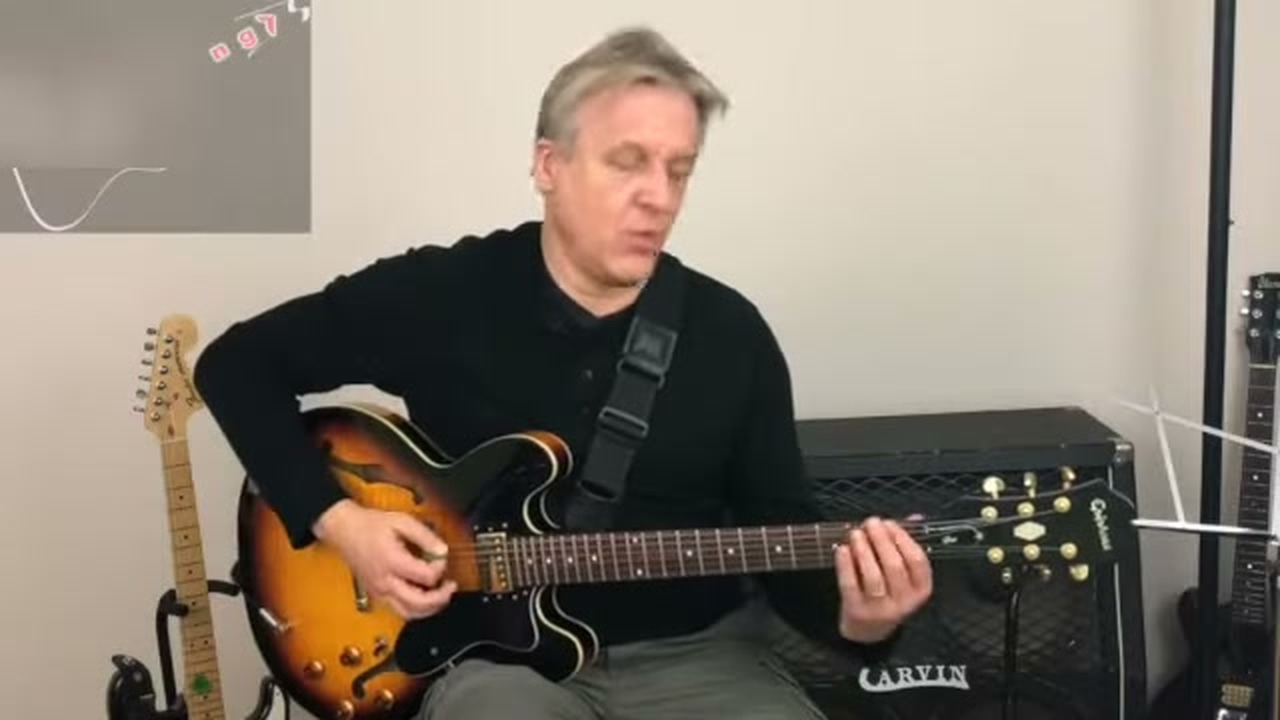
One of those drills, from Tony himself: four fingering patterns on the chromatic scale, each shown close up. The simplest is 1-2-3-4: one finger per fret on one string, each note ringing clean before the next, then the same on the next string. It is exactly the kind of thing that fits inside ten minutes and does its work over weeks.
Skill video · Alternate Chromatic Fingering
Tony teaches guitar on Tunelark. View Tony’s profile
Then comes the moment Tony has watched many times. “A few weeks later, the chord changes that felt impossible start to become easier. Notes ring out more clearly. Their fingers land in the right places more naturally. The student often feels like the improvement came out of nowhere, but it’s really the result of those small daily efforts adding up over time.”
The experience doesn’t match what most beginners are bracing for. They expect a slow, visible climb, a little better each day, a little better each week, the line going up. What actually happens is closer to a phase change. For weeks, nothing seems to be happening; the chord change is still ugly, the strumming is still stiff. And then one Tuesday the change works. The hand simply does the thing it couldn’t do the day before, and the player hears the difference, and a small awe creeps in.
The likely reason is that motor skills consolidate between sessions in ways that aren’t visible from the inside. Small daily efforts add up below the surface, and what the player notices is the moment the skill crosses a threshold and becomes available. The student feels like they “got it” all at once because, from the inside, that is exactly what it felt like.
Tony says, “Small efforts, repeated consistently, often produce much bigger results than people expect.”
Why the “I need an hour” rule does more harm than help
The conversation Tony has had most often with discouraged students is one any honest beginner will recognize. They came in believing they needed to practice for a fixed block of time, fell short of that block, and concluded they were failing.
He hears the framing all the time. “Students will often tell me, ‘I need to practice for an hour a day,’ or ‘If I don’t get my full 30 minutes in, there’s no point.’ While I understand the thinking behind that, I don’t necessarily agree with it.”
What he watches for instead is what the time in the chair is actually spent on, and his own observation there cuts both ways. “I’ve seen people spend hours running scales or repeating exercises without much focus or intention. On the other hand, I’ve seen students make real progress in 10 or 15 minutes because they sat down with a clear goal and gave that goal their full attention.”
There’s a moving-parts version of that observation he often spells out. A productive short session, he says, “starts with the right mindset. Know what you’re working on, focus on that one thing, and be fully engaged while you’re doing it. Whether it’s cleaning up a chord change, improving a strumming pattern, or working through a difficult passage, intentional practice almost always beats mindless repetition.”
But the gentler point Tony makes, the one some students need to hear more than any technique tip, is about being kind to your own schedule. “I also think it’s important to be realistic. We all have busy lives. Not everyone can dedicate an hour a day to guitar, and that’s okay.”
This is where the all-or-nothing trap really hurts people. “Sometimes students become so attached to a practice-time goal that they end up discouraging themselves. They miss a day, fall short of their target, and start feeling like they’re failing. Eventually, some of them stop practicing altogether because they can’t live up to the standard they’ve set for themselves.”
Tony’s preference is for a standard that survives a real human week. “I’d rather see someone practice 10 focused minutes consistently than spend an hour practicing once a week and feeling guilty the rest of the time.”
The hour-once-a-week student isn’t lazy. They are betting a whole month on a handful of weeks that cooperate. Miss the hour and there is nothing to fall back on until the next one comes around. Miss a ten-minute session and tomorrow closes the gap.
The point isn’t that more time is bad. If a student genuinely has an hour, they should take it. The point is that the minimum that counts is much smaller than most beginners believe, and the cost of believing otherwise is high.
“The students who make the most progress,” Tony says, “are usually the ones who stay engaged, stay consistent, and make the most of whatever time they have available. When you approach practice that way, the results tend to take care of themselves.”
A practical takeaway for the genuinely busy
If you have ten minutes today and most days this week, here is what Tony’s approach would suggest you actually do.
Sit down on time. Pick one specific, small thing to work on before you start. Maybe it’s the cleanest possible D-to-G change. Maybe it’s the first four bars of a song you’re learning. Maybe it’s a single scale played evenly and in time. Whatever it is, name it before you pick up the guitar so the session has somewhere to go.
Then practice that one thing with your full attention for the time you have. Put the phone in the next room. Don’t turn it into a tour of every song you’ve ever tried to learn. Stay with the chosen target. Track what’s improving and what isn’t.
When the ten minutes are up, stop. You don’t have to make the practice longer to make it count. Tomorrow you will sit down again with a slightly different hand than the one you finished with today, and the day after that, and the day after that. The progress lives in the streak, not the session.
And on the days when ten minutes feels like more than you can give, give two. Run through one chord change. Re-learn a single measure. Contact the instrument.
Frequently Asked Questions
Is ten minutes of guitar practice a day enough to improve?
Yes, especially for beginners and busy adults. What makes it work is aiming those ten minutes at one specific thing. Ten minutes of drifting through half-learned songs will not do it.
Why is consistent practice better than long occasional sessions?
Daily contact keeps your hands familiar with the material and gives the skill time to settle between sessions. After a long gap, expect the first session or two to go on relearning rather than advancing.
How should I spend a short ten-minute practice?
Pick one clear focus: a tricky passage, a single technique, or one song. Short, focused attention on a single goal accomplishes far more than scattered, unfocused playing.
Can I really learn guitar with only ten minutes a day?
You can make steady progress, particularly in the early stages. As you advance you may want more time, but ten focused minutes a day is enough to keep you moving forward.
What is the best time of day for a short practice?
Whenever you will actually do it consistently. Attaching practice to an existing daily habit, such as right after your morning coffee or before dinner, makes the ten minutes much easier to keep.
About Tony
Tony’s relationship with the guitar started in his living room when he was about 14. He and a friend, both huge Rush fans, started talking about forming a band. “My friend said, ‘I’ll play bass like Geddy Lee,’ and without hesitation I said, ‘Okay, I’ll play guitar like Alex Lifeson.’ That was it. Decision made.” A $100 Ibanez Junior Les Paul followed. He picked up the basics from a friend, joined a band, and was off.
That was the start of a lifetime in music. Tony has played guitar for more than thirty-five years and taught electric and acoustic guitar online for over fifteen. He studied classical guitar and music theory at the University of Illinois Chicago, and he still performs regularly, currently as lead guitarist in a Rush tribute band and at local venues and church services.
Decades later, what still keeps him in the chair is what he calls the “Professor Higgins moment,” the scene in My Fair Lady where Higgins hears Eliza get the vowels right at last and bursts out, “By George, she’s got it!” Tony describes the teaching version of it this way. “That’s exactly what it feels like when a student finally breaks through. Maybe we’ve been working on a vibrato for weeks. Maybe it’s bending strings in tune, making a difficult chord ring clearly, or getting through a challenging section of a song. Whatever it is, they’ve been putting in the effort, practicing consistently, and sometimes struggling for quite a while. Then one day they come into a lesson and it just clicks. Suddenly, they’re doing the thing that seemed impossible a few weeks earlier. Those moments never get old.”
His favorite material to teach reflects his roots: “Probably Rush and/or Eagles. Anything classic or blues rock oriented.” The years have also taught him a larger lesson. “People are capable of much more than they realize. I’ve watched students accomplish things they were convinced they could never do. And I’ve also learned that music is often about much more than music. For many people, learning guitar is tied to confidence, creativity, stress relief, or a dream they’ve carried for years. What starts as a lesson about chords and scales often becomes something much more personal.”
Ready to make ten minutes a day count?
If you’ve been waiting for a clear hour to “really start” learning guitar, the wait may be the problem. Tony works with students who have full schedules and short windows, and helps them build the kind of small, consistent practice that quietly compounds into real progress over time. Tony is currently accepting new guitar students at Tunelark.
Looking for an online guitar teacher? See our full Online Guitar and Bass Lessons page for everything you need to know about getting started.
Keep reading
About Jennifer Heath
I'm Jennifer Heath, VP of Operations at Tunelark and a lifelong singer. I joined the company in 2020 and oversee much of what makes Tunelark work for students and teachers: hiring, training and supporting our instructors, student support, marketing and day-to-day operations. I started voice lessons at 7 and sang with touring choirs through my teens. Music belongs in every life, for the self-expression, the discipline, the comfort and the simple joy of it.