When Practice Games Help, and When They Just Feel Good
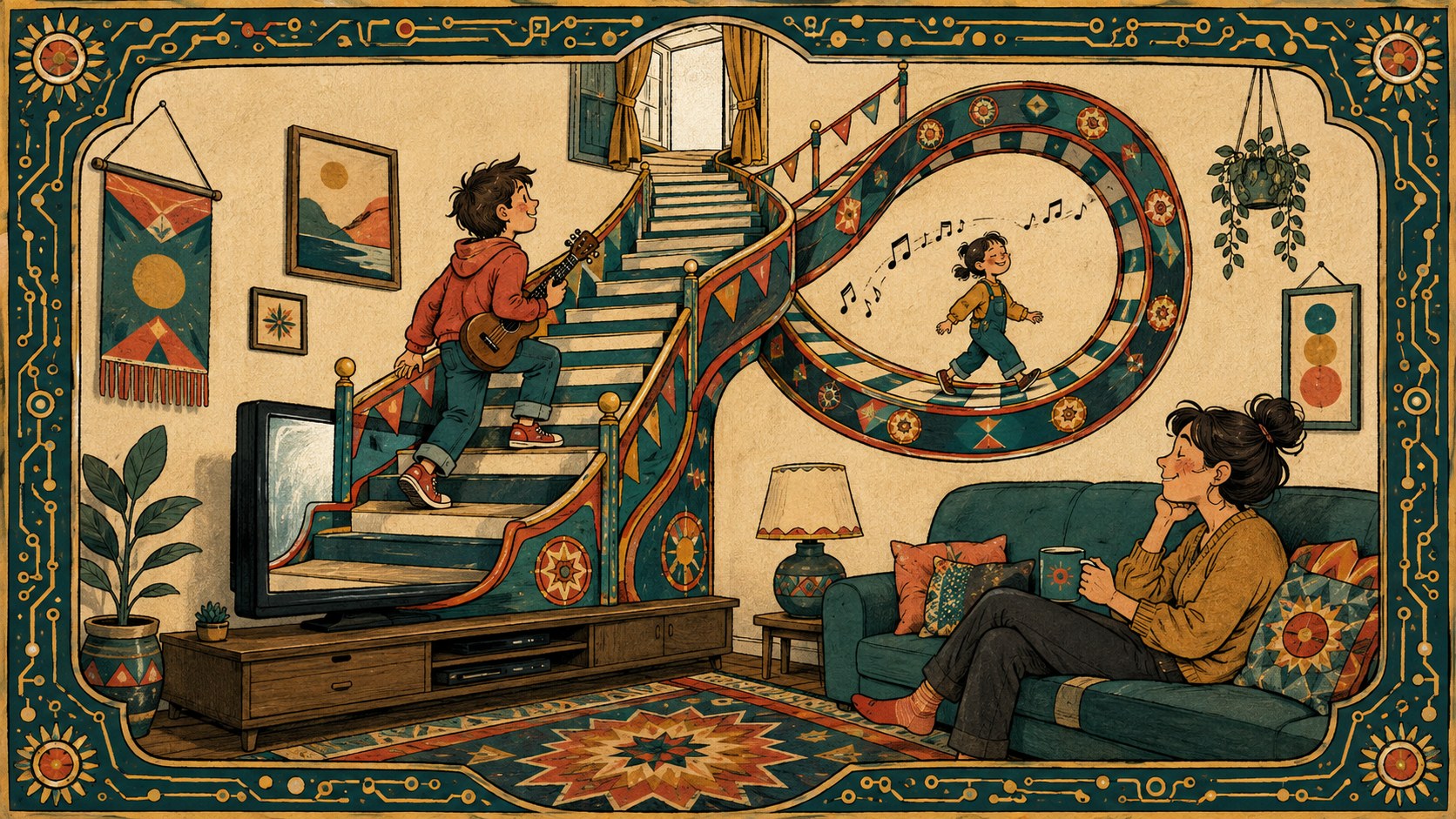
A streak is not progress. It is a record of showing up, which is a different and lesser thing, and the gap between the two is where most music games quietly fail.
That is not an argument against games. We build them, we have watched students learn from them for years, and the research is broadly on their side. It is an argument for being able to tell the difference between a game that is teaching you something and a game that is very good at making you feel like it is.
What the research says games do well
The most direct treatment comes from a chapter in The Oxford Handbook of Artificial Intelligence in Music Education, published in August 2026, in which Daniel Abrahams examines where gamification, AI and music education meet. What is useful about it is that the pedagogy is named rather than assumed. The chapter grounds gamified music learning in constructivism, reciprocal teaching, flow theory, deliberate practice and social-emotional learning, and looks at how adaptive feedback, game mechanics and learner-centered design support skill development, creativity and student agency.
Two of those frameworks explain most of why games work at all when they work.
Deliberate practice is the finding, established across decades of expertise research, that improvement comes from focused work at the edge of your current ability with immediate feedback, rather than from repetition of things you can already do. It is also the thing almost nobody does on their own, because working at the edge of your ability is uncomfortable and playing what you already know is pleasant.
Flow is the state where a task is difficult enough to demand your full attention but not so difficult that you fall apart. It has a narrow window, and the window moves as you improve. Left alone, most learners sit below it, practicing comfortable material, or occasionally leap above it and bounce off something too hard.
A well-built game solves a scheduling problem that human attention is bad at. It keeps handing you the next thing that is slightly too hard, immediately, hundreds of times, without getting bored or forgetting where you were.
Inside a lesson, that job belongs to the teacher. Jason W., who teaches guitar on Tunelark, says a lesson that feels easy and unforced is usually one where the teacher is setting the pace on purpose, weighing each challenge against a success and adjusting as they go. A well-built game carries that pacing into the days between lessons, for the material a game can mark.
The broader evidence supports the direction, and it is worth reporting in full rather than in the parts that suit an argument. A three-level meta-analysis published in the Journal of Intelligence in July 2026 examined three outcomes across the AI-assisted music learning studies it pooled. Learning motivation produced the largest and most robust effect. Creative performance came next, and that effect was large but highly variable, with a confidence interval running from very near zero up to a very large effect, which is what a small number of studies disagreeing with each other looks like. Self-regulated learning pointed positive but did not reach statistical significance, and the authors call it a preliminary trend rather than a result. A scoping review in Research Studies in Music Education from June 2026, screening 1,274 records down to 22 empirical studies, reports learning outcomes that are largely positive across motivation, self-efficacy, technical skill development and aspects of musical creativity.
Two of those outcomes decide what a game is actually for. Technical skill is the straightforward one: it is the raw material, it can be marked right or wrong, and games are built for exactly that. Creativity is the one that needs care, because it is the result most likely to be quoted as evidence that software can teach musicianship. The creative outcomes in this literature come overwhelmingly from generative tools used for composing and arranging, where a student is making something and the system is a collaborator, rather than from games that score practice. Neither review isolates games as a category and reports a creativity effect for them, and neither one measured phrasing, tone or interpretation in performance at all. So the honest reading is that these reviews point toward motivation and the raw material without having separated games out from the rest of AI in music education, and that the creativity findings belong to a different kind of tool.
Where games go wrong
The failure mode has a name in the research now. A systematic review of 21 empirical studies published in Frontiers in Psychology in February 2026 identified score-driven goal distortion, where a learner’s goals gradually bend toward whatever the system rewards, and algorithm-accommodating self-censorship, where they start shaping their work to satisfy the system rather than to be good.
In a game, that looks like this. You have a streak. The streak is now a thing you own and can lose. Preserving it becomes a goal in its own right, separate from music, and on a tired evening you will do the easy level to keep it alive rather than the hard one that would have taught you something. The mechanic designed to get you practicing is now actively steering you away from the practice that works.
The same thing happens with no game involved. Tony G., who teaches guitar on Tunelark, describes students who set themselves a daily practice-time target, skip a day, decide they are failing, and sometimes give up entirely because they cannot meet a standard they set themselves. His preference is a short, focused session most days over one long session a week and guilt in between.
The same review found that primary-age children tended to experience the AI assessment tools it studied as a restrictive scoring referee, while university students treated them as an assistant they directed. That review was not about games, but a scored game is the same arrangement viewed from the same height, and younger players look more exposed to it rather than less, which is worth knowing if the person with the streak is nine.
A useful test: if the reward disappeared, would you still have done that session? If the honest answer is no, the reward has become the point.
The second failure is subtler and shows up later. Games are extremely good at teaching things that can be marked right or wrong. Note names, intervals, key signatures, rhythmic values, chord spellings. They are poor at teaching things that cannot, which is most of what music is made of. A student can be genuinely excellent at a theory game and still not know what to do with a phrase, because nothing in the game has ever asked them that. This is the same boundary we wrote about in what AI can actually hear when you practice, showing up in a different costume.
Abrahams’s chapter is explicit that ethical challenges around data privacy, equity and cultural responsiveness sit alongside the pedagogical opportunities. Games are not neutral just because they are fun.
The distinction nobody makes: adaptive is not the same as AI
The marketing in this category has become almost useless.
A great deal of what gets sold as AI in music learning is not AI. It is deterministic progression: a designed sequence of skills, a mastery check at each stage, advancement when you pass it, and a return to the same material when you do not. Nothing in that loop is learning anything about you. It is a decision tree somebody wrote down, executed consistently.
And that is fine. More than fine. A well-designed decision tree written by people who understand how music theory is actually learned will outperform a poorly-aimed adaptive system most days of the week, because the hard part was never the adaptation. The hard part is knowing what should come after what, and that knowledge comes from teaching, not from a model.
This is where Abrahams’s emphasis on learner-centered design earns its place. What makes a music game worth a student’s time is that a teacher can point it at something specific, that it is judged on the work rather than on a score, that it responds to what the student actually plays, and that somebody is accountable for how it gets used. Every one of those is a design decision made by a human being, not a capability of a model.
AI becomes genuinely different when a system interprets input it was not scripted for, generates individualized feedback, detects patterns nobody wrote down in advance, or changes instruction dynamically based on the learner. Those are real capabilities and they are arriving. But “adaptive” on a marketing page usually means the thing that has existed in good educational software for thirty years, and you should not pay a premium for it or assume it does more than it does.
How our games actually work
We should be specific here rather than vague, since we make them.
Tunelark’s music learning games are our oldest product. They came before the lesson marketplace, going back to 2017, and they were built for classroom music teachers first. Today there are more than 150 of them, arranged as roughly fifty topics at three or more difficulty levels each, covering note reading, intervals, chords, key signatures, rhythm and ear training.
The scale they have operated at is not small. More than 2,500 classroom teachers have used them with close to 75,000 students, who between them have played close to five million game sessions and answered over 45 million questions.
They are technology, not AI. The progression is deterministic: a defined sequence of skills, a mastery check at each stage, advancement when the student demonstrates the skill, and a repeat when they do not. There is no model forming an opinion about your child. The sequencing came from music teachers, and we would rather describe that accurately than dress it up.
Two design details matter more than they sound.
They accept microphone and MIDI input, which means a student can answer with their actual instrument rather than by clicking. Playing the interval on your own instrument and clicking it on a screen are different acts, and only one of them puts the knowledge into your hands.
They are built around the piano keyboard, which is the practical reason a guitar student can still use them. The piano layout is the most direct visual map of how Western music theory is arranged, and the intervals and chords a student learns there are the same intervals and chords on their own instrument. A teacher does the translation, which is exactly the sort of job a teacher should be doing.
All of it is free with a Tunelark account, which comes with your first paid lesson; students of verified school classroom teachers who requested the games get access through that teacher. The games came out of classrooms and they still work the way a classroom uses them, as something a teacher assigns and then follows up on.
Using a game so it actually teaches you
Whatever game you use, ours or anyone’s, the same handful of habits separate the version that works from the version that just feels good.
Play at the edge, not in the middle. If you are getting nearly everything right, the level is too easy and you are collecting points rather than learning. Move up before it feels comfortable to.
Let the streak go. Deliberately, at least once. Watching a streak break and discovering that nothing happens is a genuinely useful experience, and it converts the streak from an obligation back into a nudge.
Keep the game in its lane. It is for the mechanical layer, and time spent on it is not a substitute for time spent playing music, so schedule it beside practice rather than inside it.
Use your instrument where you can. Microphone or MIDI input if the game supports it. Answering with your hands rather than a mouse is what makes theory knowledge available to you while playing rather than only while quizzing.
Take the gaps to your teacher. A game will show you very precisely which intervals you are slow on. What it will not tell you is why, or what to do about it, or whether it matters for the piece you are learning.
Ask what your practice has stopped containing. If the game has quietly replaced playing rather than supporting it, that is the trade going the wrong way. The week between lessons is supposed to contain music, not only exercises.
What this looks like for children
For younger players the calculus shifts, and the shift is worth naming.
A game solves a real problem for a child: it makes practice a defined activity with a beginning, a middle and an end, rather than a vague instruction to go and practice that produces twenty minutes of misery for everyone. Progress becomes visible, which matters enormously for a child who cannot yet hear their own improvement. And it makes the genuinely boring necessary parts, note reading above all, considerably less boring. We wrote about that in more detail in music theory games for kids.
The counterweight is the scoring-referee finding. A child is more likely to read a score as a verdict on themselves rather than as information about a task. If your child’s game has a prominent grade or streak and it can be turned down, consider turning it down, and ask them what they learned rather than what they scored. We covered the wider parent question in AI music apps and kids.
Where we sit
Tunelark uses AI in our own daily operations, and it is the direction we are building toward. Everything above about how our games work is a description of what they are today rather than a permanent position, and that is the part worth being careful about.
If AI features do join them, we will say which parts changed and what a model is doing, rather than relabeling what already exists. That commitment matters more than it sounds. The distance between what a music product says it does and what it actually does is exactly where a parent loses the ability to judge it, and this category has spent several years widening that distance on purpose.
If you want the research picture across the whole field, we covered whether AI can replace a music teacher, and the broader evidence on games specifically in do music learning games work.
The bottom line
Games are good at motivation and at the raw material music is made of, and that is where such evidence as there is points. Phrasing, tone and interpretation stay with a teacher, and a game’s reward system will happily steer you toward easy sessions that protect a number instead.
Work the habits above, and keep a person in the loop who can tell you what the score cannot: whether any of it is turning into music.
How to Find a Music Teacher on Tunelark
Tunelark connects you with deeply vetted music teachers who teach online across piano, guitar, voice, violin, drums and more. Vetting is run by working musicians and music teachers, not a general recruiter, and every teacher sets their own rate and shows it on their profile. Scheduling, billing and support are handled for you, and our music learning games are free to use with an account.
- Browse teachers for your instrument at tunelark.com/find-a-teacher.
- Read their bios and watch their videos to see how they teach.
- Book a trial lesson with the one who sounds right for you. It is $25 off that teacher’s 30-minute rate.
- How you feel afterward is the thing no system can measure for you.
Frequently Asked Questions
Do music learning games actually work?
For motivation and the raw material, yes. The 2026 reviews behind that answer, and what they left unmeasured, are set out in the research section above.
Is a streak a good measure of progress?
No. A streak records attendance, not improvement, and a 2026 systematic review found learners bending their goals toward whatever the system rewards. If you would not have practiced without the streak, the streak has become the point rather than the prompt.
Are music games with adaptive difficulty using AI?
Usually not. Most adaptive progression is deterministic: a designed sequence of skills with a mastery check at each stage, written by people rather than learned by a model. That is a legitimate and effective design, and it is not AI, whatever the marketing says.
Can a game replace music lessons?
No. Games teach the raw material, note reading, intervals, chords, rhythm, and they teach it efficiently. What to do with that material, how a phrase should sound, and whether you are progressing are questions a game has never been asked and cannot answer.
How long should a child spend on a music game?
Short and regular beats long and occasional, and the more useful question is what it is displacing. Time it takes from staring blankly at an instrument is time well spent. Time it takes from actually playing music is not.
Should I let my child’s streak break?
Occasionally, yes, on purpose. A broken streak that costs nothing goes back to being a nudge rather than an obligation.
Do the games work for instruments other than piano?
Ours are built around the piano keyboard because it is the most direct visual map of how Western music theory is laid out. The intervals and chords are the same on any instrument, and a teacher translates them to what a student actually plays.
Keep reading
About Jennifer Heath
I'm Jennifer Heath, VP of Operations at Tunelark and a lifelong singer. I joined the company in 2020 and oversee much of what makes Tunelark work for students and teachers: hiring, training and supporting our instructors, student support, marketing and day-to-day operations. I started voice lessons at 7 and sang with touring choirs through my teens. Music belongs in every life, for the self-expression, the discipline, the comfort and the simple joy of it.