You Are the Instrument: Why Singing for Someone Feels So Vulnerable, and How Voice Teachers Help

A person who would happily play a wrong note on a guitar in front of a stranger can be terrified to sing a single phrase for one kind, patient teacher in a private lesson. The audience is smaller, the stakes are lower, and yet the fear is bigger. If that has ever been you, you are not being dramatic, and you are not alone. There is a real reason singing for someone feels more exposing than almost anything else in music, and voice teachers deal with it every single day.
We asked some of our voice teachers to explain what is really going on in that moment, and what they do about it. If the fear of singing in front of a person is the thing keeping you off the path, this is the map through it.
Why the voice feels different from every other instrument
Norwood, who teaches voice at Tunelark, says every other instrument sits outside the player, while the voice is something you were born with and part of who you are. Nothing external filters what a singer shares, and because the voice is tied to body and feeling alike, criticism of the sound can land as criticism of the person. A guitarist can blame the guitar. A singer has nothing between themselves and the sound. We go deeper with him in our article on the vulnerability of the first voice lessons, but the core is that single idea. You are the instrument.
Sydney H. adds the reason it cuts so deep, and it goes back to something very old in us, a built-in alertness to rejection. “So the first time someone sings for a voice teacher in a private lesson, especially if they’re a new singer or an adult who hasn’t sung in a long time, it can feel like they’re putting themselves on the line,” she says, and in singing that sensitivity can hold a person back. She also names where the fear usually comes from, which is rarely a dramatic event. One small perceived rejection, a facial expression or a snide remark, is enough to make singing feel unsafe. Most people carrying this fear picked it up young, from one small moment that landed as a verdict on them rather than on the singing, and have been treating singing as unsafe ever since. We interviewed her for our article on singing as talking on pitch.
What teachers do in the first lessons to make it safe
The learned half of this, the association between singing and being judged, can be unlearned, and skilled voice teachers have a toolkit for exactly that. The body’s own alarm at being exposed is a separate matter, and it gets handled rather than argued away. Either way, the work starts with lowering the stakes.
Sydney’s opening goal is not a beautiful sound. It is permission. Her aim in the earliest lessons is to get a student making sounds without immediately judging them as good or beautiful. The trick she reaches for is to make singing feel less like a performance and more like something the student already does all day, which is to treat it as talking on pitch. She listens to how a student speaks and uses that as the baseline, because most of us are already expressive when we talk. Removing the idea that a singing voice has to be radically different from a speaking voice takes a surprising amount of pressure off.
Norwood works from the same starting point, which is reassurance and control. He tells new students up front that nerves and self-consciousness are normal in the early lessons and tend to ease as the weeks go by. Then he hands the student a measure of control over the lesson itself. Any exercise that feels wrong can be made simpler, adjusted or swapped for another. Nothing is forced, and no two students get the same lesson, because he builds each one around that singer’s goals and comfort. A student who knows they can slow down or swap an exercise at any point is a student whose nervous system can start to relax.
Starting from speech is something a nervous singer can watch before trying it. Neel S., who teaches voice and guitar on Tunelark, takes the first verse of “Dive” line by line, beginning with what the lyric means and how the words would be said out loud.
Skill video · Learning “Dive”
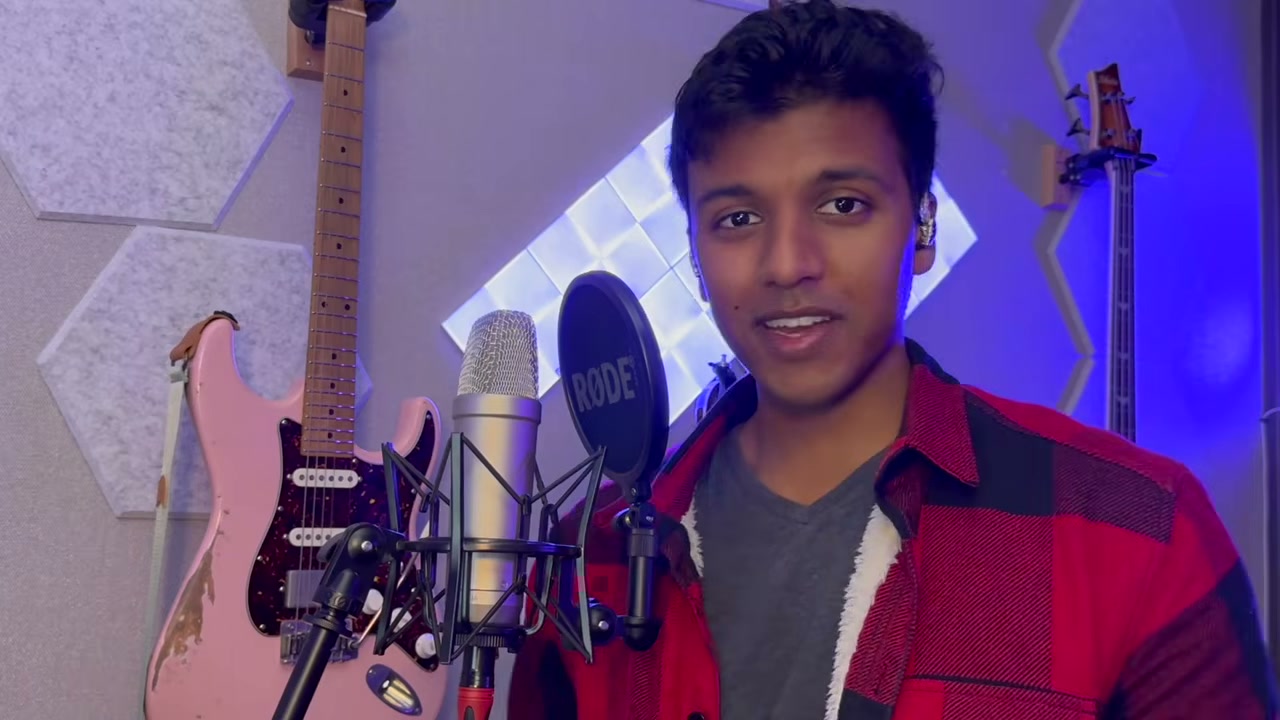
Neel teaches voice and guitar lessons online with Tunelark. View Neel’s profile
When the nerves are physical, treat them as physical
There is a moment where the fear stops being about ideas and becomes pure biology, the racing heart and the shallow breath. Mary Beth S. treats that head on. The nervous system exists to protect you from danger, and standing in front of an audience is a genuinely vulnerable state, so the body flags it. The pounding heart, in other words, is not a verdict on your talent. It is an alarm system doing its job, and alarm systems are not character flaws. Some singers move through the fear by talking themselves down and some do not, and either way the reaction is something to learn to handle rather than a sign of unfitness.
She teaches students to talk to that alarm system directly. One student had spent years singing softly and was afraid to belt, and the two of them had already spent about a year and a half building that coordination, so the sound was there and only the willingness to use it was missing. Mary Beth’s fix was a hand on the chest and a short set of spoken phrases repeated out loud, telling the body it was safe, that this was not hard, and that it had sung this before. After a few rounds, the held-back voice let go, and Mary Beth still calls the sound beautiful. The phrases did not build the belt. Eighteen months of technical work built the belt, and the phrases released it. The nerves did not vanish either. When the two of them recorded a duet later in the same lesson, the nerves came back. “The first recording, her nervous system flared again,” she says. The student settled it the same way and then delivered three clean takes. Being able to settle it is the whole skill, and Mary Beth tells the full story in our article on how performance anxiety lives in the nervous system.
That same theme, the inner critic loosening its grip, runs through how Alawna M. handles a singer stuck in self-correction. She describes stopping a student mid-song to ask whose rules they are following when they correct themselves, and how they know those rules are right. The student realized the rules were ones they had invented in their own head. Alawna followed it by asking whether singing needs rules at all, or whether a singer can stay in the present moment and be allowed to make mistakes. Her point, which she develops in our article on singing through performance anxiety, is that flawless performances simply do not exist, and that real singing calls for raw, unedited, authentic vocals rather than a perfect take.
What it looks like on the other side
None of this is theoretical, and the payoff can be dramatic. Norwood tells the story of a student who had never sung for another person and wanted lessons purely for the enjoyment of it. About a year in, Norwood says, the student felt ready to sing for other people. He answered a local band’s search for a singer, auditioned, and got in. Within a few months the band was performing at local venues and festivals. Norwood calls watching a student travel from afraid to sing for one person to performing on a stage the most rewarding part of the work.
Sydney describes the turning point from the inside, the moment a student stops trying to sound good and starts simply communicating. The voice gets more resonant, vibrato starts to appear, the whole body relaxes, and the student’s eyes widen as they realize their body already knew what to do once they stopped aiming at singing well and started aiming at saying something. That is the breakthrough the fear was hiding all along, and it is the same kind of breakthrough moment teachers across every instrument live for. The wall comes down, and the voice that was always there finally gets to come out.
The first lesson is not an audition
If there is one thing to take from teachers who do this every day, it is that the fear of singing for someone is normal, that a good part of it is learned and can be unlearned, and that all of it can be worked with. It does not mean you cannot sing. It usually means the opposite, that your voice matters enough to you to feel exposed. A good voice teacher expects that fear, plans for it, and builds the early lessons specifically to make it safe. The first lesson is not an audition, and no one is keeping score.
If that is the wall between you and singing, it is a workable problem, and often the whole thing starts to shift in the very first session. It helps to know what learning to sing online actually looks like, why lessons over video suit many self-conscious singers, who often feel safer at home, and how a simple set of vocal warm-ups can give your nerves something steady to hold onto.
Find a voice teacher who makes it safe to start
Every teacher above teaches voice at Tunelark, and every one of them treats a nervous first lesson as the beginning of the work rather than a test you have to pass. If singing for someone has been keeping your voice smaller than it wants to be, the next step is finding the right person to sing that first phrase to. Browse our voice teachers and book a trial lesson with someone who will meet you exactly where you are.
Frequently Asked Questions
Why does singing feel more vulnerable than playing an instrument?
Because you are the instrument. As our teachers explain, when you play guitar or piano the sound comes from an object you can partly hide behind, but when you sing, the sound comes directly from your body and is tied to your emotions. That is why feedback on your singing can feel personal in a way that feedback on an instrument usually does not.
Is it normal to be scared to sing in front of a voice teacher?
Completely normal, and teachers expect it. Part of it is protective biology rather than a flaw, and part of it is usually learned from a small early experience of feeling judged. Both tend to ease over the first several lessons, and you can ask to slow down or swap any exercise that feels like too much.
What do voice teachers do to help nervous beginners?
They lower the stakes. Common approaches include treating singing as talking on pitch at first, giving you permission to make sounds without judging them, tailoring exercises to your comfort level, and teaching simple techniques to calm the nervous system, like grounding phrases or a warm-up that also slows your breathing.
Will I ever get past the fear of singing for people?
Very often, yes. One teacher describes a student who began too afraid to sing for a single person and, after about a year of lessons, auditioned for a local band and was performing publicly a few months later. The fear rarely disappears entirely, but it becomes something you can settle and work through rather than something that keeps you silent.
Do online voice lessons work if I am self-conscious about singing?
For many people they work especially well. Being in your own home can feel safer and less exposed than a studio, which helps self-conscious singers relax and focus. Learning to sing over video is well established, and a teacher experienced with online lessons will build the same safe, gradual first steps into the format.
Keep reading
About Jennifer Heath
I'm Jennifer Heath, VP of Operations at Tunelark and a lifelong singer. I joined the company in 2020 and oversee much of what makes Tunelark work for students and teachers: hiring, training and supporting our instructors, student support, marketing and day-to-day operations. I started voice lessons at 7 and sang with touring choirs through my teens. Music belongs in every life, for the self-expression, the discipline, the comfort and the simple joy of it.