Are Online Music Lessons Actually Good? An Honest Look
How Online Music Lessons Work
Not long ago, the idea of taking music lessons online would have seemed unusual. Today, it’s become one of the most popular models for music education, embraced by students and teachers around the world. If you’re new to it, you might be wondering exactly how online music lessons work, and whether they’re really as effective as the traditional alternative.
The short answer is yes for most students, on most instruments, with a few real limits worth knowing before you start. Here is the closer look, including the limits.
The Basic Setup
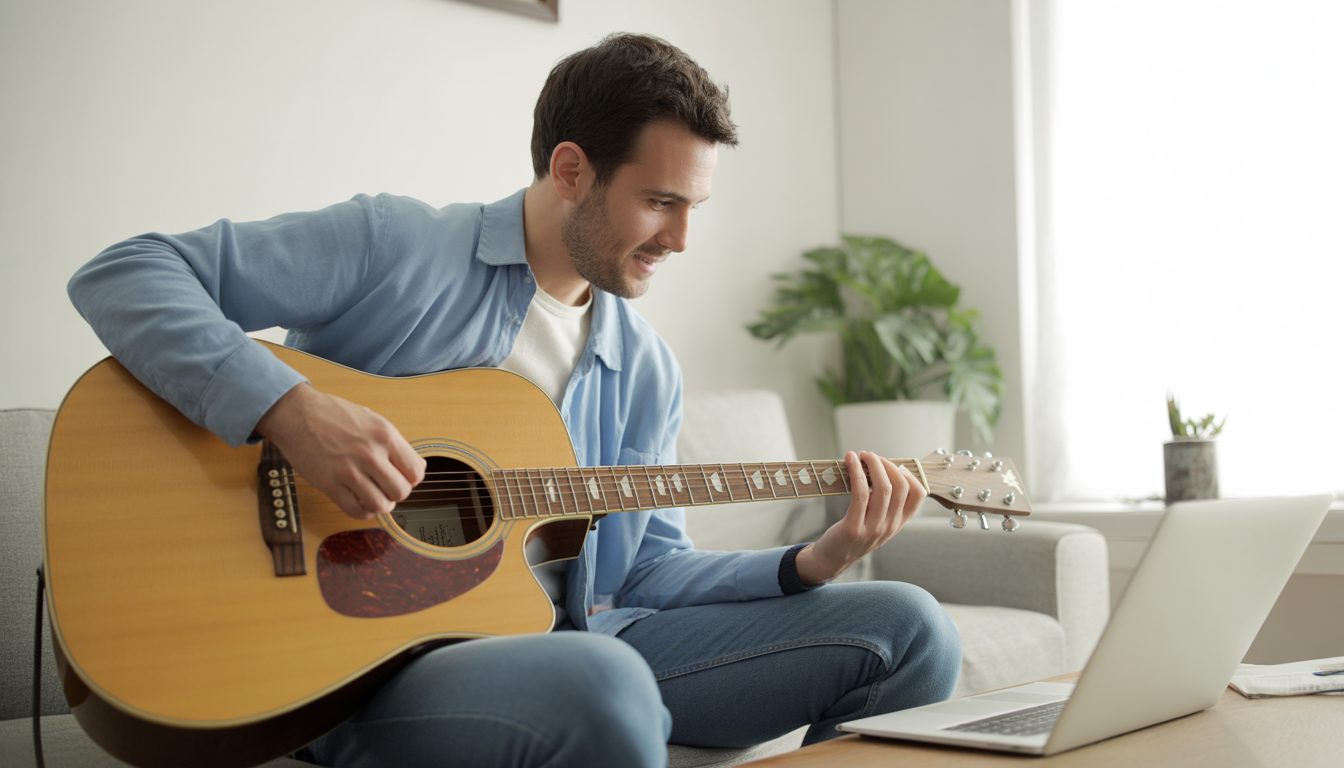
Online music lessons happen through video conferencing, typically Zoom, Google Meet, or a similar platform. You and your teacher connect at a scheduled time, see and hear each other in real time, and conduct a lesson just as you would in person, with the teacher demonstrating, giving feedback, and guiding your practice.
What you need to get started is minimal:
- A device with a camera and microphone (laptop, tablet, or desktop with webcam)
- A reliable internet connection: standard home broadband works well
- Your instrument, ready to play
- The video conferencing app your teacher uses (your teacher will let you know which one)
Most students are surprised by how quickly the online format begins to feel normal. Within a few lessons, the screen between you and your teacher fades into the background, and you’re simply focused on the music.
What a Typical Online Lesson Looks Like
A typical online music lesson follows much the same structure as any music lesson. It usually begins with a brief check-in: how was practice this week, any questions or struggles to address? Then comes work on whatever the student has been practicing.
The teacher listens carefully, watches your technique, and gives real-time feedback. If a specific technique needs demonstrating, the teacher plays it on their instrument so you can see and hear. Many teachers use a second camera angle to show their hands more clearly, or share their screen to display sheet music, diagrams, or notation software.
At the end of the lesson, the teacher typically assigns a practice plan (what to focus on, how to approach specific challenges) to guide the student’s work between sessions.
Why Online Lessons Are So Effective
Several factors make online music lessons particularly effective, some of which are genuine advantages over other formats.
Access to the best teachers. When you’re limited to teachers who live nearby, your options are constrained by geography. Online lessons remove that constraint entirely. You can work with a specialist in your exact instrument and style, regardless of where either of you lives. Students in smaller towns or rural areas have access to the same quality of instruction as students in major cities.
Consistency and flexibility. Online lessons are easier to fit into a busy life. No commute, no travel time, no logistics beyond opening an app. This makes it easier to maintain a consistent lesson schedule, and consistency is one of the biggest factors in musical progress.
Comfort of home. Many students, especially children and beginners, feel less self-conscious practicing and playing in their own space than in a teacher’s studio.
Recorded sessions. With permission from both parties, many online lessons can be recorded so students can review their teacher’s instructions and demonstrations between sessions. Recording is easier online, where the camera already points at the teacher.
What About Audio Quality?
This is the most common concern people have about online music lessons, and it’s a fair one. Video conferencing audio is processed and compressed, which can make it harder to hear subtle tonal nuances compared to live, in-room sound.
Experienced online music teachers have adapted their teaching to work within these limitations. They focus on what is clearly audible (rhythm, pitch accuracy, technique issues visible from the camera angle) and adjust their feedback accordingly. Before the first lesson, turn off the app’s noise suppression where it lets you (Zoom calls the setting Original Sound). Left on, it treats sustained notes and quiet playing as noise and drops them. With that set, a standard video call is sufficient for most students at most levels.
For advanced students working on very nuanced tonal details, some teachers and students invest in better microphones and audio setups. But for the vast majority of students, the standard setup works perfectly well.
Where the Format Falls Short
Three limits are real, and a fair answer to the question in the title has to name them. Latency means you and your teacher cannot play together in true time, so duets and play-along work happen in turn rather than at once. A teacher cannot reach over and reposition a hand, a bow arm or a shoulder, so physical correction has to be shown on camera and described in words instead of done. And on cello and double bass, where the instrument’s size and endpin setup are the whole early battle, a beginner gains from having someone in the room for the first few weeks.
Experienced online teachers work around all three, and for most students they cost very little. They are the reason the honest answer is yes for most students rather than yes for everyone, and they are worth weighing against your own instrument, your own level and the alternative teachers actually available to you.
What the Research Does and Doesn’t Say
The published research on online music instruction is smaller than the popularity of the format suggests, and most of it is descriptive rather than a controlled comparison, so we would not lean on it alone. What we can speak to is what we see across Tunelark: students who keep a weekly slot with a teacher who is comfortable on camera make the progress we would expect from a studio lesson. The flexibility of the format also makes a consistent lesson schedule easier to keep, and fewer missed lessons over a year is the clearest difference we see between students who progress and students who stall.
So, are online music lessons good? For most students, on most instruments, yes: the format holds up, and who teaches you matters far more than whether they are in the room with you. The limits are narrow, and none of them describes the average student sitting down to a weekly lesson. If you’ve been curious but hesitant, one trial lesson will answer the question for your own instrument better than any argument can.
What We Can Say From Our Own Lessons
The case above is mostly about how the format works. We can add something narrower, which is what happens when thousands of these lessons actually run.
Tunelark has billed thousands of thirty-minute lessons in the last six months. The problems that recur are not pedagogical, they are technical and fixable: noise suppression flattening a sung note, a platform’s default processing pumping the low end on a bass, a laptop microphone that cannot tell a cymbal from a clipped peak.
Most of what sounds like a limit of online lessons is a setting.
How to Find a Good Music Teacher on Tunelark
When you’re ready to start lessons, the right teacher is what turns intention into consistent progress. Many Tunelark teachers specialize in exactly the kind of student you are.
1. Open the teacher list and filter by your instrument.
2. Read bios. Look for teachers whose profile resonates with your specific goals. Generic bios are a yellow flag.
3. Book a trial and bring one specific goal to it.
After the trial, ask yourself: did the teacher seem genuinely interested in your goals, or were they running through a generic curriculum?
The trial lesson is there to find the right teacher.
Frequently Asked Questions
Are online music lessons as good as in-person?
For most students and most instruments, yes. The audio and video quality are now strong enough that experienced teachers can teach at a high level remotely. The biggest factor remains the teacher, not the format.
What instruments work best for online lessons?
Most of them work very well, including voice, piano, guitar and the common band and orchestra instruments. Drums and very loud instruments need decent microphone handling, which most platforms now manage well. Cello and double bass are the exception, for the reason given earlier.
What if the audio quality is bad?
Most issues come from the internet connection or a built-in microphone. A basic USB condenser microphone, which runs about $50 to $150 as of 2026, handles the microphone side, and running an ethernet cable from the router to the computer handles most of the rest, if the computer has an ethernet port. Neither is needed to start, and a built-in microphone is fine for a first lesson.
Can young children learn online?
Yes. Children 7 and up usually manage the format on their own, and for 5- and 6-year-olds most teachers want a parent within earshot but out of frame, handling setup and stepping in if the technology fails. Some ask for the parent beside the child to help with hand position, and the teacher will say which at the trial. Many young students thrive online: the comfortable home environment can help anxious learners. Look for teachers experienced with online kid lessons.
How can I make sure my online lesson goes smoothly?
Test your camera and microphone before the lesson, sit in a well-lit space, position the camera to show your hands and instrument, and have your music ready. Five minutes of prep makes a difference.
Keep reading
About Jennifer Heath
I'm Jennifer Heath, VP of Operations at Tunelark and a lifelong singer. I joined the company in 2020 and oversee much of what makes Tunelark work for students and teachers: hiring, training and supporting our instructors, student support, marketing and day-to-day operations. I started voice lessons at 7 and sang with touring choirs through my teens. Music belongs in every life, for the self-expression, the discipline, the comfort and the simple joy of it.