How to Help Your Child Practice Guitar at Home
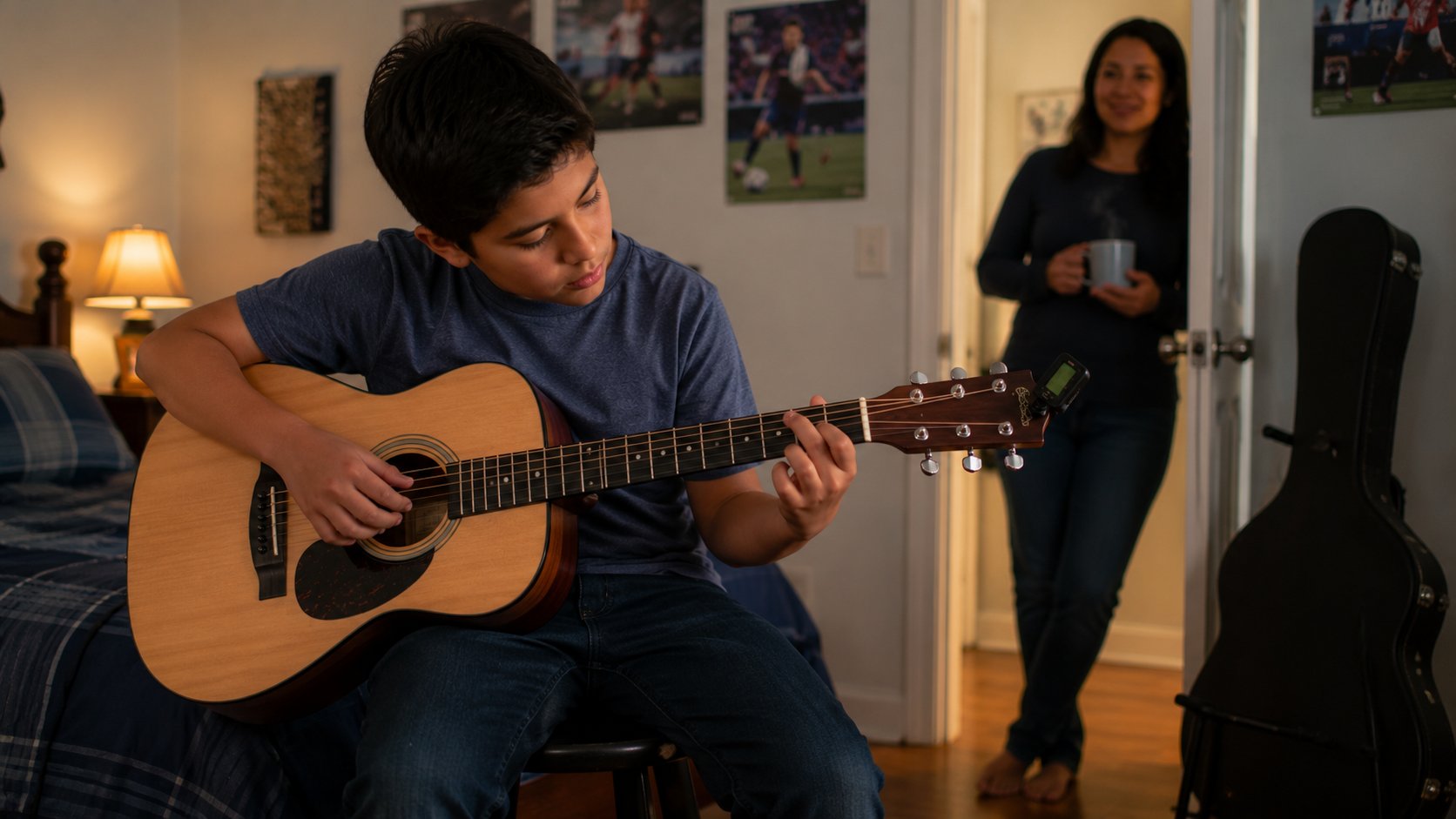
Guitar comes with its own practice dynamics. Unlike piano, it can be played in any room, and it is associated culturally with cool, which can either help or hurt depending on the child. Helping your child practice guitar effectively means leaning into what’s specific about the instrument, not just applying generic music-practice advice.
Here’s what works.
What Makes Guitar Practice Different
Three specifics that shape how guitar practice should go:
The early phase physically hurts. Beginner fingertips genuinely hurt for the first few weeks until calluses form. This is normal but discouraging if the child doesn’t know what’s happening.
Progress is uneven. Guitar students go through long plateaus followed by sudden jumps. Children who don’t understand this pattern get frustrated during plateaus.
The instrument lives wherever you put it. Unlike piano, the guitar can sit out and be picked up casually, or be put away in a case where it never gets touched. Guitar in plain sight is guitar that gets played.
These three together explain most of what makes guitar practice succeed or fail with children.
Practical Habits That Help
Keep the guitar visible and accessible. A guitar on a stand in your child’s bedroom gets played far more than one in a case in the closet. Don’t store it away “to protect it”, let it be lived with.
Use a timer and break practice into chunks. 10 minutes twice a day beats 20 minutes once for most children. Spacing practice out across the day generally beats one long block, and a short session is easier to protect on a busy weeknight than a long one.
Match practice expectations to the child’s level. A six-year-old needs 10-15 minutes. A 12-year-old can handle 25-45. Don’t push age-inappropriate practice durations. It backfires.
Distinguish practice from play. Some guitar time should be structured practice on assigned material, and some should be unstructured play: messing around, learning songs from YouTube, trying to play favorite riffs. Both matter.
Tune the guitar before every practice session. A clip-on tuner (around $15 to $20 as of 2026) takes 30 seconds and makes the instrument sound right. Out-of-tune guitar is the silent destroyer of beginner motivation.
When Fingertips Are Hurting
The first few weeks of guitar are physically uncomfortable. Two things help:
- Acknowledge the pain. Tell your child “your fingertips hurt because the calluses haven’t built up yet. They will in two to four weeks.” Knowing the discomfort is temporary makes it more bearable.
- Shorter, more frequent practice during this phase. Split the minutes your child already practices rather than adding to them. Three short sessions across the day are easier on sore fingertips than one unbroken block, so a six-year-old on 10 to 15 minutes might do two five-minute sittings, and a twelve-year-old on half an hour might do three.
Once the calluses form, the soreness fades, and it usually stays gone. A long break softens the fingertips again, and an unusually long session can leave them tender, but both settle quickly. Soreness that shows up for any other reason is worth raising with the teacher rather than waiting out. The usual causes are heavier strings, action set too high at the nut or bridge, or a new technique such as barre chords or bending that loads the fingertips in an unfamiliar way.
Avoiding Common Parent Mistakes
A few patterns that make guitar practice harder:
- Buying a guitar that’s too big. Children need appropriately sized guitars, and size follows height and arm length more than age. A guitar that is too large makes every early skill harder, from reaching the first fret cleanly to sitting up straight with the instrument, and it is one of the most common reasons a beginner sounds worse than they actually are. Have your child fitted in person at a music store rather than ordering by age alone. The rough age bands are in the sizing question at the end of this article.
- Buying a very cheap guitar. Sub-$100 guitars often have action so high that pressing the strings down hurts and clean notes are much harder to produce, though a proper setup at a shop rescues some of them. As of 2026, $150 to $300 buys a genuinely playable starter.
- Comparing your child to other kids’ progress. Guitar progress is highly individual. Some children take to it instantly; others develop over years.
- Becoming the practice coach. Resist the urge to correct technique, suggest exercises, or critique. Let the teacher teach. Your job is to make practice possible.
What to Do About Plateaus
Children plateau in guitar, sometimes for months at a time, often around barre chords or fingerstyle. During plateaus, motivation drops and quit-thoughts rise.
Tony G., who teaches guitar on Tunelark, sees the same stretch from the other side of the lesson, and he has watched short daily sessions carry students through it, usually further than anyone expected.
“Even when progress feels slow, those few minutes a day are building skills beneath the surface.”
A few things that help:
- Name the plateau. “Your teacher said you’re working on getting cleaner chord changes. That takes time. You’re not stuck, you’re building.”
- Bring a fun goal into focus. Pick a song they love and work toward playing it. The plateau becomes the path to something concrete.
- Talk to the teacher. Sometimes a plateau means the current material isn’t challenging anymore. Other times it means the material is too hard. The teacher can adjust.
- Build in occasional performance moments. Playing for grandparents, a sibling, or a class can reset motivation when daily practice feels stale.
When Your Child Wants to Switch to Electric
Many kids want to switch from acoustic to electric guitar at some point. This is usually a good thing. Interest matters more than instrument purity. Most teachers can teach either, and switching can renew motivation through the gear excitement alone.
If your child wants to switch:
- Talk to the teacher first to make sure it makes sense pedagogically.
- Buy a beginner electric setup, guitar plus a small amp, for under $300 as of 2026.
- Plan for the noise: practice amps with headphone outputs solve the apartment problem.
How to Find a Guitar Teacher on Tunelark
Every Tunelark teacher is vetted by working musicians and educators for teaching quality before they can list. To get started:
1. Open the teacher list and filter by guitar.
2. Read bios. Look for teachers who specifically mention working with children.
3. Book a trial lesson with one whose approach feels right. The first lesson with a new teacher is $25 off that teacher’s 30-minute rate.
4. After the trial, ask your child how they felt. The right teacher inspires the child to want to practice. That’s the most important indicator.
Guitar practice doesn’t have to be a fight. With the right setup, realistic expectations, and a teacher who motivates your child, daily guitar time becomes something they look forward to.
Frequently Asked Questions
How long should my child practice guitar each day?
Ages 5-7: 10-15 minutes. Ages 8-10: 15-25 minutes. Ages 11 and up: 25-45 minutes. Daily short sessions beat occasional long ones, and splitting a younger child’s minutes into two shorter sittings is normal and often works better.
What size guitar does my child need?
Size follows height and arm length more than age, but as a rough guide: 1/4 size for the smallest beginners around ages 4-5, 1/2 size around ages 5-7, 3/4 size around ages 8-10, 7/8 or full size from about age 11, and full size for nearly all children 12 and up. A music store can help fit your child precisely.
Should I correct my child’s technique during practice?
No. Leave the teaching to the teacher. Your role is to make practice possible, not to teach. Correcting in real time usually backfires.
What if my child wants to learn songs that aren’t in the lesson plan?
That’s almost always a good thing. Talk to the teacher about how to incorporate songs your child wants to learn into the lesson sequence. Engagement matters more than curriculum purity.
When should we upgrade from a starter guitar?
When your child has been playing consistently for a year or two and shows continued commitment. A mid-range guitar, around $400 to $800 as of 2026, is the typical second instrument and lasts well into adolescence and beyond.
Looking for an online guitar teacher? See our full Online Guitar and Bass Lessons page for everything you need to know about getting started.
Keep reading
About Jennifer Heath
I'm Jennifer Heath, VP of Operations at Tunelark and a lifelong singer. I joined the company in 2020 and oversee much of what makes Tunelark work for students and teachers: hiring, training and supporting our instructors, student support, marketing and day-to-day operations. I started voice lessons at 7 and sang with touring choirs through my teens. Music belongs in every life, for the self-expression, the discipline, the comfort and the simple joy of it.