Should You Switch Instruments, or Push Through? How a Multi-Instrumentalist Helps Students Decide
A few months into lessons, a familiar moment arrives for a lot of students. The guitar that felt so exciting in week one now feels like homework, and the piano across the room starts to look a lot more appealing. The pull toward a different instrument can show up at any age, and it almost always brings the same quiet worry with it. Is wanting to switch a sign that the student chose an instrument that does not fit, that they are about to quit, that they will never really learn any one thing?
That worry is worth taking seriously, because sometimes a switch is exactly right and sometimes it is just the friction of learning showing up on schedule. Telling the two apart is the hard part, and it is a question the best teachers face all the time.
Neel S. is a good person to ask, because he has lived it from every side. He is a guitar and voice teacher at Tunelark and a multi-instrumentalist who came to music as a kid through classical piano, walked away from it, fell hard for the guitar, and then circled back to the piano years later and learned to love it. His take on switching instruments is not a simple yes or no. It is closer to a way of listening to what the pull is actually telling you.
The difference between “not your instrument” and the normal friction of learning
Neel’s first move is to take the pressure off the question, because some amount of struggle is built into learning anything with strings or keys or a voice. Every instrument comes with friction, he says: hands have to adapt, vocal cords have to be trained, and muscle control has to be built. The awkward, unrewarding feeling of the early weeks is not a verdict. It is the price of admission on every instrument there is, and feeling it does not mean a student chose badly.
He knows the feeling from the inside. “I started learning classical piano as a child. I loved music so much, but I was really struggling to fall in love with the piano. I would practice, but it didn’t feel all that gratifying to get the piece.” Looking back, he can see why: he never got to choose his own music, and a strict, traditional approach did not fit how he learned. So he set the piano down, and before long the guitar started calling to him. The moment he picked it up, everything changed. “I was learning so quickly, playing and singing songs within weeks,” he says. “I was absolutely in love, and it became a huge part of my life, even being my entrance into singing songs on stages all over the world.”
That contrast is what makes his test for students so useful. The right instrument, in his telling, keeps showing you that it is worth it at every step. You hear someone else play it and want to go practice. You spend hours on one passage and the moment it lands feels like magic. The frustration is the same on either instrument; what differs is whether, underneath it, the instrument keeps pulling you back. A student who fights the same passage and then lights up when it clicks is on the right instrument. One who never feels that pull, however dutifully they practice, may just not have met their instrument yet.
The catch is that you cannot run the test from the sidelines. You cannot tell a bad fit from ordinary frustration, Neel says, without giving yourself the chance to find out. That cuts both ways: it argues for staying with an instrument long enough to feel whether it pulls you back, and it gives permission to genuinely try another one. And Neel’s own story is the reassurance: he returned to the piano years later, now genuinely enjoys it, and teaches it, though on Tunelark he offers guitar and voice. Leaving an instrument was not a door slamming shut but one he got to walk back through on his own terms. It helps to know going in what beginning music lessons are really like, so the ordinary difficulty of a first term does not get read as a bad fit.
That gives a workable rule, and it is worth settling before the question turns emotional. Give the current instrument a full term, three months or so, before treating the pull as a verdict, because the early friction feels the same on everything. Through those months, pushing through has a shape: keep one piece the student actually likes in rotation, let the teacher change the material rather than the instrument when a week goes badly, and keep practice short and frequent rather than long and dutiful. Then read the pull across weeks rather than inside one. A wish for a different instrument that keeps returning once the hard week has passed is the signal, and a bad Thursday is not. Before any switch, ask the teacher for half a lesson on the new instrument, which tests the pull without ending anything.
One student, three instruments, and the goal underneath all of them
The clearest picture of how Neel handles a switch is a student who started on voice with a wonderfully specific goal: to sing comfortably and confidently at a campfire.
To get there, they brought in a guitar to accompany the singing, and it was not long before the student asked whether they could do guitar lessons too. Neel said yes, and they worked through the basics until the student could jam a little. Then something interesting happened. As Neel taught music theory using the piano for its visual clarity, the student decided they wanted to try piano, which seemed like a “simpler layout” to them. A couple of lessons in, Neel says, the student was genuinely enjoying the piano, and it revived his interest in guitar and voice as well, approached from the keyboard first.
Notice what did not happen. The student did not abandon voice when they picked up guitar, or abandon guitar when they picked up piano. Each instrument fed the others. The piano made the theory visible, the theory made the guitar make more sense, and it all came back around to the original campfire dream.
That is the principle Neel keeps in view whenever a student wants to switch. He is not protecting a particular instrument; he is protecting the student’s relationship with music. “My thought process was, if I can help you to enjoy improving at music, you can play any instrument you’d like,” he says. When the underlying goal is enjoying the process of getting better, the instrument in your hands this month stops being the thing at stake. It is also why Neel’s answer to a restless student is often not a switch at all but an addition, and why the suggestion sometimes comes from him rather than from the student.
When the teacher is the one who suggests adding an instrument
Here is the part that surprises people. Sometimes the person who raises the idea of a new instrument is not the student. It is Neel.
“I have occasionally encouraged my voice students to learn guitar or piano, either first or in tandem with voice,” he says. The reasoning is not that voice falls short. It is that every instrument has its own strengths and its own blind spots, and pairing two can cover for both. He describes the voice as “a functionally invisible instrument,” and the phrase is precise: “you really only know if you’re singing something right if you can hear what it’s supposed to sound like.” There are no frets to look at and no keys to press, so a singer who cannot yet picture a scale has little to hold onto. “If you struggle to hear the scale and therefore sing it,” Neel says, “perhaps learning to play the scale on the piano would help clarify the notes.” A visual instrument turns an abstract sound into something you can see, and the ear catches up fast once the eye gets involved.
The voice has a second limit that a second instrument quietly solves. “Another weakness of the voice is that it is monophonic and cannot play chords without a choir or the ability to record,” he says. Picking up a piano, guitar, or ukulele changes what a singer can do alone. “You can sing and play all sorts of songs and have it sound performance-ready all by yourself.”
This reframes the whole idea of switching. Often the most useful move is not trading one instrument for another but adding a second one to target the exact thing a student is stuck on. “It usually works out to have my students learn the instrument that will target the source of their plateau,” Neel says, “especially if it helps them improve their general understanding of music.” When progress stalls, the cause is sometimes a missing piece of understanding rather than a lack of effort, so the instrument itself is rarely the first thing to suspect. And the payoff compounds. “Any instrument can be your main,” he says, “but you find that the more you understand about music, the easier every instrument gets.” A second instrument is not a distraction from the first. It is often the fastest way to get better at it. Before deciding an instrument is at fault, it is worth looking closely at what is actually happening when a student hits a plateau.
Permission to try more than one wand
Ask Neel to sum up how a student should think about all of this, and he reaches for an image rather than a rule. “Find your magic wand, and then make magic,” he says. “It’s ok to try a couple of wands, or even pick more than one. Just make magic.”
It is a generous way to think about an anxious decision, and it lands especially hard for parents watching a child drift toward a different instrument, or for adult beginners quietly wondering if they bet on the one that fits. The fear in both cases is that exploring means flaking, that a real musician picks one thing and grinds. Neel’s experience points the other way. “There’s nothing wrong with learning two instruments at the same time to see which one you’re more drawn to,” he says, and the pull can run opposite to his own. “I’ve had students who feel the opposite of me, as they are much more drawn to the piano than the guitar for its sound, simplicity in layout, and ease of getting a clear tone. It’s completely a personal journey, and as a teacher, I’m here to guide my students through it.”
What draws a person to an instrument is real and worth honoring. For Neel, the guitar won out for a feeling he could name. He grew up watching artists like John Mayer and Jack Johnson move people to tears, and what he saw in both was freedom. “I found that feeling quickly on the guitar,” he says, “and the ability to express myself in every note with bends, slides, dynamics, and tons of technique is what draws me to both guitar and piano.” That kind of pull is not a tiebreaker to overrule. It is information about which instrument a student will actually keep showing up for.
It also tracks with the most surprising thing teaching has taught him about people, which has almost nothing to do with talent. What makes the best music and the best musicians, in his account, is energy, a willingness to put in the time, curiosity, the readiness to ask questions, and love, with room left for happiness. He rates all of that well above innate talent. Energy, curiosity, and love are exactly the things a rigid one-instrument rule can quietly drain, and exactly the things a well-timed switch can restore. They are also what Neel sees in the moment that still makes teaching worth it after a decade of it: when students come in lit up about a new song, willing to go out of their way to practice something even when it is hard.
For parents, exploration is part of learning rather than evidence of quitting. Whether the answer turns out to be guitar, singing, piano, or some combination, the instrument that earns a student’s practice is the one worth chasing.
About Neel
Neel teaches guitar and voice at Tunelark, and his perspective comes from a genuinely multi-instrument life. He is a Nashville-based recording artist and session player with a Performance and Songwriting degree from Berklee College of Music and over a decade of teaching behind him, and he has studied a range of genres while performing all over the country. He works across blues, jazz, pop, and rock on guitar, and pop, rock, jazz, musical theater, and songwriting in the voice studio, and as a multi-instrumentalist he plays piano as well.
His teaching follows the same belief that runs through everything above: there is no one-size-fits-all lesson plan. He builds lessons around each student’s own favorite songs and their own pace, and he specializes in teaching how songs are actually built, so students can write their own music, learn faster, and play by ear. Most of his students end up working on something like “Hypotheticals” by Lake Street Dive, packed with great chords, quick transitions, and a memorable melody, or “Cosmic Sans” by Cory Wong for the guitar players, though he always puts the student’s own song choices first. The through-line is the one he keeps coming back to: “Music is the magic force; the instruments are just how we channel it.”
Performance · Why Georgia
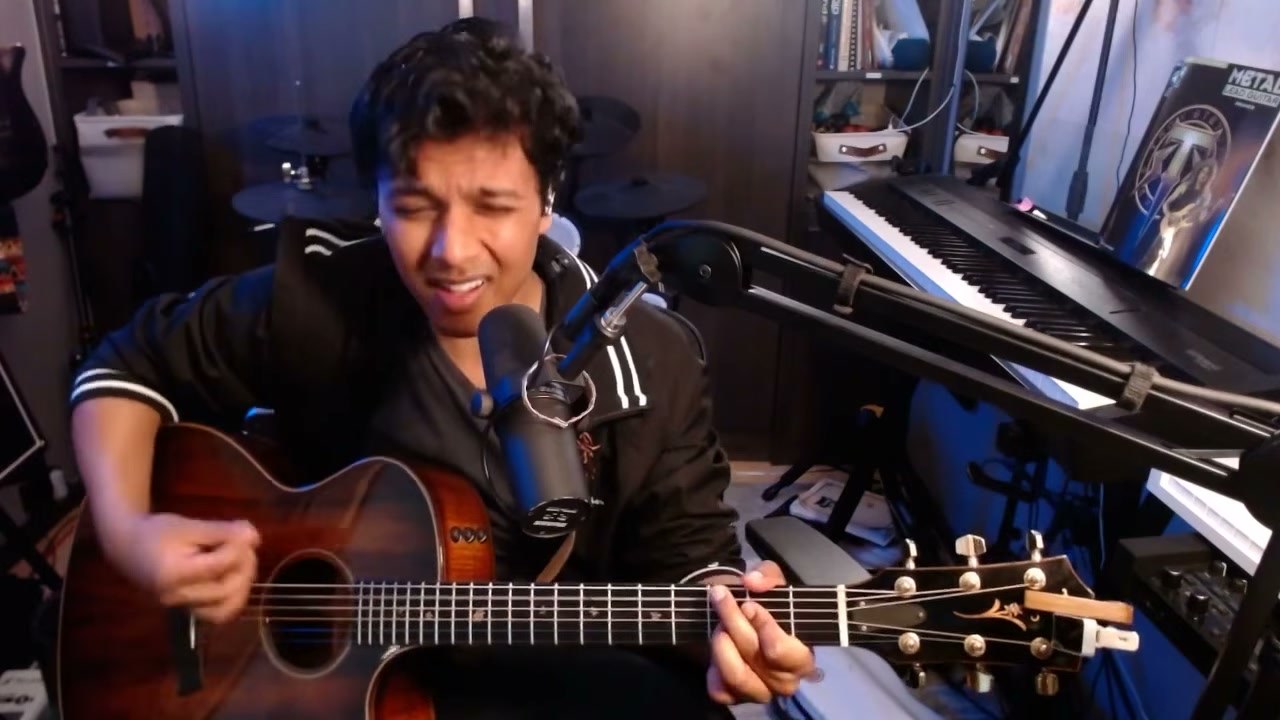
Neel plays Why Georgia. View Neel’s profile
Ready to find your instrument, or your next one?
If you have been wondering whether to switch instruments, add one, or stick with the one you have, the most useful thing is a teacher who will help you read the pull instead of guessing at it. Neel does exactly that, with the lived experience of someone who has left an instrument, found another, and come back around to the first one with new love for it. Neel is currently accepting new guitar and voice students at Tunelark. Find your wand, and make some magic.
Frequently Asked Questions
Is wanting to switch instruments a sign my child is about to quit?
Usually not. Curiosity about a different instrument is more often a sign of engagement than of giving up, and the early weeks of any instrument carry the same friction, so restlessness can just be that friction talking. What matters is whether the pull is still there once the hard week has passed.
How do I know if an instrument isn’t the right fit, or it’s just normal frustration?
Neel’s test is whether the instrument shows you it is worth it along the way. Frustration alone is not the signal, since every instrument involves long stretches of working at the same thing. The signal is the pull underneath: hearing others play moves you to practice, and landing a hard passage feels like magic. If that pull is there, you are likely just meeting normal resistance. If it never appears, another instrument may fit you better, and you can only tell by giving one a real chance.
Should a beginner learn two instruments at once?
It can work very well, especially when the second instrument covers a blind spot in the first. Neel sometimes encourages voice students to add piano or guitar, because a visual instrument makes pitch easier to see and train, and accompanying yourself sounds complete on its own. The main limit is practice time, so a busy student can focus on one at a time while still exploring both.
Does learning a second instrument slow down progress on the first?
More often it speeds it up, though not by itself. Much of what makes an instrument hard is understanding music itself, and that understanding transfers, which is Neel’s point when he says that the more you understand about music, the easier every instrument gets. The cost is practice time, so the honest version is this: a second instrument chosen to clarify theory or rhythm usually pays for itself, and one added out of restlessness alone usually just splits the week.
My child wants to switch from one instrument to another. What should I do?
Start by talking with the teacher rather than deciding alone. A good teacher can tell a passing whim from a steady pull, and can offer a half-lesson on the new instrument so your child tests it without fully leaving the first. Keep the real goal in mind: your child enjoying and improving at music, not loyalty to one instrument.
Looking for an online guitar teacher? See our full Online Guitar and Bass Lessons page for everything you need to know about getting started.
Keep reading
About Jennifer Heath
I'm Jennifer Heath, VP of Operations at Tunelark and a lifelong singer. I joined the company in 2020 and oversee much of what makes Tunelark work for students and teachers: hiring, training and supporting our instructors, student support, marketing and day-to-day operations. I started voice lessons at 7 and sang with touring choirs through my teens. Music belongs in every life, for the self-expression, the discipline, the comfort and the simple joy of it.