Is Trombone Hard to Learn? An Honest Starting Guide
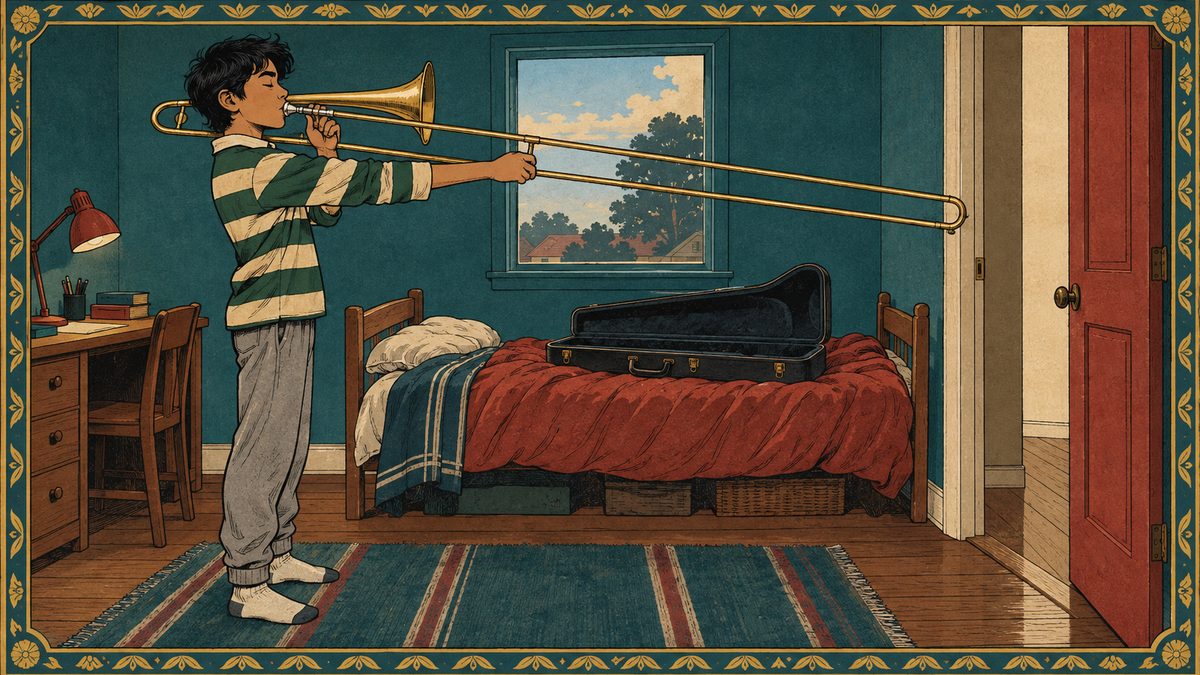
Trombone is one of the easiest brass instruments to get a note out of and the hardest to play in tune, and both facts come from the same feature: a beginner’s trombone has no valves, no keys and no frets. Nothing on the instrument marks where a note lives. Your right arm is the tuning mechanism, and your ear is what tells it where to stop.
That trade shapes the whole first year. A beginner who understands it stops being frustrated by the thing that is supposed to be hard and starts working on it.
There Is Nothing on the Instrument Telling You Where to Stop
Most instruments give you a target you can feel. A clarinet key is either pressed or it is not. A piano key is where it has always been. A trombone has seven positions along a smooth slide, meaning seven places to stop it, each one a half step lower than the last. The only one your body can find without listening is first, because that is where the slide stops when it is closed.
Two things in that picture do most of the explaining. The positions are much further apart than beginners expect, so seventh is most of an arm’s length out. And the gaps grow as the slide goes, from about three and a third inches between first and second to about four and a half between sixth and seventh, because lengthening a tube by one half step takes more added length the longer the tube already is.
That growth is the reason the outer positions are the ones that go wrong. A player who learns the feel of the inner positions and assumes the spacing is even stops the slide short in sixth and seventh, and plays them sharp.
None of this is marked on the slide. The arm learns the distances by being corrected by the ear, and tape on the slide gives the arm a target instead of the ear.
What This Makes Genuinely Easy
Two things, and they are real advantages for an absolute beginner.
There is almost no fingering to memorize. A woodwind beginner spends the first months learning which combination of holes and keys makes each note, and gets it wrong constantly. A trombonist learns seven positions and then spends their time on sound instead. Reading is simpler too, because a trombone part is a single line with no chords, usually in bass clef, the staff low instruments read from, and our guide to reading sheet music as a beginner covers it.
The mouthpiece is forgiving. It is much larger than a trumpet’s, and a first sound usually comes out of it quickly. A flute beginner is more often looking at a week or two before a real note arrives.
The Two Skills That Actually Take the Time
The ear. On a trombone, playing in tune is not a by-product of pressing the right thing. It is a continuous act of listening and adjusting, on every note. This is the genuinely hard part, and it is why trombonists cannot avoid developing an ear.
The drill that builds it is unglamorous. Play a long note in first position, listen to it, then move to second and back, listening for the point where the note settles rather than watching the slide. Do it with a drone or a tuning app sounding the target pitch, so your ear has something to match against rather than an abstract idea of correct.
The air. Trombone takes more air than beginners expect, and a thin sound is usually air rather than lips. The fix is boring and effective: long tones, as slow and steady as you can hold them, several minutes a day. Our guide to practicing music at home covers building that into a session that actually happens.
Neither skill is difficult to understand. Both take months.
The One Physical Gate
School programs start brass somewhere between about nine and twelve, which is when beginning band runs rather than when a body is ready, and the one thing that can hold a child back is arm length. Sixth and seventh position sit about nineteen and twenty three inches beyond the closed slide, and a small child cannot get there.
Schools handle this in two ways: a shorter model, or a slide handle that extends the grip. Many beginners also spend their first year using only the inner positions, since beginning band parts stay mostly in the first four, and grow into the rest. A band director checks this at a fitting, and our guide to what age a child can start music lessons covers the wider question of physical readiness.
Adults have the opposite situation. The reach is a non-issue, and an adult can usually work on intonation, meaning how in tune each note lands, deliberately from the first month. Our guide to starting music as an adult covers what else changes with a later start.
Why Short Practice Beats Long Practice Here
The muscles that hold a brass embouchure, the lip shape that makes the note, fatigue quickly for the first few months, which means short frequent practice genuinely outperforms long occasional sessions. Fifteen to twenty minutes a day, five or six days a week, does more than an hour twice a week, and on brass it is better still split into two short sittings.
Stopping while the sound is still good is the part beginners skip. When the tone goes, the session is over; playing through it trains the wrong shape.
For a sense of scale, one published district curriculum sets its beginning-level trombone outcome at playing written F below the staff up to middle C consistently, by the end of a first band year. That is an octave and a fifth, and it is a year’s work. Brass range builds slowly next to woodwinds and strings, and that is normal rather than a sign of trouble.
The thing that surprises people is how early it is possible to play with others. A trombone part in beginning band is often long, simple notes, which is exactly what a beginner can do, and playing in a section helps intonation because you can hear yourself against everyone else.
Who Decides Whether the Ear Develops
A teacher matters here because the feedback loop is the whole skill, and a beginner cannot yet hear their own errors.
Collin H., who teaches trombone on Tunelark, is a music education student at the University of Miami studying classical trombone, has played for over ten years and has taught for six through private lessons and elementary school internships. A parent of two of his students wrote that he addressed errors that previous lessons had overlooked.
Sophie P. teaches trumpet, trombone and euphonium, so a student who starts on one and moves to another brass instrument does not have to start again with someone new. Our guide to private lessons alongside school band covers how a private teacher and a band director divide that work.
How to Find a Trombone Teacher on Tunelark
Tunelark connects you with deeply vetted brass teachers who teach online. Vetting is run by working musicians and music teachers, not a general recruiter, and every teacher sets their own rate and shows it on their profile. Scheduling, billing and support are handled for you.
- Open the teacher list at tunelark.com/find-a-teacher and filter by instrument, then read the bios and watch any video a teacher has posted.
- Read for whether a teacher works with beginners and whether they cover the other low brass, which makes a later switch painless.
- Book a trial lesson at $25 off the teacher’s 30-minute rate, with the instrument out of its case and warmed up.
- Ask them to listen to your long tone and say what is wrong with it. That answer is the whole instrument.
Frequently Asked Questions
Is trombone harder than the valved brass?
It is harder in one specific way and easier in several others. Valves hand you a fixed set of fingerings; a slide hands you nothing and asks your ear to place every note. In exchange there is no fingering chart to memorize and the first sound comes easily. Someone with a good ear tends to enjoy the trade.
Can I learn trombone as an adult beginner?
Yes. The one thing to respect is the lip: embouchure muscles fatigue fast in the first months at any age, so an adult who practices for an hour on day one will have nothing on day two. Short and often is not a concession, it is the training.
Do I need to read bass clef before I start?
No, it is taught alongside playing. Worth knowing early: trombone is usually written in bass clef, but orchestral parts move into tenor clef for higher passages, and British brass band parts are written in treble clef instead. None of that arrives in a first year.
What does the F attachment do?
It is a valve on many step-up trombones that adds tubing and opens up notes below the straight instrument’s range, and it also gives alternate positions for notes that would otherwise need a long reach. Beginners generally start without one and do not miss it.
Can trombone be taught over video?
Yes, and the slide is easier to see on camera than a woodwind’s fingers, because the movement is large. Set the camera to your left side so the teacher can see the slide travel and your posture at once, and switch your video app out of its speech mode so the low notes survive the call.
Keep reading
About Jennifer Heath
I'm Jennifer Heath, VP of Operations at Tunelark and a lifelong singer. I joined the company in 2020 and oversee much of what makes Tunelark work for students and teachers: hiring, training and supporting our instructors, student support, marketing and day-to-day operations. I started voice lessons at 7 and sang with touring choirs through my teens. Music belongs in every life, for the self-expression, the discipline, the comfort and the simple joy of it.