The Questions Music Lessons Cannot Skip About AI
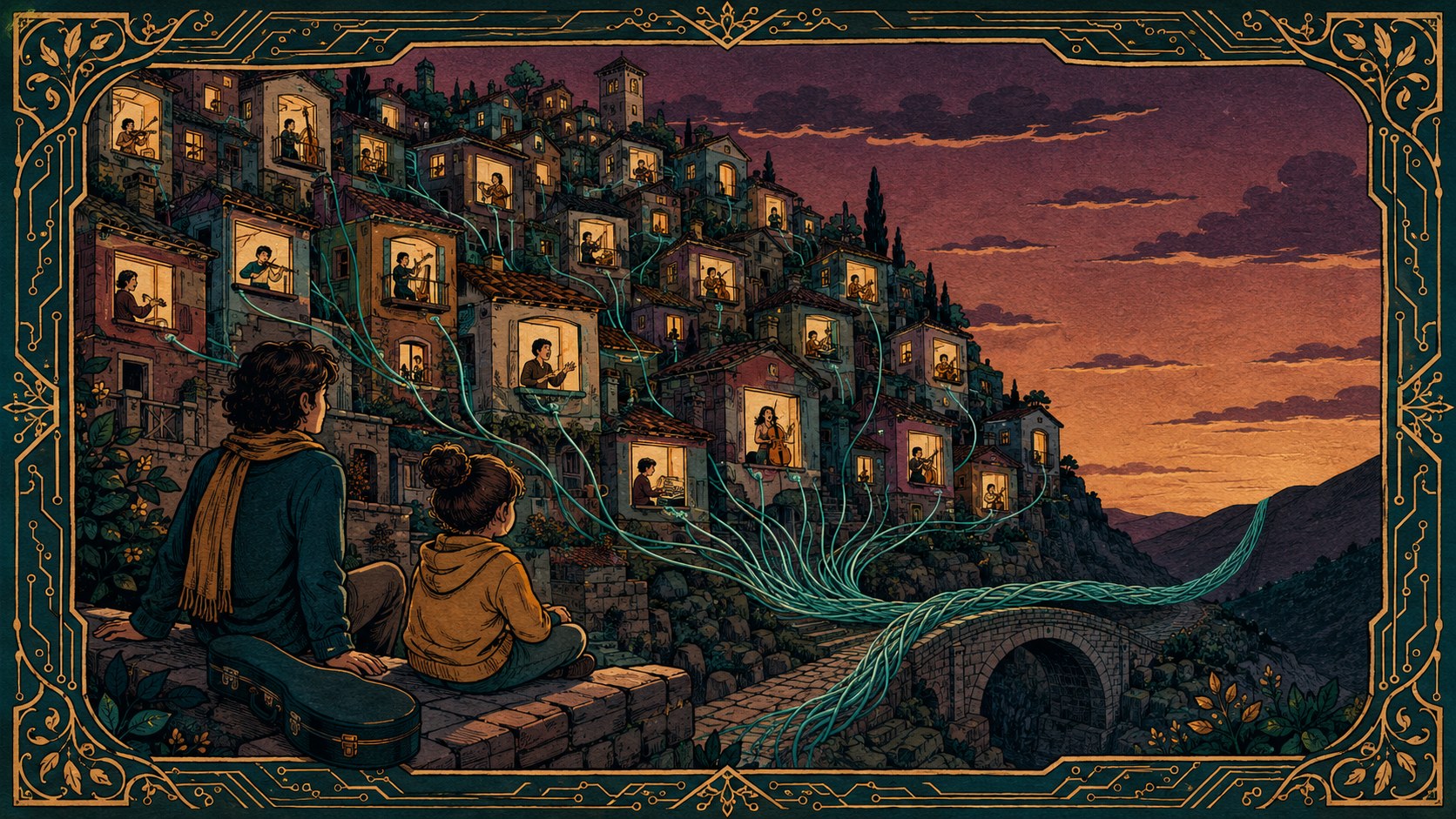
Most conversations about AI ethics in education are conducted at a height where nothing can be decided. This one is not, because music lessons have specific properties that make several of these questions concrete rather than abstract.
Music learning involves microphones. Often cameras. Recordings of a person’s voice or playing, made in their home, frequently a child’s. It involves creative work that somebody owns. And it involves a relationship with a teacher that is the actual product, not a wrapper around content delivery.
That combination means the ethical questions here are not abstract. They have answers, and you can ask for them.
A framework that is actually usable
The most useful organizing structure in this field comes from William I. Bauer’s chapter in The Oxford Handbook of Artificial Intelligence in Music Education, published in August 2026. Bauer examines AI in K-12 and higher music education and sorts the ethical terrain into nine areas of concern.
The nine are: data privacy and security; bias, equity and fairness; transparency and explainability; academic integrity and authenticity; intellectual property and copyright; dependency and skill development; the evolving role of the music educator; accessibility, inclusion and opportunity; and student voice and agency.
What makes it useful rather than decorative is that each one converts into a question a parent or an adult learner can ask out loud. The chapter’s own framing is worth borrowing too: it opens by observing that AI has provoked fears of diminished skills and lost authenticity in the way earlier technologies did, and that the impact of a technology depends less on the tool than on how educators and institutions choose to implement it.
That is the through-line of everything below.
Privacy, which is first for a reason
Bauer puts data privacy and security first, and in music it is the one with the most physical reality.
To assess your playing, a system has to hear it. That means a microphone in a room in your house, often a child’s bedroom, frequently running while other people are talking. Some systems use a camera to assess posture and hand position, which means video of a child in their home. Bauer’s chapter is the right place to start on this, because it treats privacy as a question about institutions, consent and retention rather than as a technical property of the software.
The questions worth actual answers:
Are recordings stored, or processed and discarded? There is a large difference and vendors are often vague about it.
If stored, for how long, and can you delete them?
Are they used to train models? This is now a standard practice and a standard disclosure, and a company that will not answer it plainly has told you something.
Who inside the company can access them? “Encrypted” is not the same as “nobody looks.”
If the student is a minor, what applies? In the United States there is a concrete legal floor here rather than a matter of vendor goodwill. Under the Children’s Online Privacy Protection Act, an audio or video recording containing a child’s voice or image is personal information, so an operator collecting it from a child under 13 needs verifiable parental consent first. The amended rule, with a compliance date of April 22, 2026, also limits how long that data may be kept, so indefinite retention is not permitted, and it requires separate verifiable consent before a recording is disclosed to a third party, unless the disclosure is integral to the service the parent signed up for, which is how routine cloud processing of a recording is usually treated. Where the tool arrives through a school, FERPA and state student-privacy laws apply on top of that. The questions above are how you check that a vendor is meeting the floor, because meeting it is not optional and saying so is not a favor.
You will not always get answers. Not getting one is itself information.
Bias, and why it bites harder in music than people expect
Bias in AI is usually discussed in terms of who a system works less well for. In music there is a second layer: what counts as correct.
Every automated assessment encodes a judgment about right and wrong. In-tune means in tune relative to a tuning system. Correct rhythm means correct relative to a metrical grid. Good tone means resembling some reference. Those are all choices, and they are overwhelmingly drawn from the Western classical tradition, because that is where the notation and the theory these systems are built on come from.
A student playing music with different intonation practices, different rhythmic conventions, or a different tonal ideal can be marked wrong by a system that is simply measuring against the wrong reference. A 2026 review in Discover Education lists dataset bias and cultural sensitivity among the field’s central open problems. Lee Cheng’s 2025 article in Arts Education Policy Review on generative AI in school music education makes the same point from the policy side, arguing that concerns about cultural bias, originality and equity require careful regulation rather than being left to individual discretion.
The practical question: does this system know what tradition it is judging from, and does it say so? Very few do.
Transparency, or why “the app said so” is not a reason
Bauer’s third area is transparency and explainability, and in practice it is the one students collide with daily.
A system tells you a passage was wrong. It does not tell you why, because it often cannot. You are left to guess at the cause, and people guess in the direction of whatever the system appears to be watching. That is not a small usability complaint. It is how a narrow measurement quietly reorganizes a person’s practice, as when instant feedback backfires shows.
Worth asking: does this tool tell you what it measured, or only that it disapproved? Can a teacher see the same information? A judgment nobody can inspect is not feedback, it is a verdict.
Authorship, which is genuinely unsettled
Bauer’s areas on academic integrity and on intellectual property both point at the same live question, and a second chapter in the same handbook, by Emmett J. O’Leary and Kimberly Goddard Loeffert, takes it up directly. Their chapter traces the evolution of copyright from all-rights-reserved licensing through Creative Commons and participatory culture, and into the questions AI now raises about authorship, ownership and the works that inform an AI system’s responses.
A third chapter, by Rubén Carrillo, Luis del Barrio and Patricia A. González-Moreno, examines AI in music creation and reports that while these tools can serve artistic exploration and personalized learning, significant concerns remain around authorship, copyright and equitable access, with educators expressing a clear need for guidance.
For a student the questions are concrete. If you generate an accompaniment, arrangement or backing track, who owns it? If you submit it, have you composed something? If a system was trained on recordings whose creators did not consent, does using it implicate you? And separately from the law, what did you actually learn?
Nobody should pretend these are settled. The honest position is that the law is behind the technology, the norms are still forming, and a student who wants to be able to defend their own work should be able to describe what part of it they made.
Dependency, the one that shows up years later
Bauer includes dependency and skill development among the nine, and the empirical work backs it.
A systematic review of 21 empirical studies published in Frontiers in Psychology in February 2026 identified four mechanisms by which support becomes dependence: learners outsourcing their own evaluative judgment, goals bending toward whatever the system scores, playing edited to satisfy the algorithm, and confidence becoming tethered to the tool so that it drains away without it.
The same review found something that matters for anyone making decisions on behalf of a child. Primary-age learners tended to experience these systems as a restrictive scoring referee, while university students treated them as an assistant they directed. It also reported that early childhood settings were absent from the research entirely, which we looked at in AI music apps and kids.
The ethical version of this question is not “is dependency bad.” It is: who is responsible for the scaffolding coming down? The tool will not suggest it. It is not designed to make itself unnecessary. That leaves the teacher, the parent, or the learner, and it should be somebody’s explicit job. We looked at this in detail in does a practice app make you more independent, or less.
Accessibility, the argument on the other side
It would be a distortion to write only about risk, because the strongest ethical argument in this entire field runs the other way.
Bauer includes accessibility, inclusion and opportunity among the nine, and the Oxford chapter by Cornelia Fermüller and Irina Muresanu is built on it. Their framing is that AI can reduce the geographic, economic and pedagogical barriers that have historically decided who gets access to good instruction. Not everyone lives near a good teacher. Not everyone can attend at the hours a teacher offers. Not everyone learns well in the format that has always been standard.
A tool that gives a student in a place with no teachers some structured feedback during the week is doing something genuinely valuable, and objecting to it on purity grounds would mean preferring that they get nothing.
The case is strongest where the realistic alternative is not a better teacher but no teacher at all. A student in that position is choosing between a tool and nothing, and an argument that ignores that is arguing about somebody else’s situation.
Student agency, which is the one people skip
The ninth area is student voice and agency, and it tends to be treated as a nicety. It is not.
If a student never chooses what to work on, never decides whether something sounded good, and never has a say in whether a tool is used on them, they are being processed rather than taught. It is also the area most often skipped, and the reason is structural: unlike a privacy policy or a copyright question, there is nothing here to file a complaint about and nobody obvious to file it with.
This is the area where the framework is least like a checklist and most like a test of how a tool was actually deployed. A student who is asked whether a tool gets used on them, who is asked what they think before the score appears, and who chooses some of what they work on is in a completely different relationship with the same software than a student who is not. Nothing in the technology decides which of those two a student gets.
A person decides it. When a student wants to play something beyond their current level, Alex P., who teaches guitar on Tunelark, does not rule it out. He gives them a small part of it, a riff or a piece of a solo, so they can see what getting there will take, and he finds it motivates them.
The simplest test: ask the student what they think of their own playing, and see whether they answer before checking.
Where we sit
Tunelark uses AI across our own daily operations and we are building it into what we make. Our practice games are technology rather than AI, using structured progression and mastery checks, and AI features may join them in time. A lesson platform of our own is the direction we are building toward.
On the questions above, our position is that the answers should be sayable out loud. Every Tunelark teacher is vetted by working musicians and educators for teaching quality before they can list, and the people who run that review have names and can be asked what they looked for. Background checks are part of that vetting because many of our students are minors. A live teacher stays at the center of every lesson, which is the structural answer to most of the nine areas: somebody with judgment, who knows the student, is accountable for what happens and can be asked why.
That is not a claim to have solved anything. It is a claim about who is responsible, which is the part that tends to go missing.
The bottom line
The questions worked through above are about privacy, bias, transparency, authorship and integrity, dependency, accessibility and student agency. Bauer’s remaining area, the evolving role of the music educator, sits underneath all of them rather than beside them, because almost none of these questions are answered by the technology itself. They are answered by whoever chose to deploy it and how.
So ask. Where do the recordings go. What tradition is this judging from. Can it tell you why. Who owns what you make. Who is responsible for the support coming down. And does the student still have an opinion of their own.
Anyone who cannot answer those has not thought about it, and that is worth knowing before you hand over a microphone.
For the wider research picture across this series, start with whether AI can replace a music teacher.
How to Find a Music Teacher on Tunelark
Tunelark connects you with deeply vetted music teachers who teach online across piano, guitar, voice, violin, drums and more. Vetting is run by working musicians and music teachers, not a general recruiter, and background checks are part of the process because many of our students are minors. Every teacher sets their own rate and shows it on their profile, and scheduling, billing and support are handled for you.
- Browse teachers for your instrument at tunelark.com/find-a-teacher.
- Read their bios and watch their videos to see how they teach.
- Book a trial lesson with the one who sounds right for you. It is $25 off that teacher’s 30-minute rate.
- How you feel afterward is the thing no system can measure for you.
Frequently Asked Questions
What are the main ethical concerns about AI in music education?
A useful recent framework, from a chapter in a 2026 Oxford handbook, names nine areas of concern: data privacy and security, bias and fairness, transparency and explainability, academic integrity, intellectual property, dependency and skill development, the changing role of the educator, accessibility and inclusion, and student voice and agency.
Is it safe to let a music app record my child?
It depends entirely on answers you should ask for. Are recordings stored or discarded, for how long, can you delete them, are they used to train models, and who can access them. Privacy is listed first among the nine areas of concern, and music tools involve microphones and sometimes cameras in a child’s home.
Can AI be biased about music?
Yes, and in a specific way people underestimate. Every automated assessment encodes a definition of correct pitch, correct rhythm and good tone, and those definitions are overwhelmingly drawn from the Western classical tradition. A 2026 review lists dataset bias and cultural sensitivity among the field’s central open problems.
Who owns music I make with an AI tool?
Unsettled. A 2026 Oxford handbook chapter on copyright traces how authorship and ownership questions are being reshaped by AI, and a companion chapter on AI in music creation reports educators asking for guidance that does not yet exist. The practical advice is to be able to describe which part of the work you made.
Does using AI mean I did not really learn it?
It depends on what it did for you. If it caught mistakes you then fixed yourself, you learned. If it made decisions you could not have made, that part is not yours yet. The useful question is not whether you used a tool but whether you could do it again without one.
How do I know if a tool is treating my child fairly?
Ask what it measures and what it ignores, whether it explains its judgments or only issues them, and whether your child still has opinions about their own playing that they will offer before checking a score. That last one is the most revealing test available and it costs nothing.
Keep reading
About Jennifer Heath
I'm Jennifer Heath, VP of Operations at Tunelark and a lifelong singer. I joined the company in 2020 and oversee much of what makes Tunelark work for students and teachers: hiring, training and supporting our instructors, student support, marketing and day-to-day operations. I started voice lessons at 7 and sang with touring choirs through my teens. Music belongs in every life, for the self-expression, the discipline, the comfort and the simple joy of it.