Best Age to Start Drum Lessons for Kids: An Honest Guide
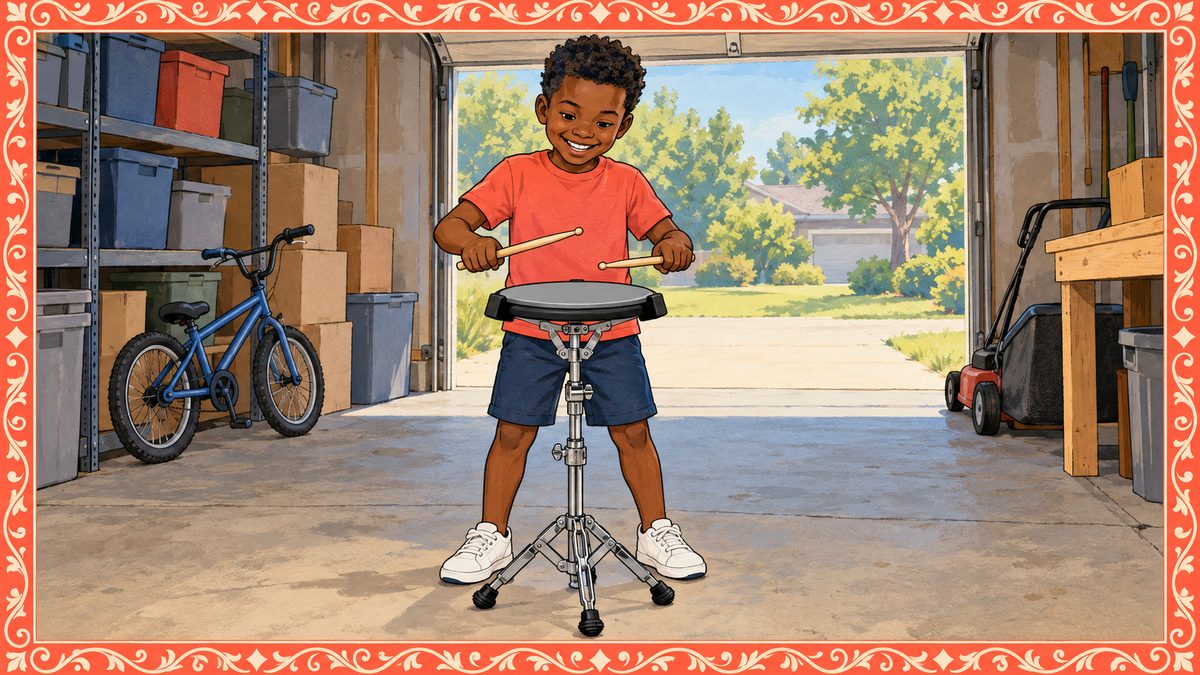
Most children are ready for drum kit lessons between 6 and 8. The birthday is a rough guide to two things a parent can check at home: whether the child can stay with one focused activity for about 15 to 20 minutes, and whether their hands and feet can do different things at the same time. A child who is not there yet can still get started on a practice pad, which costs little and makes almost no noise. The noise of the kit itself is easier to plan before it arrives than after.
What a Five-Year-Old Can and Cannot Do Yet
The CDC’s developmental milestones list what most children, 75 percent or more, can do by a given age. At five, the CDC’s list includes hopping on one foot, counting to 10, and paying attention for 5 to 10 minutes during activities such as story time or crafts, with screen time not counting. Two of those line up with what a drum lesson asks, and the third shows the gap.
- Counting to 10 covers the counting a beginner groove needs, which is four beats at a time.
- Hopping on one foot shows a child can make one leg act on its own. A kick pedal asks for that while sitting, in time with the hands.
- Five to ten minutes of attention is the gap. A 30-minute lesson, the shortest on Tunelark, runs three to six times that, so a teacher breaks it into short blocks, and even then the blocks ask for more than most five-year-olds give.
So a typical five-year-old can hold sticks, play even strokes on a pad, clap back a short rhythm and march to a beat. What most five-year-olds cannot do yet is keep the hands going while one foot plays something different, or stay with focused work for a full lesson. Hands and feet moving independently is what kit playing is built on, and together with attention it is why the usual starting window is 6 to 8. At five, the start is rhythm games and a pad at home.
Timing develops on its own schedule too. A 2000 study in Cognition by Drake, Jones and Baruch (PubMed) compared 4-, 6-, 8- and 10-year-olds with adults. When left to choose their own pace, the younger children tapped faster, and they kept time with a sequence less accurately. Both improved with age and with musical training. In a lesson this shows up as a young child who rushes, and who finds a slow, steady beat harder than a fast one. A good teacher picks a tempo the child can hold.
None of this is a hard cutoff, so the checks below say more than the birthday does. A six-year-old who passes them is ready for the kit, and an eight-year-old who does not is better served by the pad for a few more months.
Four Checks a Parent Can Run at Home
The first three take a few minutes each and need no instrument. The focus check runs during an ordinary quiet task. Together they test the two things the age range stands in for.
| Check | How to run it | Ready for the kit | Not yet |
|---|---|---|---|
| Steady beat | Play a song with a strong beat and ask your child to clap along through a whole chorus | The claps stay with the song to the end | The claps drift ahead of the song or stop. Clapping and marching games build this |
| Copy a rhythm | Clap a short pattern, such as long, long, short short long, and ask for it back | Three different patterns come back right | Patterns come back as even claps. Keep playing the game; it is what early lessons do |
| Hands and foot apart | Seated, the child taps knees right, left, right, left, then adds one foot tapping the floor on every second hand stroke | The foot keeps going while the hands alternate, even if it takes a few tries | The foot stops whenever the hands move, or the hands freeze when the foot starts. Start on the pad |
| Focus | Set a timer during one quiet task with no screen, such as a puzzle or drawing | About 15 to 20 minutes on the task | Under 15 minutes. Lessons are still possible with a teacher who works in short blocks |
The third check is the one drums add to the general readiness signs. The other three would apply to any instrument, and our guide to whether your child is ready for music lessons covers the wider list. Limb independence, playing different parts with different limbs at once, is the core skill of the kit. A child who passes the third check is ready for a first beat with the kick foot on the pedal. A child who cannot yet will spend those lessons on the hands anyway, which the pad does just as well.
Starting on a Practice Pad
A practice pad is a rubber disc on a wooden base that bounces the stick back like a drumhead and makes a dull tap. A pad costs $25 to $40 as of 2026, and with sticks the set comes in under $50. It is the start for a five-year-old playing at home, for a six-year-old in lessons who has not passed the hands-and-foot check, and for a family not ready to buy a kit.
What a child learns on a pad carries straight to the kit: the grip, even single strokes, double strokes, and counting out loud while playing, which is how a child learns where beat one is. Our beginner drum tips set out the grip and the first beats in detail. The paradiddle, a pattern that mixes single and double strokes, is often the first sticking a pad student learns by name.
Elspeth demonstrates the paradiddle, a sticking pattern that can be practiced anywhere, with or without sticks, and the kind of hand work a young pad student does in the first months of lessons.
Skill video · Paradiddle Practice
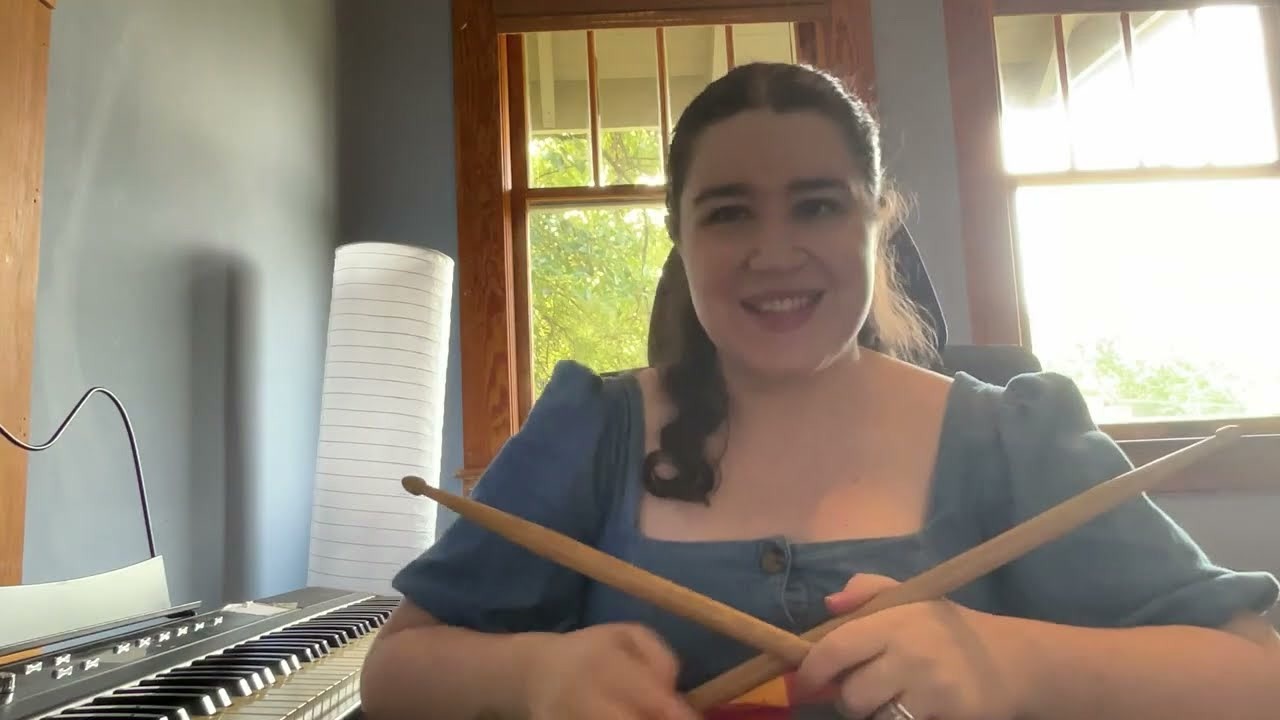
Elspeth teaches drums, piano and voice on Tunelark. View Elspeth’s profile
A child aged 5 to 7 manages 10 to 15 minutes of practice a day, and two short sessions often work better than one. A kit comes in once the foot check passes, and for many children that is a few months into lessons. Our guide to drum kit or percussion lessons for a child covers which path a child’s goals point to.
When the kit arrives, it has to fit the child, not the parent. A child whose feet dangle above the pedals cannot play the kick drum in time, so the throne height comes before anything else. Junior acoustic kits are built with smaller drums and shorter stands for young children. On an electronic kit the pads lower on the rack, and the throne’s lowest height is a separate check to make before buying.
Planning for the Noise Before the Kit Arrives
The child’s hearing comes first. In a 2025 study, Valderrama, Arenas and Cardenas placed microphones at the entrance of the ear canals of 21 drummers during a rehearsal in a recording studio (International Journal of Acoustics and Vibration). The overall level reached 103 dBA. NIOSH’s workplace limit is 85 dBA averaged over eight hours, and the allowed time halves for every 3 dBA above that. At 103 dBA the same rule allows about seven and a half minutes a day. Those are adult drummers and an adult workplace limit, and a beginner plays more softly than a rehearsing drummer, but the gap is wide. A child at an acoustic kit wears hearing protection from the first day, and earmuffs made for children are the easiest kind to fit. On an electronic kit the headphones carry the sound, so keep their volume low enough that the child can hear you speak.
Then the household. A young child practices best at the same time each day, and the after-school slot usually works better than the half hour before bed, when a younger sibling may be asleep. Our guide to electronic or acoustic drum kits weighs the two kits for the space and hours you have, and our guide to drum practice in an apartment covers the kick pedal thump that reaches a downstairs neighbor. On a pad, none of this applies yet.
What Lessons Look Like at 6 to 8
A child from 5 to 11 takes 30-minute lessons. For a six-year-old that half hour is split into short pieces: a few minutes on the pad, a few on a beat, a game with a rhythm, a short break. Yousef S., who teaches drums on Tunelark, uses timed breaks and stretches with students who need shorter spans of focus, and works in blocks of 10 to 15 minutes.
Yousef describes how he spends a first lesson:
> “Typically I like to get students the confidence boost of nailing down a basic groove, and then try to give a hint to our potential destination with my own playing.”
For a young child the groove is also something to play for the family that evening, which is often what gets the pad out the next day.
For a child of this age in an online lesson, the parent sets up the pad or kit and the camera, stays within earshot for technical trouble, and keeps out of the frame. The camera needs to see both hands, both sticks and, once there is a kit, the feet. A parent sitting beside the child splits their attention between two adults. Our guide to how long it takes to learn drums shows what the first year sounds like once lessons are going.
The pad weeks can feel slow to a child who asked for a drum kit. Give it about three months before deciding drums are not working, and tell the teacher if the child is restless, since a teacher can bring the kit in sooner or add a play-along song to the pad work.
How to Find a Drum Teacher on Tunelark
Every Tunelark teacher is vetted by working musicians and educators for teaching quality before they can list. Each teacher sets their own rate and shows it on their profile, and Tunelark handles scheduling, billing and support.
- Open the teacher list at tunelark.com/find-a-teacher and filter by drums, then read each bio for the age ranges the teacher works with.
- Choose a 30-minute lesson for a child under 12.
- Book a trial lesson. The first lesson with a new teacher is that teacher’s rate minus $25, for whatever length you choose, so trials start at $14.
- Tell the teacher your child’s age, which of the four checks they passed, and whether they will play on a pad, an electronic kit or an acoustic kit.
Frequently Asked Questions
My child is 10. Is that too late to start drums?
No. A 10-year-old usually passes all four checks at once, so lessons can start on the kit rather than the pad. Children of 8 to 10 manage 15 to 25 minutes of practice a day, against 10 to 15 at 5 to 7, so each week of practice covers more ground.
Should a left-handed child set up the kit the other way round?
Ask the teacher before buying hardware. Some left-handed drummers play a mirrored kit, with the kick pedal under the left foot, and others play a standard setup. A kit can be rearranged later, but a habit is harder to change, so settle it in the first lessons.
Where should the camera go for a pad lesson?
Beside the child at about pad height, angled so both hands, both sticks and the pad surface are in frame and close enough for the teacher to see the grip. A pad on a stand or a table at waist height keeps a young child sitting upright instead of hunching over a pad on their lap.
Does a practice pad need hearing protection?
No. A pad makes a dull tap far quieter than any drum, which is one reason it suits the first months indoors. Hearing protection comes in with the first acoustic kit, and headphone volume becomes the thing to watch with an electronic one.
What if my child wants a different instrument after a few months?
That is common at this age and costs little. Steady time, counting and rhythm reading carry to any instrument, so the months on drums are not lost.
Looking for an online drum teacher? See our full Online Drum Lessons page for everything you need to know about getting started.
Keep reading
About Jennifer Heath
I'm Jennifer Heath, VP of Operations at Tunelark and a lifelong singer. I joined the company in 2020 and oversee much of what makes Tunelark work for students and teachers: hiring, training and supporting our instructors, student support, marketing and day-to-day operations. I started voice lessons at 7 and sang with touring choirs through my teens. Music belongs in every life, for the self-expression, the discipline, the comfort and the simple joy of it.