How Long Does It Take to Learn Drums? A Realistic Timeline

Drums are one of the most immediately fun instruments to start. Most beginners play a rock beat in their first lesson or two. But how long it takes to learn drums depends on what you’re after, from holding a steady groove to playing complex fills and styles. Here’s a realistic timeline.
Drumming at the beginner level is more about pattern recognition and coordination than reading dense notation, which is part of why early progress feels so satisfying. School percussion runs the other way, notation first, and our guide to drum kit or percussion lessons for a child lays out the difference. When notation does arrive, our guide to how to read drum music covers the symbols that change how a part sounds.
The First Lessons: Your First Groove
The early work is coordination (getting your hands and foot to work independently) and building comfort with stick technique. Both come fast enough that you make music almost immediately. Apartment drummers can do all of it on an electronic kit; our guide to drum practice in an apartment has the setup.
What the First Month Actually Sounds Like
The first beat almost every drummer learns is eighth notes on the hi-hat, the kick drum on beats one and three, and the snare on two and four. It takes minutes to understand and weeks to make even. Early on your hi-hat hand speeds up whenever the kick drum gets busy, and the beat rushes slightly after every fill. Both are normal, and both are what the metronome is for.
Grip is the other first-month project. Matched grip, with the stick held mostly by the thumb and index finger and the other fingers along for the ride, lets the stick rebound off the head instead of being driven into it. Beginners squeeze, the stick stops bouncing, the arm and shoulder take over the work the rebound should be doing, and they are tired inside ten minutes. A loose grip is faster and it sounds better. Volume is a separate control: it is set by how high you lift the stick and how fast you bring it down, so loosening the hands will not quiet the kit down on its own.
Fills are the part that falls apart first. A fill that ends a beat late is the most common thing a drum teacher hears in month one, and the fix is almost always to play a shorter fill and land the first beat of the next bar in time.
Months 1-6: Grooves, Fills, and Timing
Over the first few months, you’ll add fills, learn to keep steady time (ideally with a metronome), and play along to songs. Timing is the skill that separates beginners from solid drummers, and regular practice with a teacher’s feedback accelerates it. By month six, dedicated students hold a groove confidently and play through full songs.
A groove is the unit of progress on drums. Ian M. teaches drums on Tunelark and breaks down the zydeco beat, where it came from and how it sits.
Skill video · Zydeco Drumming Basics
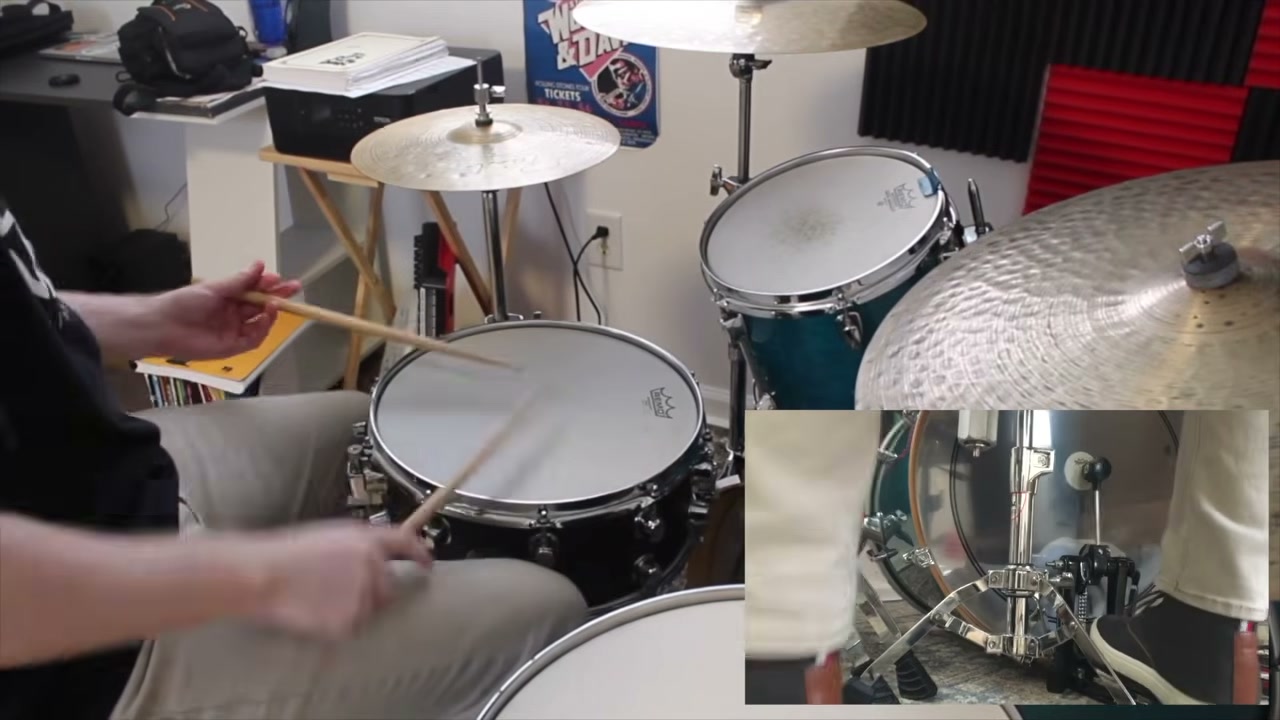
Ian teaches drums on Tunelark. View Ian’s profile
A Realistic Practice Week
Fifteen to twenty minutes a day, five or six days a week, is enough to make real progress. A workable session is a few minutes of single strokes on a practice pad, one groove at a tempo slow enough to play it perfectly, and then a song.
Use a metronome from the first week rather than adding one later. Drummers who wait find their sense of time has already set around their own drift, and pulling it back is slower work than building it straight. Click on every beat to start, then on beats two and four once that feels easy.
Record yourself every four to six weeks, playing along to a song. Timing is the one thing that is almost impossible to judge fairly while you are the person playing.
Months 6-18: Styles and Independence
After about six months of regular instruction, you’ll branch into different styles, develop limb independence, and tackle faster tempos. By 12-18 months, committed students play a range of music comfortably and may start jamming with others or playing in a band.
What a Teacher Adds That a Play-Along Video Cannot
A teacher hears where you rush, which is rarely where you think it is, and can tell you whether the problem is your hands, your foot, or the fact that you stopped counting three bars ago. That single diagnosis is worth weeks of practicing the wrong thing. The drum teachers taking new students on Tunelark do this over video every week.
They also watch for tension. Raised shoulders, a locked ankle on the hi-hat pedal, and a death grip on the sticks all put a ceiling on speed and stamina, and none of them are visible to you while you play. On camera they are obvious.
Past the first six months the value shifts to repertoire and independence: which groove to learn next, how to break a hard pattern into limbs and rebuild it, and how to play a song for a band rather than for yourself. Lessons on Tunelark run 30, 45 or 60 minutes. Odd meters and displaced grooves come later for most drummers, and our guide to odd time signatures on drums covers how to approach them.
You Don’t Need a Full Acoustic Kit
One myth worth dispelling: you don’t need a full acoustic drum kit to learn. A practice pad and a pair of sticks carry the hand technique, the rudiments and most of the timing work of the first months, and an electronic kit with mesh heads adds the kick and the hi-hat quietly, though the pedals still thump through a floor, which is why so many students start on an electronic kit or even a practice pad. What a teacher needs from you is a camera angle that shows your hands and, once there is a kit, your feet. If you are still deciding what to buy, our guide to an electronic or acoustic drum kit sets the two side by side.
How to Find a Drum Teacher on Tunelark
Tunelark connects you with vetted drum teachers who teach online, acoustic or electronic, beginner or advanced. Browse profiles, find a teacher whose approach fits, and book a first lesson at $25 off that teacher’s 30-minute rate to get your timing and technique on the right track from day one.
Frequently Asked Questions
Can I really play drums in my first lesson?
Yes: most beginners play a recognizable beat in the first lesson or two. Coordination and timing develop from there.
Do I need an acoustic drum kit to learn?
No. Many students learn on an electronic kit or a practice pad, which works well for online lessons and quiet practice. A teacher can adapt to your setup.
How long until I can play songs on drums?
Most beginners play along to simple songs within the first month or two. Holding steady time across a full song typically takes a few months of regular practice.
Is it harder to learn drums as an adult?
Adults can learn drums well. They usually have less practice time than a child and a few more tension habits to unlearn, but they also listen more carefully and know what they are working toward. Adults often pick up grooves quickly and enjoy the physical, stress-relieving side of drumming. Consistent practice is the main driver of progress at any age.
Looking for an online drum teacher? See our full Online Drum Lessons page for everything you need to know about getting started.
Keep reading
About Jennifer Heath
I'm Jennifer Heath, VP of Operations at Tunelark and a lifelong singer. I joined the company in 2020 and oversee much of what makes Tunelark work for students and teachers: hiring, training and supporting our instructors, student support, marketing and day-to-day operations. I started voice lessons at 7 and sang with touring choirs through my teens. Music belongs in every life, for the self-expression, the discipline, the comfort and the simple joy of it.