Drum Practice in an Apartment: Setup, Noise and Neighbors
You can learn drums in an apartment. Plenty of working drummers did. What you cannot do is learn drums in an apartment on an acoustic kit at full volume at nine at night, and the gap between those two facts is where most would-be drummers give up before they start. This guide closes it: the setup that keeps the neighbors friendly, what the noise really is and how to kill it, a first-week routine that needs almost no gear, and what your online teacher needs to see.
The noise is not what you think
Two kinds of sound leave a drum kit. The first is airborne: the crack of a snare, the wash of a cymbal, the boom of a kick. Walls and floors slow it down a little. The second is impact: the thud of a stick hitting a head, and above all the kick pedal driving into the floor, which travels through the building’s structure as vibration and arrives in the downstairs apartment as a low, maddening pulse.
An electronic kit solves the first almost entirely, because the sound comes out of headphones. It does nothing about the second on its own. Mesh heads help, because they have far less rebound noise than rubber pads, but the kick pedal still hammers the floor. Apartment drumming is mostly a project about impact, not volume.
The setup that works
An electronic kit with mesh heads. Mesh is quieter and feels closer to a real head than rubber. A starter kit with mesh heads runs roughly $400 to $700 as of 2026 and holds its value well on the used market. Our guide to online drum lessons without an acoustic kit explains how an electronic kit fits a lesson over video.
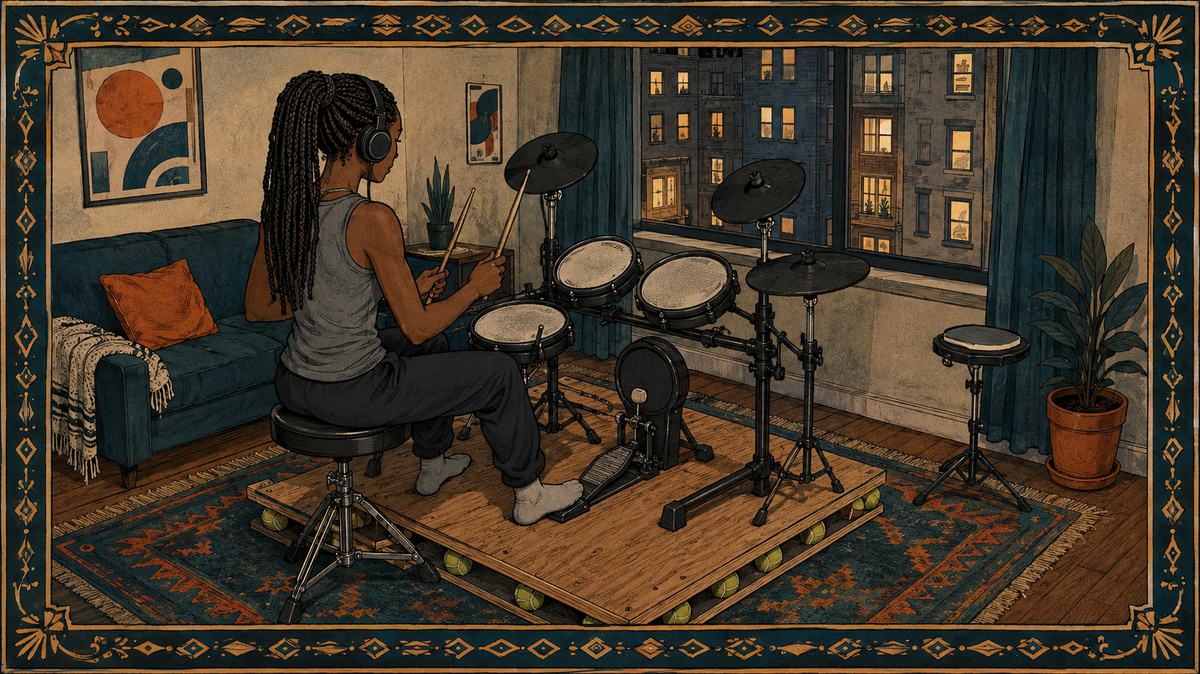
A beaterless kick pedal, not a kick tower. The kick is the neighbor problem. A kick tower is the pad a normal pedal strikes; a beaterless pedal senses the motion instead and makes almost no impact noise. If your kit came with a kick tower, put it on the isolation riser below.
An isolation riser. This is the single change that does most to keep the thump out of the downstairs apartment; ask the neighbor once what still gets through, because floors differ. The home-built version drummers have used for years: a sheet of plywood the size of the kit’s footprint, on top of a layer of tennis balls set into a second sheet, or on top of dense foam pads. The balls decouple the kit from the floor so less impact reaches it. A commercial riser does the same for more money. Either way, the kick pedal and the throne both sit on it.
A thick rug under everything. Not for the sound, for the rebound and the slide, and it helps a little with impact too. A pad also carries almost every symbol on a chart, and our guide to how to read drum music sets them out.
Closed-back headphones. Not earbuds. You want the kit loud in your ears and nothing in the room, and closed-back cans give you both. Your teacher’s voice comes through the same headphones during a lesson.
If you already own an acoustic kit, mesh conversion heads and low-volume cymbals turn it into something close to an electronic kit’s volume with a real kit’s feel. Rubber mutes work but feel dead and teach bad rebound habits.
When to practice
Talk to the neighbors before the first session, not after the first complaint. Tell them what you have done about the noise, tell them the hours you will keep, and give them a way to tell you if it is a problem. Most people are generous with someone who asked.
Then keep the hours. Roughly 9am to 8pm is fair in most buildings, whatever your lease says. Consistency matters as much as the hours themselves: a neighbor who knows drumming happens at six will stop hearing it in a way they never will if it happens at random.
What you can practice with no kit at all
Half of drumming is hands and time, and neither needs a kit. A practice pad, a pair of sticks and a metronome cover more of the first six months than beginners expect, and they make very little noise. Our beginner drum tips start here for exactly that reason.
A sticking exercise is the quietest useful thing a drummer can practice. Elspeth C., who teaches drums on Tunelark, demonstrates the paradiddle, which coordinates alternating patterns between the hands, builds tempo and internal counting, and can be practiced anywhere, with or without sticks.
Skill video · Paradiddle Practice
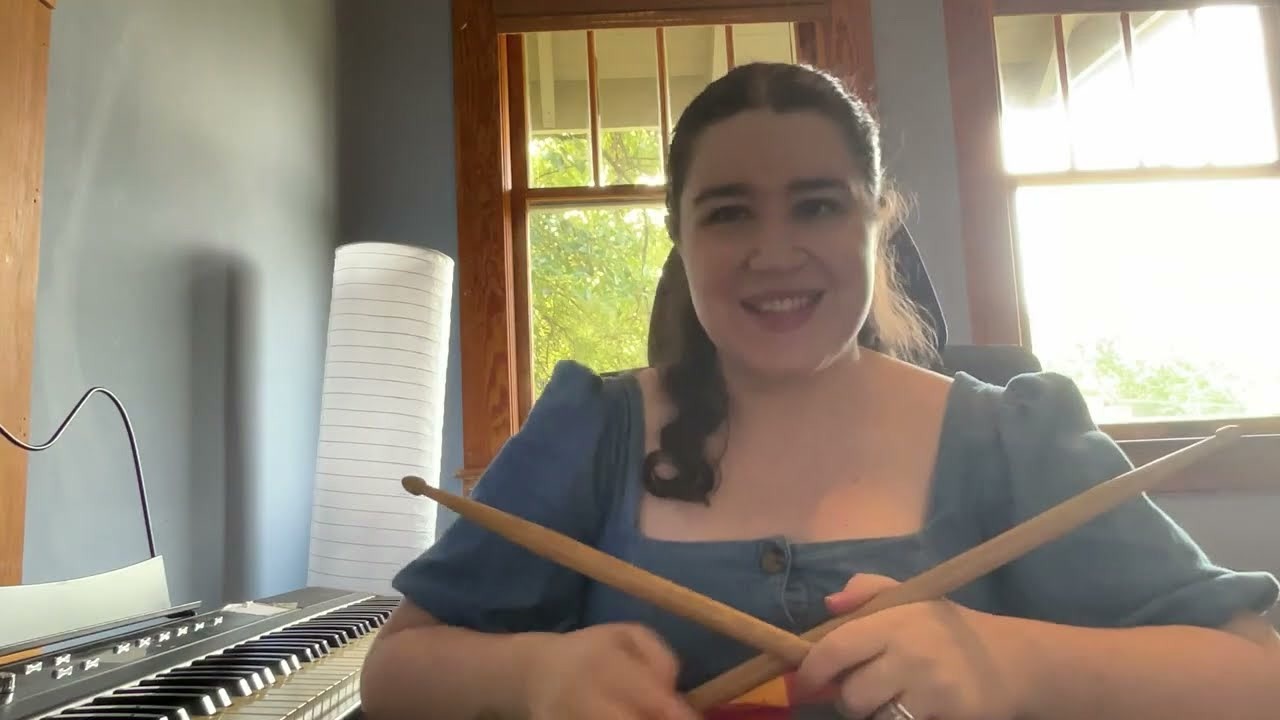
Elspeth teaches drum lessons online with Tunelark. View Elspeth’s profile
Week one, ten minutes a day:
- Single strokes, right left right left, at 60 beats per minute, each stroke landing exactly with the click. Ten minutes of this is harder than it sounds and is the foundation of everything.
- Double strokes, right right left left, at the same tempo. Let the second stroke bounce rather than forcing it.
- Grip check every day: the stick pivots between thumb and first finger, the back fingers wrap loosely and catch the rebound, the wrist steers the stroke, and the arm and shoulder stay relaxed.
- Foot on the floor, heel down, tapping quarter notes with the click, to start building the kick timing before there is a pedal under it.
That is enough for a first week, and a teacher can correct all four over video in the first lesson. Add the pad to a stand or your knee. A pillow is silent but has no rebound, so keep the doubles on the pad. Our roster of drum teachers taking new students shows who is available now.
What your online teacher needs to see
Camera angle is most of the difference between a useful lesson and a frustrating one. Your teacher needs to see both hands, both sticks and the snare, and ideally your right foot. Put the phone or laptop to your left front, about waist height, angled down slightly. If you can, a second phone on a stand pointed at the pedals is worth more than any other piece of gear for a drummer learning online.
Sound is the other half. Route the kit’s headphone output into the computer if your interface allows it, so your teacher hears the kit as you do; otherwise the laptop microphone picking up mesh-head taps is enough for timing, which is what the teacher is mostly listening for anyway. Turn on the original sound setting in your video app so the software does not swallow the transients.
Our guide to setting up a practice space at home covers lighting and the rest of the room.
How much practice, realistically
Twenty minutes a day of pad and kit combined moves a beginner faster than an hour twice a week. The general question of how much you should practice has the same answer for every instrument, and for drums the daily version has a bonus: a short session every day at a fixed hour is exactly what keeps the neighbors calm. Our realistic timeline for learning drums shows what those twenty minutes add up to over a year.
How to Find a Drum Teacher on Tunelark
Tunelark connects you with deeply vetted drum teachers who teach online. Vetting is run by working musicians and music teachers, not a general recruiter, and every teacher sets their own rate and shows it on their profile. Scheduling, billing and support are handled for you.
- Browse drum teachers at tunelark.com/find-a-teacher and watch their videos.
- Read bios for teachers who mention beginners.
- Book a trial lesson at $25 off the teacher’s 30-minute rate, with the pad if the kit has not arrived.
- Ask yourself afterward whether the teacher fixed something about your grip or your time. That is the lesson working.
Frequently Asked Questions
Can you learn drums in an apartment?
Yes. An electronic kit with mesh heads, closed-back headphones, a beaterless kick pedal and an isolation riser under the kit cut both the airborne sound and the impact noise to a fraction of an acoustic kit.
How do I stop drum noise going through the floor?
Decouple the kit from the floor. A homemade riser (plywood over tennis balls or dense foam) or a commercial isolation platform stops the kick pedal’s impact from traveling through the building. That impact, not the volume, is what neighbors hear.
Are electronic drums quiet enough for an apartment?
With mesh heads and headphones, the sound is a soft tapping in the room. The kick pedal is the remaining problem, and a beaterless pedal or a riser solves it.
What can I practice without a drum kit?
Single strokes, double strokes, grip and foot timing on a practice pad with a metronome. That covers much of the first six months and makes very little noise.
What hours are reasonable for drum practice in an apartment?
Roughly 9am to 8pm, at the same time each day, and agreed with the neighbors in advance.
Looking for an online drum teacher? See our full Online Drum Lessons page for everything you need to know about getting started.
Keep reading
About Jennifer Heath
I'm Jennifer Heath, VP of Operations at Tunelark and a lifelong singer. I joined the company in 2020 and oversee much of what makes Tunelark work for students and teachers: hiring, training and supporting our instructors, student support, marketing and day-to-day operations. I started voice lessons at 7 and sang with touring choirs through my teens. Music belongs in every life, for the self-expression, the discipline, the comfort and the simple joy of it.