How to Read Drum Music: Symbols to Your First Groove
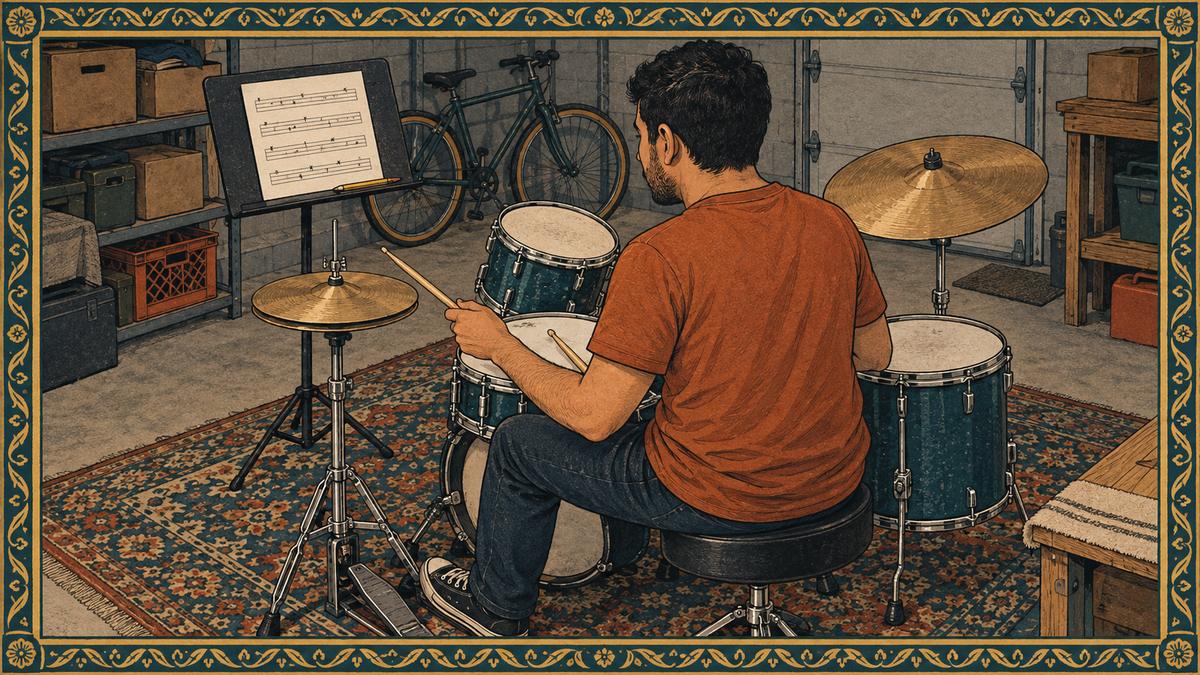
Drum notation uses the same five-line staff as every other instrument and does one thing differently with it: the lines and spaces stand for pieces of the kit rather than for pitches. A note on one line means hit the snare drum, the shallow drum with metal wires under it that give it a crack. A cross on another means hit the hi-hat, the pair of cymbals on a stand that a foot pedal opens and closes. Once that swap is clear, the rest is rhythm, which you can already count.
Reading a Chart From the Top Down
The staff runs roughly high to low across the kit: cymbals at the top, snare and toms in the middle, bass drum at the bottom, and the hi-hat played with the foot below the staff. The bass drum is played with a foot pedal, which is worth saying plainly because a chart never mentions it.
The core positions are stable. The Percussive Arts Society publishes the standard most closely followed, and it puts the bass drum at the bottom, the snare in the middle and the ride on the top line. What varies is everything past that core: a second ride, extra toms, a cowbell. That is why a well-made chart prints a key at the top mapping each line and space to an instrument. Read the key first, the way you would read a clef, the symbol at the start of a staff that tells you what the lines mean.
One distinction holds almost everywhere and is worth committing to memory: cymbals take an x notehead, the shape drawn at the center of a note, and drums take an ordinary oval. The first exception you will meet is the cross-stick on the snare, which borrows the x for a drum, and a cowbell or woodblock may take a triangle or a diamond.
The other structural signal is stem direction. Stems point up for everything played by hand and down for everything played by foot, which is what lets your eye separate the two jobs at a glance. In the chart above, the hi-hat and the snare share upward stems and the bass drum hangs below.
The Symbols That Change the Sound
A chart that you can read note for note and still play wrong is usually one where these have been skipped.
Accents. A sideways wedge above a note means hit that one harder than the ones around it. It is the difference between a groove and a metronome. Where there are none, the dynamics are left to you.
Sticking. Small R and L letters under the notes tell you which hand plays which stroke. A line of eighth notes on the hi-hat can be played with one hand or alternating hands, and on a fast part that choice decides whether it is possible at all. Sticking is written in when the choice matters.
Open and closed hi-hat. A small circle above the x means let the hi-hat ring open; a plus sign means it is closed again. A circle with a slash through it is the half-open sound, which is a third instruction rather than a version of either.
Slashes. Slash marks through a bar tell you to keep the feel going without it being written out again. They are not an instruction to copy the previous bar note for note; that is the repeat sign, a percent shape in the middle of the bar. The difference matters in a band room, because a chart full of slashes is asking you to play, not to recite.
Triplets. Three notes bracketed with a small 3 fit into the space of two, so a beat splits into three even parts rather than two. Count it as one-trip-let, two-trip-let, and keep the numbers landing exactly where they landed before.
What a Neutral Clef Is Telling You
Most drum parts open with a neutral clef, drawn as two thick vertical bars rather than the curled treble clef. It announces that the staff carries no pitches at all, which is a courtesy to anyone who might otherwise try to read the notes as notes.
Older parts often carry a bass clef, which was the earlier standard, and some simple parts carry none. None of it changes what you play. The key at the top of the chart is what settles which line is which, which is the second reason to read it before the music.
The Rhythm Half Is Ordinary
Everything past the symbols above is timing, and timing notation is identical on every instrument. Our guide to reading sheet music as a beginner covers note values, bars and time signatures, and all of it transfers to a drum part without modification.
Two things are worth flagging for drummers specifically.
A rest is a silence, and on a drum part it is one voice sitting out a slot while the others carry on. A bar with a rest in the snare line is not a bar with a gap in it. It is a bar where your left hand waits.
And a drum part is several independent lines sharing one clock, which is why it can look denser than it is. Read one line at a time. The hi-hat line on its own is almost always the simplest thing on the page, and once you have it the others are decisions about where to interrupt it.
Where the Reading Stops and the Playing Starts
A chart tells you what and when. It does not tell you how the groove should feel, how hard to hit when nothing is marked, or which of two possible stickings suits your hands, and those are the things that make a part sound like music rather than like a transcription.
That gap is the argument for a teacher, and on drums it is a specific one: the errors a reader makes are ones they cannot hear themselves making. Timing drift under a busy bar, tension in the wrist that flattens every accent, a stem direction read as a suggestion. Our guide to how long it takes to learn drums covers where reading usually sits in the first year, our beginner drum tips cover the grip and the first patterns to read, and our guide to drum kit or percussion lessons explains why a school percussionist meets notation much earlier than a kit player does.
If you have no kit at home, none of this is blocked. A practice pad and a pair of sticks will carry every symbol above except the bass drum and the hi-hat marks, and our guide to drum practice in an apartment covers what else a pad can do.
How to Find a Drum Teacher on Tunelark
Tunelark connects you with deeply vetted drum teachers who teach online. Vetting is run by working musicians and music teachers, not a general recruiter, and every teacher sets their own rate and shows it on their profile. Scheduling, billing and support are handled for you.
- Open the teacher list at tunelark.com/find-a-teacher and filter by instrument, then read the bios and watch any video a teacher has posted.
- Read the bios for whether a teacher mentions reading, since studios differ on how early it arrives.
- Book a trial lesson at $25 off the teacher’s 30-minute rate, with a chart you cannot read open in front of you.
- Ask them to play the bar you are stuck on at half speed. That is usually where it comes apart into something readable.
Frequently Asked Questions
Do I need to read music to play the drums?
No. Reading earns its place the moment you want to join something: a school band, a church group, a pit orchestra or any situation where somebody hands you a part and expects it back in tempo. Plenty of playing happens without it.
What does a number above a repeated section mean?
A small number over a repeat tells you how many times to play it, and bracketed endings marked 1 and 2 tell you to take the first ending the first time through and skip to the second on the repeat. This is the same convention every instrument uses.
Why do two charts write the same groove differently?
Because the layout past the core kit is a house style rather than a law, and because arrangers write for who is reading. A chart for a beginner spells out every bar; a chart for a working drummer gives two bars and then slashes.
What is a ghost note?
A note in brackets, played very quietly, usually on the snare between the main backbeats. It is what makes a simple groove sound loose and human, and it is a symbol that does almost nothing on the page and a great deal in the room.
Should I learn to read on a pad or on the kit?
Start symbols on a pad, where there is only one sound and nowhere to hide. Move to the kit for anything involving the bass drum and hi-hat marks, since those are the symbols a pad cannot show you.
Looking for an online drum teacher? See our full Online Drum Lessons page for everything you need to know about getting started.
Keep reading
About Jennifer Heath
I'm Jennifer Heath, VP of Operations at Tunelark and a lifelong singer. I joined the company in 2020 and oversee much of what makes Tunelark work for students and teachers: hiring, training and supporting our instructors, student support, marketing and day-to-day operations. I started voice lessons at 7 and sang with touring choirs through my teens. Music belongs in every life, for the self-expression, the discipline, the comfort and the simple joy of it.