How to Sing in Tune: A Practical Guide for Beginners

If you have ever been told you cannot sing, or quietly suspect you cannot sing in tune, here is a fact that surprises most adults: congenital amusia, the condition behind true tone-deafness, affects somewhere between 1.5% and 4% of people depending on the study, and the largest study, from 2017, found 1.5%. Almost everyone else can be taught to sing in tune. What feels like an inability is almost always an untrained skill, the ear-to-voice connection that lets you reliably hit the pitch you intend.
That connection can be built. Here is what is actually going on, and what real progress looks like.
What not being able to sing in tune usually means
When people describe themselves as bad singers, they usually mean one of three things:
They hear themselves missing notes. This is actually good news. The ability to perceive that you are off-pitch means your ear is working. The work is in coordinating your voice to match what your ear hears.
They cannot tell whether they are in tune. This is perception, not voice. Ear training moves it for almost everyone.
They feel embarrassed singing. This is often the deepest issue and the one most adults will not admit. Bodily tension from embarrassment locks the voice in ways that produce off-pitch singing, and the off-pitch singing reinforces the embarrassment. A good teacher addresses both at once.
For all three, the path forward involves training the ear and the voice together, in low-stakes settings, with someone patient and skilled.
The real causes of pitch problems
Setting aside true amusia, off-pitch singing in adults typically comes from a few specific causes:
- Pushing too hard. Excess breath pressure forces notes sharp or flat unpredictably. The test takes one repeat: sing the same phrase again at half volume, and if the pitch steadies, the pressure was the problem. The fix underneath it is steadier air rather than more of it, which is the subject of Breath Support for Singers.
- Tension in the jaw, tongue, or throat. Locked muscles change the resonance and interfere with how accurately you hear yourself while you sing.
- Singing in the wrong range. Many would-be singers try to belt in ranges that do not fit their voice. Finding your natural comfortable range fixes a surprising amount.
- Not actually hearing the target pitch first. Skilled singers hear the note internally before they sing it. Most beginners are guessing.
If the wrong range is part of your problem, this is the place to start. Elspeth C. walks through where each voice type sits, from bass to soprano, and sings a simple five-note pattern you can follow to find where your own voice is comfortable rather than where you have been trying to make it go. Get to Know Your Voice sets out the registers and voice types behind what you hear in it.
Skill video · Find Your Vocal Range

Elspeth teaches voice, piano and drums on Tunelark. View Elspeth’s profile
Tension is the cause that is hardest to hear from the inside. Louise G. shows how to move the tongue on its own, without the jaw following it, through a series of consonant exercises. If you cannot do them without your jaw moving, that is the tension Louise is describing, and the exercises are the release.
Skill video · Jaw and Tongue Release

Louise teaches voice on Tunelark. View Louise’s profile
A voice teacher diagnoses which of these (often a combination) is happening for you specifically.
What real training looks like
A typical first few months of voice lessons aimed at singing in tune involves:
- Listening exercises. Matching pitches the teacher sings or plays, first easy ones, then harder ones, then chord tones, then full melodies. The ability to match builds steadily.
- Body work. Releasing tension in the jaw, tongue, shoulders, and breath. Most pitch issues have a tension component.
- Range exploration. Finding the part of your voice that is most comfortable and natural, usually different from where you have been trying to sing.
- Recording and listening. The gap between what you think you sound like and what you actually sound like is enormous. Recording reveals progress (and remaining issues) that is invisible from inside your own head.
Progress is faster than most students expect. In our teachers’ experience, adults who arrive convinced they are tone-deaf are often confidently matching pitches within their first month of weekly lessons.
Self-training you can do now
If you are not ready for lessons yet, four small habits build toward genuine singing-in-tune ability:
Match pitches with a piano or app. Play a note (anywhere comfortable for your voice) and try to sing the same pitch. Listen for the moment they “fuse”, when the note in your head matches the note coming out. This is the foundational ear-voice connection. Five minutes a day for a few weeks moves the needle.
Sing with recorded music, quietly. Singing along to recordings of vocalists in your range trains pitch awareness in a low-pressure context. Keep one earbud out, or use open-back headphones at a low volume. With both ears sealed, your own voice masks the recording you are trying to match, and you end up tuning to a reference you can barely hear. One ear open to the room lets the recording and your own airborne voice arrive side by side, which is the comparison the whole exercise depends on.
Hum more often. Humming uses less air, less tension, and clearer resonance than open singing. It is the easiest way to train pitch accuracy without the emotional load of “real” singing.
Sing small steps on purpose. Half steps are unforgiving: a small error is audible immediately, which makes them good ear training. Mikayla R. teaches a staircase exercise that walks a few of them down and back up on a single vowel, in one breath, and takes about a minute a day.
Skill video · Staircase
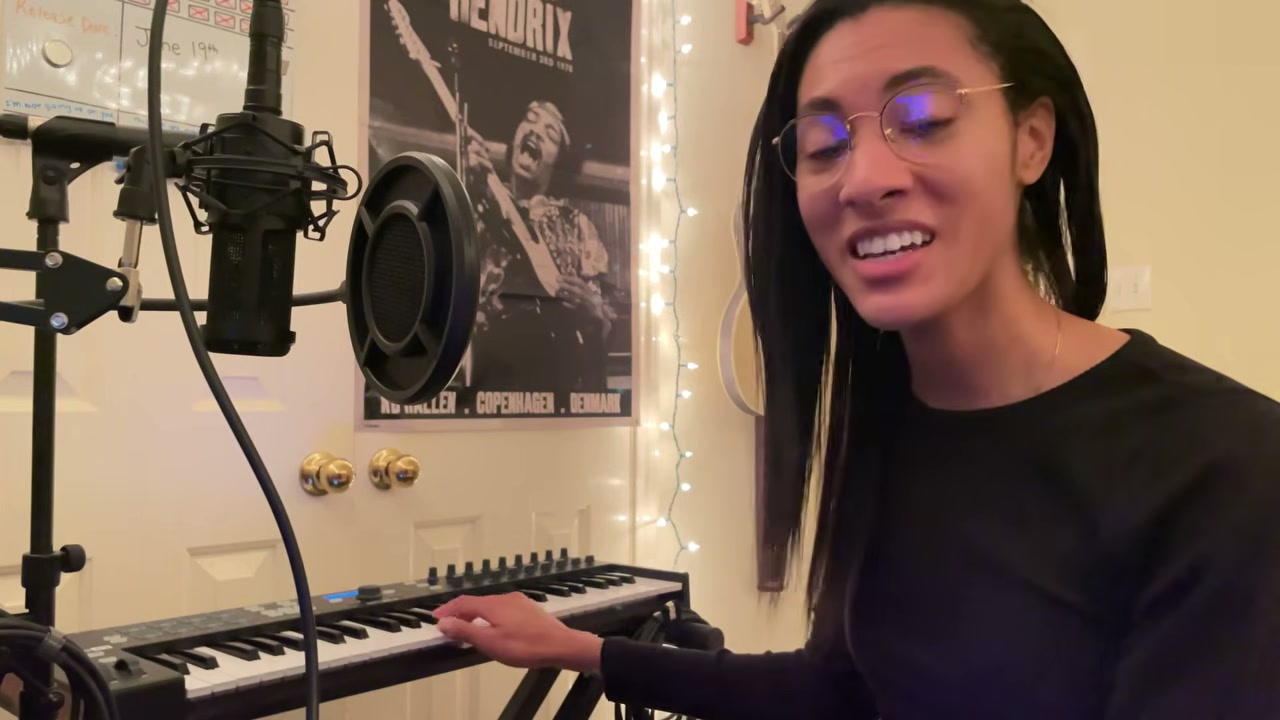
Mikayla teaches voice on Tunelark. View Mikayla’s profile
A note on embarrassment
Many adults who think they cannot sing are actually capable singers who have never been comfortable making the sound. The emotional work of being audibly imperfect in front of another person is its own skill. A good voice teacher creates the conditions for that work to happen: a private, judgment-free space where it is fine to sound bad on the way to sounding good.
Many adult voice students describe their voice lessons as some of the most personally meaningful work they have done. That is not an accident: the voice is uniquely tied to identity, and developing it changes things beyond the music itself.
Why a Second Instrument Fixes This Faster
Neel S. teaches voice and guitar, and he sometimes moves a voice student onto piano or guitar first, or alongside. His reason is mechanical rather than motivational: the voice is a functionally invisible instrument, so you only know you are singing something correctly if you can already hear what it is supposed to sound like. A keyboard shows you the note. If you cannot hear a scale well enough to sing it, playing that scale where you can see it separates the hearing problem from the producing problem. Norwood supplies the other half: a singer’s own tone, timbre and accent surface once they stop imitating whoever they listen to most.
How to Find a Voice Teacher on Tunelark
Every Tunelark teacher is vetted by working musicians and educators for teaching quality before they can list. Many of our voice teachers work regularly with absolute beginners who think they cannot sing, and their bios say so. To get started:
1. Open our voice lessons page.
2. Read bios. Look for teachers who specifically mention working with adult beginners or who describe their approach to vocal foundation work.
3. Book a trial lesson with one whose tone feels safe and patient.
4. Trust your gut on fit. The right voice teacher feels like someone you would be willing to be vulnerable around.
Singing in tune is almost certainly learnable for you. The path is real, the timeline is reasonable, and the rewards extend far beyond just being able to hold a melody.
Frequently Asked Questions
Am I actually tone-deaf?
Probably not. True tone-deafness, congenital amusia, affects roughly 1.5% of people, as the opening of this article sets out. People with amusia struggle to hear pitch differences of about a semitone and to follow a melody, even when they can hear that two notes far apart are different. Most people who describe themselves as tone-deaf are untrained, not unable.
How long does it take to learn to sing in tune?
In our teachers’ experience, most adults notice progress within the first one or two months of weekly voice lessons, and singing a whole song reliably in tune usually takes several months of consistent work.
Will singing lessons fix this completely?
For most people, lessons address the actual causes: ear training, voice training and tension release, which is the combination a good teacher provides. How complete the fix is depends on which causes are at work and how consistently the practice happens.
Can I learn on my own without a teacher?
Some progress is possible with apps and self-directed practice. But the deeper causes (tension, range, embarrassment) usually require an outside ear to diagnose and address. Students who try only self-training often plateau at the same place, which is usually the point where one of those deeper causes takes over.
What if I have been told my whole life that I cannot sing?
That is worth grieving, briefly, and then setting aside. The judgment you received was almost certainly wrong, and the experience of being told otherwise after years of believing it is one of the most rewarding parts of adult voice lessons.
Looking for an online voice teacher? See our full Online Voice Lessons page for everything you need to know about getting started.
Keep reading
About Jennifer Heath
I'm Jennifer Heath, VP of Operations at Tunelark and a lifelong singer. I joined the company in 2020 and oversee much of what makes Tunelark work for students and teachers: hiring, training and supporting our instructors, student support, marketing and day-to-day operations. I started voice lessons at 7 and sang with touring choirs through my teens. Music belongs in every life, for the self-expression, the discipline, the comfort and the simple joy of it.