Music Production Lessons for Teens: What Parents Should Know
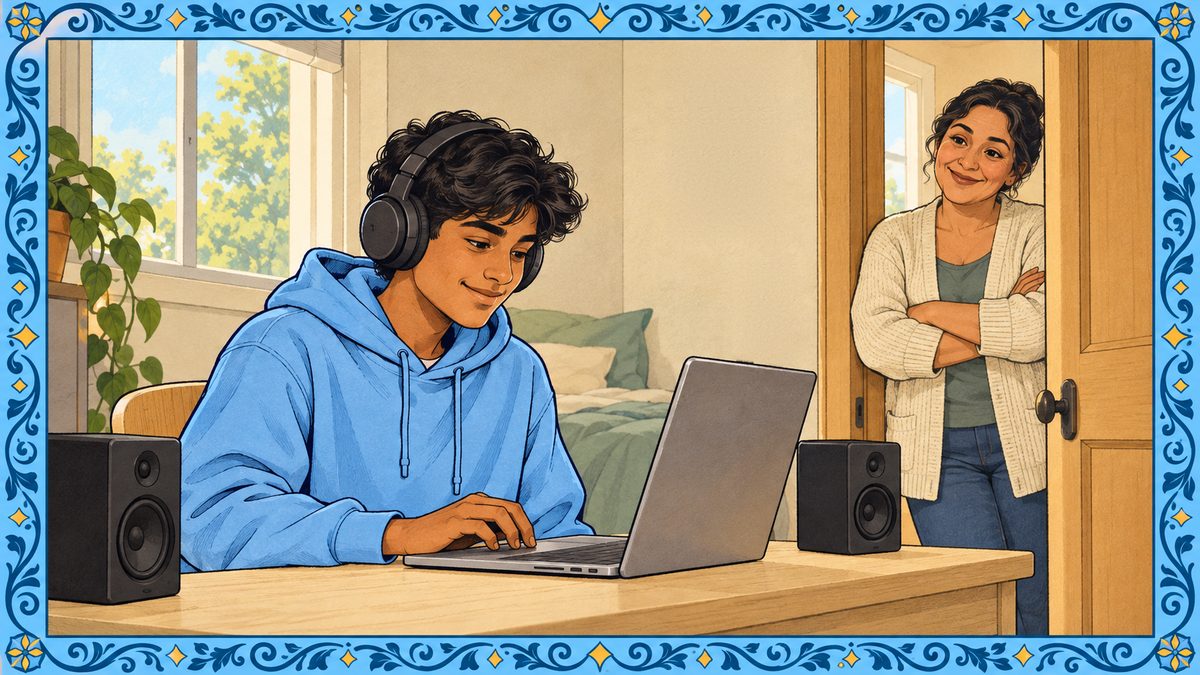
A music production lesson for a teenager is a shared-screen session on a track your teen is already building, with a teacher listening to the same playback and suggesting the next change. The setup is a computer or tablet your teen already uses plus a pair of closed-back headphones, the kind with sealed ear cups that keep the sound in. Most of what a parent needs to decide sits outside the lesson: how production hours fit the family’s rules about screens, whether a portfolio is worth building for college, and which questions to ask about the sample and collaboration sites young producers use.
What a Lesson Looks Like From the Doorway
Your teen shares their screen on a video call, plays their project, and makes changes while the teacher listens and talks them through it. From the next room it sounds like the same eight bars played over and over with one part different each time. Our guide to music production lessons for beginners walks through the first four lessons and the call settings, and our guide to the best video setup for online music lessons covers the camera and audio side.
Production also combines with an instrument. A testimonial on Peter J.’s Tunelark profile, from a student who began weekly lessons with him at 13 and stayed until 19, describes lessons that moved between learning songs on guitar, music theory and jamming over backing tracks the two of them built. Another student of his describes him bringing other programs and websites into the lesson through screen share. Peter teaches guitar, bass and music production, and for a teen who plays guitar or keyboard, lessons like these are where their playing gets recorded and arranged instead of only practiced.
Parents of teenagers usually stay out of the lesson itself. What helps from outside is knowing the week’s assignment, so the question at dinner is “did the chorus get its new drum part?” and not “did you practice?” Our guide to supporting a child learning music covers that role in more depth.
The Setup, and the Questions Specific to Teens
Our beginner guide lists the full setup by goal. For a teenager, three questions come up that an adult beginner rarely has to answer.
Whose computer is it? Many teens have a school-issued laptop, and a device managed by the school may not allow new software to be installed. Check before the first lesson. GarageBand runs on Apple devices only and Ableton Live on Mac and Windows, so a Chromebook runs neither, which usually means browser-based or Android music apps instead. A family laptop that the teen can install software on and keep projects on is simpler than a device the school can wipe in June.
Where do the files live? A production project is a folder of settings plus the audio it uses, including samples, the short recorded sounds such as a single drum hit that a track is built from. If a sample is deleted or moved, the song can open months later with a hole in it. A single folder per project, backed up somewhere other than the laptop, protects the work a portfolio will later need.
How loud are the headphones? Production means long sessions in headphones, often at night. The World Health Organization and the International Telecommunication Union set a safe listening standard for audio devices with a weekly sound allowance of 75 decibels for 40 hours a week in its mode for children, and 80 decibels for adults. The standard also recommends that devices offer a parental volume limit. If your teen’s phone or computer has a headphone level setting, set it together before the first long session.
Where Production Fits in the Screen-Time Rules
The American Academy of Pediatrics changed its approach in January 2026. Its new recommendations center on the quality of digital media and on supporting families, with the Family Media Plan among the tools it offers, and they name platforms built to keep users engaged as a cause of disrupted sleep, learning, physical health and mood. EdSurge’s report on the change notes that the guidance sets no daily limit, where a decade ago the AAP suggested two hours.
The AAP does not rate production software, so how to count it is a family’s call. A few facts about the software help. Desktop DAWs, the digital audio workstations where tracks are built, such as GarageBand and Ableton Live, have no feed and no autoplay. A session leaves behind a saved version of a track, and a parent can ask to hear what changed since last week. A browser-based music app may add sharing, comments and follows, and those parts belong under the family’s rules for social platforms.
The AAP’s concern about sleep applies to a DAW as much as to a phone, and production pulls teens toward late nights. One workable rule is that production counts like homework time, with the same stop time the family sets for screens at night.
What a Portfolio Does for College Applications
For most college applications, a production portfolio is an extra, and an optional one. MIT’s admissions office, for example, says its creative portfolios are truly optional, and that its music and theater portfolio is meant for advanced performers who plan to keep performing or studying at MIT.
For a degree in production or music technology, the portfolio is the application. Indiana University’s Creation and Production major asks for three recorded pieces of original music with a written description of the creative process for each, three letters of recommendation from teachers or musical instructors, and an essay, and it states that a musical audition is not required. The Eastman School of Music’s Music Creation and Technology major asks for three to five recordings, at least two of them original, plus a reconstruction, cover or remix of a 30-second to one-minute excerpt from one of four tracks it names. Each recording comes with its original DAW project, and Eastman asks that the project be self-contained: any track using a third-party plug-in, add-on instrument or effect software, is frozen or bounced, meaning rendered to a plain audio file, and every sample is included. Applicants also submit a five-minute video and a written explanation, and are interviewed over Zoom.
Programs also set rules on what counts as the applicant’s own work. The University for the Creative Arts in England, in its music and sound production portfolio advice, requires any work made in part or whole with AI to carry a label saying so, with a statement of how AI was used.
Requirements like these change from year to year, so check the current page for each school. What they share maps onto habits a teen can keep from the first lesson:
| What programs ask for | Where it appears | What to keep from the start of lessons |
|---|---|---|
| Finished original tracks | Indiana asks for three; Eastman for at least two of three to five | A finished, exported version of every track, dated, even the early ones |
| A written account of the process | Indiana, for each piece; Eastman, one explanation | A few lines after each lesson on what changed and why |
| The project files themselves | Eastman, self-contained, with plug-in tracks bounced and samples included | One backed-up folder per project, samples inside it |
| A remix of a set track | Eastman, a 30 to 60 second excerpt from one of four named tracks | Practice remixing in lessons, so the method is familiar when the set track arrives |
| Letters from teachers | Indiana asks for three from teachers or musical instructors | A production teacher who has heard the work develop over more than a few months |
| A conversation about the work | Eastman interviews every applicant over Zoom; Indiana invites some | Practice explaining a track in a lesson, out loud, to someone who asks why |
Indiana and Eastman both ask for finished, exported tracks. Our lesson on turning a loop into a finished track takes one project all the way to an exported file, and a teen who works through it once has the first entry for the top row.
Safety Questions About Sample and Collaboration Sites
Young producers spend time on two kinds of site besides the DAW: sample libraries, where they download drum hits, loops and other sounds, and collaboration or sharing platforms, where they upload tracks, comment and work with other people. The federal children’s privacy law covers only part of this. The FTC’s COPPA guidance says the law protects children under 13 and requires a site to get verifiable parental consent before collecting their personal information, and it states that COPPA does not apply to teenagers. For a teen of 13 or older, the protection is whatever the site’s own terms and settings provide.
Check these together on your teen’s account before the first upload:
- What is the minimum age in the terms, and does a minor need a parent’s consent to have an account? The answer is in the site’s terms of use or help pages, and it varies by site and by country.
- Who can message or comment? Look for settings that limit messages to people your teen follows, or turn them off, and whether the site restricts these features for users under 18.
- Is a new upload public or private by default? A private or link-only setting lets a teen share work with a teacher without sharing it with everyone.
- What does the license on a downloaded sound allow? Sample libraries license their sounds, and the terms differ. Splice’s licensing FAQ, for example, permits its sounds in commercial and non-commercial tracks without royalties or credit, keeps that license in place after a subscription is canceled, and forbids passing the sounds on by themselves, as loops or in a new sample pack.
- Where did a sound come from, if not a library? A clip cut from someone else’s released song carries no license from any pack, so it stays out of anything uploaded or submitted unless the rights holder, or a program setting a remix task, supplies it for that purpose.
A production teacher can check a sound’s source and license in a lesson, before it is built into a track the teen wants to release or submit. Our guide to AI music apps for kids covers a parallel set of questions about recordings and data for the practice apps younger students use.
How to Find a Music Production Teacher on Tunelark
Every Tunelark teacher is vetted by working musicians and educators for teaching quality before they can list. Each teacher sets their own rate and shows it on their profile, and Tunelark handles scheduling, billing and support.
- Open the teacher list at tunelark.com/find-a-teacher, filter by instrument, and read each bio for music production and the DAW the teacher works in.
- Choose a lesson length of 30, 45 or 60 minutes.
- Book a trial lesson. The first lesson with a new teacher is that teacher’s rate minus $25, for whatever length you choose, so trials start at $14.
- Have your teen bring a project they are stuck on, and mention any college plans so the teacher knows a portfolio is the goal.
Frequently Asked Questions
Should a parent sit in on a teen’s trial lesson?
For the first few minutes, if it helps: checking that the screen share carries the computer’s audio and meeting the teacher. After that the lesson can run between your teen and the teacher, with the parent’s questions saved for the last few minutes.
What if my teen switches DAWs before applying?
A project file opens only in the program that made it, so keep the old program, or at least export audio of every finished track and each of its parts as separate files before switching. A program that asks for the original project, as Eastman does, needs the version that made the track.
Can parts made with AI tools go in a production portfolio?
Ask each program. Indiana asks for original works created by the applicant, and Eastman for at least two original works, so a teen planning to use AI tools should read the program’s own rules before building a portfolio piece around them.
When should a teen start building a portfolio?
Before senior year. Indiana’s prescreening portfolio for its production majors and Eastman’s portfolio are both due by December 1, so the finished, written-up tracks need to exist by the fall of senior year, and a few more than the minimum give a choice.
What should a parent ask a production teacher at the trial?
Whether they have taught teenagers, how files move between lessons, how they handle the license and source of samples, and, if college is a goal, which programs their past students have applied to and what those programs asked for.
Keep reading
About Jennifer Heath
I'm Jennifer Heath, VP of Operations at Tunelark and a lifelong singer. I joined the company in 2020 and oversee much of what makes Tunelark work for students and teachers: hiring, training and supporting our instructors, student support, marketing and day-to-day operations. I started voice lessons at 7 and sang with touring choirs through my teens. Music belongs in every life, for the self-expression, the discipline, the comfort and the simple joy of it.