How to Track Your Music Practice Progress as an Adult Learner
Most adult music students go through a stretch (usually around month three or four) where they genuinely can’t tell if they’re getting better. They show up to lessons, they put in the time, and somehow nothing feels like it’s moving. The temptation at that point is to either quit or build a giant tracking spreadsheet to prove to themselves that progress is real.
Neither option is great. The spreadsheet, especially. There’s a much simpler way to track music practice progress that doesn’t turn your hobby into a second job, and it actually tells you whether you’re improving.
Why Tracking Matters for Adults
Kids don’t usually need progress tracking. Their teachers tell their parents what’s happening, and they don’t have the meta-anxiety about whether the time is well spent. Adults are different. You’re paying for lessons out of your own pocket, you’re carving practice out of evenings you could spend almost any other way, and your sense of momentum is what keeps the habit alive. Parents of younger students can use our guide to whether a child is making progress in music lessons instead.
When you can’t see progress, motivation drops. When motivation drops, practice drops. And when practice drops, you get the worst possible outcome, a long slow fade out of something you actually wanted to do.
Tracking, done right, fixes that. Not because the data itself is valuable, but because it lets you see growth that’s invisible day to day.
What Not to Track
Before getting to what works, it’s worth being clear about what doesn’t.
Don’t track minutes practiced per day as your primary metric. You’ll game it. Everyone games it. Twenty minutes of distracted noodling counts the same as twenty minutes of focused work, and you know which one you’ll do more of when “twenty minutes” is the goal.
Don’t make tempo your headline metric. A metronome mark on a scale or a technical passage is a fine secondary check, but fast doesn’t mean good, and chasing the number creates anxious, mechanical playing.
Don’t track number of pieces “learned.” Adults rarely finish pieces cleanly; they get them mostly there and move on. Counting finished pieces will either feel like a lie or will pressure you to declare things done that aren’t. Pieces you can play today, imperfectly, are a different count, and a useful one.
Skip the analytics-everything trap. The point of tracking is not to generate data. The point is to know if you’re growing. The simpler the tracking system, the more likely you’ll actually use it.
The Three Things Teachers Watch For
Teachers watching an adult student tend to come back to the same three things, all of them remarkably boring. Not one of them measures how good you sounded on any given day, which is most of why they are useful.
Consistency. Did you practice at least four days this week? Not how long: just whether. The consolidation that builds musical skill happens with frequent, short contact, and four days is the practical floor. Hit it and you’re still growing, even when individual sessions feel terrible. Drop below it for weeks at a time and progress tends to stall. Teachers treat this as the first thing to check when an adult student feels stuck. The plan behind the floor is five or six days a week, 15 to 20 minutes a day as a beginner and 30 to 45 after the first year. For more on why short sessions work, see the science behind 15 minutes a day.
Repertoire size. How many pieces can you play right now (even imperfectly) from start to finish? Playable today, not finished and filed away. This number should grow slowly over months. If it’s static for six months, something is off in how you’re practicing. If it’s growing, you’re growing.
Fluency on familiar material. Pick three pieces you learned a few months ago. Play them today. Are they smoother, more musical, easier to keep going when you stumble? That’s growth, and it’s the kind that doesn’t show up on whatever you’re currently struggling with.
That’s it. Three questions, all answerable in two minutes.
The 5-Minute Weekly Practice Journal
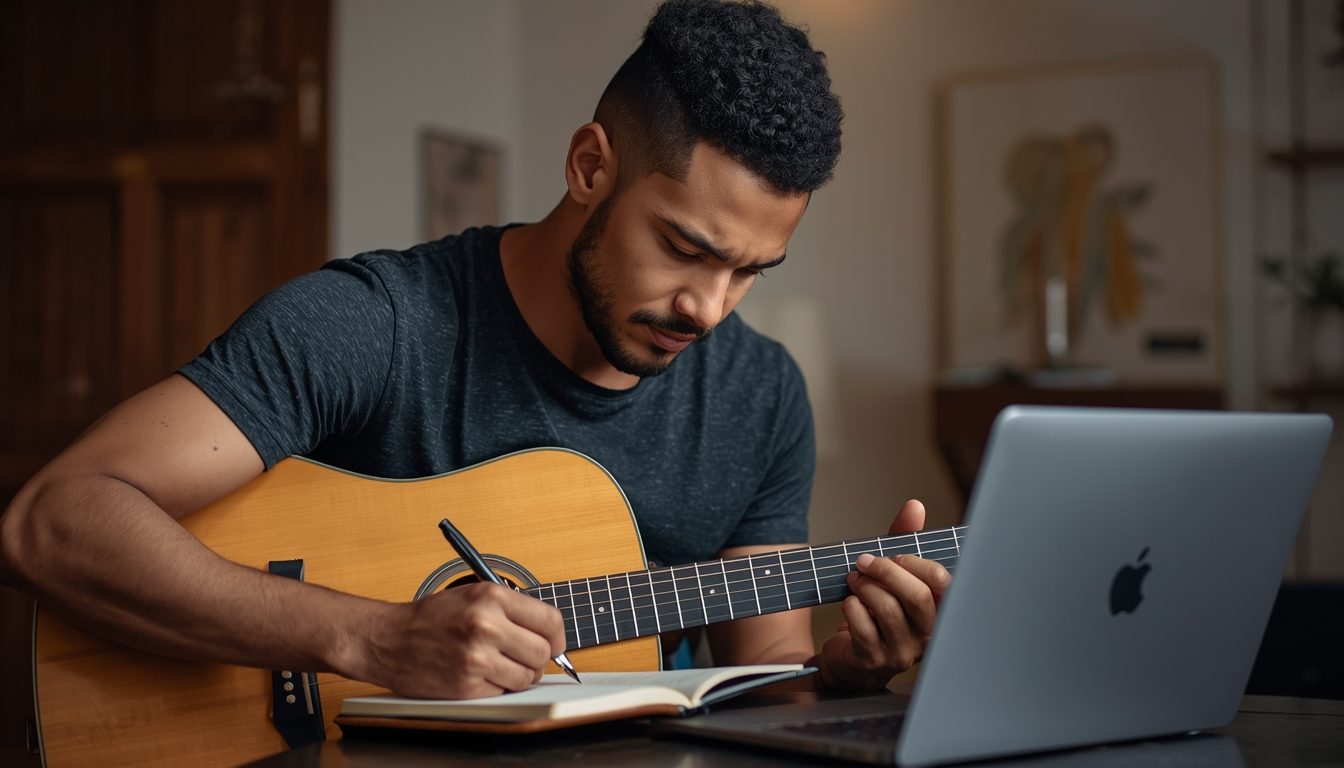
Here’s the system. Once a week (Sunday evening works well) you sit down with a notebook or a notes app and answer four questions.
1. How many days did I practice this week?
2. What’s one thing I can do now that I couldn’t do a month ago?
3. What’s one thing I’m stuck on?
4. What’s the next small piece of repertoire I want to learn?
That’s the whole journal. Five minutes, max. Over a year, you’ll have fifty-two entries that tell a clear story of your growth, and the “one thing I can do now” question is the one that will surprise you most. When you can’t see day-to-day progress, going back through old answers will absolutely show you that you’ve moved.
If you want to layer in something visual, keep a running list of pieces in your repertoire on a single page. Add to it when you genuinely get a new piece to a playable state. Don’t delete the pieces you’ve drifted away from. Mark them retired and leave them on the page. The count of pieces still marked playable is the metric that answers the repertoire question, and the full list, retired entries included, is the record of where you have been. The other optional layer is a recording of a familiar piece every four to six weeks, kept where you can find it again.
For students still building their practice rhythm, a clear practice routine is the foundation any tracking system sits on top of.
What to Do When Progress Stalls
Sometimes the journal will tell you what you already suspect. You’re stuck. Repertoire isn’t growing. The “one thing I can do now” answer is the same as last month. This is normal, and it’s actually one of the most useful moments tracking provides, because plateaus are easier to address when you’ve actually noticed them.
A few things to try when growth has flatlined:
- Drop the piece you’ve been grinding on. Pick something easier and finish it properly. Confidence often unlocks technique.
- Bring the stall to your teacher explicitly. Say “I haven’t felt growth in six weeks.” A good teacher will adjust the approach.
- Record yourself playing something familiar and compare it to the recording from two or three months ago. The difference is almost always there, even when you can’t feel it.
- Change one variable: time of day, length of session, what you start with. Sometimes the practice itself has gone stale.
Your teacher is tracking from the other side. Harry B., who teaches guitar on Tunelark, says a flattening arc is hard to see while you are deep in a new piece, and that seeing it is part of his job: when he does, he changes what the student is working on.
There’s a lot more to say about working through stalled progress, and we’ve written a separate guide on what to do when you plateau in music lessons if this is where you are right now.
The point of choosing to track music practice progress isn’t to prove anything to anyone, including yourself. It’s to give your honest effort a place to land, and to make sure that the slow, real growth of an adult learner actually gets seen.
How to Find a Good Music Teacher on Tunelark
The right teacher will help you set the metrics that matter for your specific instrument and goals. Here’s how to find them.
1. Open the teacher list and filter by your instrument.
2. Read bios. Look for teachers who talk about goal-setting and check-ins, not just curriculum.
3. Book a trial lesson with one whose profile resonates. The first lesson with a new teacher is $25 off that teacher’s 30-minute rate.
4. In the trial, ask how they help adult students see their own progress. Their answer will tell you a lot.
The right tracking system is the one you’ll actually use. Pair it with a teacher who’s paying attention to your growth from their side, and you’ll have all the visibility you need.
Frequently Asked Questions
How often should I track my practice progress?
Once a week is plenty. Daily tracking turns into a chore that eats into the practice time it’s supposed to support. A weekly check-in catches what matters without becoming the point.
Should I time my practice sessions?
You can, but don’t make minutes the headline metric. Time tells you almost nothing about quality. If you do time sessions, use it as a rough boundary (a minimum or a cap) not a score to beat.
Is recording myself useful for tracking progress?
Yes, but sparingly. A recording every four to six weeks of a familiar piece is one of the most honest progress checks you can get. Listening back to yourself often reveals growth that you can’t feel from the inside.
What if I miss several weeks of practice: should I track that?
Just note it in the journal and move on. The pattern you’re tracking is over months, not days. Missed weeks happen, and they only become a problem if one turns permanent. Coming back at about half your usual session length for a week or two makes the restart easier.
Should I show my practice journal to my teacher?
You don’t have to, but it can be useful. Sharing the “one thing I’m stuck on” answer at the start of a lesson focuses the work fast. Most teachers appreciate students who come in with that kind of self-awareness.
Keep reading
About Jennifer Heath
I'm Jennifer Heath, VP of Operations at Tunelark and a lifelong singer. I joined the company in 2020 and oversee much of what makes Tunelark work for students and teachers: hiring, training and supporting our instructors, student support, marketing and day-to-day operations. I started voice lessons at 7 and sang with touring choirs through my teens. Music belongs in every life, for the self-expression, the discipline, the comfort and the simple joy of it.