Drum Kit or Percussion Lessons: What Does Your Child Need?
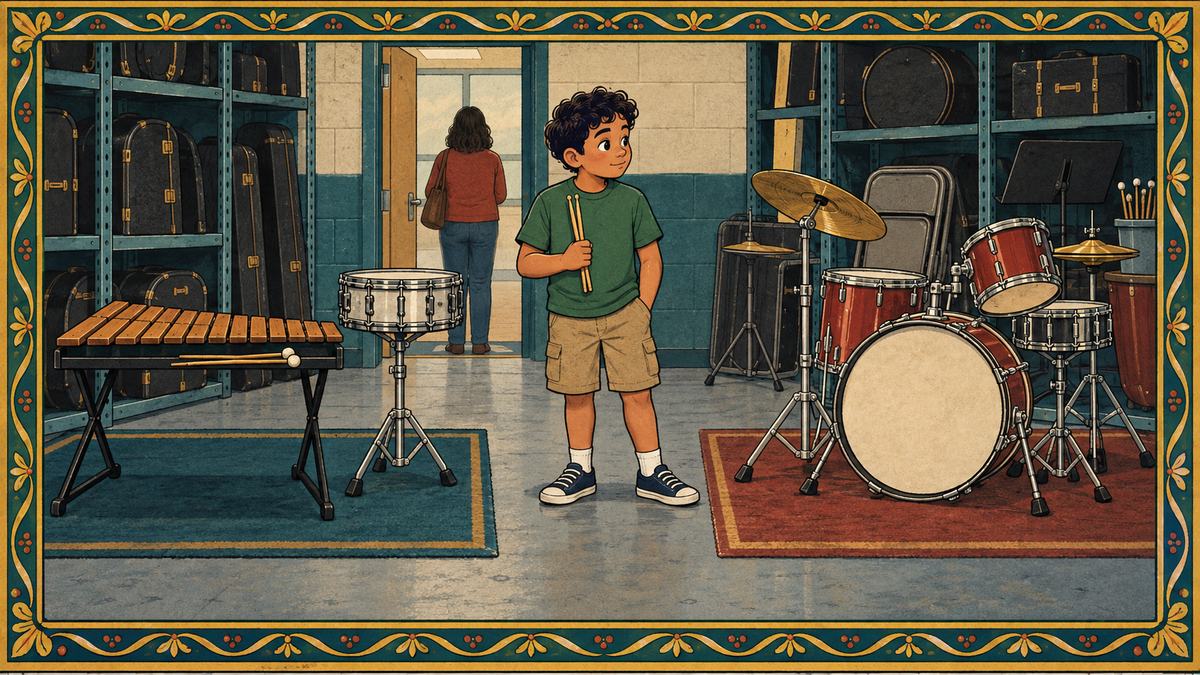
If your child wants to play songs with friends in a band, start with drum-kit lessons. If your child has been placed in the percussion section of a school band, start with school percussion, which means a snare drum and a set of bells before anything with a kick pedal. Most children who stay with either path end up doing some of both, so the choice sets the first year, not the next ten.
The confusion starts with the word. A band director says percussion, the child hears drums, and the two describe different instruments, different practice and a different first lesson.
What Percussion Means in a School Band Room
School percussion is a section, not an instrument. A beginning percussionist learns two things in the first year: the snare drum, the shallow drum with metal wires called snares across its bottom head that give it a crisp crack, and keyboard percussion, the family of tuned bars struck with mallets, which are sticks with a rubber, plastic or yarn head. Bells, also called the glockenspiel, have small metal bars, and the xylophone and marimba have wooden bars, the marimba’s wider, lower and warmer. Later come timpani, the large copper-bowled drums tuned to specific pitches with a foot pedal, and auxiliary percussion, the catch-all for triangle, tambourine, cymbals, bass drum and whatever else a band piece calls for a bar or two at a time.
The Quakertown Community School District’s beginning band percussion page requires percussion students to rent or buy a combo kit with a snare drum, a bell set, a rubber practice pad, sticks and mallets, and asks each student to pick bells or snare as the main instrument for lessons. Many districts publish a similar list, and the bell kit is the item that surprises parents who expected drums.
Directors ask for mallets and reading before a kit because the bells part in a band arrangement is a melody on the same staff the flutes read, and the snare part is a rhythm line with long stretches of rests to count through. A school percussionist’s job in a concert is to play a written part, on cue, at the marked volume, and a child who can play a rock beat but cannot read has no part to play. Our guide to reading sheet music as a beginner covers that staff.
Concert percussion is one tradition among several. Hand percussion such as congas and djembe, marching percussion, and world traditions such as tabla and taiko each have their own technique and repertoire, and a teacher who plays orchestral timpani may not have held a djembe. The word percussion on a teacher’s profile needs a follow-up question: which one?
What Drum-Kit Lessons Teach
The drum kit is one player’s instrument: a snare, a kick drum played with a foot pedal, hi-hat cymbals opened and closed with the other foot, one or more toms, and crash and ride cymbals. The skill is coordination, four limbs doing different things in time, and the first goal is a groove, a repeating pattern that holds a song together. Kit students play with recordings from the first weeks: most play along to a simple song within the first month or two and hold a groove through full songs by month six. Our realistic timeline for learning drums lays out what each stage sounds like.
This is what a kit lesson looks like once the coordination is there. Ian M. builds a zydeco groove one limb at a time, the same way a first rock beat is taught: hands first, then the kick under it.
Skill video · Zydeco Drumming Basics
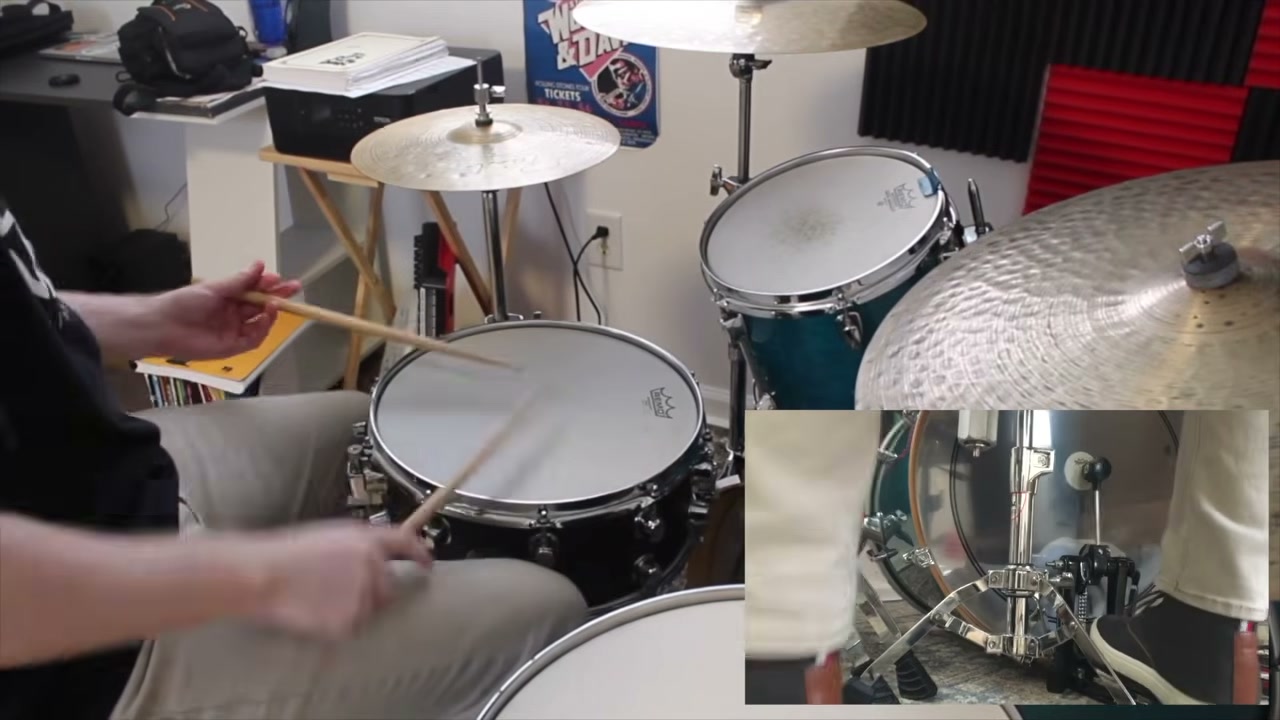
Ian teaches drums on Tunelark. View Ian’s profile
The reading tradition is different. Drum notation gives each part of the kit its own line or space on the staff, with x-shaped noteheads for cymbals, and most kit players meet it through song charts after they can already play a few beats. A good kit teacher has a child reading it by the end of the first year, but the ear and the metronome lead.
Starting at 6 to 8 takes two things: a kit set low enough that the feet reach the pedals, and enough limb independence to move hands and feet separately. Most online students start on an electronic kit, which plays through headphones, and our guide to online drum lessons without an acoustic kit explains how that works over video.
What Carries Over, and What Does Not
Stick technique transfers. Matched grip, with the stick pivoting between the thumb and index finger and the other fingers wrapped loosely so it can rebound, is the same on a pad, a concert snare and a kit snare, and our beginner drum tips walk through it.
Rudiments transfer as well. A rudiment is a short pattern of which hand plays each stroke: the single stroke roll is right left right left, the double stroke roll is right right left left, and the paradiddle is right left right right, then left right left left. The Percussive Arts Society maintains the list of 40 International Drum Rudiments, grouped as rolls, paradiddles, flams and drags, and its guidance is to practice each one open to close to open, meaning slow to fast and back to slow, or at a steady march tempo. A drumline, the marching snare, tenor and bass drum section of a marching band, is built on them, and so is a clean fill on a kit, the short burst that leads into a new section of a song. Reading rhythm is shared too, since eighth notes, sixteenth notes and rests count the same on a snare part and a kit chart, and so is the metronome.
What does not transfer is most of what each path is for. A school percussionist reads pitches on bells and, a few years in, learns a mallet grip that holds two mallets in one hand for marimba. A kit student builds foot technique and limb independence, and a school percussionist who has read snare parts for two years can sit at a kit unable to hold a basic rock beat because their feet have not been asked to do anything. Counting 40 bars of rest and coming in on one triangle note is an ensemble skill kit players rarely need and school percussionists need weekly.
Who Teaches Percussion Here, and Why the Tradition Question Matters
Ian M. started drums in first grade and studied percussion from marimba and drum set through traditional Brazilian and West African drumming before graduating from Berklee College of Music in 2018. He tours internationally with the Zydeco Experience and has performed in his home town of New Orleans with Ellis Marsalis, Preservation Hall and Donald Harrison. Egan M. came the school route instead: eight years of lessons, then high school marching band and percussion ensemble, before adding bass and guitar. Those are two different first years, and both are on the roster. A teacher who names the tradition they play, rather than the word percussion, is telling you which one your child would get.
A Decision Table for Parents
The child’s goal decides the path, and a goal stated at 8 is usually specific enough to use.
| Goal | Start with | Home setup | What to tell the teacher |
|---|---|---|---|
| Child wants to play in a rock band | Drum kit | Electronic kit with mesh heads, closed-back headphones, pad and sticks | The songs the child wants to play, and ask for a play-along in the first lesson |
| Child is in beginning band on percussion | School percussion: snare and bells | Pad, concert snare sticks, bell kit, rubber mallets, the band method book | The method book’s title, the next concert date, the assigned main instrument |
| Child wants marching band or drumline later | School percussion now, rudiments from the first lesson | Pad, sticks, metronome, plus the band class’s bell kit | Ask for the 40 rudiments open to close to open, snare reading, and the high school drumline audition list |
| Child wants orchestra | School percussion, mallets first, timpani when the school has them | Bell kit, pad and sticks | Ask how mallets and timpani are covered over video with no timpani at home |
| Child is 6 to 8 and just wants to hit things | Drum kit, 30-minute lessons, pad work in each one | Pad and sticks first, then an electronic kit set low after a couple of months | Ask for lessons that keep the child moving and end with one thing to play 10 to 15 minutes a day |
| Family lives in an apartment | Either path, with the kit path on an electronic kit | Pad and sticks. A bell kit is quiet. The kit path needs headphones | What can make noise at home and when |
A child whose goal changes moves across the table rather than starting over. The pad work, rudiments and rhythm reading come along.
What to Practice at Home on Each Path
Both paths start with the same three things: a practice pad, $25 to $40 as of 2026, a pair of sticks and a metronome. The pad makes almost no sound.
For school percussion, add the bell kit the district requires, usually a student bell set with stand, case and rubber mallets, rented or bought through the school’s music dealer. The dealer’s rental price is printed on the district’s instrument form. The bell kit is the mallet practice instrument. Rubber mallets keep the ring short, and a towel laid across the bars quiets it further for grip and stroke work.
For the kit path, an electronic kit with mesh heads from Alesis runs roughly $400 to $700 as of 2026, and the entry all-mesh kits from Roland start closer to $800 to $1,000. Add closed-back headphones, $30 basic or $50 to $100 better, so the kit is loud in the child’s ears and quiet in the room. In an apartment the kick pedal still thumps through the floor, and our guide to drum practice in an apartment has the fix.
Practice minutes follow the child’s age, not the path. Ages 5 to 7 manage 10 to 15 minutes a day, ages 8 to 10 manage 15 to 25, and ages 11 and up manage 25 to 45, five or six days a week, and two short sessions beat one long one for a young child. A school percussionist splits the time between pad and bells, a kit student between the pad and one groove played slowly and cleanly.
Questions to Ask a Prospective Teacher
A trial lesson answers most of these.
1. Do you teach mallets? A child in school percussion needs bells and, later, marimba in the lesson. A kit-only teacher leaves half of the school part uncovered.
2. Which of the 40 rudiments do you teach in the first year, and in what order? A teacher on either path should name the single stroke roll, the double stroke roll and the paradiddle.
3. Can you prepare a child for a school audition? Auditions for seating order in the section, for the district honor band and for drumline ask for a prepared snare piece, sight-reading and specific rudiments, so ask what the last audition the teacher prepared a student for required.
4. Which percussion traditions do you play? Concert, kit, hand, marching and world traditions are separate skills, and few teachers cover them all.
5. Can you work from the school’s method book? The lesson should move the concert part forward.
For a child aged 5 to 11, a 30-minute lesson is the right length, and our guide to the best online drum teachers describes what a first lesson over video covers.
How to Find a Drum Teacher on Tunelark
Tunelark connects you with deeply vetted drum teachers who teach online. Vetting is run by working musicians and music teachers, not a general recruiter, and every teacher sets their own rate and shows it on their profile. Scheduling, billing and support are handled for you.
- Browse drum teachers at tunelark.com/find-a-teacher and watch their videos.
- Read bios for whether a teacher covers mallets and school percussion, or grooves and beginners if your child wants a kit.
- Book a trial lesson at $25 off the teacher’s 30-minute rate, with the school method book open if there is one.
- Ask your child afterward what they played. A child who can name it is far likelier to practice it.
Frequently Asked Questions
What is the difference between drum lessons and percussion lessons?
A percussion lesson rotates among snare, mallets, timpani and auxiliary percussion as the concert calendar demands. A drum lesson stays on the kit and follows songs. College percussion auditions ask for snare, mallets and timpani, with drum set usually optional, so a child who wants to keep percussion open past high school needs the school path at some point.
Can a drum-kit teacher teach school percussion?
Often. Many kit players came up through school bands and teach snare technique and reading well. Fewer keep mallet instruments at home, so ask to see the bells on camera before booking.
What age can a child start percussion lessons?
Kit lessons work from about 6 to 8, once a child can move hands and feet independently. Most US school bands begin in fourth, fifth or sixth grade, so school percussion tends to start at 9 to 11.
Does my child need a bell kit for drum-kit lessons?
No. A bell kit is a school-percussion tool, and a kit student who joins band later can rent one then. Kit reading and stick technique carry into the snare part.
Can school percussion be taught online?
Yes. The camera sits at pad height so the teacher sees both hands, with the bells in frame for the mallet part. Few families own timpani, so timpani exercises go on the pad and get checked on the school’s drums.
Looking for an online drum teacher? See our full Online Drum Lessons page for everything you need to know about getting started.
Keep reading
About Jennifer Heath
I'm Jennifer Heath, VP of Operations at Tunelark and a lifelong singer. I joined the company in 2020 and oversee much of what makes Tunelark work for students and teachers: hiring, training and supporting our instructors, student support, marketing and day-to-day operations. I started voice lessons at 7 and sang with touring choirs through my teens. Music belongs in every life, for the self-expression, the discipline, the comfort and the simple joy of it.