Suzuki or Traditional Violin Lessons: What to Compare
The real difference between Suzuki and traditional violin lessons is who does the teaching between lessons and when the child starts reading music. Suzuki expects a parent at every lesson and at the center of daily practice, and it teaches by ear before notation. Traditional lessons usually bring reading in from the first weeks and treat the parent as support rather than as a second teacher.
Both approaches have produced fine violinists. The better question for a family is which set of demands fits the child’s age and the household’s week, and whether the teacher in front of you actually works the way the label says.
What Suzuki Asks of a Family
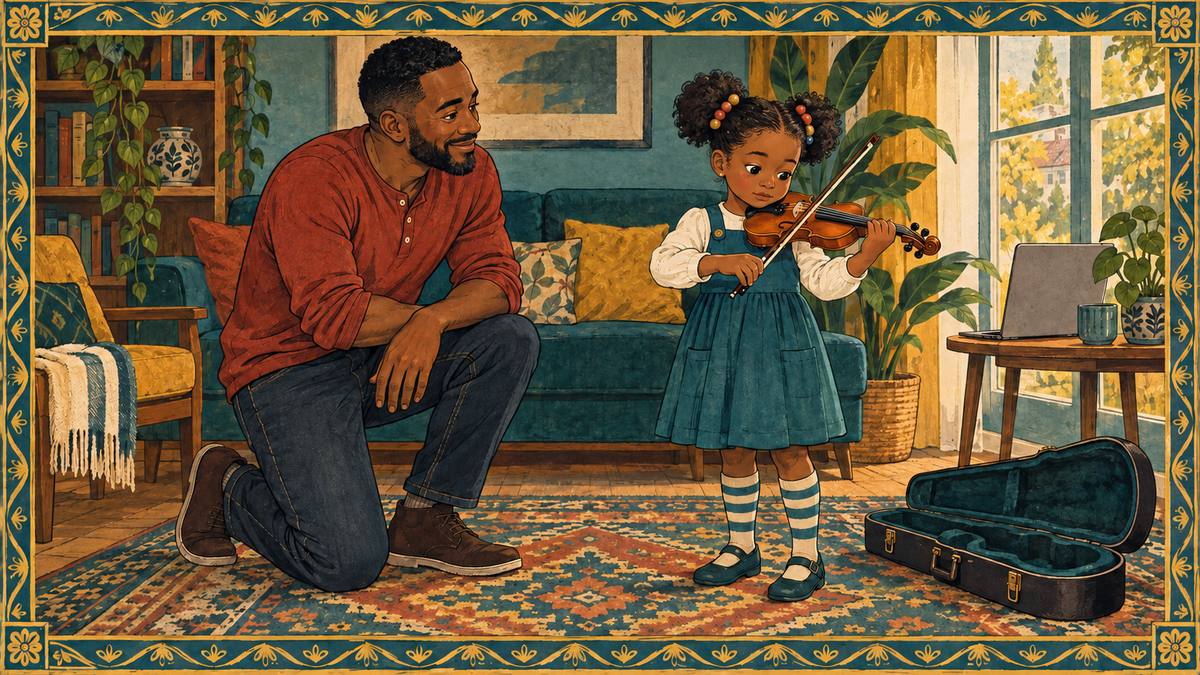
The Suzuki Association of the Americas describes the method as a triangle of teacher, parent and child. The parent attends lessons and serves as what the association calls the home teacher and practice partner for the rest of the week. That role is the reason a Suzuki child can start so young: a three- or four-year-old cannot run their own practice, so an adult who watched the lesson runs it for them.
Three other pieces come with the method. Children learn by ear first, the way they learned to talk before they learned to read. They listen to recordings of the pieces they are studying, daily and a lot, which the association treats as part of the method rather than an extra. And students are expected to take part in group lessons and performances alongside their private ones.
The repertoire is shared. Suzuki Violin School runs to ten books, and Suzuki students move through the same core pieces in the same order. Book 1 opens with the Twinkle Variations, the same tune in five different rhythms, which beginners first play on the open A and E strings, meaning the strings sounded without a finger pressing them down. It continues through folk songs such as Lightly Row and Go Tell Aunt Rhody to three minuets the book credits to Bach and a Gavotte by Gossec. A child who moves to a new Suzuki teacher in another city can usually pick up where they left off.
The association is candid that not every child has a parent free for all of this, and says some of its teachers find other ways to provide support at home. That flexibility belongs to the individual teacher, so it is worth asking about directly.
What “Traditional” Means When No One Owns the Word
Traditional is not a method with a governing body the way Suzuki is. It is shorthand for everything else, and in practice it tends to mean three things: notation from the start, a teacher who chooses the books, and a parent who is not in the lesson.
One published example is Essential Elements for Strings, a method book written for school orchestra classes. Its Book 1 asks a violinist to name the four strings, G, D, A and E, and pluck them on its first page of playing. By the next page the student is reading a staff, counting quarter notes and rests, and plucking a line marked open D, with the letter names printed alongside the notes. The bow does not touch the string until exercise 47. A private teacher who calls their approach traditional typically follows the same reading-first logic with their own choice of scale books, studies (short pieces written to drill one technique) and repertoire, and our guide to private lessons alongside school orchestra covers how that work divides with a school director.
The parent’s role is different too. For a child of about six to eight in conventional violin lessons, the parent handles the setup, stays within earshot and out of frame, and is the audience afterward rather than a second voice during the lesson. From about eight the parent is usually not in the lesson at all. Our guide to how parents can support a child learning music covers that quieter role.
Listening First or Reading First
The order of skills is the biggest day-to-day difference in the first year. A Suzuki child plays the Twinkle Variations with a bow, by ear, sometimes for months before a page of music appears. A child in a reading-first book spends those same weeks connecting each note on the staff to a finger and a string, and plucks for a good while before bowing.
Neither order skips anything. The Suzuki child builds sound, posture and memory first and adds reading later, with the timing left to the teacher. The traditional child builds reading alongside the instrument and can sound less polished early, with attention split between the page and the hands. Our guide to reading sheet music as a beginner shows what that reading involves.
Both approaches start from the same place in the first weeks: the four open strings, named and played until the child can find each one without looking.
For a sense of pace on either path, simple folk tunes by about month three and recognizable, mostly clean notes by about month six are a realistic first-year shape, and our guide to how long it takes to learn violin sets out the full timeline.
How Each Approach Works in an Online Lesson
Online, the Suzuki parent does one more job. The teacher can see the bow hold, meaning how the fingers grip the bow, but cannot reach through the screen to shape it, so the adult beside the child becomes the teacher’s hands: adjusting a thumb, tilting the violin, moving the camera so the teacher can see the bow on the string. For a four-year-old, that parent is what makes the lesson work at all.
The group half of Suzuki is the piece a one-to-one video lesson does not supply by itself. Tunelark lessons are one-on-one, so a family committed to the full method pairs private online lessons with a local group class or an ensemble, or chooses a teacher who builds performance into the studio another way. Ask what that looks like before booking.
Traditional lessons travel online with fewer adjustments. A child reading from a stand in front of a laptop needs the camera to show the left hand, the bow and the music, and a parent who checks the setup before the lesson and then leaves the room. For a young child in either approach, 10 to 15 minutes of daily practice at ages five to seven is the usual load, and splitting it into two short sessions is normal.
Our guide to the best age to start violin lessons covers readiness signs by age, and our guide to online violin lessons for adults covers what changes when the beginner is the grown-up.
Which Approach Fits Your Family
Labels matter less than the facts of a household. Where two rows point in different directions, the adult’s time usually decides it, because Suzuki depends on a home teacher.
| If this is true | It points toward |
|---|---|
| The child is 3 to 5 | Suzuki, with a parent in every lesson. It is the approach built for this age |
| An adult can attend every lesson and run a short practice every day | Suzuki is realistic |
| No adult can attend lessons or run daily practice | Traditional, or ask a Suzuki teacher how they support practice at home |
| The child already reads music in a school orchestra | Traditional, or a teacher who mixes both and keeps the reading going |
| The child picks up tunes by ear and loves recordings | Suzuki plays to that strength |
| The family wants group classes where everyone plays the same pieces | Suzuki, if a program nearby can supply the group half |
| A school or community orchestra seat is the near-term goal | Reading first |
| The beginner is an adult | Either. An adult is student and home teacher at once |
When both columns fit, a teacher does not have to pick one. Jana K., who teaches violin and viola on Tunelark, holds violin degrees from McGill University and Indiana University. Her profile describes younger students working through the Suzuki method and student concertos, which are longer solo pieces written for learners, adult students choosing their own genre, and three online recitals a year.
Questions That Show How a Teacher Really Teaches
A blended studio is often the right answer, but only if the parts are real. These questions sort that out in a first conversation:
- Which Suzuki book units have you completed? The association trains teachers one book at a time, through a registered course for each book, and its Find a Suzuki Teacher search lists member teachers. A teacher who is not a member may still be excellent, so ask about both training and experience.
- When do you introduce reading, and how? A Suzuki teacher should have a plan for it. A traditional teacher should name the book they start in.
- What do you expect from me during the lesson and at home? In a Suzuki studio the answer is usually attendance, notes and daily practice. In a traditional one it is usually setup and encouragement.
- What should we listen to, and how often? A Suzuki teacher will name the recording. A traditional teacher’s answer shows how much they value listening.
- How do students play with other people? Group class, recitals, a youth orchestra, or nothing yet. Any answer is fine as long as it is honest.
- Can we watch a lesson first? The association notes that many Suzuki teachers invite families to observe before starting, and a short look at how a teacher corrects a child says more than any label.
How to Find a Violin Teacher on Tunelark
Every Tunelark teacher is vetted by working musicians and educators for teaching quality before they can list. Each teacher sets their own rate and shows it on their profile, and Tunelark handles scheduling, billing and support.
- Open the teacher list at tunelark.com/find-a-teacher and filter by violin, then read the bios for the words Suzuki, traditional or both.
- Choose a lesson length of 30, 45 or 60 minutes. For a child of five to eleven, 30 minutes is the usual length.
- Book a trial lesson. The first lesson with a new teacher is that teacher’s 30-minute rate minus $25, so trials start at $14.
- Bring the questions above to the trial, and have the adult who will run home practice sit in on it.
Frequently Asked Questions
Can my child switch from Suzuki to traditional lessons later?
Yes. The thing to expect is a gap between what the child can play and what they can read, so a new teacher may assign reading material that sounds easy next to their pieces. Closing that gap is a normal part of the switch, not a step backward.
Do I need to play the violin to be a Suzuki parent?
No. The association’s introductory course, Every Child Can!, runs six to eight hours, is open to parents, and requires no instrument or audition. It introduces Dr. Suzuki’s philosophy, which is the part of the method a parent carries into daily practice.
Is a Suzuki-trained teacher certified?
Not in the usual sense. The Suzuki Association of the Americas registers each training course a teacher completes but states that registration is not certification, and it does not offer certification as such. It does run a separate Certificate of Achievement program.
What does a Suzuki family need to buy?
The Suzuki Violin School book for the current volume and its recording, which daily listening is built on, plus a fractional violin sized to the child’s arm by a teacher or a string shop. Violin sizes run down to 1/16 and 1/32 for the youngest starters.
How young can a child start in each approach?
In traditional lessons, 6 to 8 is the conventional start, with 6 as the practical youngest. Suzuki starts children as young as 3 or 4, most often between 4 and 6, on the condition that a parent attends every lesson and leads short practice at home every day.
Looking for an online violin teacher? See our full Online Violin Lessons page for everything you need to know about getting started.
Keep reading
About Jennifer Heath
I'm Jennifer Heath, VP of Operations at Tunelark and a lifelong singer. I joined the company in 2020 and oversee much of what makes Tunelark work for students and teachers: hiring, training and supporting our instructors, student support, marketing and day-to-day operations. I started voice lessons at 7 and sang with touring choirs through my teens. Music belongs in every life, for the self-expression, the discipline, the comfort and the simple joy of it.