Best Online Piano Lessons: How to Find a Teacher Who Fits Your Goals
Best Online Piano Lessons: How to Find a Teacher Who Fits Your Goals
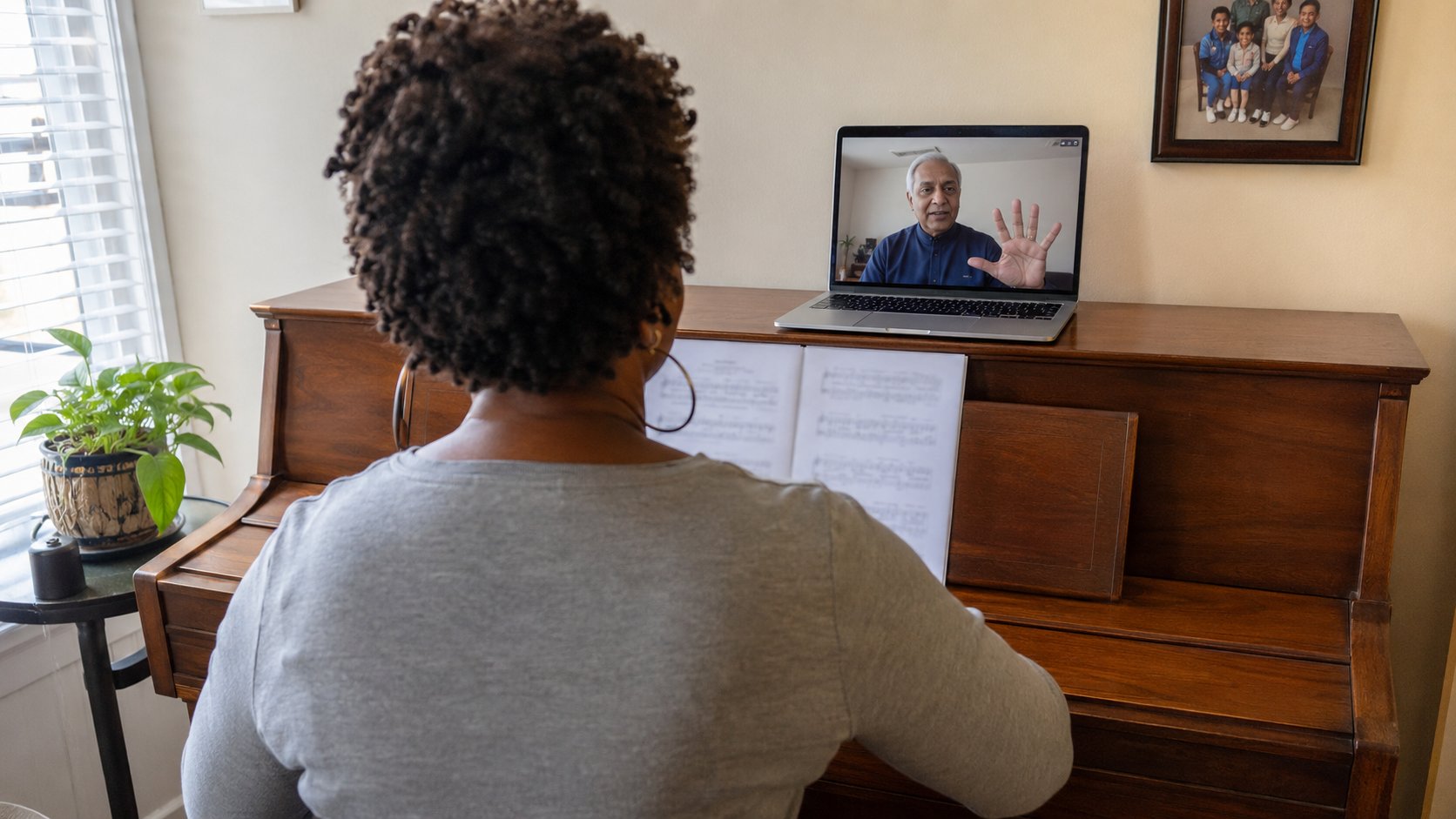
Piano is one of the best instruments to learn online. The setup is straightforward: a digital piano or acoustic upright, a laptop, and a webcam angled to show your hands. There’s nothing about piano that requires being in the same room as your teacher, which is why so many serious students have shifted to online lessons in the last decade and never looked back.
The question isn’t whether online piano lessons work. It’s how to find the right teacher among the thousands who advertise online instruction.
Why Online Piano Lessons Actually Work Well
A piano lesson is, fundamentally, a conversation about what your hands are doing, what your ears are hearing, and what the music is asking for. None of that requires shared physical space. A good webcam shows your hands clearly. Audio over a decent connection is fine for almost all teaching purposes. And the time you save not driving to a studio every week translates directly into more practice: the actual variable that determines progress.
Students often discover that online lessons feel more focused than in-person ones. You arrive on time because there’s no commute. You play on your own piano in your own room, the same piano you practice on all week, so what you show your teacher is honestly representative. Recording the lesson for later review is trivial. None of this is true of in-person instruction.
What to Look For in an Online Piano Teacher
Three criteria matter more than the rest.
Pedagogical training. Many great pianists are mediocre teachers, because performing and teaching are different skills. Look for teachers who describe how they teach, what their first lesson with a beginner looks like, how they introduce reading, how they sequence repertoire. Vague language like “I customize lessons for each student” tells you almost nothing. Specific language tells you a lot.
Experience with your level. A teacher who specializes in advanced classical students may not be the right fit for an adult re-starter who wants to play pop songs. Read bios carefully. If a teacher lists exclusively conservatory placements, they may be optimized for a path you’re not on.
Communication style. You’ll spend dozens of hours with this person over the next year. Their tone should feel natural to you. Some students need warm, encouraging teachers. Others want direct, demanding ones. Both produce excellent musicians. The wrong fit produces frustrated dropouts.
What to Expect by Level
Absolute beginner (months 0-6). Hand position, basic note reading, simple two-hand coordination, your first pieces. A good teacher won’t rush this phase, sloppy foundations cause every problem you’ll have later.
Early intermediate (months 6-18). Reading both staves comfortably, simple chord progressions, basic scales and arpeggios, real repertoire from the Anna Magdalena Bach notebook or popular sheet music. You start to recognize that you’re playing music, not exercises.
Intermediate (year 2-3). Multiple keys, more complex rhythms, beginning improvisation or arrangement, longer pieces. This is where most adult learners settle in for a long, satisfying plateau.
Advanced (year 3+). Serious repertoire, expressive control, the start of stylistic specialization. Many students never feel “done” here, and that’s the point. Piano gets richer the longer you play.
Equipment That’s Actually Necessary
A weighted-key digital piano is the minimum. 88 keys is ideal. Less than 76 keys limits what you can play. Touch matters more than brand, a hammer-action keyboard mimics the resistance of an acoustic piano and builds the right finger strength.
For the lesson itself: laptop or tablet with a webcam, decent internet, and an external webcam pointed at your hands. The built-in camera shows your face, which your teacher cares less about than what your hands are doing. A $50 USB webcam clipped to a music stand solves this completely.
Audio doesn’t have to be studio quality. Built-in laptop microphones are fine for most teaching. If your teacher asks you to upgrade later, a $40 USB mic is plenty.
Red Flags When Evaluating a Teacher
A few patterns to watch for:
- No structured first lesson. A good teacher has a clear sense of what they’re going to assess in lesson one. “Let’s just play and see” is a flag.
- Refuses to answer questions about pedagogy. A real teacher can explain why they sequence things the way they do.
- Pushes long-term commitments before a trial. A trial lesson is industry standard. A teacher who resists offering one is protecting something.
- No mention of practice expectations. Teachers who don’t talk about practice are teaching you to be entertained, not to play piano.
How to Find a Piano Teacher on Tunelark
Every piano teacher on Tunelark is vetted for credentials, teaching experience, and ability to teach effectively online. Our roster includes teachers who specialize in classical, jazz, pop, and adult re-starters specifically. To find your match:
1. Browse our piano teachers and filter by instrument.
2. Read bios carefully. Look for teachers whose described approach matches your goals.
3. Book a trial lesson with two or three teachers whose profiles resonate.
4. After each trial, notice: did the teacher feel curious about you and clear about what they’d work on? Both signals matter more than credentials.
The best piano teacher for you isn’t the most credentialed or the most popular. It’s the one whose teaching style and personality fit how you learn. Tunelark makes that match easier to find.
Frequently Asked Questions
Are online piano lessons as good as in-person?
For most students, yes. Piano is uniquely well-suited to remote instruction because the teacher can see your hands clearly, hear what you’re playing, and discuss everything that matters. Many serious students prefer online lessons after experiencing both.
How much do online piano lessons cost?
Most online piano teachers charge $40-$100 per hour, depending on experience and credentials. Tunelark teachers fall in this range, with most students starting at $50-$75 per hour for a 45-60 minute lesson.
Do I need an acoustic piano, or is a keyboard okay?
A weighted-key digital piano with 88 keys is fine for almost any student. The touch is what matters, hammer-action keyboards build the same finger strength as acoustic pianos. Unweighted keyboards make technique harder to develop.
How often should I take piano lessons?
Weekly lessons are standard and produce the most consistent progress. Some advanced students take lessons biweekly; some serious students take twice weekly. Less than weekly tends to produce slow, frustrated learning.
Can I learn piano online as a complete beginner?
Yes. Many adult beginners start with no prior musical experience and progress steadily with a good teacher and consistent practice. The first few months are about foundation (hand position, reading, basic coordination) and those are taught equally well online.
Looking for an online piano teacher? See our full Online Piano Lessons page for everything you need to know about getting started.
Keep reading
About Jennifer Heath
I'm Jennifer Heath, VP at Tunelark and a lifelong singer. I joined the company in 2020 and oversee much of what makes Tunelark work for our students and our teachers. That includes hiring, training, and supporting our instructors, customer and student support, marketing, and the day-to-day operations of the business.
I started voice lessons at age 7, sang with professional choirs that toured internationally through my teens, and performed solo at competitions and community events across Texas before stepping away in my twenties to study other interests, including business management. I haven't performed professionally in years, but I'll happily take the microphone at a karaoke night. Music has been in me every day of my life. Being able to spend the last six years working inside an online music education company, while traveling the world full-time, has been a perfect fit.
I believe deeply that music belongs in every life. For the self-expression, the discipline, the comfort, and the simple joy of it.
The Tunelark blog is where we share what we've learned about online music lessons: how to choose an instrument and a teacher, what to expect from your first lesson, how the major platforms compare, and how to keep music going through the busier seasons of life. Practical, honest writing you can act on.
Who we are
Tunelark provides virtual 1-on-1 music lessons to learners
of all ages.
We remove the barrier of geography and connect learners and teachers — wherever they are. Our growing community of vetted, experienced music educators have expertise in a wide variety of instruments, genres, and skill levels. We are passionate about connecting each student with the perfect instructor.