How Long Does It Take to Learn Trombone? A Realistic Timeline

Most beginners get a note out of a trombone in the first lesson or two and play simple tunes within the first few weeks. The range a band part asks for takes years: one published school district curriculum expects F below the bass staff up to middle C by the end of the first two years of band, the F above middle C during years three to five, and reading in more than one clef only in the last two years of high school. Three things set that pace on trombone: how accurately the slide arm lands, how far the lips can extend the range, and how fluently the player reads bass clef.
The First Weeks: A Note, Then Tunes Close to the Body
A first sound often comes in the first lesson, buzzing the lips into the mouthpiece alone and then on the instrument. Within the first weeks most beginners can play simple melodies using the inner positions, the slide stops nearest the player, where the arm barely has to travel. Lip soreness in this stretch passes within about two weeks as the embouchure, the lip shape that makes the note, becomes more efficient.
Habits set in these weeks decide how quickly the later stages come:
- The slide sits in the fingertips. The thumb and first two fingers hold the slide brace, the crossbar near the mouthpiece, and the wrist leads small movements. Brian Weidner’s textbook Brass Techniques and Pedagogy describes beginners wrapping the whole fist around the brace, which stiffens the wrist.
- The left hand carries the instrument. All of the weight belongs in the left hand, and the right hand only moves the slide. A beginner who props the bell section on the left shoulder to rest the left hand collapses the posture and restricts the air.
- The mouthpiece alone gives a steady tone. Arlington Public Schools’ band curriculum lists buzzing sirens or songs on the mouthpiece with a full, clear, sustained tone as a beginning-level outcome, next to tonguing each note on the syllable doh or toh.
A teacher can check all three in the first lesson.
What One School District Expects, Level by Level
A detailed public timeline for trombone comes from that same Arlington curriculum. It sets out four levels, each tied to playing years and school grades, with a trombone range the student plays consistently at each one.
| Level | Playing years and grades | Range played consistently | New at this level |
|---|---|---|---|
| Beginning | Years 1 to 2, grades 4 and 5 | F below the bass staff to middle C | A sustained mouthpiece buzz, tonguing on doh or toh, a steady left hand and a relaxed right |
| Intermediate | Years 3 to 5, grades 6 to 8 | E below the staff to the F above middle C | Natural slurs and legato tonguing, the smooth note changes explained below, and choosing a mute and correcting the tuning it causes |
| Advanced | Years 6 to 7, grades 9 and 10 | E below the staff to the second B flat above the staff | A first grasp of double tonguing, alternating t and k syllables for fast notes, plus deliberate slides between notes |
| Artist | Years 8 to 9, grades 11 and 12 | The full extended range | Double and triple tonguing used consistently, reading in more than one clef |
A few cautions go with it. It is one district’s standard. It describes children who start in fourth grade and learn in group band classes, and the curriculum itself says the timeline should be adjusted for students who start later. And each range is what a student plays consistently, which sits below the highest note they can reach on a good day.
Read that way, the ladder says more about order than about speed. Range and tone come first, legato tonguing and mutes in the middle years, and double tonguing and a second clef last. Our guide to private lessons alongside school band covers when a child in a program like this gains from one-on-one work.
Why the Slide Arm Sets the Pace
A trombone’s slide positions are not fixed marks. Weidner notes that the exact spot for a note shifts with the partial being played, the particular note in the series the lips can produce at one slide setting, and with playing conditions, so a trombonist keeps adjusting the slide by ear. The arm learns distances, and the ear corrects them. Our guide to whether trombone is hard to learn draws the positions to scale and shows why the outer ones go wrong.
That correction loop is why the outer positions stay unreliable long after the inner ones are solid. The low E in the intermediate range sits in seventh position, the farthest out on a tenor trombone without an F attachment, a thumb valve that adds tubing. That puts the longest reach on the instrument into years three to five on the ladder above.
Speed is the second part of slide accuracy. A slide that drifts between notes smears through every pitch in between, even when the player tongues each note cleanly. Weidner’s fix is to move the slide quickly and practice the movement in isolation, beginning with notes a step apart and widening the intervals.
Legato is where the slide makes trombone unlike other winds. Woodwind and valved brass players slur by changing fingers under a continuous stream of air. A trombonist cannot, because the slide has to travel between most notes, and an unbroken stream would sound as a glissando, the sliding effect the instrument is famous for. The answer is legato tonguing, a very light lah that interrupts the air just long enough to hide the slide’s travel, and natural slurs, moves between two notes at the same slide position that the lips can make alone. Arlington places both at the intermediate level, in years three to five.
A self-check for this stage: record a slow scale, then listen back for smears between notes. A smear means the slide moved too slowly or the tongue arrived too late.
Range Grows Slowly, and Pushing It Costs Time
Brass range tends to develop more slowly than range on woodwinds or strings, and Weidner puts beginning trombonists at around an octave. Higher notes need strength and control in the lip muscles, which build over months of short daily practice.
The trap is reaching for high notes before the lips can hold them. Pressing the mouthpiece harder into the lips can force a note out today and leave a sore, tired embouchure tomorrow. Weidner’s advice is not to push students higher than they can play without pressure and with good air, and to build the range with long tones, single notes held steady, and interval studies, patterns that move between two notes a set distance apart.
On the Arlington ladder the top of the range moves from middle C to the F above it over roughly three years, then to the next B flat up over two more. The low end barely changes after the beginning level. If a student’s top note has not moved in a few months, check mouthpiece pressure, a thin air stream, and a practice routine that never leaves the comfortable middle of the range. Our guide to what to do when you plateau covers the wider pattern of stalls in the second to fourth year.
Bass Clef Is the Other Gate
Trombone music is written in bass clef, the staff low instruments read from, and a trombonist reads it at concert pitch: the written note is the note that sounds. A beginner who already reads treble clef from piano, recorder or a school music class has to relearn every line and space, because the same position on the staff names a different note.
A band part arrives as notation, and a rehearsal does not stop while a student works out the next note. Reading the notes off the page without stopping is what lets a student keep their place, so reading practice belongs in the daily routine from the first month: a few minutes naming the notes in the band part before playing it.
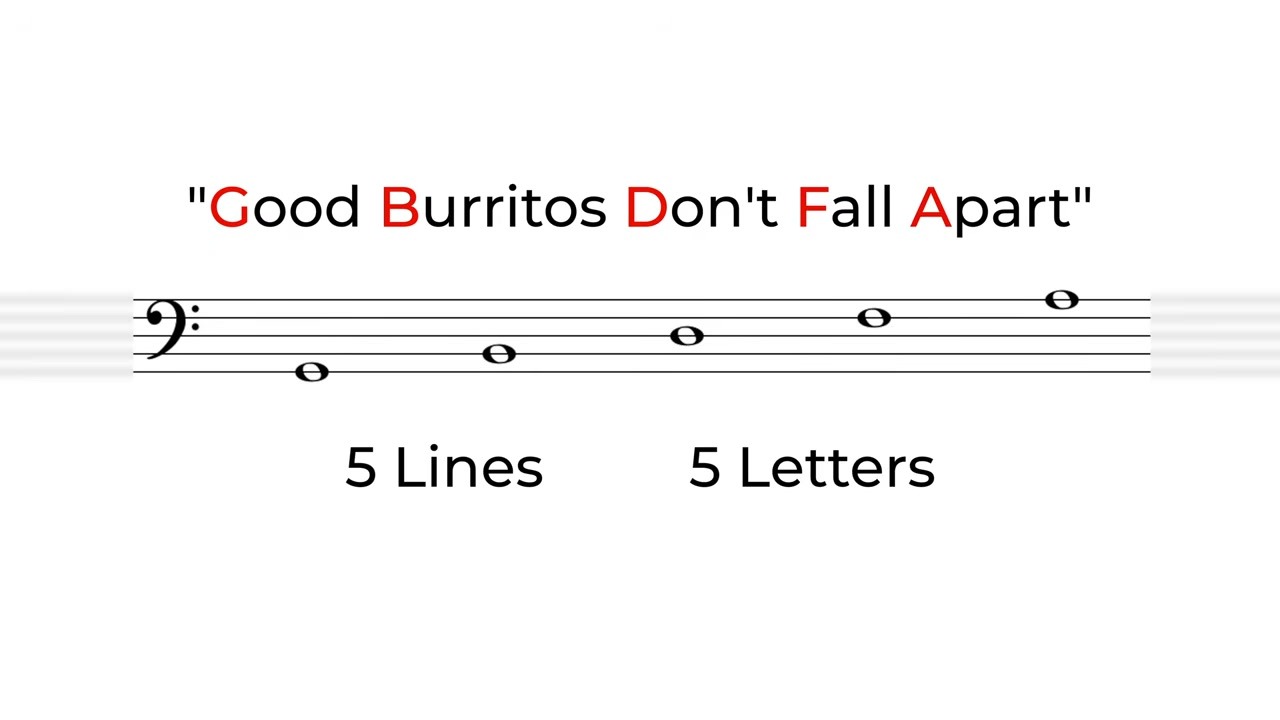
The bass clef lines, bottom to top, are G, B, D, F and A, and the spaces are A, C, E and G. Our guide to reading sheet music as a beginner covers both clefs, note values and counting.
Joshua names the bass clef lines and spaces separately, then puts them together: from G on the bottom line, each step up the staff, line to space, is the next letter of the alphabet, and each step down goes backward.
Skill video · How to Read Notes on the Bass Clef
Joshua recorded this lesson for the Tunelark channel.
Tenor clef, used for higher passages in orchestral and solo music, comes much later. Arlington lists reading in multiple clefs only at its final level, in years eight and nine.
Where an Adult or Private Student Fits on This Timeline
No published benchmark of this kind exists for adults or for students in private lessons alone, so use the district ladder for the order of skills, and expect the years to differ. An adult has the arm length for seventh position from day one and can practice deliberately, but the lip muscles still build strength over months, and they tire quickly for the first few.
Practice time is the factor a student controls most directly. For a beginner the target is 15 to 20 minutes a day, five or six days a week, rising to 30 to 45 minutes past the first year. Our guide to how much to practice explains why short daily sessions do more than one long one.
Weekly feedback moves it too, because the slide errors and air problems above are hard to hear from the inside. Sophie P. teaches trombone, trumpet and euphonium on Tunelark, and has played with ensembles including the Oakland and Modesto symphonies and appeared at the SF Jazz Center. One parent wrote on her profile that their child started trombone lessons with Sophie the summer before middle school, for fun, and was playing in the middle school jazz band by seventh grade. That is one family’s account.
How to Find a Trombone Teacher on Tunelark
Every Tunelark teacher is vetted by working musicians and educators for teaching quality before they can list. Each teacher sets their own rate and shows it on their profile, and Tunelark handles scheduling, billing and support.
- Open the teacher list at tunelark.com/find-a-teacher and filter by instrument, then read the bios for trombone and low brass experience.
- Choose a lesson length of 30, 45 or 60 minutes.
- Book a trial lesson. The first lesson with a new teacher is that teacher’s rate minus $25, for whatever length you choose, so trials start at $14.
- Bring the band part or method book page you are working on, and ask the teacher where it sits on the ladder above.
Frequently Asked Questions
Can I use a practice mute to practice quietly every day?
Use it for short quiet sessions, not for all of your practice. A practice mute packs the bell with batting, and Weidner warns that the back pressure it adds can cause harm and build bad habits. Keep most of the week’s playing on an open bell.
When should a student move to a trombone with an F attachment?
When parts start going below low E, or fast passages keep sending the slide to sixth and seventh. The attachment supplies the notes a plain tenor trombone cannot play between low E and the B flat below it, and gives closer alternate positions for the far ones. It also adds weight, which a smaller player feels in the left arm.
Does playing piano first shorten the trombone timeline?
It shortens the reading part. A pianist already reads bass clef with the left hand, so band parts make sense from the first week. The lips and the slide arm start from zero like anyone else’s, and those set most of the pace.
Does switching from euphonium make trombone faster to learn?
Mostly, yes. Arlington lists identical beginning and intermediate ranges for euphonium and trombone, both read bass clef, and the mouthpieces are close in size. What is new is the slide: placing notes by ear and learning legato tonguing.
When does a trombonist start using vibrato?
Later than most beginners expect. Arlington’s trombone row introduces a basic understanding of vibrato at its advanced level, years six to seven, and expects several kinds of vibrato only at the artist level. Before then, a steady straight tone is the goal.
Keep reading
About Jennifer Heath
I'm Jennifer Heath, VP of Operations at Tunelark and a lifelong singer. I joined the company in 2020 and oversee much of what makes Tunelark work for students and teachers: hiring, training and supporting our instructors, student support, marketing and day-to-day operations. I started voice lessons at 7 and sang with touring choirs through my teens. Music belongs in every life, for the self-expression, the discipline, the comfort and the simple joy of it.