How to Write a Song: Where to Start and How to Finish
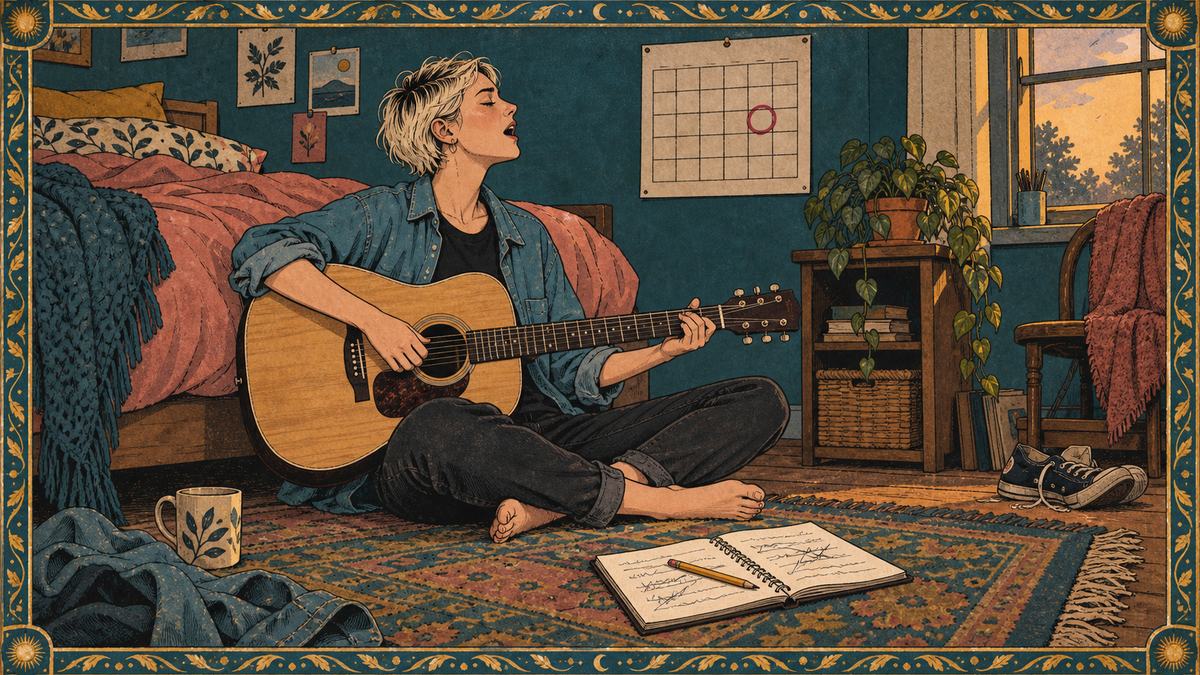
Most people who want to write a song are not short of feeling. They are short of a method. They sit down with a guitar or at a piano, play something that sounds roughly like a verse, run out of words by the fourth line, and add it to the pile. Jay H. teaches voice and guitar at Tunelark, tours with an Americana roots band, and is finishing a master’s degree in songwriting at Berklee College of Music. His answers below cover both halves of the problem: how to start a song when you have nothing, and how to finish the ones you keep abandoning.
Start with a sound, not a subject
The instinct is to decide what the song is about and then find music to carry it. Jay starts first-time writers the other way around, with an exercise that removes words from the problem entirely.
“I’m a big fan of ‘mumble tracks,'” he says. “Play an easy chord progression or bassline and repeat it over and over while you explore melodies by singing total gibberish.” Mumbles, made-up sounds, words that do not belong together, whatever arrives. “Let your subconscious fully take the wheel for a while.”
Two or three chords are enough, and the repetition is doing the work. Once your hands no longer need watching, the part of you that judges lyrics has nothing to judge, and melody turns up without having to be negotiated with. Writers who cannot get a line onto paper often find they can sing one straight away. Our guide to why music theory matters covers what a four-chord loop is doing underneath all this, though you can run the exercise without knowing any of it.
What the mumbling leaves you with is a shape rather than a song. “You’ll eventually end up with the melodic scaffolding for a verse or chorus,” Jay says, describing the result as a sort of musical Mad Lib. “Then you can go back and replace those random sounds with lyrics that fit the rhythm and melody.”
That order matters more than it looks. A melody written to fit finished lyrics tends to follow the sentence, and sentences are not shaped like tunes. Lyrics written to fit a melody have to obey its rhythm and its stresses, which is most of what makes a line sound like it belongs in a song rather than on a page.
For a first-time writer who wants something to read alongside the work, Jay points people toward Jeff Tweedy’s How to Write One Song, which he describes as a small book with a lot of wisdom in it.
What writing your own songs changes
Songwriting is usually framed as an output. Ask a working writer what it did to them and you get something broader.
“I can speak from my own experience here,” Jay says, and the answer is that it changed his life. “Songwriting connected me to some of my best friends and heroes, created career opportunities, gave me a reason to pay close attention to the world around me, and allowed me to comfortably do a lot of self-reflection.” His own summary is that “songwriting changes your awareness as a musician, but it can also be a tool for improving your life as a whole.”
There is a narrower version of that worth naming, because it is why songwriting earns a beginner’s time even if nothing they write is ever played for anyone. Writing forces you to use musical knowledge rather than recognize it. You find out what a chord does when you put it somewhere unexpected, why a melody sags when it sits too long on one note, what a bar of silence buys you. A player who only ever learns other people’s songs can go years without making a single one of those decisions. The same is true of improvising, which is the other place a musician has to choose rather than reproduce.
Why your voice memos are full and your song list is empty
Nearly every songwriter has a folder of promising fragments and very few finished songs. Jay’s fix for that is one sentence long.
“This is true, and there’s a very easy fix: set a deadline,” he says. “That’s it. Pick a date and time when the song has to be ‘done.'”
It sounds too simple to be the answer, which is exactly why most writers skip it and go on collecting. The reason it works is that an unfinished song is rarely blocked. It is open. With no end date there is always a better second verse still to come, so leaving it costs nothing. A date turns the song from something you are exploring into something you are delivering, and delivering forces the small decisions that exploring lets you defer.
Two things make the date stick. Set it while the idea is a week old rather than a year old, and tell one person when it is. A deadline nobody else knows about is a preference.
The work between now and then does not need to be long, only regular. Twenty minutes at the instrument most days beats one heroic Saturday, for songwriting the same as for everything else, and the research on short practice sessions points the same way. If you are fitting this around a job, our practice routine template for adults is a workable frame to hang it on.
Give the song a shape before you fill it in
The second thing Jay asks for is a map.
“Lay out the structure of the song and create a roadmap early that you think supports the song,” he says. “It’s much easier to see what needs work when you can actually see the whole shape of it.”
In practice that is a line on a page: verse, chorus, verse, chorus, bridge, chorus, with a rough bar count written against each. It takes two minutes, and it changes what you are looking at. A song you can only hear has to be replayed from the top to be judged, and by the time you reach the weak part you have talked yourself back into it. A song you can see is an object with proportions, and proportions are where beginner songs most often go wrong: two verses before the first chorus arrives, a bridge that turns up after the listener has already decided, a final chorus repeated twice where once would have landed.
The roadmap is a draft and not a commitment. Its job is to make “this section is too long” a thought you can have.
Let someone hear it while it is still wrong
“Second, let other people hear it,” Jay says. “When someone brings me an unfinished song, I’m happy to throw ideas around with them, and I encourage them to do the same with songwriters they completely trust. Songs don’t have to be finished alone.” His reason is the one every writer eventually runs into: “Sometimes another person hears the thing you’ve been missing because you’ve listened to the song 400 times.”
The qualifier in there is carrying weight. Songwriters they completely trust. An unfinished song played to the wrong listener comes back with a verdict when what it needed was a question. The useful listener is the one who tells you which line they still remembered an hour later, or the moment their attention wandered, rather than whether they liked it.
A recording is the cheap version of the same service. Your ears play you the song you intended. Your phone plays you the one you actually made, and the gap between them is usually where the work is. Singers already know this from practice, and our guide to recording your own practice applies without much translation.
Finished is not the same as final
Borrowing a thought from visual artists, Jay holds that “a song is never really finished.” It “just stops in an interesting place.”
“Songs aren’t written in stone,” he says. “You can finish one today, play it for a year, and discover a better lyric or chord later. Most artists eventually change and adapt songs when they perform them live from the original recordings we hear.”
That is not an argument against the deadline. It is what makes the deadline bearable. If finishing meant settling forever, hesitating would be the rational move. It does not. Finishing means the song becomes playable, and a song you can play is a song that can go on changing, because you will hear it in rooms and find out what it does. The alternative is a folder of fragments, none of which has ever been tested against anything.
Your first finished song will not be your best one. That is the point of finishing it.
About Jay
Jay teaches voice and guitar at Tunelark, from his studio in Colorado. He has been playing for more than 25 years and teaching for over 15, with more than a thousand shows across the United States behind him and an Americana roots band he still tours with. He holds a B.A. in Music Education from Fort Lewis College and a B.S. in Exercise Physiology, and he is completing a master’s degree in songwriting at Berklee College of Music, where he has been mentored in songwriting by Oliver Wood of The Wood Brothers.
He teaches elementary students through adults, and connects especially with singers and songwriters drawn to folk, blues, Americana, gospel, country and pop. His lessons are built around what each student is actually excited about, which for a songwriter usually means the song currently sitting unfinished.
Jay singing and playing guitar on Everlasting Light. Advice about playing an unfinished song to somebody is easier to weigh up when you can hear the person giving it play.
Performance · Everlasting Light

Jay teaches voice and guitar on Tunelark. View Jay’s profile
Ready to write your first song?
You can run every method above on your own, and plenty of writers do. What a teacher adds is the outside ear at the point it is most useful, which is while the song is still wrong, plus the deadline you cannot quietly move.
Jay is accepting new voice and guitar students at Tunelark, and an unfinished song is a good thing to bring to a first lesson. You can also find a teacher for any instrument across the rest of the roster.
Frequently Asked Questions
Can you write a song without any musical training?
Yes. The mumble-track method needs one chord progression you can repeat, which is two or three chords on a guitar or piano. Training changes how quickly you can chase an idea you have already had, and it helps a great deal later, but it is not what gets a first song written.
What comes first, the lyrics or the melody?
Either can, but for a first song the melody is the easier starting point. Lyrics written to fit an existing melody have to follow its rhythm and stresses, which is much of what makes a line sound sung rather than read. A melody built onto finished lyrics tends to follow the shape of the sentence instead.
How long should it take to write a song?
There is no correct length, which is the problem a deadline solves. Pick a date while the idea is about a week old and work in short regular sessions until then. Songwriters who set an end date finish songs, and songwriters who wait for the song to be ready collect fragments.
Do I need to know music theory to write songs?
No, and many well-known writers work largely by ear. Theory speeds up the part where you know something is wrong and want to know why, so it is worth learning alongside writing rather than before it.
Can songwriting actually be taught?
The craft can. Structure, melody writing, rhyme and how to revise are all teachable, and so is the habit of finishing. What a teacher cannot supply is what you have to say, which is also the part you already have.
Keep reading
About Jennifer Heath
I'm Jennifer Heath, VP of Operations at Tunelark and a lifelong singer. I joined the company in 2020 and oversee much of what makes Tunelark work for students and teachers: hiring, training and supporting our instructors, student support, marketing and day-to-day operations. I started voice lessons at 7 and sang with touring choirs through my teens. Music belongs in every life, for the self-expression, the discipline, the comfort and the simple joy of it.