Why Music Theory Matters (Even If You Just Want to Play Songs)

When people find out that music lessons include music theory, a common reaction is a quiet groan. Theory has a reputation for being dry, academic, and disconnected from the actual joy of playing. If you’ve been wondering why learn music theory when you just want to play your favorite songs, this article is a direct answer to that question.
The short version: music theory is a tool, not a test. And like most tools, once you understand what it’s for, you’ll wonder how you ever got along without it.
What Music Theory Actually Is
Music theory is simply the language musicians use to describe and understand what they’re hearing and playing. It’s the vocabulary and grammar of music. Notes, scales, chords, rhythm, intervals, keys. These are all elements of theory, and theory is just the system that explains how they relate to each other. The alphabet of that language is the staff, and our guide to reading sheet music walks through it from the beginning.
When you learn that a G chord is followed by a C chord in a song, and then notice that the same G-to-C move appears in fifty other songs you know, you’ve started using theory. A huge number of pop hits are built on one four-chord pattern, written I-V-vi-IV. In G major those four numbers are G, D, E minor, C. Move the same pattern into C major and you get C, G, A minor, F: the same four relationships in a different place, which is why a song you have learned in one key is most of the way to being learned in another. Hearing that pattern arrive and being able to name it is theory in action. It’s not abstract. It’s everywhere. On guitar, our guide to music theory for guitarists shows that same move as one small shape you can slide to any key.
Robin W., who teaches piano on Tunelark, has a student who had played guitar for a few years before starting piano lessons.
“He has changed the way I think about music and helped my ability to identify the theory and reason behind the music I’m hearing and rehearsing.”
Theory Makes You Learn Songs Faster
When you know how chords are typically organized in a key, what music theorists call “chord functions”, you can often predict or quickly figure out what the next chord in an unfamiliar song is going to be. In G major, the chord that pulls hardest back toward home is D, the fifth, so when a verse sits on D you can usually guess that G lands on the downbeat of the chorus. Instead of memorizing every chord of every song from scratch, you’re pattern-recognizing. Songs that would take you several sessions to figure out by ear become much faster to work out.
Similarly, understanding the major scale means you’re not learning 12 unrelated collections of notes. You’re learning one pattern of intervals, whole whole half whole whole whole half, that stays the same in all twelve keys, even though the shape it makes under your hands changes from key to key. On piano the black keys fall differently in every key and the fingering changes with them. On guitar the same pattern lives in a handful of movable shapes rather than twelve separate ones. Practicing intervals by ear builds the relative pitch that lets you pick out melodies from the distances between the notes instead of hunting for them one at a time, and notice when a string has drifted. Every element of theory is a shortcut masquerading as an extra thing to learn.
Neel S., who teaches guitar and voice on Tunelark, told us about teaching theory at the piano to a student who sang and played guitar, because the keyboard lays it out where you can see it. Heather D., who teaches piano on Tunelark, plays the major scales at the keyboard and shows the one pattern underneath all of them.
Skill video · Major Scales
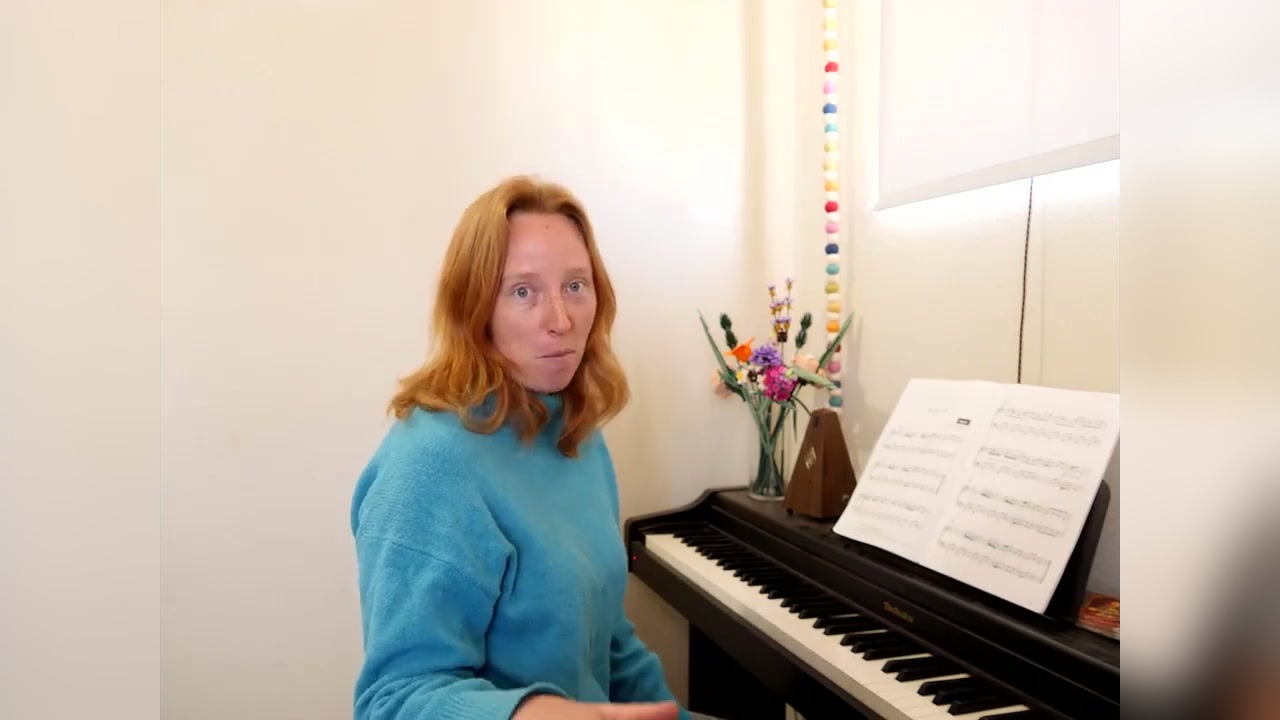
Heather teaches piano lessons online with Tunelark. View Heather’s profile
Theory Helps You Communicate With Other Musicians
Music is a social activity for many people. Whether you want to play in a band, jam with friends, write songs with a partner, or eventually teach music yourself, theory gives you a shared language.
When a musician says “let’s play this in the key of D” or “can you add a seventh to that chord?” they’re speaking theory. When a teacher tells you to “practice your pentatonic scale” or “work on your arpeggios,” those are theory terms. Understanding them means you can participate in those conversations (and act on that instruction) rather than smiling and nodding while feeling lost.
Even at the most casual level, being able to say “I think this song is in G major” and then find it quickly on your instrument is enormously useful.
Theory Unlocks Songwriting and Creativity
If you have any interest in writing your own music, even just noodling around and seeing what comes out, theory is the accelerator. It doesn’t constrain creativity; it expands it, by giving you a map.
Without theory, you might stumble onto a nice chord progression by accident and not be able to reproduce it, explain it, or build on it. With theory, you can deliberately explore. You know which chords in a key tend to work together, which ones create tension, which ones resolve. You can make choices rather than just discoveries. That gap shows up fastest the first time you try to write a song of your own, because the exercise starts with holding one loop steady for long enough to sing over it.
Some of the most creative musicians in history, including jazz improvisers who appear to be doing something entirely spontaneous, are deeply grounded in theory. The spontaneity is built on a foundation of knowledge. Theory is what lets them color outside the lines intentionally.
How to Make Peace With Theory
The good news is that you don’t have to study music theory in isolation, like a textbook subject. The best music teachers weave theory into practical application constantly. When you’re learning a chord, you also understand why that chord works the way it does. When you’re working on a scale, you see how it relates to the songs you’re playing. Pete L., who teaches guitar on Tunelark, has a student two years into lessons who describes them as a balance of theory and practical application.
You also don’t have to learn it all at once, and you don’t have to learn it from a textbook. Basic theory (the major scale, simple chords, the concept of keys) is accessible to beginners and immediately useful. More advanced concepts build naturally on top, at a pace that matches your development. Younger students usually meet the same basics through music theory games long before they see the terminology.
Why learn music theory? Because it makes everything else you want to do with music easier, faster, and more satisfying. It’s not the destination. It’s the map that helps you get where you’re going.
How to Find a Good Music Teacher on Tunelark
When you’re ready to start lessons, the right teacher is what turns intention into consistent progress. Many Tunelark teachers specialize in exactly the kind of student you are.
1. Open the teacher list and filter by your instrument.
2. Read bios. Look for teachers whose profile resonates with your specific goals. Generic bios are a yellow flag.
3. Book a trial lesson with the one you like best. It is $25 off that teacher’s 30-minute rate.
After the trial, ask yourself: did the teacher seem genuinely interested in your goals, or were they running through a generic curriculum?
Frequently Asked Questions
Do I need to learn music theory?
Not to play songs, but the basics cut the time each new song takes to learn. They matter most once you improvise, compose or move between styles.
How much music theory should beginners know?
Know what scales and chords are, understand basic rhythm notation, and recognize how songs are structured. That’s enough to make your practice meaningfully faster.
Can I just play music without theory?
Yes, especially in styles learned by ear (folk, blues, pop). Theory becomes more important as you move into improvisation, composition, or playing with other musicians.
Where do I start with music theory?
Start with intervals, major and minor scales, basic chord construction, and rhythm reading. Your teacher can integrate these into your regular lessons rather than treating theory as separate.
Is music theory boring?
Only when taught disconnected from playing. When you immediately apply each concept to a song you’re learning, theory becomes the most useful tool you have.
Keep reading
About Jennifer Heath
I'm Jennifer Heath, VP of Operations at Tunelark and a lifelong singer. I joined the company in 2020 and oversee much of what makes Tunelark work for students and teachers: hiring, training and supporting our instructors, student support, marketing and day-to-day operations. I started voice lessons at 7 and sang with touring choirs through my teens. Music belongs in every life, for the self-expression, the discipline, the comfort and the simple joy of it.