Odd Time Signatures on Drums: How to Count and Feel Them
Almost everything a new drummer learns first is in 4/4: four beats to the bar, a kick drum on one and three, a snare on two and four. An odd time signature breaks that symmetry. A bar of 5/4 has five beats, a bar of 7/8 has seven eighth notes, and neither divides into equal pairs, so the groove has a long part and a short part and the drummer has to know which is which.
Yousef S. teaches drums at Tunelark and is recognized for their approach to odd-time and displaced grooves. They also transcribe and notate music and exercises for their students. We asked them how they introduce odd time signatures, how a drummer moves from counting a meter to feeling it, and what a displaced groove is and what it does for a drummer.
It will not feel natural at first
“Personally I don’t think it needs to be natural and likely won’t be at first,” Yousef says. “Most music with odd meters is not intuitive.”
Most of the music a listener has absorbed runs in groups of two, three and four beats, so a bar of five arrives one beat later than the ear expects, and a bar of seven eighth notes cuts the last beat short or stretches it. The stumble a student feels is that expectation, not a lack of rhythm. The practical goal at the start is accuracy: play the bar correctly while counting it, every time, and let the sense of where it resolves come from repetition.
What the time signature is telling you
Yousef teaches odd meters the same way whatever the instrument, and only once a student can read the basics. “I find that teaching odd times is actually pretty similar regardless of instrument, because I do it only after we’ve established an understanding of how time signatures and note values work,” they say.
Those basics are short. The top number of a time signature is how many beats are in a bar. The bottom number is which note gets one beat: 4 means a quarter note, 8 means an eighth note. A bar of 5/4 holds five quarter notes. A bar of 7/8 holds seven eighth notes. Our guide to reading sheet music walks through note values and a counted bar of 4/4, and our guide to reading drum music covers the symbols a drum chart adds.
What the time signature does not print is the grouping. A bar of 5/4 is almost always felt as three beats plus two, or two plus three. A bar of 7/8 is felt as 2+2+3, 3+2+2 or 2+3+2. The grouping decides where the accents fall, which decides where a drummer puts the kick drum and the snare. Two songs in 7/8 can feel completely different because they group the same seven eighth notes differently.
Why 3/4 and 6/8 come first
Before any odd meter, Yousef goes to the two meters in three: “I always start with 3/4 and 6/8,” they say.
The pair is useful because it trains the grouping skill without the odd count. Both bars hold six eighth notes. In 3/4 they are heard as three pairs, counted “1 & 2 & 3 &”, with three beats you could clap. In 6/8 the same six are heard as two groups of three, counted “1 2 3 4 5 6” with the weight on 1 and 4, and you would clap twice. A student who can hear six identical eighth notes as either shape already understands the thing odd meters ask for: the grouping, not the number of notes, is what makes the feel.
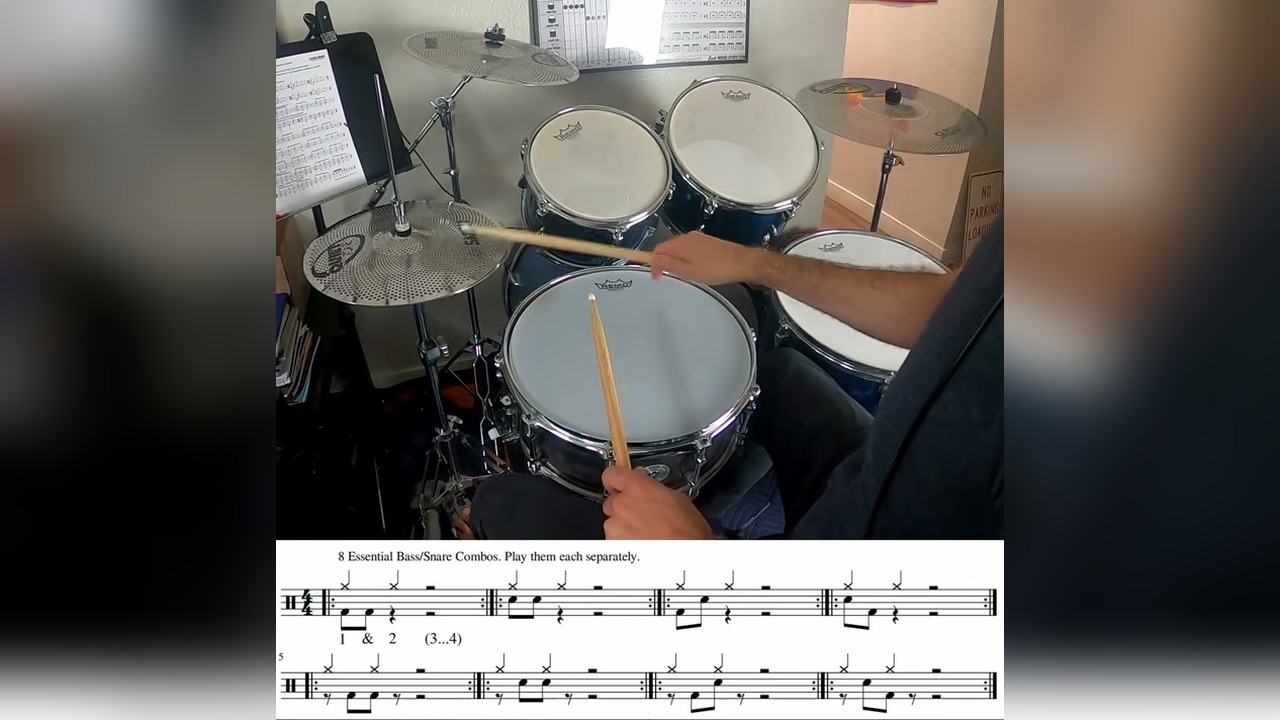
Yousef’s independence lesson below puts this into the hands and feet: short bass drum and snare combinations played against a steady hand pattern, first in 4/4 and then moved into 6/8 time.
Skill video · Essential Patterns for 8th Note Independence
Yousef teaches drums on Tunelark. View Yousef’s profile
Start from a steady quarter-note count
For the less common meters, Yousef anchors everything to one steady pulse, with students “developing a consistent quarter note count.” The groove is built on that count and kept deliberately thin. “When we build a basic groove we start with a continuous hihat/cymbal quarter note count and only add 1 or 2 more elements so that we stay focused on the counting.”
The hi-hat on every quarter note is the count made audible. Everything else hangs from it, and a mistake shows up immediately as a gap or a doubled stroke in a part that should never change. Here is a first groove in 5/4 built the way Yousef describes:
1. Hi-hat alone. Play the hi-hat on every beat and count all five out loud, “1 2 3 4 5”, at a slow tempo. Keep going until the “1” arrives without a hitch.
2. Add the bass drum on 1 and 4. Those are the first beats of the two groups, so the kick tells you the bar is 3+2.
3. Add the snare on 3 and 5, the last beat of each group.
That is the hi-hat plus two more elements, which is as far as Yousef takes a new meter before the counting is secure. Fills, ghost notes and busier hi-hat patterns can wait.
Counting 7/8
A bar of 7/8 does not divide into whole quarter notes: seven eighth notes are three and a half quarters. The workable count is by group. Grouped 2+2+3, the bar is counted “1 2, 1 2, 1 2 3”, and each “1” is the start of a group. The two short groups are each one quarter note long and the group of three is a quarter note and a half, so the steady-pulse idea still holds, with one long beat at the end of every bar.
The same layering order works here. Hi-hat on every eighth note with the group count out loud, then the bass drum at the start of the first two groups, then the snare at the start of the long group. Once 2+2+3 is secure, the same seven notes regrouped 3+2+2 make a new groove from identical material.
Counting is a tool, not the goal
Yousef does not treat counting as the goal. “I always like to clarify that counting and subdividing are tools, and we can use them however best suits us,” they say. Subdividing means counting the smaller notes inside each beat, “1 & 2 &” for eighth notes or “1 e & a” for sixteenths, so the space between beats has a shape too.
Not every instrument hears the bar the same way. “Certain instruments might feel the music in different ways because they’re syncopating or emphasizing in different spots,” Yousef says. A guitar riff in 7/8 may push against the grouping the drummer is counting, and a piano part may lean on a beat the drums leave empty.
So Yousef sends drummers to the other players: they have students listen closely to the guitar or piano to hear where the main hits land. Then counting can recede. “With proper training and independence practice, drummers can start to hear those pulses more than they need to actively count.” Independence here means limb independence: each hand and foot playing its own part without dragging the others along, which is what lets a drummer hold the hi-hat steady while the kick follows a riff.
Listening for the hits
A recording in an odd meter is the best place to practice this. The Dave Brubeck Quartet’s “Take Five” is in 5/4, and the piano vamp under it marks the 3+2 grouping in a way you can tap along to. The verses of Pink Floyd’s “Money” are in 7/4, and the bass riff that opens the song repeats once per bar.
Listen first without playing. Tap the hits of the riff on your leg. Find the point where the riff starts over, which is the “1” of the bar, and count from there. Then play the hi-hat on the beat along with the recording, and add the kick on the hits you found. When you can put the recording on and land on the “1” every time without counting out loud, you are hearing the pulse rather than calculating it.
Displaced grooves: moving the notes, keeping the time
Most music has a drum part that stays put: four on the floor, which is a bass drum on every beat, or another rhythm that repeats unchanged. “But sometimes we want more,” Yousef says, and they point to a line from Gavin Harrison, the drummer known for his work with Porcupine Tree and King Crimson: “It is everybody’s job in the band to play in time, but it’s the drummer’s job to make the time interesting.”
Displacement is one of the main ways to do that. “Displacement could mean many things, but generally speaking I use it to refer to when our notes get shifted to a spot (time interval) they weren’t originally,” Yousef says. The pattern stays the same and moves against the beat, usually by an eighth or a sixteenth note.
In the second grid the hi-hat has not changed, so the time has not changed. The bass drum and snare have each moved one eighth note later, onto the “&”s, and the same groove now pulls against the beat instead of sitting on it.
Yousef hears the uses in terms of the band. Bass guitar often plays in the space between the other instruments, they point out, and displacement lets a drummer go there with it. “As drummers, we can use displacement to lock in with the bass,” Yousef says, and the choice depends on the section of the song: “maybe this is more appropriate in some parts of the song where we want another instrument to shine.” It changes energy in both directions. “We can also use it to create a sense of urgency or the opposite, to drive certain parts or to throw people for a loop.”
What displacement does for your time
A displaced groove is only as steady as the count underneath it. To play a snare on the “&” of 2 instead of on 2, a drummer has to know exactly where 2 is while deliberately not playing on it. If the internal count wavers, the pattern slides back to where it started, and the displaced version collapses into the ordinary one. That makes displacement a test of time as much as a creative device: the hi-hat or the count holds the grid while the kick and snare move against it.
The creative side comes from the same mechanism. A groove the drummer already knows, moved by one eighth note, sounds new without a single new note, and a drummer who can do that has a way to change a section of a song without playing anything busier. It also connects back to odd meters. Both separate the pattern from the beat, and both depend on a pulse the drummer keeps without hearing it played.
A practice order
This sequence is ours, built from what Yousef described.
1. Get the reading basics solid: note values, and what the two numbers of a time signature mean.
2. Play grooves in 3/4 and 6/8 until you can hear the same six eighth notes as three pairs or two threes.
3. Build a 5/4 groove on quarter-note hi-hat, counting out loud, adding the kick and then the snare.
4. Play along with a recording in 5/4 or 7/4, finding the hits of the riff before you play.
5. Count 7/8 by group, 2+2+3 first, then regroup the same notes.
6. Displace a 4/4 groove you already know by one eighth note, keeping the hi-hat where it was.
How long each step takes depends on how steady your 4/4 time is to begin with. Our guide to how long it takes to learn drums sets out a realistic timeline for the fundamentals, and our beginner drum tips cover the grip, setup and first grooves this builds on.
About Yousef
Yousef took up drums in high school, drawn to the drummers in the music they loved and to the chance to play alongside a brother who played guitar. They kept playing through university, where they majored in civil engineering, and their aggressive but tasteful playing became well known in the DC rock scene. They are recognized for odd-time and displaced grooves and for music that crosses genres, and they have an advanced understanding of music theory.
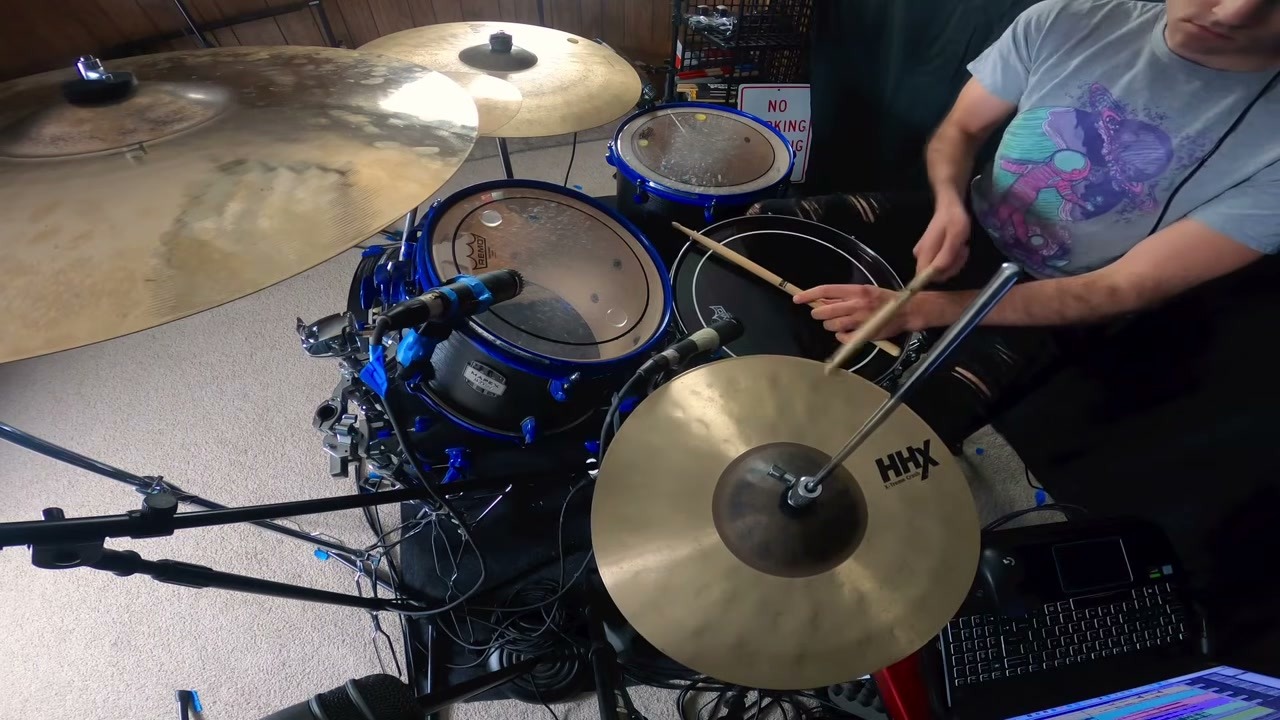
At Tunelark they teach drums to students from ages 4 to 67 from their home in Tacoma, Washington. A first lesson with Yousef usually gives a new student a basic groove they can already play, followed by a short demonstration on Yousef’s own kit of where the lessons are heading. They also spoke to us for our guide to choosing a music teacher for a child with ADHD or autism. Here they are in performance, playing a drum cover of “Witches” by the Taiwanese math-rock band Elephant Gym.
Performance · Witches
Yousef teaches drums on Tunelark. View Yousef’s profile
Ready to play in odd time?
Yousef is accepting new drum students at Tunelark. A recording of a song in an odd meter that you want to play is a good thing to bring to a first lesson, since Yousef transcribes and notates music for their students and can start from the song itself.
Frequently Asked Questions
What is an odd time signature?
A meter whose bar does not divide into equal groups of two or four, such as 5/4, 7/8 or 11/8. The bar is felt as uneven groups, for example 3+2 or 2+2+3.
Is 6/8 an odd time signature?
No. A bar of 6/8 has six eighth notes felt as two even groups of three, which makes it a compound meter rather than an odd one. It is a useful step toward odd meters because it trains hearing notes in groups of three.
How do you count 7/8 on drums?
Count by group rather than by beat. Grouped 2+2+3, the bar is 1 2, 1 2, 1 2 3, with the hi-hat on every eighth note and the kick at the start of groups.
What songs are in 5/4 time?
Take Five by the Dave Brubeck Quartet is the best-known example, and its piano part repeats the 3+2 grouping in every bar. The theme from Mission: Impossible is also in 5/4.
What is a displaced groove in drumming?
A familiar groove with its notes shifted earlier or later against the beat, usually by an eighth or sixteenth note, while the pulse stays where it was. It changes the feel of a section without adding notes.
Looking for an online drum teacher? See our full Online Drum Lessons page for everything you need to know about getting started.
Keep reading
About Jennifer Heath
I'm Jennifer Heath, VP of Operations at Tunelark and a lifelong singer. I joined the company in 2020 and oversee much of what makes Tunelark work for students and teachers: hiring, training and supporting our instructors, student support, marketing and day-to-day operations. I started voice lessons at 7 and sang with touring choirs through my teens. Music belongs in every life, for the self-expression, the discipline, the comfort and the simple joy of it.