Singing Tips for Beginners: How to Start Your Vocal Journey

Almost everyone sings: in the shower, in the car, along with their favorite playlists. But taking the step from casual singing to actually studying your voice is a different experience, and it can feel both exciting and a little vulnerable. Your voice goes everywhere you go, it changes with your mood and your sleep, and there is no case to put it back in.
These singing tips for beginners are designed to help you approach that journey with confidence, curiosity, and good habits from the start.
Warm Up Before You Sing: Every Time
This is the most commonly skipped step in vocal practice. The vocal folds, which most people know as the vocal cords, are delicate layered tissue with muscle underneath, and like the rest of the body they respond better and are less prone to injury when they’ve been warmed up gradually before demanding use.
A basic warm-up doesn’t need to take long. Five to ten minutes is usually enough, and it might include:
Lip trills: Blow air through loosely closed lips, making a “brrrr” sound while moving through different pitches. This engages the voice gently without strain.
Humming: Gently hum through your comfortable range, starting in the middle and moving up and down gradually.
Sirens: On a lip trill, a hum or an ng sound, slide slowly and smoothly from a comfortable low note up toward the top of your easy range and back down, like a gentle siren. Stop short of the extremes at both ends, and let the voice thin out as it climbs rather than pushing chest voice up to the highest note you own. Keeping a partly closed sound on the slide is what lets the registers connect without strain.
Vowel exercises: Sing simple vowel sounds (ah, ee, oh) on scales or arpeggios, focusing on keeping the tone consistent as you move through pitches.
Gillian H. explains what a lip trill is doing physically, the back pressure that lets you warm up without pushing, and then runs a few fifths you can sing along with. If your lips will not cooperate, the fingertip trick that loosens them is in the video too.
Skill video · Lip Trill Vocal Warmup Tutorial

Gillian teaches voice and bass on Tunelark. View Gillian’s profile
Your teacher will develop a warm-up routine specifically suited to your voice. Make warming up a non-negotiable part of every practice session. Each of these exercises is demonstrated by one of our teachers in Vocal Warm-Up Exercises. The other end of the session matters as much and gets talked about far less. A few minutes of easy humming or gentle lip trills after the singing stops eases the voice back toward its speaking baseline, and The Voice Practice Routine That Actually Keeps You Singing explains why teachers rate that cool-down so highly.
Understand Breath Support
If there’s one technical concept that underlies virtually every aspect of good singing, it’s breath support. This term refers to the way singers use the muscles of the torso (the abdominal wall and the muscles around the lower ribcage) to meter the flow of air through the vocal folds, with the diaphragm doing the work of the breath in rather than the breath out.
Poor breath support is the cause of many common beginner problems: a voice that runs out of air mid-phrase, a tone that sounds thin or unsupported, difficulty reaching higher notes, and vocal fatigue.
Learning proper breath support takes time and often requires guidance to get right, because the sensations involved are subtle and the muscles involved aren’t ones most people have thought about deliberately. Your teacher will guide you through breathing exercises that help you feel the difference between surface breathing (chest rising) and deeper, more supported breathing (ribs expanding sideways).
A simple first exercise: place your hands on your lower ribs, at the bottom of the ribcage, with your thumbs pointing toward your back. Take a breath and feel the ribs widen under your hands as you inhale. That lateral expansion is what supported breathing feels like, and it is a different sensation from the belly moving forward, which you will notice a little lower down at the same time. Practice this before you sing a single note. What support actually is, and the exercises that build it, are in Breath Support for Singers.
Stella B. shows the first breathing exercise new singers start with: one hand on the belly, a breath that fills low rather than high, and short “ch” sounds you can feel pushing back against your hand. It is the quickest way to feel the breath dropping low, which is what happens when the diaphragm descends and the abdominal wall gives way in front of it.
Skill video · A Simple Breathing Exercise
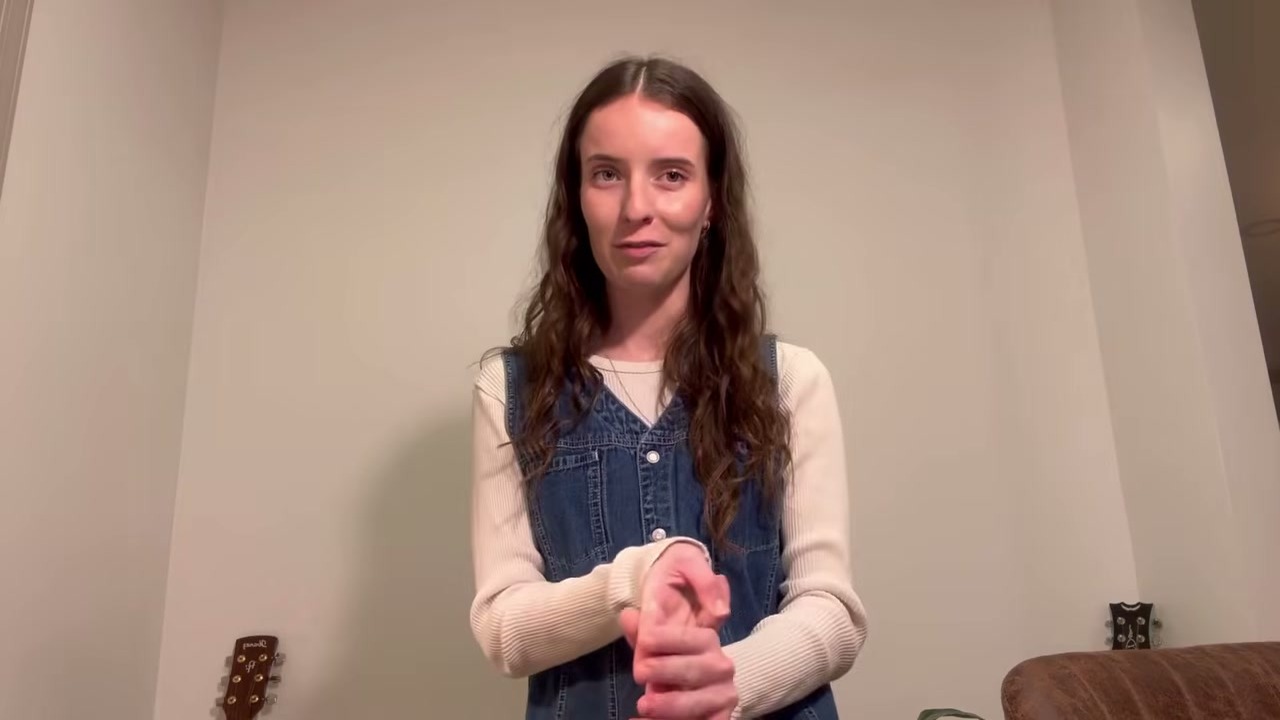
Stella teaches voice on Tunelark. View Stella’s profile
Take Care of Your Voice
Treating the voice as a physical instrument has a second half that beginners rarely hear, which is that it can be trained and not only protected. Our guide to vocal stamina takes that comparison seriously.
Your voice is a physical instrument that requires care. A few basic practices will keep it healthy and help you progress faster:
Stay hydrated. Vocal folds need to be well-lubricated to vibrate efficiently. Drink plenty of water throughout the day: not just right before singing. Herbal teas (without caffeine) are also great. Avoid excessive caffeine and alcohol, which are dehydrating.
Avoid straining. If something hurts (a sharp sensation, a rough feeling in your throat) stop immediately. Pain during singing is always a signal to rest and potentially seek guidance. Singing through pain is how vocal injuries happen.
Rest your voice. Like any part of the body that works hard, your voice needs recovery time. If you’ve had a particularly intense practice session or a performance, give yourself a quiet day or two afterward.
Manage reflux. Acid reflux is surprisingly common among singers and can irritate the vocal folds significantly. If you notice your voice is raspiest in the morning, it’s worth mentioning to a doctor.
Find Your Range, and Work in It
Beginner singers often try to sing too high, too soon. Many popular songs sit outside a comfortable beginner range, and struggling with notes that are genuinely beyond your current reach creates tension and bad habits. Our guide to how to choose songs for your voice explains why where a song sits matters more than its highest note.
Your teacher will help you identify your comfortable singing range and work to expand it gradually through proper technique. It’s much better to sing well within a modest range than to strain for notes outside it.
Becky O. shows exactly how a first lesson finds a new student’s range and voice type, and why, for many students, much of the early work goes into the head voice rather than the chest voice you already use all day.
Skill video · Vocal Range and Voice Type

Becky teaches voice on Tunelark. View Becky’s profile
As you develop, your range will expand, both higher and lower. This is a natural product of technique development, not something you should force. Trust the process and work with your teacher on music that suits where you are right now. Get to Know Your Voice explains where your range sits and what the registers are, and How to Expand Your Vocal Range Safely covers how the top grows.
Enjoy the Vulnerability
Singing in front of another person (even a supportive, professional teacher) can feel exposing in a way that other instruments don’t. Your voice is intimate. That’s normal. Let yourself be a beginner. Allow the voice to crack, to be imperfect, to surprise you.
Students who let themselves experiment without self-judgment tend to make faster progress, because a voice that is being guarded is a voice that never gets tested. The awkward early weeks are the work rather than a detour around it: warming up slowly, figuring out how breathing actually functions, and finding out that the voice, with care and practice, does considerably more than you expected of it.
What Voice Teachers Say About the Practice Itself
Alawna M. recommends a session of about thirty minutes to an hour, roughly the length of a lesson, spent mostly on warm ups, vocal technique and exploring registers safely, with the song you are working on attempted no more than three times. Belting the same difficult note over and over is what produces strain and frustration with a piece. She also names the step almost everyone skips, which is cooling down afterward: resting and resetting the voice is what keeps it working, and she compares it to stopping for fuel rather than driving on an empty tank.
How to Find a Voice Teacher on Tunelark
Once you’re ready to start, the right teacher makes the difference between fast progress and slow frustration. Many Tunelark teachers specialize in working with new students at this stage.
1. Open our voice lessons page.
2. Read bios. Look for teachers who explicitly mention working with beginners and who describe their teaching approach (not just their credentials).
3. Book a trial lesson with one whose profile resonates.
After the trial, ask yourself: did the teacher meet you where you actually are, or were they running through a generic beginner curriculum?
The early weeks of any instrument are where habits get formed. A good teacher gets you started right.
Frequently Asked Questions
Can anyone learn to sing?
Almost anyone. Pitch and tone are learnable skills. A small percentage of people have true tone-deafness, but most who think they ‘can’t sing’ simply haven’t been taught how.
How do I find my vocal range?
Your teacher will help map this in the first few lessons. Generally, you’ll sing notes up and down to find your comfortable low and high notes, then identify your most resonant middle range.
Should I warm up before singing?
Yes, always. Even five minutes of lip trills, scales, and easy vocalizing reduces strain and makes your voice respond better. Singing hard without warming up raises the risk of strain.
How long until I sound better?
Most students hear noticeable changes within 2–3 months of consistent lessons. Bigger technique shifts take longer, and solid foundational technique usually takes a couple of years of lessons and practice, with wide variation between students.
Do I need an expensive microphone for online voice lessons?
No. An entry-level USB microphone, around $50 to $100 as of 2026, dramatically improves what your teacher can hear over a built-in laptop mic. Built-in mics work but compress your voice in ways that hide important details.
Looking for an online voice teacher? See our full Online Voice Lessons page for everything you need to know about getting started.
Keep reading
About Jennifer Heath
I'm Jennifer Heath, VP of Operations at Tunelark and a lifelong singer. I joined the company in 2020 and oversee much of what makes Tunelark work for students and teachers: hiring, training and supporting our instructors, student support, marketing and day-to-day operations. I started voice lessons at 7 and sang with touring choirs through my teens. Music belongs in every life, for the self-expression, the discipline, the comfort and the simple joy of it.