Ukulele or Guitar: Which Should a Beginner Start On?
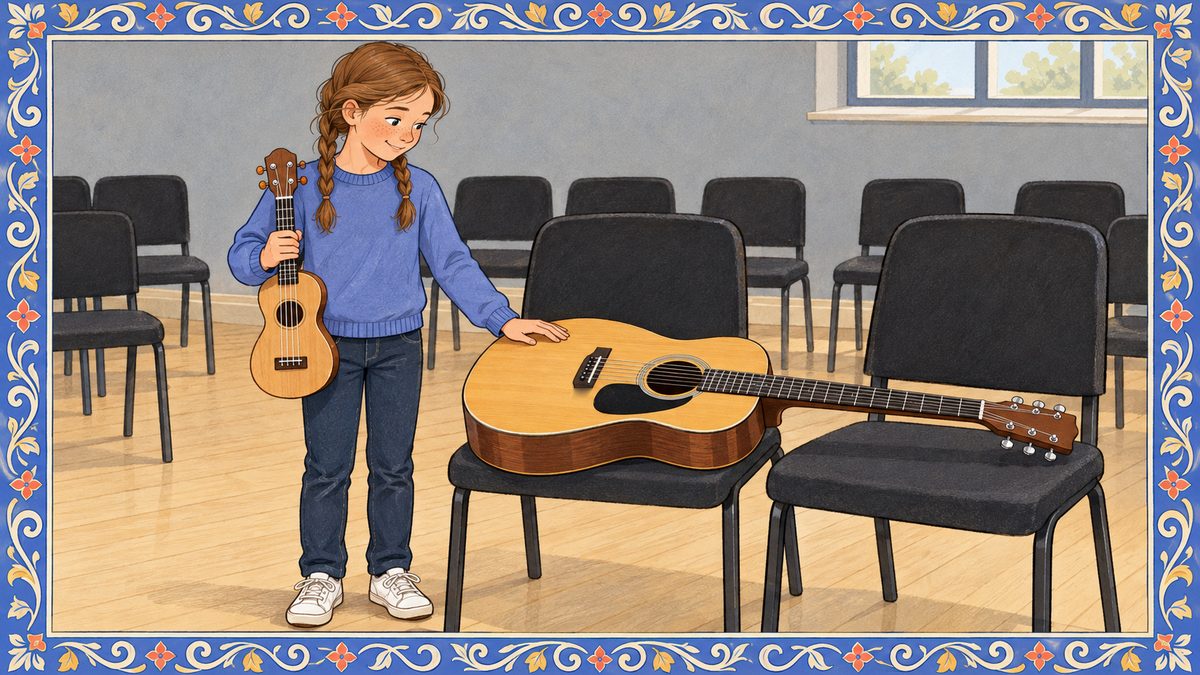
A child under 7 usually starts on a soprano ukulele, and an adult who mainly wants to strum and sing starts on a concert ukulele. A child of 7 or older who asks for a guitar, and an adult who wants the sound of a guitar, start on a guitar sized to their body. The choice turns on three things: how hard the strings push back, how far the hand has to reach, and which music the beginner is after. The first two have numbers, and most of what a beginner learns on the ukulele carries straight across to the guitar later.
The Numbers Behind the Two Instruments
A ukulele and a guitar differ in the length of string that vibrates, the number of strings, and how tightly those strings are pulled. The vibrating length, from the nut at the top of the neck to the saddle on the body, is called the scale length, and it sets how far apart the frets sit.
A soprano ukulele has a scale of about 13 inches, a concert about 15, a tenor about 17 and a baritone about 19, by the sizes listed for the instrument. Kala, which builds all four, describes each step up as widening the gap between the frets. A full-size guitar has a scale of 25.5 inches on Fender designs, 24.75 on Gibson designs and about 25.6 inches (650 mm) on a classical guitar, by the standard scale lengths. So the frets on a soprano ukulele sit roughly half as far apart as the frets on a guitar, and a four-fret stretch on a ukulele covers about the distance of a two-fret stretch on a guitar.
The strings pull harder on a guitar. D’Addario publishes a tension chart for every set it sells. Its most popular light steel acoustic set, EJ16, lists 23.4 pounds on the thin E string alone and about 160 pounds across all six strings. Its normal-tension nylon classical set, EJ45, lists 16.2 pounds on the thin E and about 86 pounds across six. Its nylon soprano ukulele set, EJ65S, lists 5.5 pounds on the A string and about 21 pounds across four, and that chart is for A D F sharp B, a tuning a whole step (two frets) above the standard G C E A, so at standard pitch the pull is lower still. A fingertip pressing one string down on a steel-string guitar is working against roughly four times the tension it meets on a ukulele, and more at standard ukulele pitch.
| Instrument | Strings | Scale length | Thinnest string, tension | Whole set, tension |
|---|---|---|---|---|
| Soprano ukulele, nylon (chart at A D F sharp B) | 4 | about 13 in | 5.5 lb | about 21 lb |
| Classical guitar, nylon | 6 | about 25.6 in | 16.2 lb | about 86 lb |
| Acoustic guitar, light steel | 6 | 24.75 to 25.5 in | 23.4 lb | about 160 lb |
Tension figures are from D’Addario’s published charts for the three sets named above. Other makers and other gauges, meaning string thicknesses, differ by a few pounds, and the ranking does not change.
That tension is the reason for the fingertip soreness the guitar is known for. On steel strings, teachers usually see calluses form in two to four weeks of regular playing. On nylon, the soreness is mild and fades sooner, and some players barely register it. Our realistic timeline for learning guitar puts a two- or three-chord song at a slow tempo around month two, and our realistic timeline for learning ukulele puts a first song within a week or two. Tension, fret spacing and one-finger chord shapes all feed that gap.
Hand Size: Children, Small Adults and the Fractional Guitar
For a child, the ukulele is physically workable first. A soprano ukulele works from about 5 or 6: the scale is short, the strings are nylon, and the first chords take one finger. Guitar usually works from 7 to 9, when the fingertips can press a steel string clean, and a nylon-string guitar in half size brings that down to about 6 for a large-handed child. Those are typical ages, and some children are ready earlier. Below 5, neither instrument has a conventional lesson start. A soprano ukulele in the house to strum along on is fine, and lessons wait.
Fractional guitars shorten the reach and lower the tension somewhat, but a steel string on a quarter-size guitar still pushes back far harder than nylon. The size follows height and arm length rather than the birthday: half size around 5 to 7, three-quarter around 8 to 10, and our guide to helping a child practice guitar at home has the full ladder and the fitting. A teacher offered a 5-year-old who wants a guitar will usually suggest a ukulele or a nylon-string first, because the fingertip is the limit, not the arm.
For an adult the question runs the other way. Large hands feel crowded on a soprano. A concert or tenor ukulele adds two to four inches of scale that spread the frets out, and Kala says a tenor may be more comfortable still for larger hands and fingers. Our guide to online ukulele lessons for beginners covers what the sizes cost and which to buy. On guitar, hand size is rarely the barrier an adult beginner thinks it is. The strings usually are, and a classical guitar with nylon strings is the middle path for an adult who wants six strings without the steel-string tension.
What Carries Across From Ukulele to Guitar
A ukulele’s four strings carry the same notes, fret for fret, that a guitar’s four thinnest strings would with a capo (a clamp across the neck) at the fifth fret, with one exception: the ukulele’s G string is tuned an octave higher than that. So the shapes carry across even though the ukulele’s strings do not climb in pitch in the same order. Each common open ukulele shape, meaning a chord played at the top of the neck with some strings left unfretted, is the top four strings of a standard open guitar chord, under a name a fourth lower. A fourth is the distance of five frets.
Hold the ukulele C shape, one finger on the A string at the third fret, on a guitar’s thinnest four strings and you are holding the top of a G chord. The ukulele F is the top of a guitar C. The ukulele G is a guitar D, string for string. The ukulele A minor is the top of an E minor. A beginner who spends a year on ukulele arrives at the guitar with G, C, D and E minor already shaped on the top four strings. What is new is a bass note or two under each, and on E minor a refingering: the middle finger moves to the A string and the ring finger takes the D string.
Every ukulele note sounds a fourth higher than the same fret on a guitar, and the high G string an octave above that. The fingering is unchanged and the sound is brighter, and our guide to tuning a guitar or a ukulele explains why a tuner in guitar mode calls that G string wrong.
The fretting hand’s habits transfer too, and they are the habits a teacher spends the first month on: fingertip close behind the fret wire rather than in the middle of the space, the finger curved so it clears the string next door, and the thumb low on the back of the neck so the hand can open. Adriel A., who teaches guitar and ukulele on Tunelark, demonstrates that thumb placement on guitar chords in the lesson below, and the correction is the same one a ukulele player gets.
Adriel shows the thumb coming down the back of the neck so the hand opens, on the D, C and G shapes, and what the cramped version looks like beside it.
Skill video · Hand Positions for Guitar Chords

Adriel teaches guitar, piano and ukulele on Tunelark. View Adriel’s profile
Three things do not carry across. The strumming hand has to learn which strings to leave out, because a guitar C major starts on the fifth string and leaves the sixth silent, where a ukulele strum covers all four. Steel strings mean the calluses start over. And barre chords, where one finger presses across several strings at once, come later and less often on ukulele, and the F chord that stops so many guitar beginners is a two-finger shape on ukulele.
When to Switch, and When Not To
The switch from ukulele to guitar is a matter of wanting something the ukulele does not offer, and the signals are specific. The player keeps reaching for songs whose sound lives in the two low strings a ukulele lacks, or wants to play lead lines (single-note melodies over the chords), or wants to play in a band where the guitar part is written for six strings. A child who started on a soprano at 5 has usually grown into a three-quarter guitar by 8 to 10, and if the asking persists, the hands are ready.
There is a bridge, and there is a half step before it. A low-G string, a wound fourth string that replaces the high G, makes a concert or tenor ukulele’s strings climb in pitch in the same order as a guitar’s, so fingerpicking patterns start to feel like guitar patterns. A baritone ukulele goes further: it is tuned D G B E, the same as a guitar’s four thinnest strings, which Kala describes as the reason it is the easiest size for a guitarist to pick up. It works in the other direction too, since a ukulele player who moves to a baritone learns guitar chord names on nylon strings and a 19-inch scale, and the final step to a guitar is two more strings and the tension.
Most of what a ukulele player knows comes across whole: chord-chart reading, the drill of changing between two shapes in time, keeping the strumming hand moving through a change, and the habit of tuning before every session. Our guide to whether to switch instruments or push through covers how a teacher reads the difference between wanting a new instrument and wanting a break from practicing. The reverse move needs no plan: a guitarist who picks up a ukulele usually plays a full song in the first sitting, once they read the ukulele chord names.
One situation calls for both at once. A parent on Asher N.’s profile describes taking guitar lessons from him while their 5-year-old takes ukulele lessons, each on the instrument that fits their hands. Asher teaches guitar on Tunelark and lists ukulele among his instruments, and his profile says he teaches from preschool children to adults. Two instruments that share their chord shapes let a parent and a young child play the same songs together, with the same chord names on the page and different shapes under the fingers.
A Decision Table for the Common Situations
| The beginner | Start on | Why, and what comes next |
|---|---|---|
| A child of 5 or 6 | Soprano ukulele | Short scale, nylon strings, one-finger chords. Reassess for guitar at 7 to 9 if they ask |
| A child of 5 or 6 who wants a guitar and will not be talked out of it | Nylon-string guitar, half size, if the hands are large for their age | Nylon pulls about half as hard as steel, still about three times a ukulele’s. Fit it in a shop, not by age |
| A child of 7 to 9 who wants a guitar | Guitar, half or three-quarter size | The fingertips are ready. Expect two to four weeks of soreness on steel |
| A child of 7 to 9 with no preference | Either; ukulele if the goal is singing along | The first song comes weeks sooner on ukulele, and the shapes move to guitar later |
| An adult who wants to strum and sing | Concert ukulele, tenor for large hands | Four chords cover most of what you want in the first three months. Move to guitar only if the sound is missing |
| An adult who wants the guitar’s sound, lead lines or a band | Guitar, full size | Starting on ukulele first saves little here. Nylon strings if the steel-string soreness worries you |
| An adult with stiff or easily sore hands | Ukulele, or a classical guitar | Compared with a steel-string guitar: about a quarter of the tension per fingertip on ukulele, a half to two thirds on nylon-string guitar |
| An adult returning to guitar after years away | Guitar | The motions survived the layoff even if the calluses did not. A ukulele is a fine second instrument, not a restart |
| A parent and a young child learning together | Guitar for the parent, ukulele for the child | Same chord names, same songs, each on the instrument that fits |
As of 2026 a soprano or concert ukulele from a known maker runs roughly $50 to $100 and a playable acoustic guitar roughly $150 to $300, a gap that is real but rarely the deciding one. On a cheap guitar, ask the shop to check the string height at the twelfth fret before you buy, because a guitar whose strings sit high off the fretboard makes every press harder and is the usual reason a sub-$100 instrument fights a beginner.
How to Find a Ukulele or Guitar Teacher on Tunelark
Every Tunelark teacher is vetted by working musicians and educators for teaching quality before they can list. Each teacher sets their own rate and shows it on their profile, and Tunelark handles scheduling, billing and support.
- Open the teacher list at tunelark.com/find-a-teacher and filter by the instrument you chose, then read each bio for beginners of your age or your child’s.
- Choose a lesson length of 30, 45 or 60 minutes.
- Book a trial lesson. The first lesson with a new teacher is that teacher’s rate minus $25, for whatever length you choose, so trials start at $14.
- Tell the teacher which instrument you are deciding between and why, and ask them to look at the hands on camera before you buy anything.
Frequently Asked Questions
Should I buy a low-G ukulele if I plan to move to guitar?
Only on a concert or tenor, where a low-G string is a normal option, since a soprano is built for the high G. A low G gives you the guitar’s string order for fingerpicking and takes away the bright reentrant strum, so a player who mostly strums and sings loses more than they gain. A baritone does the same job more completely.
Will starting on ukulele teach my child bad habits for guitar?
One habit shows up. A ukulele neck is narrow enough that a thumb hooked over the top still lets the fingers reach every string, so the habit goes unpunished for months. On the wider guitar neck the same thumb pulls the palm against the neck, so the fingers flatten and mute the thin strings, and a teacher corrects it early.
Can I play guitar songs on a ukulele?
Yes, in the same key, by reading the ukulele version of each chord. If you hold the guitar shapes on the top four strings instead, every chord comes out a fourth higher, so the song sits in a different key from the recording.
Which ukulele size should a guitarist buy?
A baritone if you want your guitar chord shapes to work unchanged, a tenor if you want the standard G C E A sound. The trade: on a baritone the chord names in ukulele songbooks do not apply, so you read guitar chord charts instead, and the instrument sounds closer to a small guitar than to a ukulele.
Can I use a guitar chord chart for ukulele?
Not directly. A chord chart is a grid of the strings with dots where the fingers go, and a guitar chart has six columns where a ukulele chart has four. The four right-hand columns of a guitar chart give the ukulele shape for the chord a fourth higher, which is a useful trick for a guitarist and a confusing one for a beginner, so a beginner uses ukulele charts and learns the guitar names later.
Looking for an online guitar teacher? See our full Online Guitar and Bass Lessons page for everything you need to know about getting started.
Keep reading
About Jennifer Heath
I'm Jennifer Heath, VP of Operations at Tunelark and a lifelong singer. I joined the company in 2020 and oversee much of what makes Tunelark work for students and teachers: hiring, training and supporting our instructors, student support, marketing and day-to-day operations. I started voice lessons at 7 and sang with touring choirs through my teens. Music belongs in every life, for the self-expression, the discipline, the comfort and the simple joy of it.