Alto or Tenor Saxophone: Which Should You Start With?
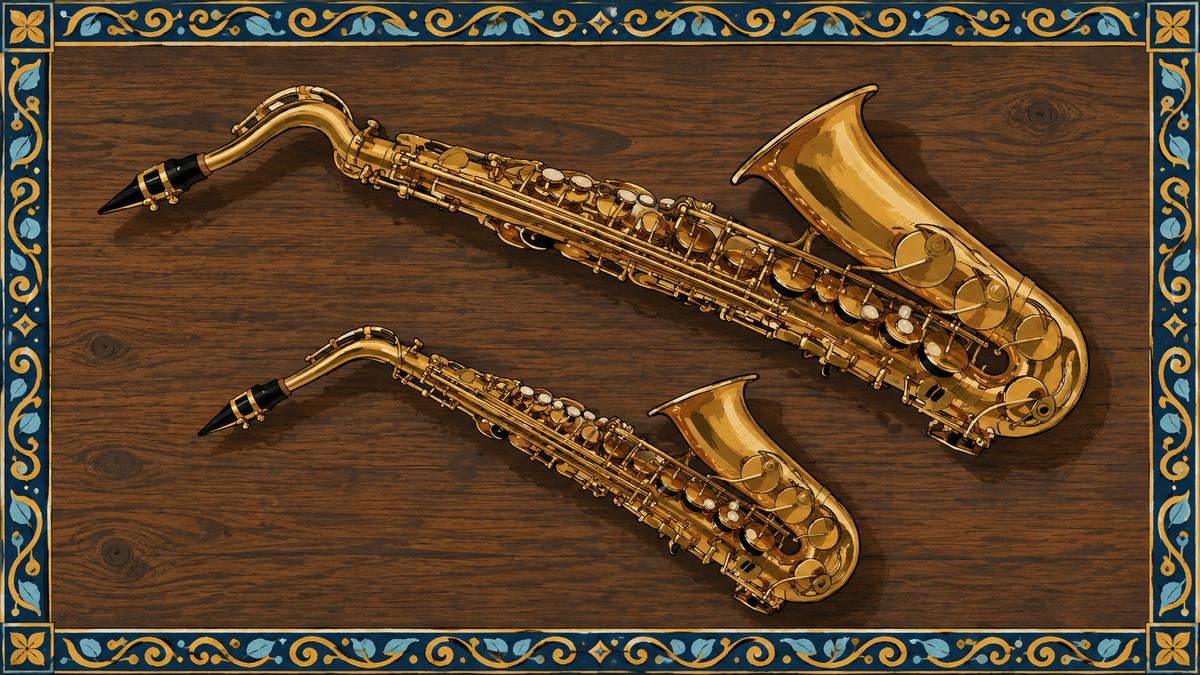
Start on alto unless you are an adult or a fully grown teenager who specifically wants the tenor’s sound. The alto is about two pounds lighter, it is the saxophone school bands start beginners on, and it costs less to rent. The fingerings and reading carry over: every saxophone uses the same fingerings and reads treble clef with the same written note names, so a later move to tenor means a bigger instrument, a new mouthpiece and more air.
How the Two Sound, and Which One You Are Hearing
The alto is pitched in E-flat, meaning a written C sounds as the concert E-flat a piano would play, and the tenor is pitched in B-flat, a lower instrument with a bigger, darker sound. In a concert band the alto sits in the middle of the texture: the Denton, Texas band guide describes it as playing the middle tones, more often harmony or accompaniment than melody. The tenor plays lower still, and Andrew J. Allen, who teaches saxophone at Georgia College, writing for band directors in The Instrumentalist, says it is often underused in band music and gets its best parts in jazz band and saxophone quartets.
For someone choosing by sound, a good test is the recording that made them want to play. The liner notes or streaming credits name the saxophonist and usually the instrument, so check them before anything is rented.
Max S., who teaches saxophone on Tunelark and works with students on soprano, alto, tenor and baritone, recorded all four parts of a saxophone quartet arrangement himself, one instrument in each panel. It lets you hear the four sizes side by side in the same piece of music: the alto and tenor parts sit in the middle of the quartet, between the soprano on top and the baritone underneath.
Performance · Bagel on the Malecon

Max teaches saxophone on Tunelark. View Max’s profile
Weight, Size and Air
A Yamaha YAS-280, a common student alto, weighs 2.35 kilograms for the body and neck alone, a little over five pounds, according to Howarth of London’s specification, and closer to five and a half with the mouthpiece and strap on. The matching student tenor, the YTS-280, weighs 3.38 kilograms, about seven and a half pounds, on the same retailer’s page measured the same way.
That weight hangs from a strap around the neck, and Allen says the strap should take all of it, with the hands supporting none. A tenor needs a strap rated for tenor and baritone weight rather than the one sold with altos. Travis S., who teaches saxophone on Tunelark and directs school band programs in the New York area, started on alto at 10 and remembers the alto already feeling fairly heavy at that age.
Size is the bigger gate for a child. Allen writes that the tenor is too large for most 10- and 11-year-olds to hold and play comfortably, and that the test is height: a student does not need to be above average, only tall enough to play without contorting their posture. Our guide to the best age to start saxophone lessons covers the reach and weight checks for a younger child on alto.
The tenor also takes more air, and Allen warns that on a horn that size, trying to start and stop each note with a puff of breath instead of the tongue is close to impossible. Our guide to whether saxophone is hard to learn covers the tone and stamina work that both sizes ask for in the first year.
What School Band Expects
A family starting through school band usually does not get an open choice, because the program decides the starting instrument. Denton’s guide for incoming sixth graders lists the alto as its only saxophone. Allen’s advice to directors is that programs starting in fifth or sixth grade should put their saxophone beginners on alto and introduce the tenor in seventh or eighth grade. Some districts go further and start would-be saxophonists on clarinet, which our guide to choosing a band instrument explains.
When the tenor arrives, it often comes as the director asking an alto player who has grown into it to fill the tenor chair, in concert band or jazz band. A student who owns an alto and is asked to switch should ask whether the school owns a tenor they can borrow before the family rents one. An alto cannot simply cover the tenor part, for a reason the section below on switching explains, so without a spare tenor the director has to find one or give the player an alto part instead.
Starting on alto does not close off jazz band either. A parent testimonial on Max’s profile describes a child who began alto lessons with him online as a beginner, and whom he later prepared for symphonic, county and district bands while they played in the high school jazz ensemble. Our guide to private lessons alongside school band covers how a private teacher and a director divide that work.
Renting and Buying: What Changes With the Tenor
A tenor costs more to rent than an alto from the same shop. Alamo Music in San Antonio lists $70 a month for an alto and $90 for a tenor as of 2026, and says renters can trade a smaller instrument for a larger one as they grow. Ask about that clause anywhere you rent, since it lets a later move to tenor happen inside the contract you already have. Our guide to online saxophone lessons gives the typical price ranges for renting or buying an alto, and why a very cheap saxophone tends to frustrate a beginner.
The accessories are size specific. A tenor takes a larger mouthpiece, reed and ligature, the metal or fabric clamp that holds the reed in place, so a box of alto reeds is no use on it. Allen also warns that a mouthpiece facing that suits an alto rarely suits a tenor; the facing is the curve on the mouthpiece where the reed lies, and it decides how far the reed can vibrate. A tenor rented or bought used should come with its own mouthpiece, and the family should budget for tenor reeds.
What Carries Over If You Switch
Every saxophone uses the same key arrangement and fingerings, its music is written in treble clef, and most sizes share the same written range, as the Wikipedia saxophone article sets out. A player who learns a written G on alto plays the written G on tenor with the same fingers. What changes is the sound that comes out. A half step is the smallest step in Western music, one piano key to the next, and the alto sounds a major sixth below what is written, nine half steps, while the tenor sounds a major ninth below, fourteen half steps, according to Grinnell College’s instrument collection.
Swipe sideways to see the whole diagram.
The gap between the two sounding notes, five half steps, is why an alto part and a tenor part are printed separately. An alto player reading the tenor part in jazz band would come out in the wrong key, even though every fingering on the page is familiar.
The reading, the fingerings and the habits of breath, posture and tonguing carry over in either direction. The new work after a switch is physical: a bigger mouthpiece in the mouth, a heavier instrument on the strap, more air for each phrase, and a tone that has to be found again on the larger reed. Allen also recommends a “ti” syllable over “ta” for tonguing on the bigger horns, because it keeps the tongue’s contact with the reed light and avoids slaps and thuds.
The embouchure, the shape the lips and face hold around the mouthpiece, already exists and only has to adjust. A teacher who plays more than one size can hear which adjustment is missing, so when booking, ask whether the teacher plays and teaches the size you are moving to.
A Decision Table for the Common Situations
| Your situation | Start on | Why, and what to check |
|---|---|---|
| A child of 10 to 12 starting school band | Alto, or clarinet if the district requires it | The director’s list decides. The tenor is too big for most children this age |
| A child who wants the tenor because of a recording | Alto | The fingerings and reading carry over. Revisit the tenor in seventh or eighth grade, or when they have grown |
| A middle schooler asked by the director to move to tenor | Tenor | Ask whether the school owns one first. Budget for a tenor strap, mouthpiece and reeds |
| A teen or adult who wants jazz, rock or R&B and loves the tenor sound | Tenor is reasonable | Check the recording you love really is a tenor. Expect more air work and a higher rent |
| An adult beginner with no strong preference | Alto | Lighter, cheaper to rent, and the standard first saxophone |
| A returning player who played alto at school | Either | The fingerings and reading are still there. A tenor now is a mouthpiece and air adjustment, not a restart |
| A child who has to carry the case to school and back | Alto | The tenor in its case is the heavier carry, every school day |
Our guide to online saxophone lessons for adults covers what the first months look like on either size for a grown beginner.
How to Find a Saxophone Teacher on Tunelark
Every Tunelark teacher is vetted by working musicians and educators for teaching quality before they can list. Each teacher sets their own rate and shows it on their profile, and Tunelark handles scheduling, billing and support.
- Open the teacher list at tunelark.com/find-a-teacher and filter by saxophone, then read each bio for the sizes the teacher plays and the styles they teach.
- Choose a lesson length of 30, 45 or 60 minutes.
- Book a trial lesson. The first lesson with a new teacher is that teacher’s rate minus $25, for whatever length you choose, so trials start at $14.
- Tell the teacher which saxophone you have, alto or tenor, and the music you want to play on it.
Frequently Asked Questions
What reed strength should a beginner use on tenor?
The same soft range as on alto, a 2 or 2.5, bought in tenor size. Thomann’s starter set for the Yamaha YTS-280 ships with strength 2 tenor reeds. Harder reeds come later, once the embouchure has built up.
What brand of tenor should we look for?
Allen names Selmer Paris, Yanagisawa and Yamaha as the standard for every size of saxophone and tells directors to be wary of unfamiliar brands and prices that look too good.
How should a tenor be framed on camera for an online lesson?
Set the camera farther back than for an alto. The tenor is longer, with its bell and low keys sitting lower on the body, and the teacher needs the face, both hands and the bell in one frame, from slightly to one side.
Can I learn alto and tenor at the same time?
The fingerings are shared, so nothing stops you. The tone is built separately on each mouthpiece and reed, though, and the embouchure muscles tire quickly in the first months, so a beginner usually gets further by building the sound on one size first.
Does my child need a different method book for tenor?
Yes. Band method books are printed in a separate edition for each instrument, and Essential Elements for Band, a common school method, publishes a B-flat tenor saxophone book alongside the E-flat alto book. A child switching mid-year needs the tenor edition to play from the same page as the rest of the band.
Keep reading
About Jennifer Heath
I'm Jennifer Heath, VP of Operations at Tunelark and a lifelong singer. I joined the company in 2020 and oversee much of what makes Tunelark work for students and teachers: hiring, training and supporting our instructors, student support, marketing and day-to-day operations. I started voice lessons at 7 and sang with touring choirs through my teens. Music belongs in every life, for the self-expression, the discipline, the comfort and the simple joy of it.