From Choir to Solo Singing: What Changes When You Sing Alone

Choir is how an enormous number of people come to singing. School choirs, church choirs, community choruses, a section you have stood in for years. Then something changes. A solo comes up, or an audition, or a wish to finally sing one song by yourself, and the voice that has always worked suddenly does not.
Singers often assume this means they were never any good, and that the choir was carrying them. That is not what is happening.
Grace M. has spent her career on both sides of it. She is a mezzo-soprano and a voice teacher at Tunelark who still sings in professional opera and symphony choruses while taking her own solo roles, so she is describing a transition she makes regularly rather than one she made once and left behind.
Her answer to what changes technically is the surprising part.
The technique does not change
“Your singing technique should not be any different when you are singing in a chorus/choir or solo,” Grace says.
The underlying technique is the same. What changes is the constant adjustment of volume, tone, and vibrato you were making in order to blend, and letting your full sound out again takes practice. Singers who expect solo singing to require a different instrument are looking for a change that is not there.
What changes is everything around the technique. Ensemble singing adds a skill on top. “The technique to singing in a chorus/choir is to be a good listener and collaborator,” she says. “Listen to the people around you and adjust your volume, tone quality, and expressiveness accordingly.”
That adjustment is constant and specific. “If they are singing out in full operatic sound, match that. If they are singing a mixture of everything, try to find a middle ground. If you are singing in a chamber group and there is no vibrato, don’t be the person with vibrato,” Grace says.
And it is not only about fitting in. “If the people around you do not sound confident and you know the part, sing out and confidently lead,” she says.
So a choir singer has been running a continuous calibration against the voices around them. Remove those voices and the calibration has nothing to work against. The technique is intact. The reference points are gone.
What the choir was actually giving you
Two things, and losing them explains most of the early difficulty singers hit.
The first is cover. In a choir, Grace says, “the large mix of voices makes it easy to hide your mistakes.” Years of that builds a particular relationship with error, where a wrong note is absorbed by the section and rarely has consequences.
The second is pitch. “You realize that you rely on hearing others around you to keep your center of pitch,” she says. Singers who have never had to hold a pitch center independently often discover they cannot, not because their ear is poor, but because that specific muscle was never asked to work alone.
Grace describes the two ways it shows up. “When you are in a choir, you have the comfortability of people singing around you and you do not necessarily have to listen to your voice. When suddenly you are faced with singing by yourself. You have been told to blend in with the people around you the whole time you have been in choir. We know how to not stick out of the choir, and now we have to be in the spotlight.”
The first response is to disappear. “So we go with what feels good: sing as quietly as possible so we go unnoticed,” she says.
The second is stranger and catches confident singers off guard. “Or we can be really confident singers in choir, and then when we are by ourselves, we cannot find the pitches,” Grace says.
Neither is a sign of a bad singer. Both are the direct result of years of being trained, correctly, to blend.
What the ensemble taught you that solo work never would
Worth saying before the fixes: the choir years were not lost time, and they gave a singer things that solo practice cannot.
“Working in an ensemble teaches you and constantly reminds you that to be a good musician, you need to be a collaborator,” Grace says. “Whether you are in a chorus, band, choir, trio, duet, or simply working with a pianist, we are all collaborating together. Our united efforts make music happen and we can forget that when we focus so much on our own solo vocal technique and career all the time.”
It also builds a professional standard that solo practice does not demand. “Being prepared is a necessity. This is respectful to your colleagues and makes you more re-hireable,” she says.
And it teaches a kind of self-accountability that only exists when nobody is checking. “Being in a chorus/choir teaches you to be responsible for yourself without someone always hearing when you are wrong,” Grace says. “You set yourself apart when you automatically fix your mistakes instead of assuming the problem will fix itself. Staff and other singers will notice when you care and are reliable.”
What a solo singer needs
“To become a confident solo singer, you need a few things in your toolbox,” Grace says. “You need to project your voice, have confidence, good enunciation and storytelling. Pitches and rhythms are helpful too.”
Storytelling is the one choir singers have had least practice at, because a section communicates collectively and an individual voice inside it is not asked to carry meaning alone. Standing by yourself, that becomes the job.
A teacher shortens all of it. “This is where having a teacher can help you if you are feeling insecure about it,” she says. “They can help you learn pitch matching, encourage you when you feel insecure, motivate you to sing with confidence, or help you understand how to tell a story on your own.”
If you are working on your own
Grace is clear that progress does not require a teacher, and she gives two sequences that work alone. “There are things that you can do to help yourself get more comfortable if a teacher is not accessible to you,” she says.
Building the nerve
The first sequence is about exposure, in small deliberate steps.
“If you are scared of singing in front of other people but want to push yourself to do it, a great first step is to practice singing in front of a mirror,” Grace says. “Then you can get used to your own voice and having to see someone else (even if it’s just yourself in the mirror).”
Then one person. “When you feel comfortable with that, you can ask a trusted person to listen to you,” she says.
She does not pretend this is comfortable. “Singing by yourself is vulnerable and can be scary. But the more you expose yourself to uncomfortable situations, the easier it gets. Self-confidence grows with time and one day you can take the stage yourself!”
If nerves are the larger obstacle, our guide to overcoming stage fright covers the performance side in more depth.
Building an independent pitch center
The second sequence is a drill, and it directly addresses the singer who loses the note the moment the section stops.
“If you are feeling insecure about pitch, this is something that you can also fix on your own,” Grace says. “Find an F4 on the piano if you are female identifying or an F3 if you are male presenting. (only suggested since these are usually easily accessible pitches for female and male ranges). You can use a piano app or an actual piano. Turn on an audio recording. Play the note and try to match the pitch. Then listen to the recording back and see if you matched it or not. Or have someone else play the note for you and tell you if you are singing the right pitch.”
F4 is the F just above middle C. F3 is the F an octave below that one, which lands a fifth under middle C: it is the nearest F to the left of middle C on the keyboard. If you are using a piano app, count from middle C rather than trusting the octave numbers printed on the keys, because apps label them inconsistently. The recording is what makes the drill work. Matching a pitch feels accurate from the inside far more often than it is, so a recording, or a tuner app, is the honest feedback available without another person. It is the same reason recording your practice is worth the small effort for any singer.
Then it grows. “After a few sessions of this, you can move onto adding more pitches on the piano to match,” Grace says.
And it takes time, which she says clearly rather than promising a quick fix. “This can take a few weeks to build this skill, but take it slowly and be patient with yourself. Once you feel comfortable, this skill easily translates to learning songs without a choir around you!”
For broader work on pitch accuracy, our guide to singing in tune goes further into why pitch wobbles and how to steady it.
A warm-up to run before the sequences above: Grace’s semi-occluded exercises, which hum the voice through a partly closed mouth (puffed cheeks, or an ng), settling placement and breath before the voice has to stand on its own.
Skill video · SOVT
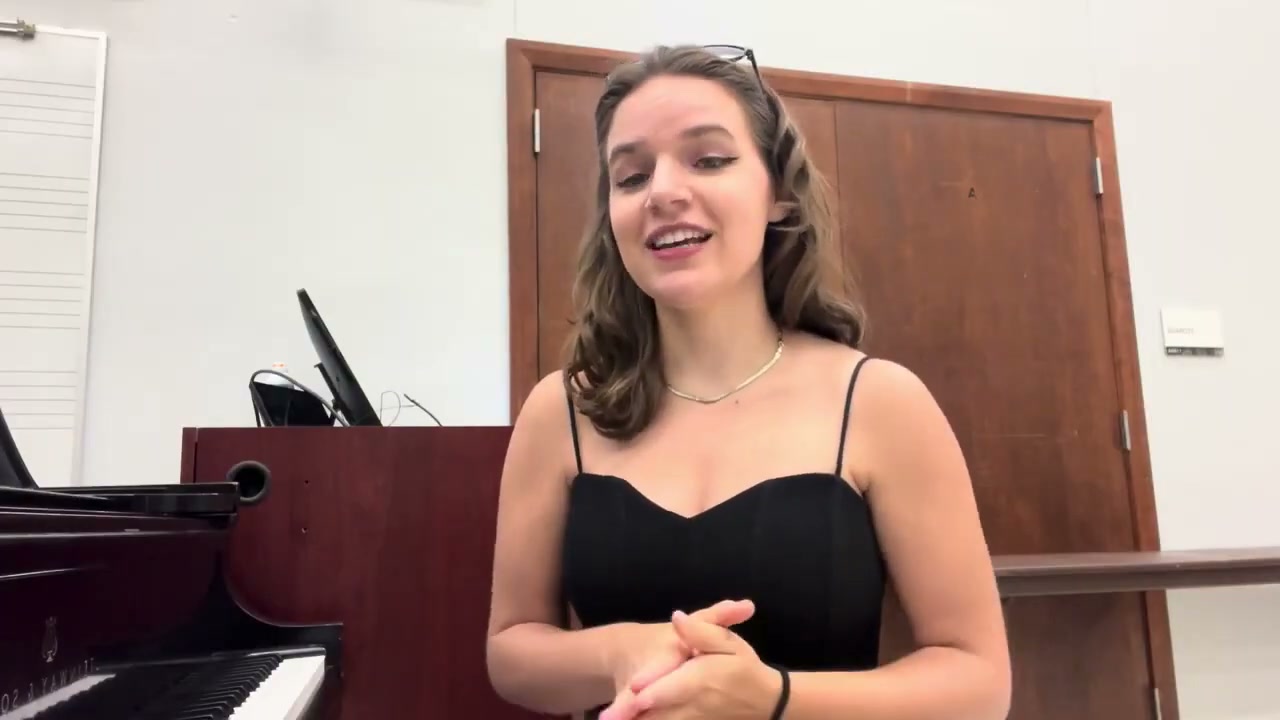
Grace teaches voice on Tunelark. View Grace’s profile
What to expect
The transition takes months rather than weeks, and it follows the same pattern as most vocal development, where awareness arrives first and reliability follows. Our honest timeline for developing vocal technique sets out what changes in each phase.
The encouraging part is that a choir singer is not starting over. The breath, the blend and the musicianship are already there. What is missing is a narrow set of skills, holding a pitch center without help and being willing to be heard, and both respond to direct attention.
If your goal on the other side of this is a bigger, more powerful sound, that is a separate skill with its own groundwork, and our guide to what belting actually is covers how to build it without straining.
About Grace
Grace is a mezzo-soprano from Kentucky and a voice teacher at Tunelark, where she teaches classical, musical theater, pop, jazz, and contemporary singing. She holds a bachelor of arts in vocal performance from Asbury University and a master’s degree in vocal performance from Southern Methodist University.
Her roles include Hodel in Fiddler on the Roof, Silver Dollar in The Ballad of Baby Doe with Opera North, Cherubino with Opera Lucca, and The Mother in Amahl and the Night Visitors. She sings as a chorister with Houston Grand Opera, The Dallas Opera, and the Dallas Symphony Orchestra, which is why the ensemble side of this is current experience rather than memory.
She teaches middle school students through adult beginners, and specializes in belting technique, audition coaching, and advanced expression. Her own path into teaching started outside music. She grew up in rural Kentucky riding horses and taught riding lessons in high school, and found the same thing again in a vocal pedagogy class as an undergraduate. She describes the draw the same way in both: helping students build confidence and watching them grow.
Performance · Pie Jesu

Grace performs Pie Jesu. View Grace’s profile
Ready to sing on your own?
Stepping out of a section is a specific skill, and it is a narrower fix than most choir singers expect once someone is listening to the right things. A teacher can tell in one lesson whether the problem is pitch independence, projection, or nerves, which saves months of guessing.
Grace is currently accepting new voice students at Tunelark, and you can browse our vetted voice teachers to find the right fit. Every Tunelark teacher is vetted by working musicians and educators for teaching quality before they can list. Our guide to what to look for in an online voice teacher is a good place to start if you are not sure what you are looking for.
Frequently Asked Questions
Why can’t I find the pitch when I sing alone after years in a choir?
Because a choir gives you a constant external pitch reference, and holding a pitch center independently is a separate skill that ensemble singing rarely asks you to develop. It is not a sign of a poor ear, and it responds to a few weeks of deliberate pitch matching practice.
Is solo singing technique different from choir technique?
No. Breath, placement, and vowel production are the same. Ensemble singing adds a listening and blending skill on top, constantly adjusting volume, tone, and vibrato to the voices around you. Stepping out removes that adjustment rather than changing the underlying technique.
How do I stop singing quietly when I sing alone?
Singing quietly to avoid being noticed is a habit learned from blending, not a technical limitation. Building exposure gradually helps, starting with singing to a mirror, then to one trusted person, then to a larger group.
How long does it take to get comfortable singing solo?
The pitch independence work takes a few weeks of consistent short sessions. The confidence side takes longer and depends on how often you put yourself in front of other people. Most singers see real change within a few months.
Was my time in choir wasted if I want to sing solo?
The opposite. Choir builds musicianship, breath, collaboration, and reliability, and those transfer. What is missing is a narrow set of skills that can be added directly.
Do I need a teacher to make the transition?
No, and Grace gives sequences for working alone. A teacher makes it considerably faster, mainly because they can identify in one lesson whether the obstacle is pitch, projection, or nerves, which is difficult to diagnose yourself.
Looking for an online voice teacher? See our full Online Voice Lessons page for everything you need to know about getting started.
Keep reading
About Jennifer Heath
I'm Jennifer Heath, VP of Operations at Tunelark and a lifelong singer. I joined the company in 2020 and oversee much of what makes Tunelark work for students and teachers: hiring, training and supporting our instructors, student support, marketing and day-to-day operations. I started voice lessons at 7 and sang with touring choirs through my teens. Music belongs in every life, for the self-expression, the discipline, the comfort and the simple joy of it.