Chord Melody Guitar: Playing Melody and Chords Together
Chord melody is a way of playing a song alone on one guitar, with the melody on top and the chords and bass underneath it, so the guitar carries the tune and its accompaniment at once. The way in is to learn the song as two voices first, the bass note and the melody, played in time, and then fill in the harmony between them using inversions that put each melody note on top of its chord.
Stu P. teaches guitar at Tunelark. He holds a Bachelor of Music in jazz studies from SUNY Purchase, where he studied with the guitarist John Abercrombie, composes his own music, and in 2026 was awarded a scholarship to the Julian Lage Master Class. We asked him how he explains chord melody to a player who has only ever strummed chords or played single-note lines, how he teaches the hand independence it needs, and how a student builds a first arrangement of a song they already know.
What chord melody is
Most guitarists learn two separate ways of playing: strumming chords to accompany a singer, or playing single-note lines such as riffs, scales and solos. Chord melody joins them. Stu describes it in terms of where each part sits on the instrument. “I think of the guitar in three registers: the bass, the middle voices, and the top voice,” he says. “In chord melody, the melody is often the top voice, with the chord and bass note “underneath” to support it, though they are not separate from one another.”
The three registers map onto the strings. The bass usually lives on the low E, A and sometimes D strings, played by the picking-hand thumb. The top voice, the melody, usually sits on the B and high E strings. The middle voices fill the gap, on the D and G strings, and they are the part that can be thinned out or left out while a player is learning.
The last clause of his description is the one beginners tend to miss. The melody note is part of the chord rather than a separate note laid over it, so a chord melody arrangement chooses each chord shape for the melody note it puts on top.
Hearing the top note in songs you already strum
A player who strums chords has been playing a top line all along without listening for it. “We can listen for this in any strummed chord progression too, as the highest note of each chord creates a melody across that progression,” Stu says. “Some songs keep this top note the same as the chords change underneath, which offers a thread of familiarity to the listener through the song. Getting Better and Dear Prudence by The Beatles offer great examples of this.”
To hear it, strum a progression you know slowly, then play only the highest string of each chord. The open C chord (x32010) has an E on top, the open G chord with the third fret on the high E string has a G on top, and an open D chord has an F sharp on top. Played one after another, those top notes form a short melody of their own. Chord melody turns that around: the melody is decided first, and the chords are chosen so their top notes spell it.
What you need before you arrange
Stu’s list of prerequisites is short. “To arrange this yourself, it helps to know the song’s chord progression and form, and then the scale, triads, and inversions in the key,” he says. “Inversions help us to put a specific melody note on top of a chord.”
Progression and form. The progression is the chord sequence, and the form is how the sections repeat: verse, chorus, bridge. Knowing the form means a player arranges each repeated section once. Our guide to music theory for guitarists covers how the chords in a key relate.
Scale and triads. A triad is the three-note core of a chord: C major is C, E and G. Every melody note in a song either belongs to the chord under it or comes from the scale around it.
Inversions. An inversion is the same three notes stacked in a different order. On guitar, the order decides which note ends up on the highest string. Take the open C chord. As x32010 it has E on top. Add the third fret on the high E string (x32013) and the same C chord has G on top. Leave the high E string out (x3201x) and C is on top. Three melody notes, one chord, three shapes. Our guide to guitar scales and the fretboard shows how the scale shapes connect across the neck, which is where most inversions are found.
Seeing all of those shapes at once is the hard part, and Stu built a tool for his own students. “Visualizing all of this on the neck can be overwhelming and confusing, which is why I built Fretboard Constellations, an app my private students use as part of our lessons,” he says. “It cycles through scales, triads, seventh chords, and every inversion in every key across the whole fretboard, with diagrams, color coding, TAB, and notation, so students can find the shape that puts their melody note on top.”
Two voices first
The step that makes chord melody manageable is to leave the chords out at first. Stu learned the method from a jazz guitarist at the top of the field. “In a sense, melody and harmony aren’t two separate jobs,” he says. “At Julian Lage’s master class this year, which I attended on scholarship, he shared a practice he learned from Tuck Andress: learn every song first as a two-part invention, just the bass note and the melody, played in time even if it has to be very slow.”
A two-part invention, the name borrowed from Bach’s keyboard pieces, has exactly two independent lines. On guitar that means the thumb plays the bass note of each chord and one finger plays the melody, and nothing else. “Keeping both voices going together is exactly the independence that solo guitar asks for, and once they feel steady, they become a frame,” Stu says. “The harmony can then fill in the space between them.”
Starting with two voices has a practical reason. A player who tries to finger full chords and the melody at once usually loses the time, and a chord melody that stops between chords no longer sounds like the song. Two voices played in time already sound like the song, and the middle voices can be added one at a time without breaking it.
In his lesson on developing hand independence, Stu works on getting each hand to hold its own job instead of copying the other.
Skill video · Developing Hand Independence
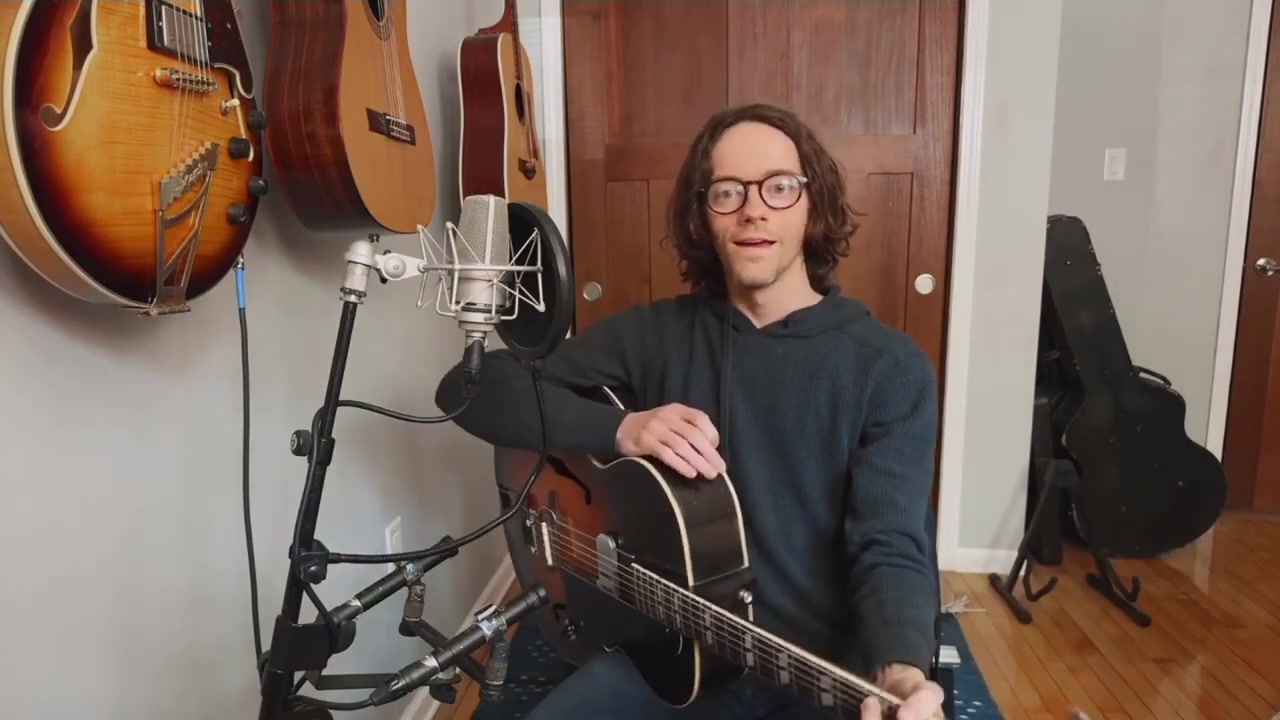
Stu teaches guitar on Tunelark. View Stu’s profile
For newer players: the thumb as anchor
A player who has not yet done any fingerpicking needs a step before the two-part version. “For newer players, I start a step earlier,” Stu says. “The picking-hand thumb becomes the anchor, playing a steady bass note on each beat, and once that runs on its own, one finger joins on top, then the next. Practice one bar on a loop, slowly and in time, until the bass note no longer needs your attention.”
The test is in that last sentence. The thumb is ready when it keeps going while the player’s attention is on the fingers. Our guide to fingerstyle guitar for beginners covers the picking patterns that build the same thumb independence.
Stu’s suggested first piece needs no fretted bass at all. “A pedal tone is a good first piece of music: let an open bass string ring while a simple melody moves above it, like the drone in Indian classical music or a pedal point in jazz music,” he says. One version: with the thumb, play the open D string on every beat at a slow metronome setting. With a finger, play the second, third and fifth frets of the high E string (F sharp, G and A) and back down, one note per beat. Every note belongs to D major, so every combination sounds right, and the one job left is keeping the thumb steady while the melody moves.
Building a first arrangement
Stu’s process for a student’s first arrangement starts away from the guitar. “Sing the melody first so it’s clear in your ear,” he says. “Then learn the song’s bass notes, chords, and form. As you choose a key and register, look for an area of the guitar where the melody resonates well on your particular instrument. You can start with the two-voice version I described above, adding the bass note and the melody together, and filling in the rest later.”
Singing first helps because a melody that the player cannot sing is hard to keep on top once the bass and chords arrive. Picking a song the student already knows by heart, and can work out by ear, saves a step, and our guide to learning songs by ear on guitar covers finding a melody on the neck.
A worked example, using a tune every reader knows: Twinkle, Twinkle, Little Star in C major. The melody of the first line is C, C, G, G, A, A, G, with the chords C, C, F, C underneath. As two voices:
- C, C (twin-kle): bass C on the A string, third fret, with the thumb; melody C on the B string, first fret.
- G, G (twin-kle): bass C again; melody G on the high E string, third fret.
- A, A (lit-tle): bass F on the D string, third fret; melody A on the high E string, fifth fret.
- G (star): bass C on the A string; melody G on the high E string, third fret.
The second line, under the words how I wonder what you are, runs F, F, E, E, D, D, C over F, C, G, C, and every shape stays in the first three frets:
Played in time at a slow tempo, those two lines are already a recognizable solo guitar version of the song.
Filling in with inversions
Once the two voices run steadily, the middle voices go in, one melody note at a time. “For each important melody note, you might find an inversion of that beat’s chord with the melody note on top,” Stu says. “This is where the Fretboard Constellations app helps. Notes that aren’t in the chord can be found in the scale notes around the chord shape.”
In the Twinkle example, the G on the second “twinkle” sits over a C chord. The x32013 shape from earlier is a full C chord with exactly that G on top, so it can replace the two-note version on that beat. Not every note needs a full chord. The strong beats, where the chord changes, usually get the fuller shape, and passing notes in between are often played as melody alone over the ringing chord.
Sometimes the search for a shape turns up a different chord that also fits. “Sometimes we discover a chord we like that supports the melody, but sits outside of the written chord change,” Stu says. “That’s a first step into what’s called re-harmonization.” In the first line of Twinkle, the A of “little” sits over F major (F, A, C). D minor (D, F, A) also contains that A, and swapping it in under “little” is a common first reharmonization: the melody is unchanged and the color underneath it shifts.
How to tell the melody is coming through
The most common problem in a first chord melody arrangement is a melody that disappears into its chords. Stu’s check is a recording. “To check that the melody is clear, record a voice memo and listen back,” he says. “If you can sing along easily, or a friend recognizes the song without being told what it is, it’s coming through. If not, try playing the melody notes with a little more emphasis in your picking hand, and the inner voices more lightly.”
The picking-hand fix works because the melody finger and the inner-voice fingers are separate fingers, and each can play at its own volume. Practicing a two-note shape with the melody deliberately louder than the bass, then a three-note shape with the middle note softest, trains that balance directly. A phone recording is an honest listener, because while playing, the player hears the melody they intend, while the recording carries only the one that came out.
Chord melody is a solo skill. Accompanying another player or a singer with jazz chords, called comping, is a different job with a different chord vocabulary, and our guide to learning jazz guitar from rock or blues covers that route.
About Stu
Stu first heard the guitar through a door. “My uncle, who taught computer music at Columbia, would always spend time with us around the holidays,” he says. “I remember hearing him play through the door at my grandparents’ house, and the simple magic and warmth of that acoustic guitar’s resonance filling a room is what made me want to pick one up.” He has now played for more than 24 years and taught for more than 19, toured from 2022 to 2024 as guitarist for August Ponthier, and played rooms including the Beacon Theatre and the United Nations General Assembly Hall.
His approach to teaching notes on the neck comes from John Abercrombie, his teacher in college, who had him loop a chord as a drone and find the notes he liked by ear. “It took the question from “what’s correct” to “what do I hear.” I use that constantly,” Stu says. “John always taught with the mindset that we are learning theory so that we can let go of it, and just play.”
Here he plays Duke Ellington’s Reflections in D, arranged for solo guitar.
Performance · Reflections in D

Stu teaches guitar on Tunelark. View Stu’s profile
Ready to arrange your first song?
Stu is accepting new guitar students at Tunelark, and the song you want to arrange, sung through once so you know the melody, is the best thing to bring to a first lesson. If you are looking for a different instrument, you can find a teacher across the rest of the roster.
Frequently Asked Questions
What is chord melody on guitar?
A way of playing a song alone on one guitar with the melody as the highest note, supported by the chord and bass underneath, so no singer or second player is needed.
Is chord melody hard for beginners?
It asks the thumb and fingers to work independently, so most players start once they can change chords in time. A pedal tone exercise, open bass string plus a simple melody, is a good first step.
What is the first step in arranging a song for chord melody?
Sing the melody, then learn the song as two voices, bass note and melody only, played in time at a slow tempo. The chords are filled in after.
Do I need to know music theory to play chord melody?
It helps to know triads and inversions in the song’s key, because an inversion is how a chosen melody note ends up on top of a chord. The rest can be learned from the song itself.
How do I make the melody stand out in a chord melody arrangement?
Pick the melody notes a little harder and the inner voices more lightly, then record yourself and check whether you can sing along.
Looking for an online guitar teacher? See our full Online Guitar and Bass Lessons page for everything you need to know about getting started.
Keep reading
About Jennifer Heath
I'm Jennifer Heath, VP of Operations at Tunelark and a lifelong singer. I joined the company in 2020 and oversee much of what makes Tunelark work for students and teachers: hiring, training and supporting our instructors, student support, marketing and day-to-day operations. I started voice lessons at 7 and sang with touring choirs through my teens. Music belongs in every life, for the self-expression, the discipline, the comfort and the simple joy of it.