Music Theory for Guitarists: Why Your Chords Belong Together
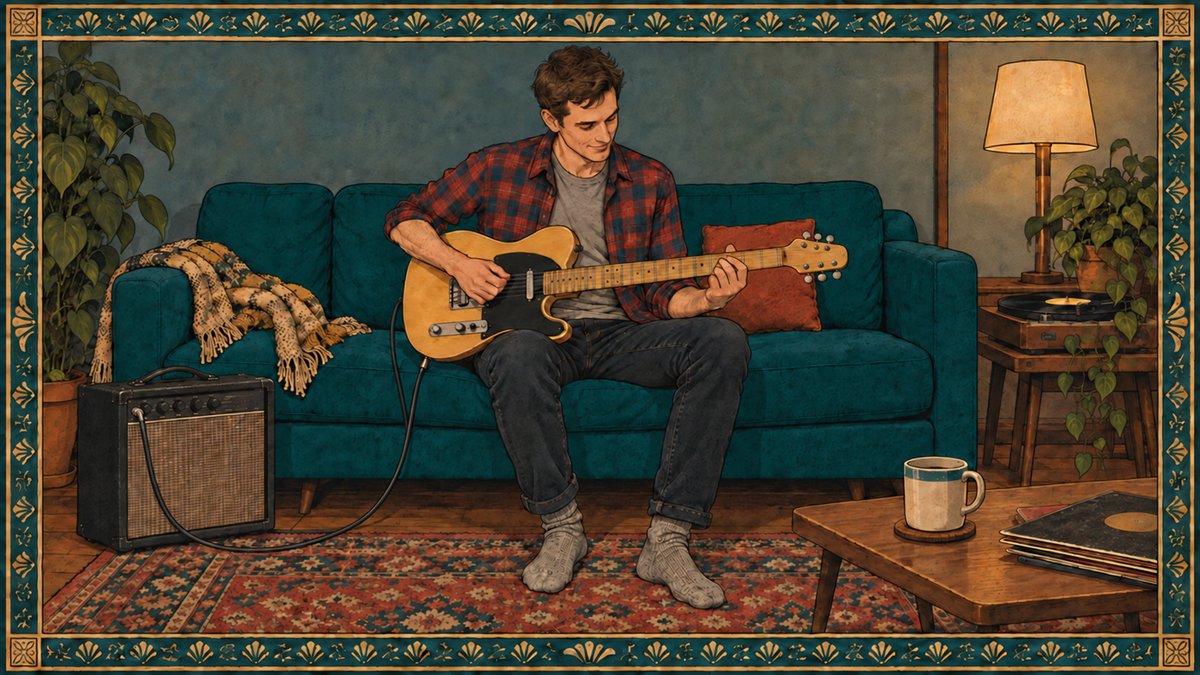
Plenty of guitarists can play a hundred chord shapes and still not say why a G, a C and a D sound right together in so many songs. They learned by shapes and tabs, which works well until it stops working: a song in an awkward key, a chord symbol they have never seen, a solo that wanders off, or a song of their own that is nearly right and they cannot say why.
Pete P. teaches guitar at Tunelark. He holds a B.A. in Jazz Studies from the State University of New York at New Paltz, studied classical theory for two years at Rutgers University’s Mason Gross School of the Arts before that, and has been teaching for more than 31 years. Theory is the part of his teaching he has built his own method around. We asked him where he starts with a player who knows shapes but not the reasons behind them, how he makes keys and the number system something a guitarist can see on the neck, and what theory gives a player that shapes and tabs never will.
Where Pete starts with a player who knows shapes
Pete does not treat theory as a semester. “I can teach theory pretty efficiently and quickly at this point,” he says. “I use the approaches I learned from my teachers at SUNY along with my own method. I can teach the essentials in 2-3 hours. It’s a how-to approach rather than an exhaustive analysis of every aspect.”
The pace depends on the student. That fast version, he says, “assumes the student is very studious and attentive. Otherwise, I’ll slow it down and teach it over a month or so.” Either way, the destination is the same, and he names it in order: “I make sure they understand the musical alphabet, the chromatic scale (sharps and flats), the major scale (scale degrees), all chord types, the scale degree of each chord shape on the guitar, chord symbols, and how to change these chords into other chords rather than learning 1000 shapes cold.”
The musical alphabet. Music uses seven letter names, A through G, and then starts again. That is the whole alphabet.
The chromatic scale. Between most of those letters sits one more note, a sharp or flat. B and C sit right next to each other, and so do E and F, with nothing between. That makes twelve different notes before the pattern repeats. On a guitar each fret is one of those steps, a half step, which is why the neck is such a clear picture of the chromatic scale: twelve frets up any string, and you are back to the same note an octave higher.
The major scale and its degrees. Pick any of the twelve notes as a starting point and walk up in a fixed pattern of whole steps, which are two frets, and half steps, which are one: whole, whole, half, whole, whole, whole, half. From G that gives G, A, B, C, D, E, F sharp and back to G. Theory numbers those notes 1 through 7, and those numbers are the scale degrees.
Chord types. Chords are described with their own numbers, counted from the chord’s root rather than from the key. In the key of G, C is the 4 of the key, but inside a C chord, C is the 1. A major chord is 1, 3 and 5. A minor chord lowers the 3 by a half step: 1, flat 3 and 5. A dominant seventh chord adds a flat 7 to a major chord: 1, 3, 5 and flat 7. A minor seventh is 1, flat 3, 5 and flat 7, and a major seventh is 1, 3, 5 and 7. The types are recipes, and once a player knows them, a chord symbol stops being a name to memorize and becomes a set of instructions.
The scale degree of each note in a shape. This is where the guitar comes in. Most chord shapes a player already knows are made of roots, thirds, fifths and sometimes sevenths, and knowing which finger is sitting on which is what makes the rest of the list possible.
Changing chords into other chords. Instead of memorizing a thousand shapes, a player who knows those recipes changes the one or two notes that turn one chord into another.
One shape, three chords
A worked example of our own shows the idea. Take a G major barre chord at the third fret, the shape built on the open E chord, with the root on the low E string. Reading from the lowest string up, the notes are G, D, G, B, D and G, which makes those strings the 1, 5, 1, 3, 5 and 1 of the chord. In the usual fingering the index finger bars the third fret, the middle finger holds the G string at the fourth fret, the ring finger the A string at the fifth, and the little finger the D string at the fifth.
1. Make it minor. The 3 is the B on the G string, under the middle finger. Lift that finger and the barre sounds the G string at the third fret instead: B flat, a flat 3, and the chord is G minor.
2. Make it a dominant seventh. Go back to G major. The G on the D string, under the little finger, is a doubled root. Lift the little finger and the barre sounds the D string at the third fret: F, a flat 7, and the chord is G7.
3. Move the whole thing. Slide all three shapes up two frets and they become A, A minor and A7, because the relationships inside the shape have not changed, only the starting note.
That is three chord types in one position, and every key within reach on the neck, from a single shape and two rules. A player who memorizes shapes one at a time needs a separate picture for each of those, and still does not know what to do when a chart asks for a chord they have never met. A player who knows which note in the shape is the 3 and which is the 7 can build it.
Pete demonstrates the same idea in the other direction below, adding notes to open chords a player already knows to give them new colors.
Skill video · Adding Tensions to Guitar Chords
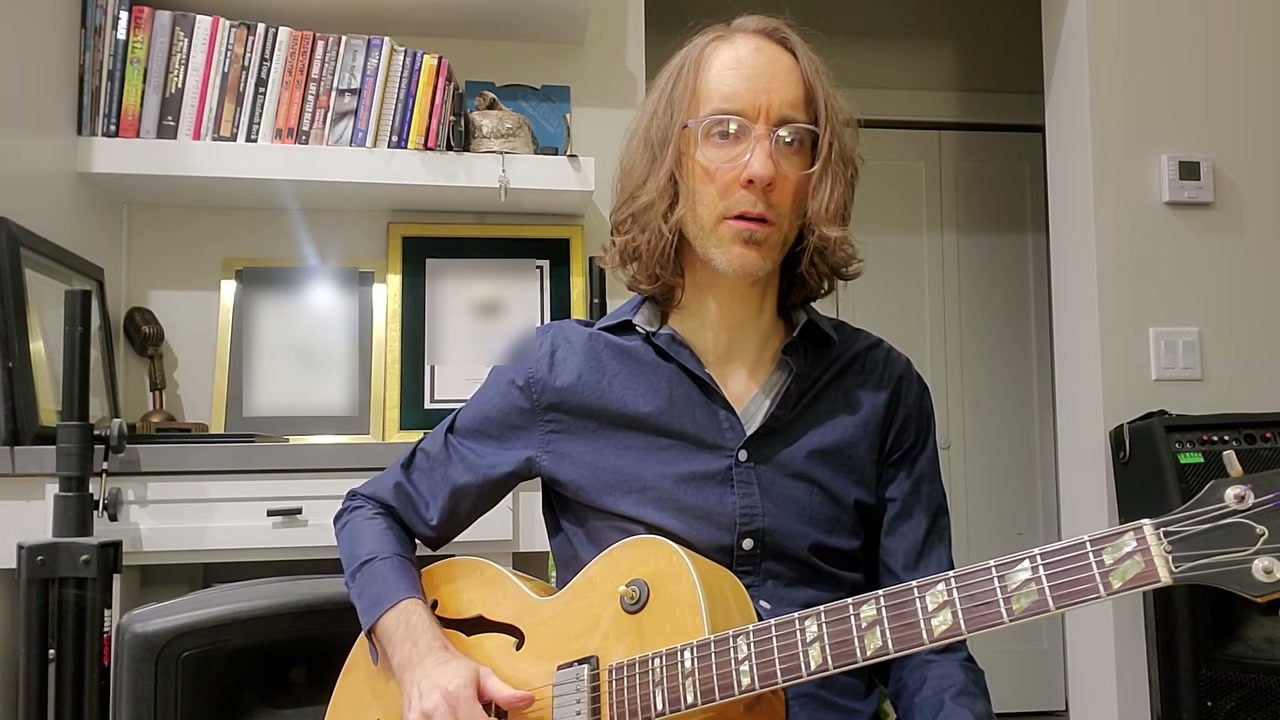
Pete teaches guitar on Tunelark. View Pete’s profile
Keys and the number system, seen as shapes
Pete’s view of keys starts from the guitar itself. “Keys are not as important on the guitar because most shapes are movable as opposed to piano where the shapes always change,” he says. On a piano, the same progression in a new key usually puts a different pattern of white and black keys under the hands. On a guitar, a fully fretted shape can slide along the same strings to a new fret and keep every relationship inside it. Open-string chords do not move that way. They need a capo, a barre or a different voicing.
That does not mean a guitarist can skip the idea of a key. “Knowing how to determine the key of a song takes learning theory first and then applying it to the guitar,” he says, and what he wants a student to own is the degree of every note under their fingers. “Knowing the scale degrees of every relative note on the guitar is critical to being able to transpose, solo, and embellish when comping.”
His way of teaching it is his own. “I use an interval shape method I developed which trains the student to see shapes rather than note names,” he says. “These shapes can be placed anywhere up and down the neck, whereas the note names keep changing.”
The 1, 4 and 5 of a key show why that way of seeing works so well on a guitar. In the key of G, the major scale is G, A, B, C, D, E and F sharp, so the 1 chord is G, the 4 chord is C and the 5 chord is D. Those three chords carry a huge share of rock, blues, folk and country songs. On the neck, their roots make one small shape:
- The 1: the root on the low E string. For G, that is the third fret.
- The 4: the same fret, one string higher, on the A string. For G, that is C at the third fret.
- The 5: two frets higher on that A string. For G, that is D at the fifth fret.
Move the 1 to the fifth fret, where the low E string gives A, and the same shape gives the 4 and 5 of A, which are D and E. The note names changed. The shape did not. That is the idea behind seeing shapes rather than note names, and it is why a guitarist who hears a song move from the 1 to the 4 can find it in any key without working out the letters first.
Why G, C and D belong together
The roots show where the chords sit. The notes inside them show why they belong together. Each of the three is built only from notes of the G major scale:
| Chord | Its notes | Number in G |
|---|---|---|
| G | G, B, D | 1, home |
| C | C, E, G | 4 |
| D | D, F sharp, A | 5, pulls back to G |
In a song centered on G, the G chord sounds like home and the D chord pulls back toward it, while the C chord moves away and gives the progression somewhere to go. Blues bends this on purpose: a blues in G is often played with G7, C7 and D7, and the flat 7s in G7 and C7, F and B flat, sit outside the G major scale, which is part of what gives the blues its sound.
Hearing the numbers comes from the same place. Once a player knows that the move from G to C in one song and the move from A to D in another are both a 1 going to a 4, they start to recognize the sound of that move in songs they already play, and a song they have never played becomes a set of numbers they can follow in any key. A chart written in numbers still marks each chord’s quality, such as minor or seventh. Our guide to easy guitar songs with two or three chords is full of the 1, 4 and 5 in action.
Transposing, soloing and comping
The three things Pete names in that answer are the everyday uses of all this.
Transposing means playing a song in a different key, usually to suit a singer. A player who knows the song as numbers moves a progression of fully fretted shapes by moving the starting fret, and the relationships between the chords stay the same.
Soloing gets easier because a player who knows where the 3 of the current chord sits, and the 7 when it is a seventh chord, can aim for them, and those are the notes that make a line sound like it belongs to that chord. Our guide to starting to improvise on guitar goes further into the soloing side, and the scale shapes that sit underneath it are covered in our article on guitar scales and the fretboard.
Comping is playing chords behind a singer or a soloist. It is a large part of a guitarist’s job in most bands, and embellishing it, adding a passing note or a suspended color, is easier when a player knows which degree a note is, though many players find those changes by ear first. Pete was also interviewed for our guide to learning jazz guitar from rock or blues, which covers the chords he starts rock and blues players on.
What theory gives a player that shapes and tabs do not
Guitarists often worry that theory will make their playing mechanical, or that it is dry. Our article on why music theory matters makes the general case for any instrument. Pete’s answer goes straight to what a player makes with it. “Theory is critical for songwriting,” he says. “Sure, anyone can come up with a series of chords and a melody, but knowing theory will take a song that is 80% good and make it 100% good.”
The mechanism is specific. “Theory teaches you which notes are creating unwanted dissonances that might get overlooked without analysis,” he says. “It teaches you which chords are the best options to play underneath a melody.”
Both of those are problems a songwriter meets constantly. A melody note that clashes with the chord underneath it can sound like a mistake the writer cannot locate, even though they can hear that something is off. Not every clash is a mistake, and plenty of good melodies lean on one on purpose, which is why the word that matters in his answer is unwanted. Knowing that a melody sitting on B fits comfortably over a G chord, where B is the 3, or over an E minor chord, where B is the 5, turns a vague feeling into a choice between options. It works the same for picking chords: a melody built around the notes of the G major scale can usually be harmonized with chords built from that same scale, and theory tells the writer which ones share the melody’s notes at any given moment.
A tab shows where to put your fingers, and plenty of songwriters use it to record their own ideas. What it does not show is why those notes work together. Theory supplies the names and patterns that make those relationships easier to see, change and reuse, whether the player writes their own music or simply wants to understand the music they love. Our guide to how to write a song looks at the songwriting process itself, where this knowledge earns its keep.
About Pete
Pete grew up in a house full of music, with a father and brother who played guitar and a mother who played piano, and started learning chords and riffs at about seven. He holds a B.A. in Jazz Studies from the State University of New York at New Paltz and studied classical theory at Rutgers University’s Mason Gross School of the Arts. He has been playing guitar for more than 42 years and teaching for more than 31, including at Rutgers University and Swallow Hill Music.
He has performed or recorded with Rock and Roll Hall of Fame members Levon Helm of The Band and Dizzy Reed of Guns N’ Roses, and with Steve Ferrone, longtime drummer of Tom Petty and the Heartbreakers, and he plays in Tasty Face with Angelo Moore of Fishbone. His work has appeared on the Grammy Award ballot 12 times, and he has played the 27,000-seat StubHub Center in support of Kevin Costner & Modern West.
At Tunelark he teaches guitar to students aged 3 and up, beginner through advanced, in rock, blues, jazz, folk, country and metal, along with improvisation, music theory, songwriting and composition. He shapes lessons around each student’s goals, balancing the technique and theory a student needs with the songs they want to play. Here he is in performance, playing his own arrangement in tribute to Eddie Van Halen, the guitarist who made him decide to dedicate his life to the instrument.
Performance · Eddie Van Halen Tribute
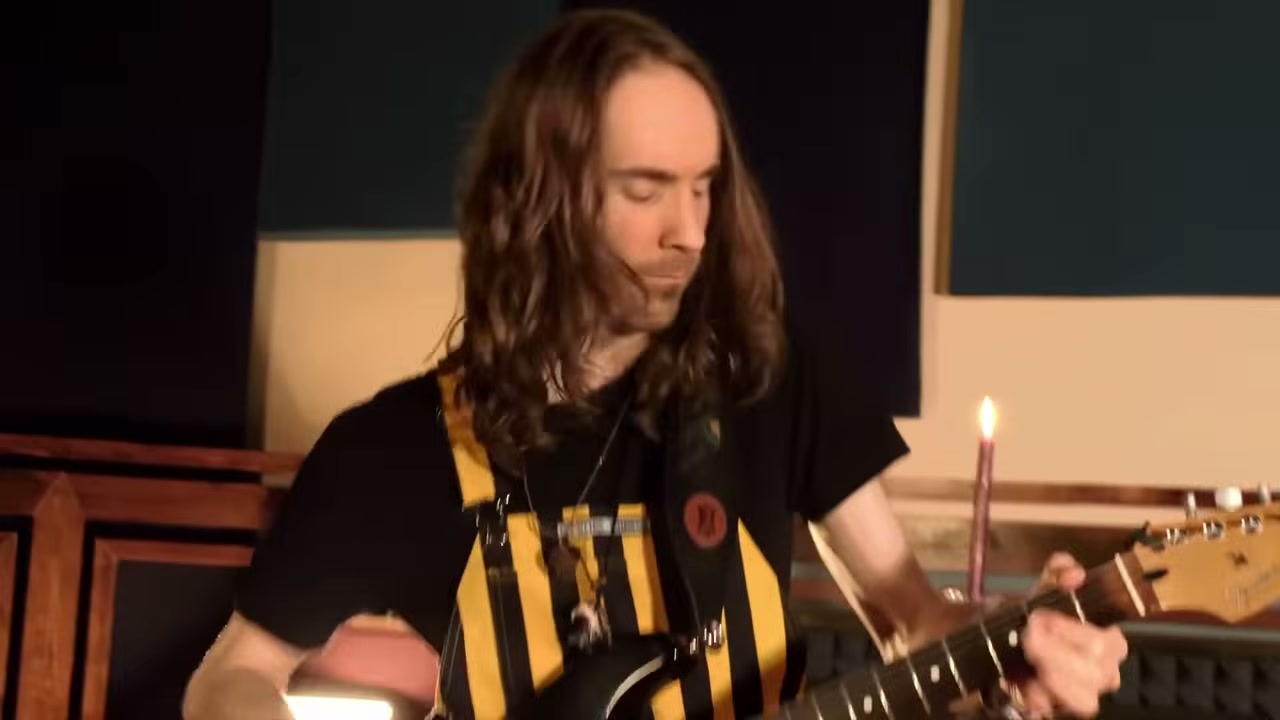
Pete teaches guitar on Tunelark. View Pete’s profile
Ready to understand the chords you already play?
Theory for a guitarist is not a separate subject from playing. It is the musical alphabet, the twelve notes, the major scale and its numbers, the recipes for chord types, and the degree of every note in the shapes already under your fingers. With those, one shape becomes several chords, a key becomes a movable shape, and a song that is nearly right becomes easier to diagnose.
Pete is accepting new guitar students at Tunelark, and a song you can already play but do not fully understand is a good thing to bring to a first lesson. You can also find a teacher for another instrument across the rest of the roster.
Frequently Asked Questions
Do I need to read sheet music to learn music theory on guitar?
No. The ideas in this article are about notes, numbers and shapes on the neck, and they can be learned without reading standard notation. Reading helps later, and our guide to reading sheet music covers it separately.
How long does it take to learn guitar theory?
Pete teaches the essentials in two to three hours to a focused, attentive student, or over about a month at a slower pace. Applying them fluently to songs takes much longer and keeps going for years.
What is the number system in music?
It names chords by the scale degree of their root instead of by letter. In G, the 1 chord is G, the 4 is C and the 5 is D. A chart still shows each chord’s quality, such as minor or seventh, and the same numbers work in every key.
Is music theory different on guitar than on piano?
The theory is identical. What differs is the picture: on guitar a fully fretted shape can usually move to a new key along the same strings, while on piano the pattern of white and black keys usually changes from key to key.
Will learning theory make my playing less creative?
Theory describes what already sounds good rather than dictating it. It mostly gives a player more choices and a faster way to find the sound they are hearing in their head.
Looking for an online guitar teacher? See our full Online Guitar and Bass Lessons page for everything you need to know about getting started.
Keep reading
About Jennifer Heath
I'm Jennifer Heath, VP of Operations at Tunelark and a lifelong singer. I joined the company in 2020 and oversee much of what makes Tunelark work for students and teachers: hiring, training and supporting our instructors, student support, marketing and day-to-day operations. I started voice lessons at 7 and sang with touring choirs through my teens. Music belongs in every life, for the self-expression, the discipline, the comfort and the simple joy of it.