Guitar as a Daily Mindfulness Practice: 10 Minutes That Reset Your Day
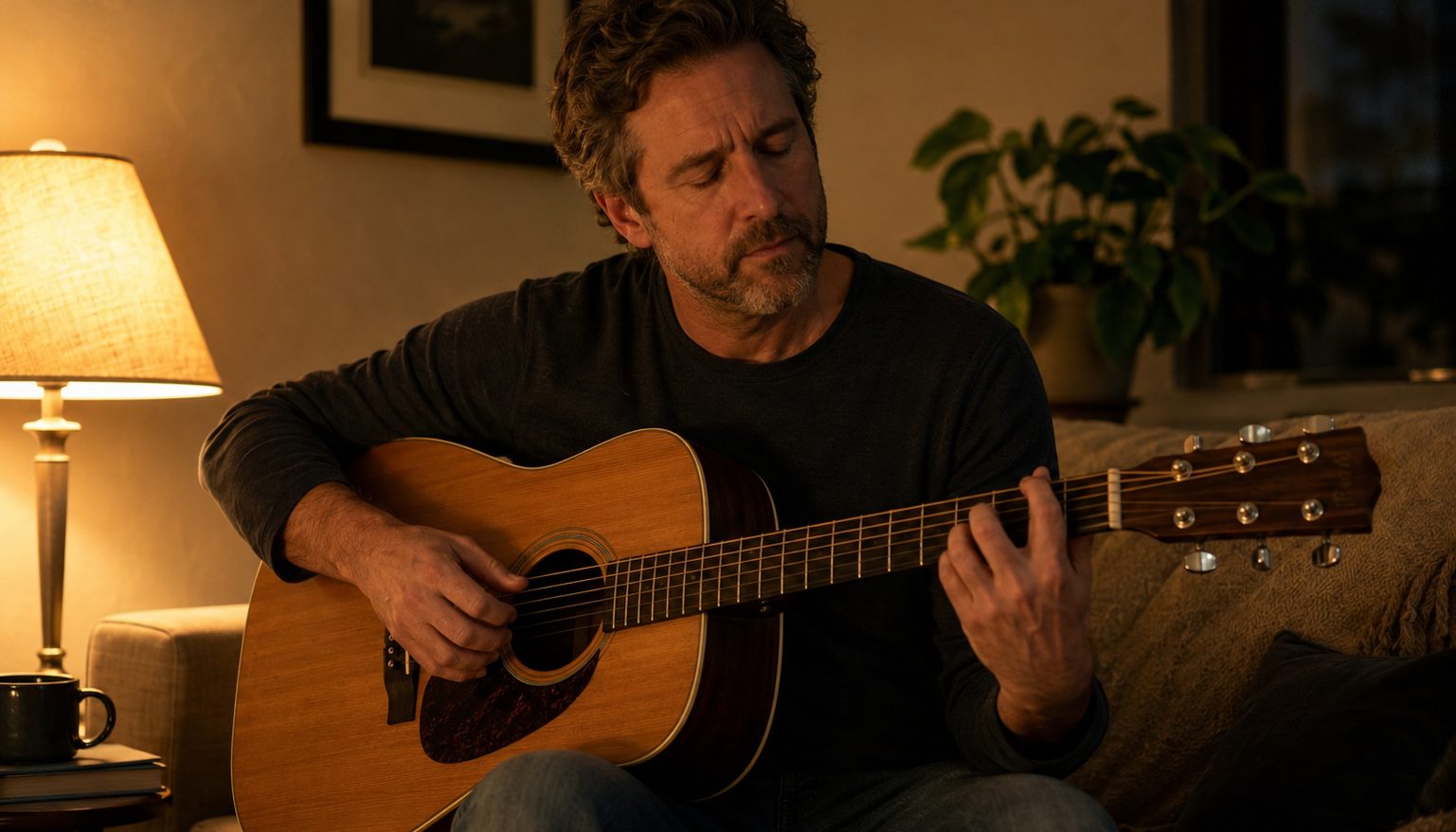
There’s a moment, somewhere between picking up the guitar and the third or fourth chord, where the noise in your head quiets down. Not all the way, but enough that you can feel it.
A guitar mindfulness practice isn’t about becoming a better player. It’s about using the instrument as a way to land back inside your own body and attention. Ten minutes is enough. You don’t have to be good. You don’t even have to have been playing long. What you need is the willingness to treat the guitar like a meditation cushion for a few minutes a day.
Why Guitar Works as Mindfulness
A lot of objects can anchor attention: a candle flame, your breath, a mantra. Guitar works particularly well for adults who struggle with seated meditation because it gives your hands something concrete to do. You’re not trying to clear your mind. You’re trying to listen, and the instrument keeps pulling your attention back when it wanders.
It can also be settling. Slow, repetitive sound at a comfortable volume gives the body something steady to follow. Many people notice their breathing slow and their shoulders drop within a few minutes. None of this requires you to be playing music anyone would want to hear. It’s about the physical act of producing slow, sustained sound while paying attention to it.
For most adults, picking up an instrument is associated with practice, with goals, with effort, with the slight low-grade pressure of trying to get better. A mindfulness practice is the opposite. The goal is to be present, not to improve, and that reframe is what makes the guitar work as a settling tool rather than another source of stress.
The Science (Briefly)
There’s growing research on the effects of music-making on stress physiology in adults. Playing music (even simple, slow, unstructured playing) is associated in small studies with lower cortisol levels, higher heart rate variability, which is a marker of a calmer nervous system, and improved mood reported shortly after playing.
We have a fuller breakdown of the cortisol research in our article on whether playing guitar lowers cortisol, and a broader look at the wellbeing case in music lessons as a stress reliever. The short version: small studies report lower cortisol and better mood after music-making, those results are group averages rather than a guarantee, and many people notice the calming effect themselves after even a brief session.
What matters for daily use isn’t the lab data, though. It is whether ten minutes earns its place in your day, and the way to settle that is to run it for a couple of weeks and pay attention to how the rest of the evening goes.
The 10-Minute Routine
Here’s a structure that works for almost anyone, regardless of skill level.
Minutes 0-2: Settle. Sit with the guitar in your lap. Don’t play yet. Let the weight of the instrument settle on your leg. Tune it slowly, by ear if you can, or with a tuner. The tuning itself is part of the practice. It’s a structured way to start listening.
Minutes 2-5: Single notes. Play one open string. Listen to it fully: the attack, the sustain, the way it fades. Wait until you can’t hear it anymore before playing the next note. Move through the six strings this way, slowly. If your mind wanders, no problem. Come back to the sound.
Minutes 5-8: A simple pattern. Pick something you know well and can play without thinking: a chord progression, a finger-picking pattern, a familiar exercise. Play it slow. Slower than you want to. The goal isn’t musicality. It’s to give your hands something to do while your attention stays on the sound and the breath.
Minutes 8-10: Free time. Play whatever you want, very softly, for the last two minutes. No structure. Don’t try to make it sound like anything. End by letting the last chord ring out fully before you set the guitar down.
That’s the whole practice. Ten minutes. Lower shoulders when you stand up, a slower breath, a head that has stopped arguing with itself: any one of those is a sign it landed. Some sessions produce nothing you can point to, which is not a failure and not a reason to stop. The practice is the ten minutes, not the feeling at the end of them.
What to Play Even If You’re a Beginner
If you’ve been playing for less than a few months, the routine above still works. You just simplify each section.
The single-notes section needs no skill at all. Any beginner can play one string at a time and listen to it fade.
The pattern section can be as simple as one chord (Em or G) strummed slowly, four beats per chord, the same chord for the full three minutes. The practice is close attention to something simple. A simple fingerpicking pattern from Fingerstyle Guitar for Beginners works well here too, once it runs on its own.
Jay H., who teaches guitar on Tunelark, breaks one such pattern down string by string. Learn it in a regular practice window, and bring it to the ten minutes once your hands can run it without your attention.
Skill video · Travis Picking Basics

Jay teaches guitar lessons online with Tunelark. View Jay’s profile
The free time can be plucking individual strings in a random order, very softly. You’re not composing. You’re just making sound and listening.
If you’re brand new to the instrument, you might find it useful to also have a few foundational moves to draw from. Our guide to beginner guitar tips covers the basics. But none of that is required to start a guitar mindfulness practice today.
When This Practice Falls Apart
It will fall apart, by the way. Every daily practice does. Some predictable failure modes:
You’ll skip a few days, and when you come back you’ll feel like you have to “make up” for it. Don’t. The practice doesn’t accumulate debt. Today is today.
You’ll start using the ten minutes to actually practice, drilling something, working on a song, getting frustrated with your hands. This is also fine, but it isn’t the mindfulness practice anymore. If you want both, give them different windows. Don’t try to make ten minutes do two jobs.
The two windows still help each other. When regular practice turns into a struggle, Harry B., who teaches guitar on Tunelark, tells students to step away from the instrument, then come back to a simple song they know well and remember that getting to play music at all is good luck. It is the same move as the middle of this routine: something familiar, played for its own sake.
You’ll get bored. This usually means you’re rushing through the slow parts. The remedy is to go slower, not faster. The boredom usually breaks if you stay with it.
You’ll judge how you sound. This is the deepest one. The guitar mindfulness practice is genuinely not about how it sounds. It’s about whether you’re there. If you find yourself bothered by your tone or technique, the move is to make the playing simpler (one note at a time, single string) until the judgment quiets down.
A daily ten-minute guitar mindfulness practice isn’t going to make you a better player. It might, as a side effect, but that’s not what it’s for. What it’s for is giving you a small, reliable way to put down the noise of the day and listen to something for a little while.
How to Find a Guitar Teacher on Tunelark
If you’re new to guitar and want a teacher who supports both skill-building and the way you actually use the instrument, wellbeing included, here’s how to find them.
1. Open the teacher list and filter by guitar.
2. Read bios. Look for teachers who mention working with adult learners or who talk about playing as more than performance.
3. Book a trial lesson with one whose profile resonates. It is $25 off that teacher’s 30-minute rate.
4. In the trial, mention that you want to play partly for stress relief and presence. A teacher who hears that without pushing back is the right teacher.
The benefits of learning music as an adult are deeper than the technical milestones. A guitar mindfulness practice is one of the most accessible doorways into them.
Frequently Asked Questions
Do I need to know how to play guitar to do this?
No. The single-notes portion of the routine works with no skill whatsoever, just pluck a string and listen. The practice deepens as your playing develops, but it does not require it.
Will this make me a worse guitar player by replacing real practice?
No, but it isn’t real practice either. Treat it as a separate thing. If you have skill-building goals on guitar, do those in a different window. The mindfulness practice complements but doesn’t replace structured practice.
Acoustic or electric: does it matter?
Acoustic is simpler because you don’t have to plug anything in. Electric works fine too, played unplugged or at low volume. Whatever guitar makes you most likely to actually pick it up is the right one.
What if I only have five minutes?
Five minutes works. Compress each section proportionally. The ritual matters more than the duration.
Can I do this at night before bed?
Yes: many people find it works best in the evening as a wind-down. The slow tempo and quiet playing tends to be calming rather than activating. Just keep the volume low enough that it doesn’t pull you back into alertness.
Looking for an online guitar teacher? See our full Online Guitar and Bass Lessons page for everything you need to know about getting started.
Keep reading
About Jennifer Heath
I'm Jennifer Heath, VP of Operations at Tunelark and a lifelong singer. I joined the company in 2020 and oversee much of what makes Tunelark work for students and teachers: hiring, training and supporting our instructors, student support, marketing and day-to-day operations. I started voice lessons at 7 and sang with touring choirs through my teens. Music belongs in every life, for the self-expression, the discipline, the comfort and the simple joy of it.