Guitar Strumming Patterns: From Chord Shapes to Rhythm

In four-four time, a guitar strumming pattern is a choice about which of eight evenly spaced strokes touch the strings. The strumming hand moves down and up through every bar at one steady rate, and the pattern decides which of those strokes you let through. A hand that has learned the motion can play any of the patterns below by changing contact alone, which is also what keeps it moving when the chord changes.
The chord changes below use the fingerings from our guide to the five acoustic guitar chords beginners learn first: G with the ring finger on the low E string, the middle on the A string and the pinky on the high E string, which leaves the index finger ready for C; E minor with the middle and ring fingers; C and A minor with three fingers each.
Counting Eight Strokes to the Bar
Most songs a beginner strums are in four-four time: four beats to the bar, counted “one and two and three and four and.” Each number and each “and” is an eighth note, half a beat, which gives eight slots per bar. The hand comes down on the numbers and goes up on the ands, every time, in every pattern here.
On a guitar the two directions sound different, and the patterns are built around that. A downstroke starts at the chord’s lowest string: all six for G and E minor, the fifth string for C and A minor, the open fourth string for D. An upstroke usually catches only the top three or four strings, so it comes out lighter and higher.
The movement comes mostly from the wrist, with the forearm following. Hold the pick between the pad of the thumb and the side of the index finger with only the tip showing. A thin or medium pick flexes as it crosses six strings, which keeps the strum even while the hand is still learning the motion.
When a pattern leaves a slot empty, the hand still makes the stroke and misses the strings on purpose. The hand keeps moving at the speed of the eighth notes, so every stroke that does land arrives on time.
Stu P., who teaches guitar on Tunelark, shows the moving hand on a C chord. He counts the pulse out loud, keeps his strumming hand going down and up on every beat, and only changes which strokes touch the strings, so with the sound off his hand looks the same whichever pattern he plays. In the second half he works hammer-ons into the strum without dropping the beat.
Skill video · Hand Stabilization for Strumming
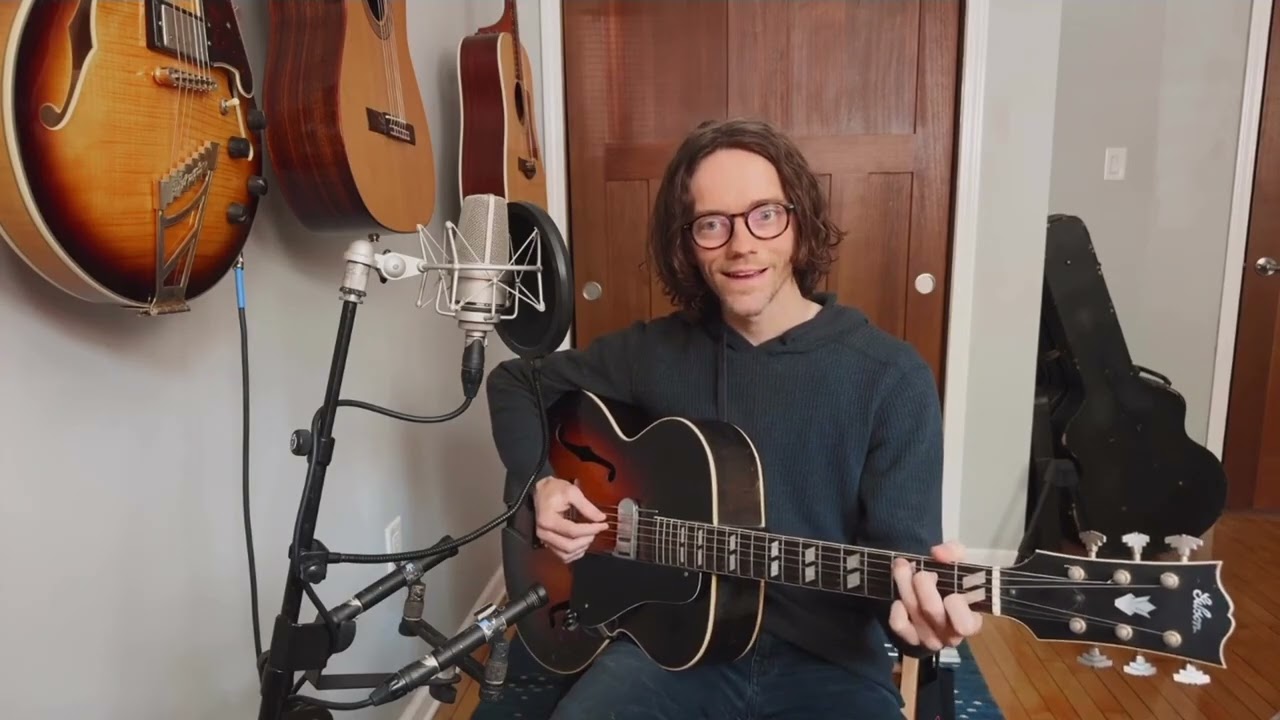
Stu teaches guitar and ukulele on Tunelark. View Stu’s profile
Three Patterns, Each Built on the Last
Learn these in order. Each one keeps the same hand motion and changes only which strokes touch the strings.
Swipe sideways to see the whole diagram.
Pattern 1, four downstrokes. Down on 1, 2, 3 and 4. The hand rises between beats without touching the strings. It suits slow songs and a chord change you have only just learned, because it leaves a full beat between strokes.
Pattern 2, down, down up, down, down up. Down on 1, down on 2, up on the and of 2, down on 3, down on 4, up on the and of 4. The two upstrokes come right after beats two and four, so the bar falls into two matching halves.
Pattern 3, down, down up, up down up. Down on 1, down on 2, up on the and of 2, then a miss on beat 3, up on the and of 3, down on 4, up on the and of 4. This is pattern 2 with beat three taken out and the and of three put in. The emphasis now falls between the beats, which is what syncopated means. On a guitar that off-beat push is carried by an upstroke, the lightest stroke in the bar, so it helps to dig the pick into the and of 3 a little harder than the other ups. Say “three” out loud on the miss, so the empty beat stays as long as the others.
Accents: Where the Weight of the Bar Goes
An accent is a louder stroke. On a guitar a harder downstroke usually digs through all the strings of the chord with more force, so it reads as heavier as well as louder. Two players can strum the same eight strokes and sound like they are playing different songs, depending on where they lean.
The usual place is beats 2 and 4, where the snare drum usually lands in rock, pop and country. Play all eight strokes lightly and dig into the downstrokes on 2 and 4.
Swipe sideways to see the whole diagram.
The percussive version replaces those two accents with a chuck. On beats 2 and 4 the side of the strumming hand’s palm comes down onto the strings as the pick strums through them, so they click instead of ringing. The stroke is still a downstroke and the hand does not change direction, which is why the chuck fits into the motion without a hitch. On open chords the strumming hand usually does the muting, because easing off with the fretting fingers leaves the open strings ringing. On a barre chord, where one finger lies flat across all six strings and nothing is open, the fretting hand can release pressure to get the same click, and our guide to fretting-hand technique covers how that muting works.
The Bass and Strum: Splitting the Chord in Two
Country and folk guitar often split each chord into two jobs. The pick plays the chord’s lowest note alone on beat 1, strums the rest of the chord, plays a second bass note alone on beat 3, and strums again. The low note on beat 1 is the root, the note the chord is named after. The note on beat 3, the alternate bass, is usually the chord’s fifth, the note five letter names up from the root: for G that is G, A, B, C, D, so D.
Swipe sideways to see the whole diagram.
| Chord | Beat 1: the root | Beat 3: the alternate bass |
|---|---|---|
| G | G, on the low E string, 3rd fret | D, on the open D string |
| C | C, on the A string, 3rd fret | G, on the low E string, 3rd fret. The ring finger hops over from the A string at the same fret |
| D | D, on the open D string | A, on the open A string |
| Am | A, on the open A string | E, on the open low E string |
| Em | E, on the open low E string | B, on the A string, 2nd fret. The middle finger is already there |
On C, the ring finger hops to the low E string for beat 3 and comes back to the A string for the strum on 4, or the strum sounds an open A inside the chord.
Three of the five chords have an open string as their root, so beat 1 of D, A minor or E minor sounds before the fretting hand has done anything. The fingers have until the strum on beat 2 to finish the shape. G and C are the opposite case. Their roots are fretted, so the finger on the bass string has to land first, ahead of the rest of the shape. Lead with that finger, and the others have until beat 2, since nothing above the bass string sounds before then.
In three-four time the same idea becomes bass, strum, strum: the root alone on 1 and a downstroke strum on 2 and on 3. Amazing Grace and Down in the Valley are both in three, and both are in our list of easy guitar songs with two or three chords, with the chords for each. Fingerpicking divides the chord the same way, with the thumb taking the bass strings, and our guide to fingerstyle guitar for beginners builds its first patterns on that split.
Changing Chords Without Stopping the Strumming Hand
A fast change on guitar mostly comes down to how many fingers have to move. Some pairs of chords share a finger exactly, and some keep a finger on the same fret one string over, which is a slide rather than a lift. Comparing the fingerings finger by finger gives this:
| Change | Stays exactly where it is | Keeps its fret, moves one string | Has to find a new spot |
|---|---|---|---|
| C to Am | index, middle | none | ring |
| Em to G | middle | none | ring, pinky |
| G to C | none | middle, ring | index |
| Em to Am | none | middle, ring | index |
| G to D | none | none | middle, ring, index |
| C to D | none | none | index, middle, ring |
| G (four-finger) to D | ring | none | index, middle |
| G (four-finger) to Cadd9 | ring, pinky | index, middle | none |
C to A minor is the cheapest change in the set. The index and middle fingers stay down and only the ring finger moves, from the A string at the third fret to the G string at the second. E minor to G keeps the middle finger on the A string’s second fret. G to C and E minor to A minor each move a pair of fingers one string toward the floor without changing fret, so the hand can keep its shape and shift.
G to D and C to D share nothing, which makes D a common place for a beginner’s strum to stall. Many players switch to a four-finger G for songs that go between G and D, written 320033 (fret numbers from the low E string to the high E, with 0 for an open string and x for one left out). It puts the ring finger on the B string at the third fret, and D keeps the ring finger in exactly that spot. The same idea extends to a third chord: Cadd9, x32033, keeps the ring and pinky where the four-finger G has them, so G, Cadd9 and D change around one planted ring finger. Cadd9 sounds brighter than C, and many acoustic players use it in C’s place for that reason.
Whatever moves still needs time to move, and in the eighth-note patterns that time comes from the last stroke of the bar, the upstroke on the and of 4. Lift the fretting fingers as that stroke begins. The pick crosses the top strings, which ring open as E, B and G for that one stroke, and the new chord is on the strings for beat 1. At tempo the open strings pass as part of the strum.
To work on one change, loop the pair at 60 beats per minute, changing every bar, until eight bars in a row run with no hitch in the strumming hand. Do it with pattern 1, then pattern 2, then pattern 3, and finish with the bass and strum, which checks that the bass-string finger is landing first. Only then raise the tempo, a few beats per minute at a time. The usual beginner guideline of 15 to 20 minutes a day, five or six days a week, leaves room for one change and one pattern per session.
Choosing a Pattern for a Song
The drums tell you most of what the strum should be. The snare shows where the accents belong, usually beats 2 and 4. A hi-hat or shaker playing two even notes per beat means the song moves in eighths and the eighth-note patterns fit. If the song falls into groups of three, it is in three-four, or in six-eight, which is two groups of three per bar, and the bass, strum, strum is the place to start.
A useful way in is to start with straight eighths, accent the snare beats, and then take strokes out until it sounds like the recording. A ballad may thin out to pattern 1. A song with a push between beats usually wants pattern 3.
A guitarist playing with other people needs a few of these ready to choose from, and our guide to playing guitar in a band takes the choice further, into how busy a part should be when a bass player and a drummer are already filling the bar.
How to Find a Guitar Teacher on Tunelark
Every Tunelark teacher is vetted by working musicians and educators for teaching quality before they can list. Each teacher sets their own rate and shows it on their profile, and Tunelark handles scheduling, billing and support.
- Open the teacher list at tunelark.com/find-a-teacher and filter by guitar, then read bios for the styles you want to strum.
- Choose a lesson length of 30, 45 or 60 minutes.
- Book a trial lesson. The first lesson with a new teacher is that teacher’s rate minus $25, for whatever length you choose, so trials start at $14.
- Bring the pattern and the chord change that keep breaking, and play them in the first few minutes so the teacher can watch your strumming hand.
Frequently Asked Questions
Can I strum with my fingers instead of a pick?
Yes. A common approach is the index fingernail on the downstrokes and the pad of the finger on the upstrokes, which gives a softer, rounder sound than a pick. The thumb alone gives a warmer downstroke but makes quick upstrokes harder. A pick gives the most even attack across six steel strings.
Should the strum come from my wrist or my arm?
Mostly the wrist, with the forearm rotating slightly. Loud, slow strumming uses more of the arm, and fast eighth notes need a smaller motion, so the size of the stroke shrinks as the tempo rises. A strum driven only from the elbow tends to tire the shoulder and drift from the beat.
How do I strum a song in six-eight?
Count six to the bar, one two three four five six, with the weight on one and four. The simplest strum is a downstroke on one and on four. From there, strum down on all six counts with accents on one and four, or play the root alone on one and four and strum on the counts between.
How tightly should I hold the pick?
Just firmly enough that it does not turn or slip when it meets the strings. A grip that is too tight makes the pick dig in and catch, and the strum sounds choppy; a grip that is too loose lets the pick spin in your fingers. If the pick keeps turning, a pick with a textured grip or a slightly thicker one usually helps.
My strum works on its own but falls apart when I sing. What helps?
Get the pattern running for several minutes without looking at either hand, then speak the words in rhythm over it before singing them. Many players drop to pattern 1 under the voice at first and add strokes back once the words sit in time.
Looking for an online guitar teacher? See our full Online Guitar and Bass Lessons page for everything you need to know about getting started.
Keep reading
About Jennifer Heath
I'm Jennifer Heath, VP of Operations at Tunelark and a lifelong singer. I joined the company in 2020 and oversee much of what makes Tunelark work for students and teachers: hiring, training and supporting our instructors, student support, marketing and day-to-day operations. I started voice lessons at 7 and sang with touring choirs through my teens. Music belongs in every life, for the self-expression, the discipline, the comfort and the simple joy of it.