Easy Guitar Songs You Can Play With Two or Three Chords
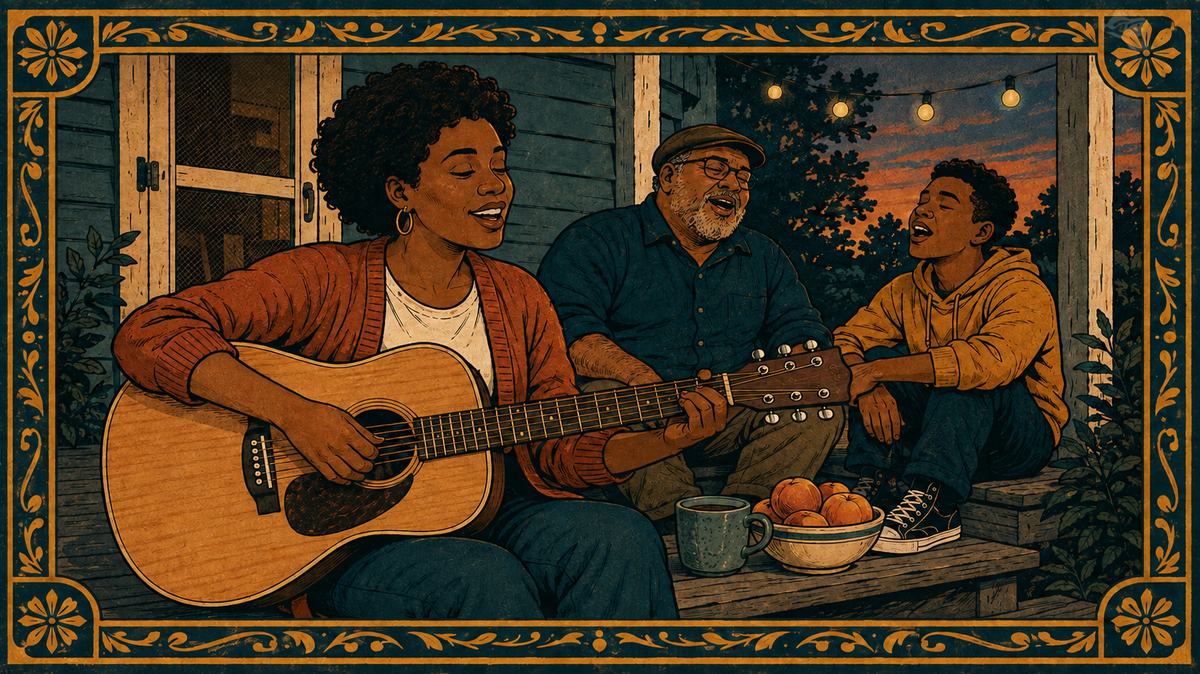
The fastest way to stay with the guitar is to play something you recognize in the first week. Not a scale, not an exercise, a song. The songs below need two or three open chords, the changes are mostly slow, and every one of them is something a room full of people would sing along to. One song here, Bad Moon Rising, moves fast, and its entry says so and gives you a starting tempo well under the record. Nothing here asks for a full barre chord. One song does call for a small F, where the first finger has to cover the top two strings, and there is a no-barre substitute for it below. Each entry lists the exact chords, whether you need a capo, the one thing that usually trips beginners up, and in most cases a tempo to aim for.
If you have not learned your first shapes yet, start with our guide to the five chords every beginner needs, then come back. Everything here is built from G, C, D, Em, A and E, plus a few close cousins that some of the songs call for: G7, D7, a small F with Fmaj7 as its easier stand-in, and the D6add9 in one song. Fret numbers in this guide read from the low E string to the high E string in standard tuning (E A D G B E), and x means do not play that string: G7 is 320001, D7 is xx0212, the small F is xx3211, Fmaj7 is xx3210, and D6add9 is 200200.
Two-chord songs
These are the songs to learn in your first two weeks. The whole job is switching cleanly between two shapes in time, which is the single skill that unlocks everything after it.
Jambalaya (Hank Williams). C and G7. No capo. Aim for about 120 beats per minute once you can switch without stopping. The trap: G7 uses the same three fingers as G in a different spot, so learn G7 as its own shape rather than adjusting G on the fly.
Achy Breaky Heart (Billy Ray Cyrus). A and E. No capo. About 120 beats per minute. The trap: E is the first chord most people rush. Place all three fingers together as one shape, not one finger at a time.
A Horse With No Name (America). Em (022000) and D6add9 (200200). Keep both fingers at the second fret and move them outward one string each: the finger on the A string goes to the low E string, the finger on the D string goes to the G string. Strum all six strings for both chords. No capo. Slow, around 100 beats per minute. This is the best first song for a strumming hand, because the chords are so easy that all your attention goes to keeping the rhythm even.
Eleanor Rigby (The Beatles). Em and C. No capo. About 130 beats per minute, but learn it at 80. The trap: the C to Em change moves three fingers at once. Practice the switch on its own, twenty times in a row, before you play the song.
Feelin’ Alright (Dave Mason, made famous by Joe Cocker). C and F. No capo. The F is the one place a beginner will stall. Use the small F, fretting only the top four strings and letting the low strings go quiet. That shape does ask the first finger to lie flat across the first fret of both the B and the high E string, which is a small barre, so give it a few days. If it will not ring cleanly yet, play Fmaj7 instead, the same shape with the high E left open and no barre at all. The song still sounds right either way.
What I Got (Sublime). D and G. No capo. Around 90 beats per minute. A good song for learning to change on the beat rather than a little after it.
Row, Row, Row Your Boat and Down in the Valley (traditional). C and G7, or G and D7. No capo. Neither one is in four: Down in the Valley is a waltz counted in three, and Row, Row, Row Your Boat is felt in six, two groups of three. These matter more than they look. Simple public-domain songs with slow changes are what teachers use to fix a strumming hand, because there is nothing else to hide behind.
Three-chord songs
Add a third chord and most of rock, folk and country opens up. The G, C and D family covers more songs than any other set of shapes on the instrument.
Bad Moon Rising (Creedence Clearwater Revival). D, A and G. No capo. About 180 beats per minute, so start at 100. The trap is the speed: the changes are easy but they come fast. Play it slow until the switches are boring.
Sweet Home Alabama (Lynyrd Skynyrd). D, C and G. No capo. Around 100 beats per minute. The little walk between the chords that the record has can wait. The three shapes on their own carry the song.
Wild Thing (The Troggs). A, D and E. No capo. About 100 beats per minute. This is the song for learning to mute the strings between chords with the side of your strumming hand, which is what gives it that stomp.
Three Little Birds (Bob Marley). A, D and E. No capo. Around 75 beats per minute. Same three chords as Wild Thing at a completely different feel, which is a useful lesson on its own: the chords are not the song, the rhythm is. The trap: the strum lands on the offbeats. Count one and two and, play only on the ands, and let the fretting hand relax between them so the strings go quiet on the numbers.
Ring of Fire (Johnny Cash). G, C and D. No capo. About 105 beats per minute. The trumpet line is not your job. The G to C change is, and this song drills it more than any other.
Leaving on a Jet Plane (John Denver). G, C and D. No capo. Slow, around 75 beats per minute. A good first song for singing while you play, because the changes come slowly enough to think about the words. The trap: the chord changes fall in the middle of a sung line rather than at the end of one. Get the strum running without thinking about it, then add the words a line at a time.
Twist and Shout (The Isley Brothers, then The Beatles). D, G and A. No capo. About 125 beats per minute. Three chords, a whole party. The trap: the loop never rests. D, G and A cycle continuously with no bar off, so any hesitation on a change shows up immediately. Count out loud and move your fingers on the last beat of the bar rather than on the first beat of the next one.
Louie Louie (The Kingsmen). A, D and Em. No capo. Around 120 beats per minute. The Em is the odd one out and gives the riff its color. The trap is the rhythm rather than the chords. The riff is not an even strum: it falls into a group of three strums and then a group of two, over and over, and the Em has to arrive right on time or the loop sags. Say the rhythm out loud before you play it.
Amazing Grace (traditional). G, C and D, with a D7 if you want it. No capo. Slow, about 65 beats per minute, in three beats to the bar rather than four. Counting in three is a skill in itself, and this is the gentlest place to learn it.
About the capo
None of the songs above need one, which is on purpose. A capo is not a shortcut around learning chords. It is a tool for moving a song into a key that fits a singer’s voice, and it gets useful the moment you start singing with someone. When you do reach for one, remember that the chord shapes stay the same and the sound moves up: the same G, C and D shapes with the capo on the second fret produce A, D and E. Most singers find one or two capo positions that suit their range, and stay there.
How to practice a song, not just play it
Learn the changes before the song. Take the two hardest chords in the song and switch between them for two minutes with a steady count. Then add the third.
Play the whole song slowly with no stops, even if it is ugly. Stopping to fix a chord trains you to stop. Our teachers say this more than anything else about beginners, and it is the difference between someone who can play three songs and someone who can play three songs in front of people.
Strum simply. Four downstrokes to the bar carry most of this list, but three of the songs are counted differently. Amazing Grace and Down in the Valley are in three, so give them three downstrokes to the bar. Row, Row, Row Your Boat is felt in six, two groups of three, which is easiest to start as two strokes to the bar, one for each group. The strumming patterns from the records come later and add nothing while the changes are still slow.
Ten minutes a day, kept up, is enough to carry this whole list, and fifteen to twenty is better once the songs start stacking up. What ten minutes of daily practice actually buys you is the difference between a song in a week and a song in a month.
When your fingers hurt, that is normal for the first two to four weeks and it passes as the calluses form. If a chord buzzes, the cause is nearly always the hand, not the chord, and our article on the fretting hand walks through the thumb-behind-the-neck fix that clears most of it.
What to learn next
Once three chords feel automatic, three roads open up. The first is more chords in the same family, which is what our piece on choosing your first guitar song is about: picking songs that add one new shape at a time. The second is playing the same songs without a pick, which fingerstyle guitar for beginners covers from the first pattern. The third is learning to read what other players write down, and how to read guitar tabs gets you there in an afternoon.
A teacher makes all three faster, mostly by choosing the order. Left alone, most beginners pick songs that are two steps too hard and stall. A good teacher picks the song that is one step ahead of where you are, every week.
How to Find a Guitar Teacher on Tunelark
Tunelark connects you with deeply vetted guitar teachers who teach online. Vetting is run by working musicians and music teachers, not a general recruiter, and every teacher sets their own rate and shows it on their profile. Scheduling, billing and support are handled for you.
- Browse guitar teachers at tunelark.com/find-a-teacher and watch their videos to hear how they play and explain.
- Read bios for the words that matter to you: beginners, adult learners, songs, or a style you love.
- Book a trial lesson at $25 off the teacher’s 30-minute rate and bring one song from this list.
- Ask yourself afterward whether you left knowing exactly which change to practice this week.
Frequently Asked Questions
What is the easiest song to play on guitar?
A Horse With No Name by America is the usual answer. Its two chords keep the same two fingers at the second fret and the change moves each of them by a single string, so the switch is tiny and all your attention can go to keeping an even strum. The two-chord list above gives the move finger by finger.
How many chords do I need to play songs on guitar?
Three open chords in the same key cover hundreds of songs. G, C and D is the most useful first set, followed by A, D and E.
Do I need a capo for easy guitar songs?
No. None of the songs in this list need one. A capo becomes useful when you want to match a song to a singer’s voice without learning new chord shapes.
How long does it take to learn a two-chord song?
Most beginners can play a two-chord song slowly within the first week and at tempo within two to three weeks of daily ten-minute practice. Clean changes are the whole job.
Why do my chords buzz when I switch?
Usually the fingers are landing too far from the fret or the thumb has crept over the top of the neck. Press close behind the fret, keep the thumb behind the neck, and practice the switch on its own before you play the song.
Looking for an online guitar teacher? See our full Online Guitar and Bass Lessons page for everything you need to know about getting started.
Keep reading
About Jennifer Heath
I'm Jennifer Heath, VP of Operations at Tunelark and a lifelong singer. I joined the company in 2020 and oversee much of what makes Tunelark work for students and teachers: hiring, training and supporting our instructors, student support, marketing and day-to-day operations. I started voice lessons at 7 and sang with touring choirs through my teens. Music belongs in every life, for the self-expression, the discipline, the comfort and the simple joy of it.