Snare Drum Rudiments: The First Five and How to Play Them
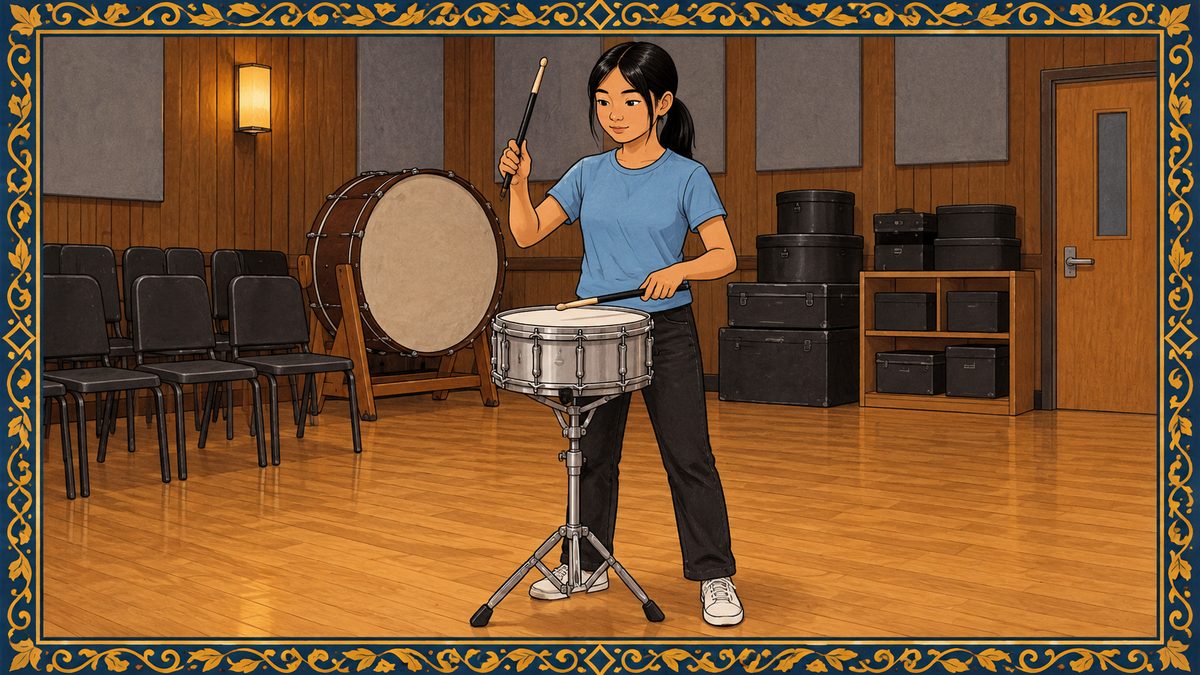
The first five snare drum rudiments for a beginning percussionist are the single stroke roll, the multiple bounce roll, the double stroke open roll, the single paradiddle and the flam. Together they cover three of the four rudiment families a first-year band part uses, rolls, diddles (two strokes in a row with one hand) and flams, and they teach two controls the later rudiments build on: which hand plays, and how high each stick starts. Practice them on a pad with a metronome, slowly, at two stick heights, for five to eight minutes of a fifteen- to twenty-minute practice day.
Why These Five, and Why in This Order
The Percussive Arts Society’s 40 International Drum Rudiments are the standard list, grouped as rolls, diddles, flams and drags, and our guide to drum kit or percussion lessons for a child explains what a rudiment is and why a school percussionist meets them before anything with a pedal. The five here come from the first three families, and each one adds a single new demand to the one before it.
- Single stroke roll (PAS 1): alternating hands at one height.
- Multiple bounce roll (PAS 4): the same alternation, with each stroke bouncing several times. It is also called the buzz roll, the closed roll or the concert roll, after the band and orchestra parts where it stands in for a sustained note on a drum that cannot hold one.
- Double stroke open roll (PAS 6): two clean strokes per hand.
- Single paradiddle (PAS 16): singles and doubles mixed, with accents, so the sticks start working at two heights.
- Flam (PAS 20): both sticks at once, at two different heights, so a small grace note lands just before the main note.
Drags, the fourth family, come next, once the doubles are even. Our guide to reading drum music covers the accent wedges and the R and L sticking letters the figures below use.
Stick Height Is the Volume Control
A snare drum gets louder when the stick starts higher, so a beginner who can play an accent and a soft note in the same bar, one measure of music, is controlling two heights. Karlyn R. Viña, writing in the PAS Educators’ Companion, names four basic strokes by where the stick starts and where it ends:
- Full stroke: starts high, rebounds, ends high.
- Down stroke: starts high, the rebound is controlled, ends low, close to the head.
- Up stroke: starts low, the wrist and arm help it back up, ends high.
- Tap: starts low and ends low.
Which stroke a note needs depends on two things, its own volume and the height of that hand’s next note. Every stroke has a second job, setting the stick up for what comes after it. Viña leaves the multiple bounce and double stroke rolls out of the scheme, so here it applies to the singles, the paradiddle and the flam.
Viña also isolates what each hand plays on its own, which she finds makes a technical problem much easier to diagnose. The two height traces below do that for the paradiddle and the flam.
Grip comes first, and our beginner drum tips walk through matched grip. Everything here assumes a loose fulcrum, the thumb and index finger point the stick pivots on, so the stick can rebound.
The First Five, One at a Time
1. Single stroke roll
Right, left, right, left, with every note the same height and the same volume, so every note is a full stroke. The single stroke roll trains the weaker hand to match the stronger one. A right-handed student’s left stick often starts lower and lands a little late.
2. Multiple bounce roll
Each stroke is dropped into the head with slight pressure so it bounces several times, and the hands alternate so that one hand’s buzz picks up where the other’s fades. Dr. Paul Buyer’s roll tips for Yamaha start with one hand at a time: drop a stick, let it buzz for as long as it will, and listen for density, the number of bounces, and shape, whether the buzz stays even. He also recommends the arm as the main lever rather than the wrist, which keeps the sticks flatter to the head.
The roll needs a base, a steady rhythm the hands alternate on. The common bases are sixteenth notes and triplets, three even notes to a beat, and a softer roll takes a slower base with more bounces per hand. Among the faults Buyer lists is tension, which he says gives a choppy, crushed and uneven sound.
3. Double stroke open roll
Two strokes per hand, right right, left left, each pair as even as two separate notes. At slow tempos, Bill Bachman writes in Modern Drummer, both strokes are mostly wrist strokes and the stick rebounds on its own, so he warns against clamping it against the palm. At faster tempos the forearm takes over the first stroke and the first two fingers play the second, which becomes a down stroke. Left to the bounce at speed, the second stroke comes out softer and a little early: right, a smaller right, left, a smaller left. That is easier to hear on a recording than while playing.
4. Single paradiddle
The paradiddle is the first rudiment where the stroke changes from note to note. Accent the first note of each half and the two hands play different jobs, which the trace shows.
Elspeth demonstrates the paradiddle at practice speed.
Skill video · Paradiddle Practice
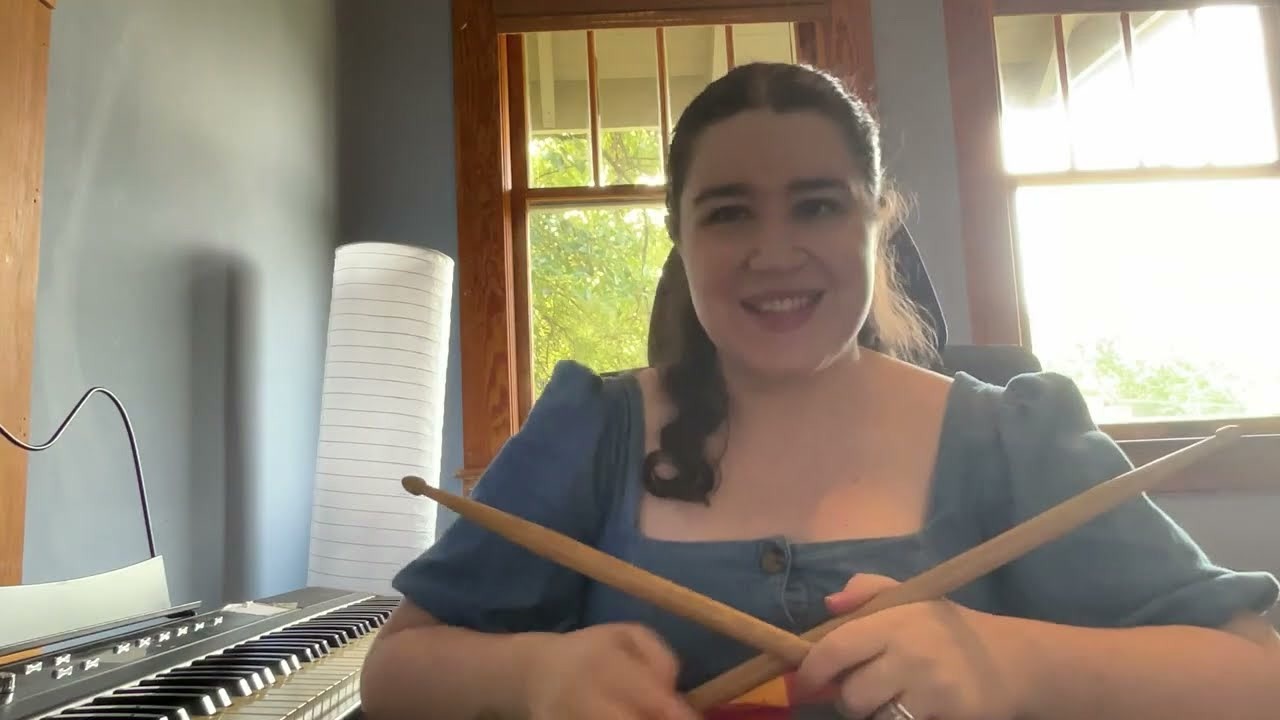
Elspeth teaches drums, piano and voice on Tunelark. View Elspeth’s profile
Swipe sideways to see the whole diagram.
The accented right note is a down stroke, because the right hand’s next note is soft. Two right taps follow, and then a soft right note that has to come up high, an up stroke, because the next right note is the accent that starts the cycle again. The left hand does the same thing four notes later. The fault is a flat paradiddle, every note at one height, which happens when the up stroke gets skipped.
Elspeth C., who teaches drums, piano and voice on Tunelark, plays the paradiddle in a short lesson of her own.
5. Flam
Swipe sideways to see the whole diagram.
A flam is one note with a grace note, a small quiet note, just in front of it. Viña sets one stick about an inch or two above the head and the other high, and brings both down together; the low stick arrives first because it has less distance to travel. The result should be one slightly wider sound, a flam rather than a fa-lam.
Swipe sideways to see the whole diagram.
After a right flam the right stick has to stay low, a down stroke, so it can play the grace note of the left flam, and then come up again, an up stroke, for the next right flam. The two faults Viña names are a grace note that comes up too high, and the flat flam, where both sticks start at the same height and land together. In alternating flams she traces the trouble most often to the down stroke, which should rebound only to a low height, not all the way back up.
A Tempo Ladder for Each Rudiment
The PAS sheet says every rudiment should be practiced open (slow) to close (fast) to open (slow), or at an even moderate march tempo. A metronome ladder is how a beginner does the second half of that without guessing. The table is our worked example of one, set at a click of 60 beats per minute, with four notes to each click for the rolls and the paradiddle.
| Rudiment | First rung | Clean means | Step back when |
|---|---|---|---|
| Single stroke roll | Sixteenths at 60 | Both sticks at one height, every note with the click | The weaker hand drops lower or lands late |
| Multiple bounce roll | Sixteenth base at 60, and it stays there for the first weeks | No gap where one hand hands over to the other | The buzz turns choppy. Loosen the grip and stay at this base |
| Double stroke open roll | Sixteenths at 60, two wrist strokes per hand | The second note of each pair as loud as the first | The second note shrinks or rushes |
| Single paradiddle | Sixteenths at 60, accents on the first and fifth notes | Accents high, taps low, the accent moving hand to hand | The taps creep up to accent height |
| Flam | One flam per click at 60, then two | One sound, the grace stick low every time | The two sticks land together, or as two separate notes |
Climb 4 beats per minute at a time, and only after a full minute at the current rung is clean twice in a row. When a rung falls apart, drop back two rungs, so the next attempt starts well inside the clean range. Write the day’s top tempo on the practice sheet and start the next session two rungs under it. Then finish the rudiment the way the PAS sheet describes, without the click: start slow, speed up gradually until the pattern almost breaks, and slow back down.
The buzz roll is the exception. It stays on one base while the student works on density and evenness, and later the music’s tempo and dynamic choose the base.
Fitting Five Rudiments Into a Practice Day
A beginner’s practice is 15 to 20 minutes a day, five or six days a week, and the band part needs more than half of it. Five to eight minutes of rudiments fits: the single stroke roll every day as the warm-up, then two of the other four, rotated through the week. Our guide to how much to practice explains why short daily sessions beat one long one.
When a rudiment stalls on one spot, shrink it. Elspeth learned that from her flute teacher, who told her to break a piece into smaller pieces and “focus on the parts that were difficult,” even when that meant one measure or two notes, “and then piece it back together gradually.” She still passes it on to her students. For a rudiment, that means looping the two notes where it breaks, such as the handover from the right double to the left accent in a paradiddle, at a rung where they are clean, then putting the whole pattern back together.
All five work on a practice pad, which makes almost no sound, and our guide to drum practice in an apartment covers the rest of a quiet setup. The one rudiment a pad changes is the buzz roll, because a rubber pad does not rebound like a snare head, so check the buzz on a real snare each week.
What a Teacher Checks, and What Comes Next
Three of the faults are easy to see on camera and hard to feel. A teacher watching both sticks at pad height sees a left hand starting lower than the right, a paradiddle up stroke that stays low, and a grace stick creeping higher. The buzz roll is judged by ear, and a video app’s noise suppression can thin out a sustained buzz, so the lesson needs the app’s original sound setting turned on.
A teacher also decides when the five are ready to combine. The next rudiments on the PAS sheet build directly on them:
- Five stroke roll, PAS 7: right right left left, then an accented right, mirrored as left left right right left.
- Flam tap, PAS 22: a flam followed by a tap in the same hand.
- Drag, PAS 31: two grace notes in one hand before a main note in the other, left left right.
Our guide to private lessons alongside school band covers how a private teacher and a band director divide that work.
How to Find a Percussion Teacher on Tunelark
Every Tunelark teacher is vetted by working musicians and educators for teaching quality before they can list. Each teacher sets their own rate and shows it on their profile, and Tunelark handles scheduling, billing and support.
- Open the teacher list at tunelark.com/find-a-teacher and filter by drums, then read each bio for snare, concert percussion or school band experience.
- Choose a lesson length of 30, 45 or 60 minutes.
- Book a trial lesson. The first lesson with a new teacher is that teacher’s rate minus $25, for whatever length you choose, so trials start at $14.
- Bring the pad, the sticks and the band method book, and play the rudiment that gives you the most trouble at the top of your ladder.
Frequently Asked Questions
What is the difference between an open roll and a closed roll?
An open roll is made of distinct strokes, two per hand in the double stroke open roll, and each one can be heard. A closed roll is the multiple bounce roll, where the bounces are packed so tightly that they blur into one sustained sound. Concert band and orchestra parts mostly call for the closed roll, which is where its name the concert roll comes from, so ask the director when a piece wants it open.
Should rudiments be practiced loud or soft?
Both. Viña writes that the rudiments prepare a player for most snare challenges once they are mastered at a variety of tempos and dynamics, meaning volumes. One pass with every note at accent height and one with every note at tap height tests whether the pattern holds when the height changes stop helping.
Which hand should lead?
Both, in turn. The PAS sheet prints the single stroke four and single stroke seven with a right-hand and a left-hand lead, and the paradiddle and alternating flams switch the lead on their own every half. For the single stroke and double stroke rolls, start every other repetition with the left hand.
Are these the same rudiments a drum kit player learns?
Yes. The patterns and stickings are the same, and kit players use them around the toms in fills. A school percussionist usually meets the buzz roll and the flam sooner, because band parts write them.
How will I know the five are ready for a band part?
When each one stays clean at the tempo the piece asks for, at the written volume, with either hand leading. The band director or a private teacher can set that tempo from the music.
Looking for an online drum teacher? See our full Online Drum Lessons page for everything you need to know about getting started.
Keep reading
About Jennifer Heath
I'm Jennifer Heath, VP of Operations at Tunelark and a lifelong singer. I joined the company in 2020 and oversee much of what makes Tunelark work for students and teachers: hiring, training and supporting our instructors, student support, marketing and day-to-day operations. I started voice lessons at 7 and sang with touring choirs through my teens. Music belongs in every life, for the self-expression, the discipline, the comfort and the simple joy of it.