Online Bass Lessons for Adults: Starting or Coming Back

Bass is an underrated entry point for adult musicians, and one of the easiest instruments to come back to. The fretboard logic is simpler than guitar, the role is easier to be useful in quickly, and a reliable bassist who shows up and plays in time rarely waits long for a band. If you played years ago and stopped, your hands remember more than you expect.
This guide is for adults new to bass and adults coming back to it: what online lessons look like, what equipment you need, what to expect by level, and what changes when you are returning.
Why Online Bass Lessons Work Well
Bass is well-suited to online instruction because most of what your teacher needs to see is your hands: left-hand fingering and right-hand technique. A webcam pointed at the fretboard and your plucking hand gives them everything. Audio takes one setting. The default speech processing on the common video platforms filters and pumps low frequencies, so turn on original sound (Zoom calls it that, and FaceTime has Wide Spectrum under Mic Mode) before your first lesson. With that on, a laptop microphone carries your timing and articulation well enough. For your teacher to hear your tone, run the bass through a small audio interface into the computer.
The biggest advantage online: you get to choose from a much larger pool of bass teachers than your local area can offer. A specialist in walking bass, slap technique, or fretless playing is rarely in the same zip code as you. Online instruction removes that constraint entirely.
What You Need to Get Started
A bass guitar. Starter four-string electric basses run $200 to $400 as of 2026 for something genuinely playable. Brands like Squier (the Affinity line), Ibanez (GSR/SR), and Yamaha (TRBX) are all solid at the entry level. Used basses in this range are an excellent deal, because bass holds up well over time. If you are returning with a bass that has sat for years, have it set up before your first lesson: new strings, an intonation check and an action adjustment.
An amp or headphone solution. A small practice amp ($100-$200) is the most common choice. For apartment dwellers, a headphone amp like the Vox amPlug, around $50 to $60 as of 2026, plugs directly into your bass and gives you a real bass tone through headphones with zero noise leakage.
Cable and tuner. A decent instrument cable ($15-$25), clip-on tuner ($15), and a strap ($20) round out the basic kit.
For lessons specifically: webcam (the built-in laptop one is usually fine), and a music stand for sheet music or tablet.
Total entry cost: roughly $350 to $700 for a complete setup as of 2026. Less if you buy used.
The tuner is the first piece of that kit you will use. TJ F., who teaches bass on Tunelark, walks through standard tuning on a four-string bass, E, A, D and G.
Skill video · Tuning
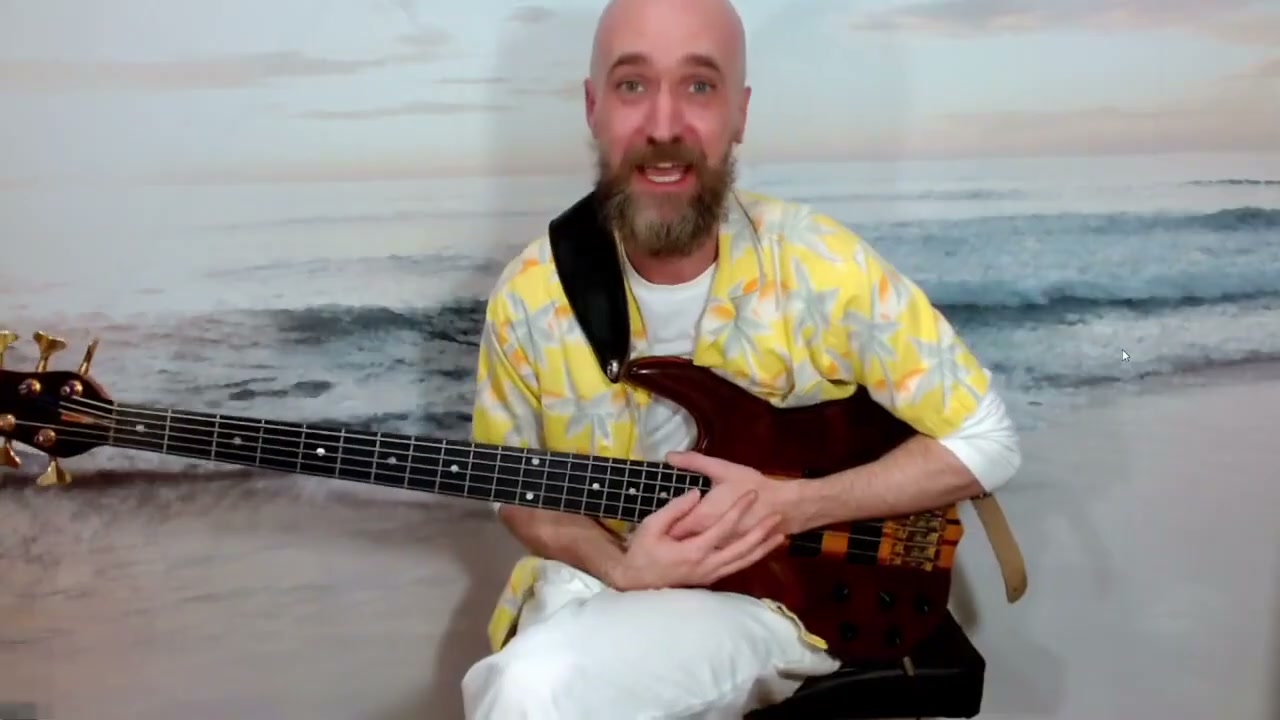
TJ teaches bass lessons online with Tunelark. View TJ’s profile
What to Expect by Level
Beginner (months 0-6). Posture, both-hand technique, basic note names on the fretboard, simple bass lines in popular keys. You’ll learn to play to a click track from very early on, because keeping time is the bassist’s main job. By month six, you should be able to play along to slow rock, pop, or blues songs with a working bass line.
Note names come early because charts, teachers and bandmates all describe a bass line in them. Gillian H., who teaches bass on Tunelark, works through finding and naming the notes on the bass.
Skill video · Learning the Notes
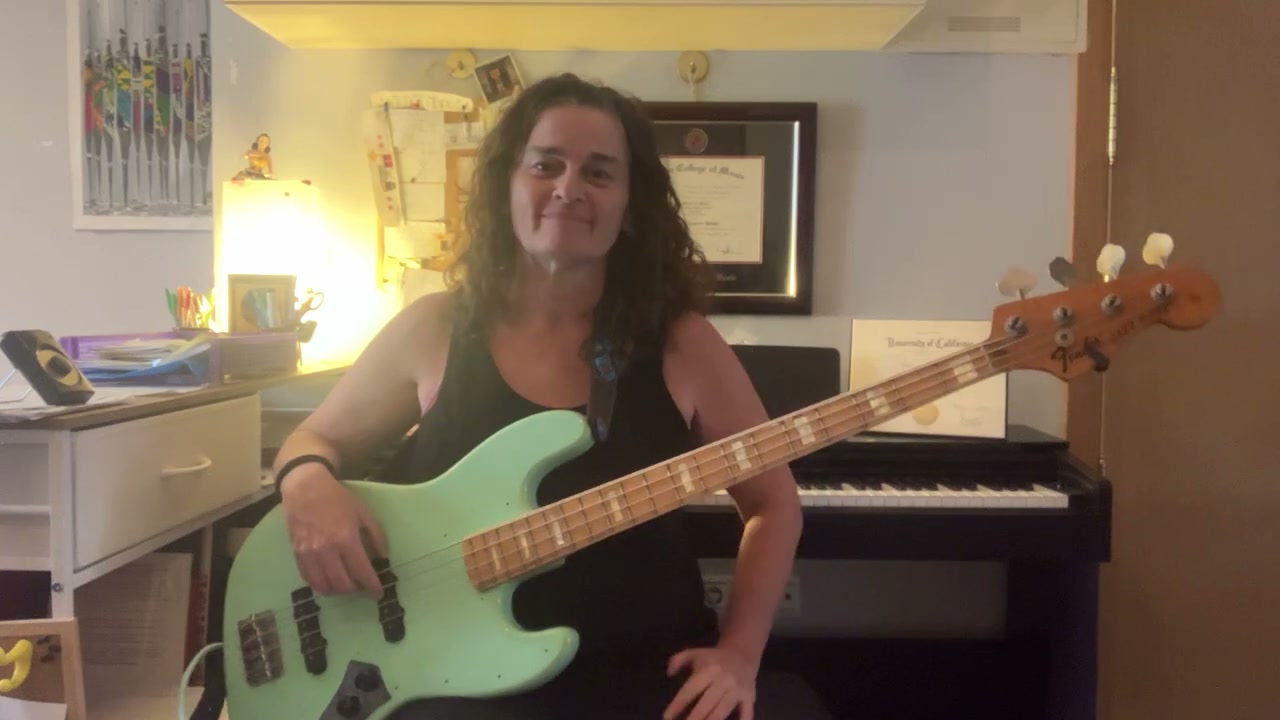
Gillian teaches bass lessons online with Tunelark. View Gillian’s profile
Early intermediate (months 6-18). Scales in multiple keys, chord tones and root-fifth-octave patterns, reading basic notation, the first taste of walking bass for jazz or blues. You can sit in on most casual jam sessions and contribute usefully.
Intermediate (months 18-36). Genre-specific vocabulary (R&B, funk, jazz, rock), slap and pop basics, fingerstyle vs pick playing, basic improvisation, more complex reading. This is where bass starts to feel like a real musical voice rather than a support role.
Advanced (after three years). Specialized study: jazz walking, slap mastery, fretless playing, six-string extended-range bass, advanced theory. Most serious bass students settle into one or two stylistic specialties at this point.
What an Online Bass Lesson Looks Like
A typical 45-minute online bass lesson covers a warm-up with the metronome, review of your week’s homework, technique work (whatever your teacher has you focused on), and new material: a groove, a tune, a scale pattern, or a concept. Your teacher demonstrates on their bass, you copy on yours, and you trade observations until things click. Our lesson on how bass and drums lock together walks through one of those grooves note by note.
Recording the lesson for later review is easy online, and many students do it. Re-watching the parts you struggled with is one of the most underrated advantages of remote instruction.
Coming Back to Bass
If you played bass years ago, the motions survive the layoff better than anything else. Teachers who work with returning players see plucking patterns and the left hand’s shape around the neck come back first, often within the first lesson or two, well ahead of repertoire and reading. Bass lines you played dozens of times tend to return within minutes, and groove sense comes back quickly once you play with a click or a drummer again. Your fingertips are the exception: calluses soften after a few weeks away and take two to four weeks of regular playing to rebuild. The music theory you once knew (chord tones, intervals, song structure) needs refreshing rather than relearning.
What usually needs real work is anything you taught yourself the first time. The common ones are a left hand that presses too hard, leaves out the fourth finger or lands anywhere in the fret instead of just behind it, two-finger plucking that falls apart at faster tempos, reading that never got past tab, and slap technique that was approximated rather than learned. These are quicker to fix than they would be for a new player, because your ear and instincts are already built.
A rough timeline. In the first two weeks, old songs and hand shapes come back while calluses rebuild. Months one to three are cleanup, sorting what came back clean from what came back rough, and most of the growth happens here. By months four to six you are on a regular practice routine with new repertoire and deeper theory, and somewhere in months six to twelve many returning players pass where they were the first time. Where you land depends less on how long you were away than on how much of the first round was self-taught. A player who had lessons mostly needs the rust knocked off. A player who worked it out alone has habits to unpick as well.
For the wider picture, see our guide to restarting music lessons after years away.
How to Find a Bass Teacher on Tunelark
Every Tunelark teacher is vetted by working musicians and educators for teaching quality before they can list, and each teacher sets their own rate and shows it on their profile. To get started:
1. Open the teacher list and filter by bass.
2. Read bios. Look for the styles a teacher specializes in, since funk, jazz and rock each have their own teaching emphases. If you are returning, look for mention of adult students or technique refinement.
3. Book a trial lesson with one whose profile resonates, at $25 off that teacher’s rate for the length you choose.
4. After the trial, ask whether the teacher’s approach to time, feel, and groove fits what you want to learn. If you are returning, the teacher should have heard you play before assigning anything. Ask them to name two things in your playing they would work on first, and their answer shows whether they listened.
Bass is one of the most rewarding instruments to learn as an adult. With a good teacher and consistent practice, you’ll be playing real music within months and contributing to bands or recordings within a year or two.
Frequently Asked Questions
Is bass easier to learn than guitar?
In some ways, yes: fewer strings, simpler chord requirements, and a more straightforward role in most songs. In other ways, no: timing has to be impeccable, and bass lines require deep listening. Many beginners find early progress feels faster on bass because you start with one note at a time.
Do I need a five-string or six-string bass?
No. A standard four-string bass is the right starting point and covers nearly all common music. Extended-range basses are specialist instruments worth considering only after you’ve found the right musical direction.
Can I learn bass with no prior musical experience?
Yes. Bass is one of the most beginner-friendly instruments for adults. The combination of simple early technique and immediate musical usefulness makes it especially encouraging for first-time learners.
How often should I take online bass lessons?
Weekly is the usual cadence, and it gives new and returning players regular course-correction in the early months. Some students go every other week and practice on their own in between.
Do online bass lessons work over slow internet?
Bandwidth is rarely the problem. Standard home broadband handles bass lessons fine, and anything above 10 Mbps with reasonable stability works well. The setting that matters more is original sound in your video app, because default speech processing filters out the low end of a bass. With that on, timing comes through clearly over a laptop mic, and an audio interface adds the tone.
Looking for an online bass teacher? See our full Online Guitar and Bass Lessons page for everything you need to know about getting started.
Keep reading
About Jennifer Heath
I'm Jennifer Heath, VP of Operations at Tunelark and a lifelong singer. I joined the company in 2020 and oversee much of what makes Tunelark work for students and teachers: hiring, training and supporting our instructors, student support, marketing and day-to-day operations. I started voice lessons at 7 and sang with touring choirs through my teens. Music belongs in every life, for the self-expression, the discipline, the comfort and the simple joy of it.